
Thunderous Charge Superpower Explained: Build Speed, Strike, Thunderclap
Some powers throw lightning. Thunderous charge runs into you with it: the power to build speed into a devastating rush and release a thunderclap shockwave on impact. It is the cavalry charge weaponized as a superpower, the boom you can aim. This guide, part of our Energy Powers collection, explains what a thunderous charge is, the three beats that power it, what it can do, the real physics behind thunder, and which famous characters embody the charge.
In this guide:
- What Is a Thunderous Charge?
- Thunderous Charge vs Other Powers
- What Can a Thunderous Charge Do? Applications
- Real Physics: How Thunder Actually Works
- Weaknesses and Limitations
- Famous Thunderous Charge Users
- Conclusion
What Is a Thunderous Charge?
Other electric powers fire current or burst in place. The thunderous charge moves: by building speed, striking with the body, and releasing a thunderclap on impact, the user turns momentum itself into a weapon. The sections below define the power, explain the thunder side, and map its three beats.
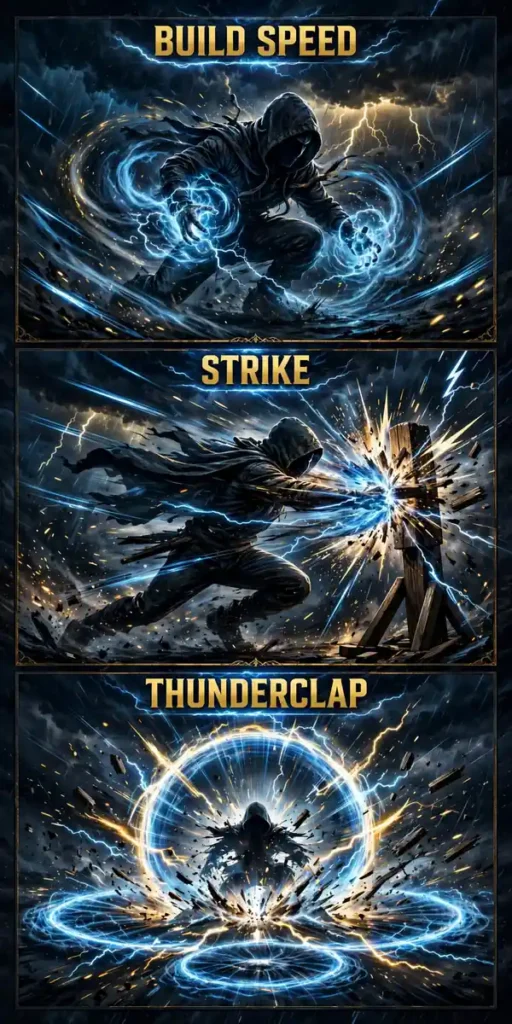
The Charge, Defined
A thunderous charge is the power to turn a sprint into a weapon: the user builds speed, aims their body like a battering ram, and strikes with a burst of thunder. The clearest rules text comes from the 5th Edition spell that shares its name: a 1st-level transmutation cast with a thunderous battle cry, letting the caster move in a straight-line charge and land a melee weapon attack that either gains a +5 bonus on attack damage or shoves the target 10 feet. It is a power of commitment: once the charge starts, there is no turning, only arriving.
The defining rhythm is three beats. First comes the run up, gathering momentum until the body is a projectile. Then comes the strike, the moment of contact where all that speed becomes damage. Then comes the thunderclap, the shockwave that blooms from the impact and turns one hit into an area event. Build speed, strike, thunderclap: skip the run up and you have a punch, but run all three and you have the charge.
The Thunder Side: What the Boom Does
The thunder is what makes the charge more than a tackle. The fan catalogs file the power to manipulate thunder as Brontokinesis, and describe its core as concussive shockwaves that behave like solid walls of force: bursts that send opponents flying, crack stone, shatter metal, and rip trees from their roots. At close range, the same force can knock the air from an opponent’s lungs, disorient with sheer pressure, or render a target unconscious. The charge borrows all of it and delivers it at a sprint.
Control is what separates a thunder user from a loud accident. With precision, the catalog says, the waves can be shaped into narrow rifle-like bursts that pierce through obstacles, or wide all-encompassing blasts; thunder-enhanced strikes turn ordinary punches into bone-rattling punches and kicks into kicks reinforced by concussive shockwaves. The thunderous charge user does the same shaping with their body: the run up aims the boom, and the impact fires it.
Build Speed, Strike, Thunderclap: The Three Beats
Every thunderous charge runs the same three beats. First, the user builds speed: a rushing attack that gathers momentum with every stride, the way Warhammer’s Mournfang cavalry surge towards the foe until the line breaks. The run up is the weapon’s fuse. A charge that starts too close has no boom to spend, which is why the best chargers want distance the way archers want high ground.
Second comes the strike: the melee strike lands and the stored momentum becomes damage, with the option to shove the target 10 feet or take the +5 bonus on attack damage. Third comes the thunderclap, the thunderclap shockwave on impact that turns one hit into a blast radius. The 5th Edition spell opens with a thunderous battle cry for a reason: the sound is part of the weapon. In the Dragalia Lost telling, the charge is a guided dash attack that inflicts stun, which is the same three beats with better steering.
Thunderous Charge vs Other Powers
Readers meet fourteen electricity and energy specialists across our guides: bio-electricity, bio-lightning, electric discharge, electric field manipulation, electric shield, electric surge, electrokinetic constructs, electrokinetic flight, electromagnetic pulse, lightning rod, solar beam, solar flare, static charge, and static cling. Thunderous Charge is the family’s battering ram: where the others fire, burst, shield, sense, build, fly, focus, accumulate, or stick, this power runs into you. The table below maps the charge against its neighbors.
| Power | What it does | How Thunderous Charge differs |
|---|---|---|
| Thunderous Charge | Builds speed into a rushing attack that ends in a thunderclap shockwave | The baseline: momentum plus boom, the charge you can aim |
| Electric Surge | Vents built-up electricity in a sudden burst | The burst: a surge detonates in place, the charge delivers the boom on the move (guide) |
| Electrokinetic Flight | Flies by riding electric charge | The ride: flight is graceful travel, the charge is a weaponized sprint (guide) |
| Electric Discharge | Releases stored charge as aimed sparks and arcs | The zap: discharge fires from range, the charge closes the distance first (guide) |
| Lightning Rod | Attracts and channels lightning strikes | The magnet: draws the sky’s lightning down, the charge carries its own thunder in (guide) |
| Bio-Lightning | Generates lightning bolts from the body | The bolts: bio-lightning throws the bolt, the charge IS the bolt’s delivery (guide) |
| Thunder Breathing | Anime sword techniques themed on thunder | The sword style: a fighting style, not a power; the charge is the power itself (guide) |
| Thunder Manipulation | Manipulates thunder as an element | The parent: all of thunder’s tricks, of which the charge is one weaponized form |
What Can a Thunderous Charge Do? Applications
The applications flow from the three beats: build the speed, land the strike, and decide what the thunderclap does on arrival. Impact, mobility, sound, and the cry each shape a different confrontation.
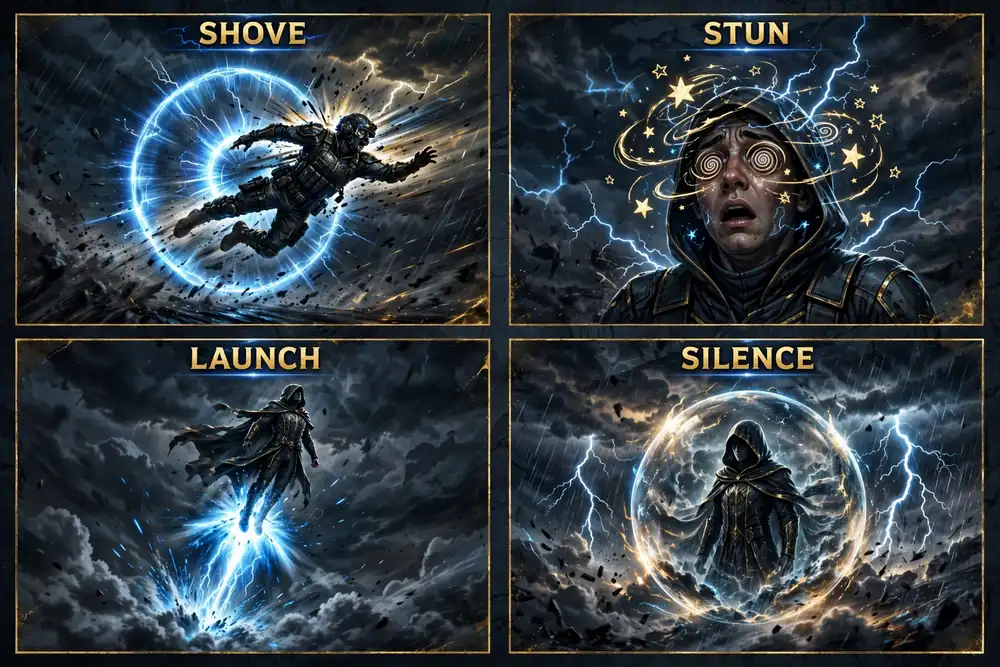
The Impact: Shove, Shatter, Stun
The impact is where the charge cashes in. The catalog’s thunder hits like the sheer impact of an explosion: concussive force that can send opponents flying, fracture bones, and leave devastating craters. The 5th Edition spell gives the same result in game terms: shove the target 10 feet or add a +5 bonus on attack damage, with thunder damage at higher levels. Warhammer’s telling is blunter: the fallen are not just slain but utterly pulverized, whole formations mowed down by one great, thunderous charge.
The subtler impact is the stun. A thunderclap at close range can knock the air from an opponent’s lungs and disorient with sheer pressure, and in the VRMMO telling the skill carries a 50% chance to paralyze the target, a lightning stun that hinders movement for seconds. Takemikazuchi’s version inflicts stun on anyone unlucky enough to be hit. The charge does not need to kill to win: a stunned enemy is a finished fight.
The Mobility: Launch, Redirect, Defy Gravity
A thunderous charge user is never stuck in place. The catalog grants thunder users heightened mobility: by directing the explosive energy of a thunderclap beneath them, they can launch forward at high speeds, defying gravity and altering trajectory mid-air. The charge is the weaponized version of that hop: every boom is a burst of thrust, and a skilled user chains them into a storm of lunges.
Steering is the advanced form. In the Dragalia Lost telling the charge is a guided dash attack that can be guided, curving toward its target instead of running straight. The 5th Edition spell scales the same idea: At Higher Levels, the distance increases by 10 feet per level, so a stronger charge covers more ground before it lands. The VRMMO skill charges targets within 5-45 yards with a 25 second cooldown and a 50 MP cost, which is the honest price of all that speed: the charge is devastating, but it cannot be spammed.
The Sound: Fear, Silence, and Signals
The thunder does more than hit. The catalog lists Fear Inducement among its applications: an earth-shaking roar that arrives before the charge does is shock and awe made literal, and armies have broken on sound alone. The same shaping that makes the boom can make its opposite: zones of absolute silence where not even a whisper can escape, and barriers of compressed air that deflect attacks or absorb incoming force.
The subtlest use is communication and sensing. Through mastery of resonance, a thunder user can run echolocation via controlled pulses, reading the returning vibrations to detect movement and hidden enemies, and can send coded thunderous pulses over vast distances that bypass normal sound interference. The charge is the loudest thing on the battlefield, and the user decides what the loudness does.
The Cry: Why the Battle Cry Matters
Every thunderous charge starts with a shout, and the shout is doing work. The 5th Edition spell requires it mechanically (Components: V, a verbal component): no cry, no charge. In fiction the thunderous battle cry is the weapon’s safety coming off, a burst of Fear Inducement that hits before the body does and a signal to everything nearby that something unstoppable is moving.
The cry is also honest advertising. The catalog describes the thunder user at full strength: the very air trembles, rolling booms mark every step, and their presence is announced by the deafening voice of the storm. A silent charge is an ambush; a thunderous charge is a siege engine with a soundtrack. The cry says the boom is coming, and the boom keeps the promise.
Real Physics: How Thunder Actually Works
Explosive Expansion: The Shock Wave You Hear
Real thunder is already a weapon, and it starts with heat. Per NOAA, thunder is the acoustic shock wave from the extreme heat generated by a lightning flash: lightning heats the air surrounding its channel to 54,000°F (30,000°C), five times hotter than the surface of the Sun, in a fraction of a second. That instant heating triggers explosive expansion: the air expands so rapidly that it compresses the air in front of it, forming a shock wave similar to a sonic boom.
The numbers are the point. The channel’s air suffers a large over-pressure and expands supersonically, and what reaches your ears is the collapse of that violence: a loud bang, crack, or snap up close. A fictional thunderous charge user is, physically speaking, a walking version of that process: the same explosive expansion, the same supersonic front, worn as a body instead of a lightning bolt.
Claps, Rumbles, and the Distance Rule
Thunder is not one sound but many arriving late. Per Britannica, the lightning channel is branched and tortuous, so sound from distant portions of the bolt arrives later than sound from near portions, which accounts for the characteristic claps and rumbles and the continuous booming/rumbling sound we hear. The return stroke, carrying a larger and faster-rising electric current, produces the loudest thunder of all.
Distance writes the rules. Sound crawls at the speed of sound, about 343 metres per second, so the old counting trick works: 3 seconds per kilometre (5 seconds per mile) between flash and boom. And the boom has a hard limit: thunder is seldom heard beyond 20 km (12 miles). Real thunder is mighty but local, which is exactly why fiction’s version cheats: the charge carries the boom to the target instead of waiting for the target to hear it.
Real Thunder vs the Fictional Charge
Fiction takes real thunder and puts legs on it. The table below compares what nature does with what the charge adds.
| Aspect | Real thunder | Fictional thunderous charge |
|---|---|---|
| Source | A lightning flash superheating a channel of air | The user’s body and motion, no storm required |
| Speed | The speed of sound, 343 metres per second | Faster than the eye can track, aimed at a target |
| Control | None: it just rumbles where the bolt fell | Aimed, guided, shaped into bursts or blasts |
| Range | Seldom heard beyond 20 km | Close-range impact, the boom arrives with the body |
| Effect | Startles, rattles windows | Shatters, shoves, stuns, craters |
| The cry | None | The thunderous battle cry that starts the charge |
Our lightning rod guide covers the lightning side of the family; this is the thunder side of the same storm.
Weaknesses and Limitations
No power is complete without its counters. The thunderous charge is devastating but committed: take away its line, smother its boom, or step aside, and the battering ram hits empty air.
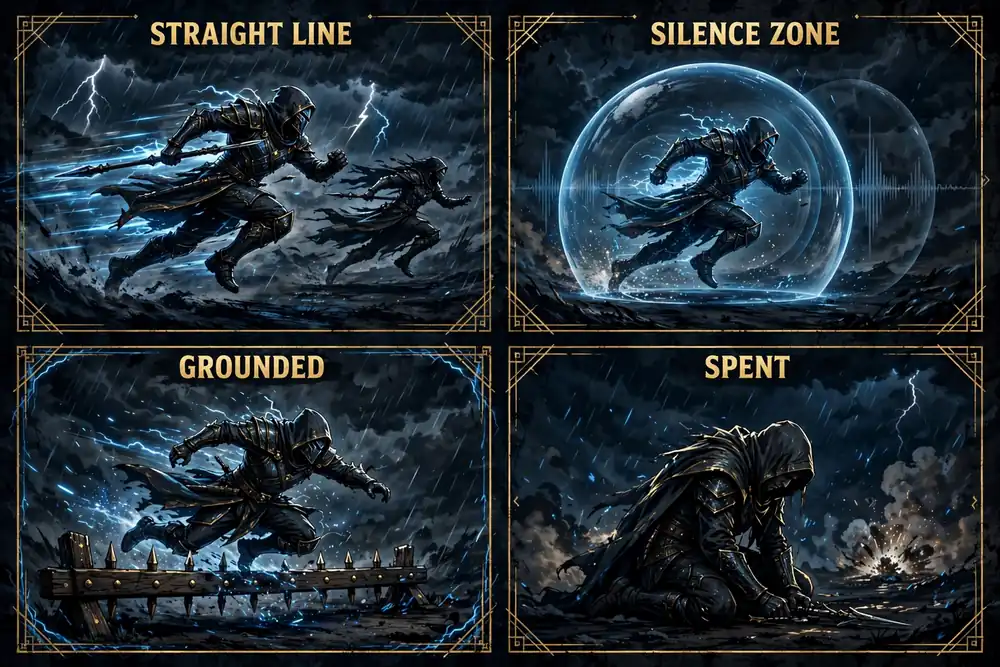
What Stops a Thunderous Charge User?
Every charge has a counter, and the first is geometry. A straight-line charge is a predictable path: sidestep it and the thunder hits empty air, which is why the guided dash attack is so feared and the unguided one so dodgeable. The catalog’s own thunder tricks turn against the charger: barriers of compressed air can meet the charge head-on, and zones of absolute silence can smother the boom that powers it.
The subtler counters are the ones stories actually use. The charge needs a run up, so a charger caught before the sprint is just a person; grounding the user before the boom lands kills the weapon. Vibration Immunity and sound immunity no-sell the thunder itself, and a big careless charge in the wrong place is a hazard to the charger’s own side. For more ways to humble a powerhouse, try our random weakness generator; for power variety, see emitter quirks and god ki abilities.
Famous Thunderous Charge Users
From comics to anime to games, these are the characters who defined the art of the charge.
Icons of the Charge in Comics, Anime, and Games
The icons each found a signature way to weaponize the charge, as depicted in their stories: Thunder (DC Comics) and Thunder (Teen Titans), who carry the name itself; ThunderMan.EXE (Mega Man Battle Network 2), electrifying his dashes; Sam-R-I (Dexter’s Laboratory), the cartoon version; Oya (Yoruba Mythology) and Shango (Yoruba Religion), the orishas of storm and thunder; Soga no Tojiko (Touhou Project), haunting with thunder; Lei Kung (Kung Fu Panda), attacking with Thunder Magic; Storm (Marvel Comics), commanding the weather that makes thunder, all as listed in the fan catalog’s gallery.
The deeper cuts show the charge in motion. Takemikazuchi (Dragalia Lost) runs the guided dash attack that inflicts stun, as reported via TV Tropes. The Mournfang Cavalry (Warhammer Fantasy) are the heaviest shock cavalry, quoted as able to mow down entire enemy formations in a great, thunderous charge, as quoted via a fan forum thread. And the thunderclap itself belongs to the Hulk, Superman, Wonder Woman, and Doomsday, with Zoom‘s thundersnap making a sonic boom from a finger snap, as listed on the thunderclap page. For thunder-themed fighting styles, see thunder breathing; for storm context, see atmospheric adaptation.
Conclusion
Thunderous charge is energy at its most committed: not the bolt or the burst, but the run, the body as a battering ram with a thunderclap for a warhead. Whether it arrives as a 5th Edition spell’s battle cry, a Mournfang cavalry line, or a thunderclap blooming from
a superhero’s impact, it runs on the same three beats: build speed, strike, thunderclap. Want to give the power to your own character? Try our superpower generator and see what your charge would shatter.


