
Lightning Rod Superpower Explained: Attract, Absorb & Redirect
Some powers throw lightning. Lightning rod catches it: the power to attract lightning to your own body, absorb the charge, and redirect it wherever you choose. It is the living version of Benjamin Franklin’s invention, the body as conductor. This guide, part of our Energy Powers collection, explains what a lightning rod user is, the three jobs the power performs, what it can do, the real physics behind Franklin’s rod, and which famous characters embody the living conductor.
In this guide:
- What Is a Lightning Rod?
- Lightning Rod vs Other Electricity Powers
- What Can a Living Lightning Rod Do? Applications
- Real Physics: How Franklin’s Rod Works
- Weaknesses and Limitations
- Famous Lightning Rod Users
- Conclusion
What Is a Lightning Rod?
Other electricity powers start with the strike. The lightning rod starts before it: by being the most attractive target in the storm, the user decides where every bolt lands. The sections below define the power, then break it into its three jobs.
The Living Conductor, Defined
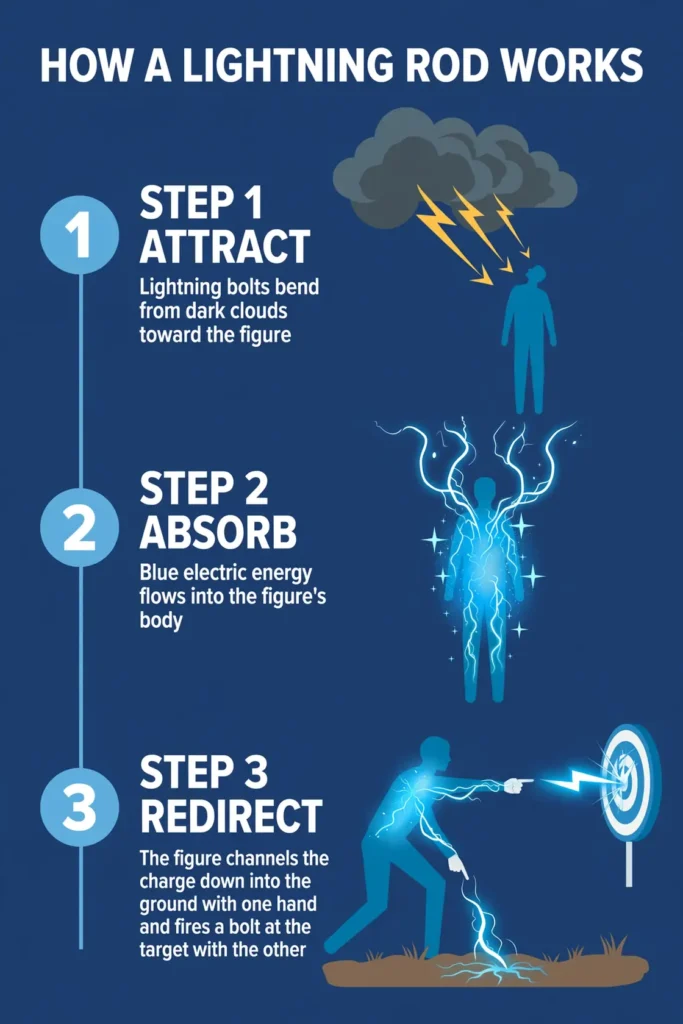
A Lightning Rod user is a living lightning rod: a person who attracts lightning, absorbs electricity through their body, and routes it where they choose. The fan catalogs file the concept under Electrical Immunity, also calling it Living Lightning Rod or Shockproof, because the defining trait is being completely unharmed by electricity while bolts bend toward you. Instead of dodging the strike, the rod user invites it (Electrical Immunity).
That is the power’s signature: ground electricity so it harmlessly passes into the ground, or redirect incoming electricity and lightning into a different direction. Where other electricity users fire bolts outward, the lightning rod user starts by receiving them. The body is the conductor, the will is the switch, and the bolt always ends where the user decides.
Attract, Absorb, Redirect: The Three Jobs
The power runs on three jobs, and each one is optional: attract lightning to yourself, absorb it into your body, and redirect it onward. Attraction means calling forth lightning from the sky, the fan catalogs’ Lightning Attraction/Calling, drawing the strike like a raised Franklin rod. Absorption means drinking the charge, removing it from the source so nothing harmful remains, then using it as power source for your own body or your own attacks (Electricity Absorption).
Redirection is the master’s job, and fiction’s best example is Iroh of Avatar: The Last Airbender, who invented the method of absorption and redirection of lightning to redirect natural lightning through his own body and out again, as depicted in the story. Attract brings the bolt, absorb holds it, and redirect chooses its destination: the ground, the enemy, or back into the storm.
Lightning Rod vs Other Electricity Powers
Readers meet nine electricity specialists across our guides: bio-electricity, bio-lightning, electric discharge, electric field manipulation, electric shield, electric surge, electrokinetic constructs, electrokinetic flight, and electromagnetic pulse. Lightning Rod is the receiver of the family: where the others fire, burst, shield, build, fly, or kill technology, the rod user invites the strike and routes it through their own body.
The Family Comparison
The table below places the rod against its closest neighbors. Electric Shield blocks bolts with barriers, Electric Surge vents raw charge outward, and Electricity Absorption drinks charge to keep it; the rod does all three jobs in sequence, attract, absorb, then redirect.
| Power | What it does | How Lightning Rod differs |
|---|---|---|
| Lightning Rod | Attracts, absorbs, and redirects lightning through the body | The baseline: the living conductor, bolts end where the user decides |
| Electric Shield | Raises defensive barriers of charge | Blocks the bolt; the rod invites it in and channels it (guide) |
| Electric Surge | Vents built-up charge in a sudden burst | Bursts raw charge outward; the rod starts by catching it (guide) |
| Electricity Absorption | Drinks charge and keeps it as fuel | Keeps the charge inside; the rod channels it onward to ground or enemy |
| Electric Discharge | Releases charge as aimed sparks and arcs | Fires zaps outward; the rod’s defining half is the catch, not the throw (guide) |
| Lightning Summoning | Calls bolts down onto enemies | Summons lightning as a weapon; the rod calls it to the self (powerlisting) |
| Electromagnetic Pulse | Kills technology with an EM wave | A wave that erases function; the rod routes physical bolts (guide) |
What Can a Living Lightning Rod Do? Applications
The applications flow from the three jobs: protect by attracting, empower by absorbing, and attack by redirecting. Each job has its own battlefield logic.
Shielding Others by Taking the Hit
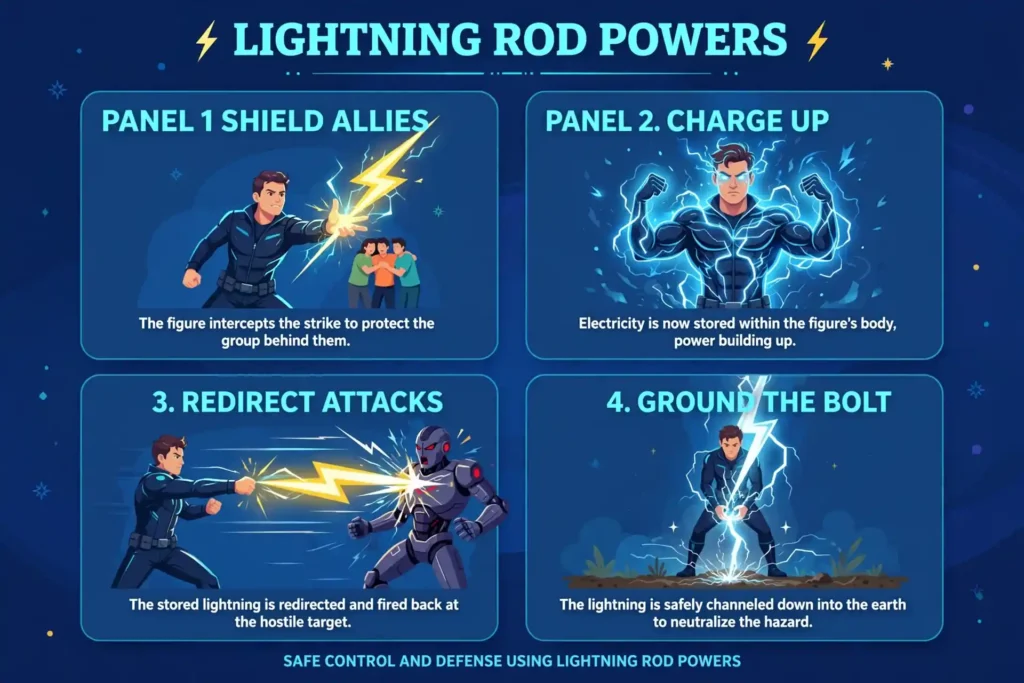
The noblest use of the power is also the oldest: stand tall so the bolt hits you instead of everyone else. A real lightning rod attracts lightning strikes much more readily than the building it protects, then provides a low-resistance path to ground so the discharge safely reaches the ground. The living version does the same for people: step into the storm, let every bolt bend toward you, and nothing else gets touched.
Lightning even jumps around seeking the path of least resistance, which is why the rod user must be the easiest target in the area. It is a power built on self-sacrifice: you cannot shield anyone without becoming the strike’s preferred destination, and you have to trust your own body to do what copper wire does.
Charging Up: Absorption as Fuel
What the rod catches, the rod can keep. Absorbed lightning becomes fuel: the user can use it as power source, enhancing themselves or gaining the drained power of whatever they drank. The Pokémon games built an entire ability on this logic: a Pokémon with Lightning Rod draws in all Electric-type moves, and instead of taking damage, its Sp. Atk stat is boosted. The hit becomes the power-up (Electricity Absorption).
Fiction’s heavy hitters show the same pattern, as depicted in their stories: Cole MacGrath (inFamous) grows stronger by absorbing electricity from anything live; Nora Valkyrie (RWBY) can charge electricity into her muscles to increase her strength and speed; and the X-Files episode “D.P.O.” gave Darrin Peter Oswald the ability to absorb and toss around lightning after one fateful strike. The bolt stops being a threat and starts being a battery.
Redirection: Sending It Back
The flashiest job is also the oldest in fiction: catch the bolt and send it somewhere else. Iroh’s method, absorption and redirection of lightning, turns the body into a circuit: in through one arm, through the stomach, out the other arm, aimed wherever the user points. The fan catalogs file the same idea under Electrical Immunity’s variations: redirect incoming electricity and lightning into a different direction (Electrical Immunity).
Redirection is why the power terrifies other electricity users: their own weapon becomes yours. Hellboy once conducted electricity through his own body to destroy the hellhound Samael, as depicted in the story, and Enel (One Piece) treats incoming charge as raw material. A redirector does not need to generate a single volt; they fight entirely with the enemy’s lightning.
Real Physics: How Franklin’s Rod Works
The Kite, the Point, and the Ground Wire
Real science invented this power centuries before fiction borrowed it. In 1749 Benjamin Franklin conceived the lightning attractor, or Franklin rod: a sharpened upright rod that would draw the electrical fire silently out of a cloud and conduct it into the earth. His famous kite experiment of 1752 tested the idea, and by 1754 Father Prokop Divis had erected a fully grounded rod, the first proper lightning conductor (Lightning rod).
The physics is beautifully simple: give the bolt a low-impedance path and it takes it. Copper and its alloys are the most common materials because they conduct so well, and the rod’s job is to be the most attractive target in the area, then a perfect highway to earth. Every fictional lightning rod user is that highway in human form: the point that draws the strike, and the wire that carries it away.
The Numbers Behind the Bolt
Lightning is not a metaphor for power; it is the thing itself. A single flash averages 500 kV with currents of about 50 kilo amperes, and it is over in 10 to 50 microseconds. The biggest strikes push past 150,000 A, a current so violent that wood explodes when its water flashes to steam, which is why trees shatter and barns burn.
Here is the stranger number: only about 15 percent of lightning reaches the ground at all; most of it stays between the clouds. So the living rod’s true skill is not surviving the strike, it is attracting one of the rare ground-striking bolts in the first place. Catching lightning is a hunting skill before it is a defensive one.
The Three Modes Compared
Attract, absorb, and redirect are three separate skills, and a user can master any combination of them. Some only attract: human bait for the storm. Some only absorb: a living battery with no aim. The rare masters do all three, which is what makes the power so versatile. The table below maps each mode to its purpose and its real-world mirror.
| Mode | What the user does | Best for | Real-world parallel |
|---|---|---|---|
| Attract | Draws bolts toward the body, away from others | Protecting allies and buildings; baiting enemy lightning users | The Franklin rod: a sharpened point that preferentially terminates strikes |
| Absorb | Drinks the charge into the body and keeps it | Fueling empowerment, charging attacks, surviving the strike | The capacitor: stores charge for later use |
| Redirect | Channels caught charge onward to ground or enemy | Returning enemy attacks, grounding bolts harmlessly | The down conductor: copper wire carrying current safely to earth |
Weaknesses and Limitations
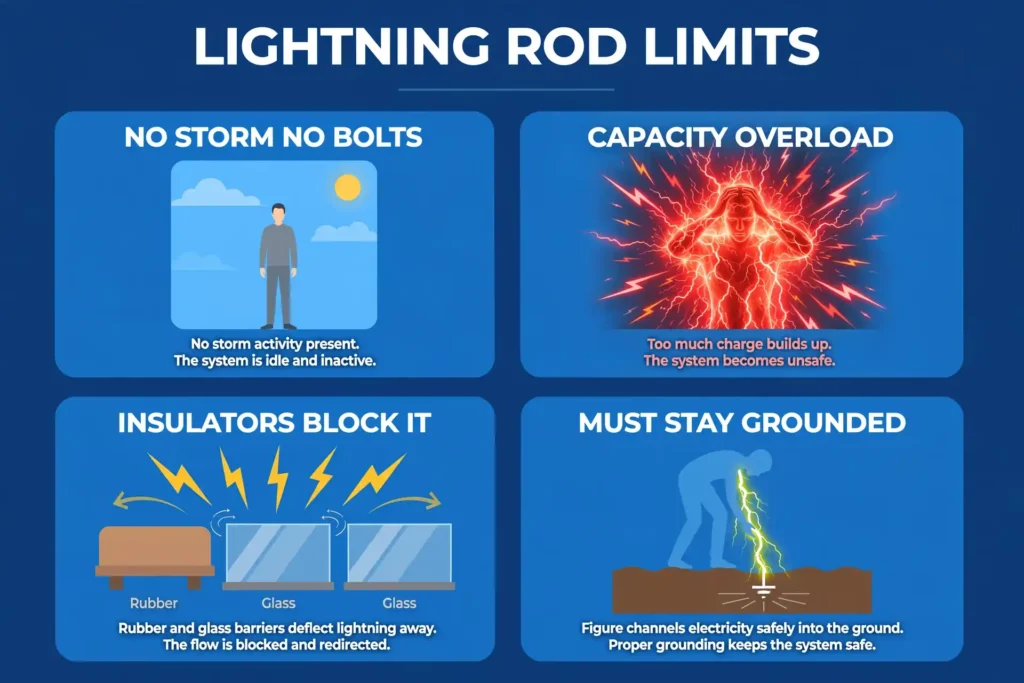
No power is complete without its counters, and the rod’s first weakness is written into its name: it needs lightning to catch. Nothing to catch means nothing to channel.
What Can Stop a Lightning Rod User?
The fan catalogs warn that a user may be limited to stormy weather, may require the presence of cumulonimbus clouds, and a cloudless sky is a powerless sky. No storm, no bolts, no rod.
Then there is the capacity problem. The charge has to go somewhere: to ground, back at the enemy, or stored inside, and every route has a limit. Absorbed charge is only held temporarily or permanently if the user’s body can take it, and a bolt the user fails to route will hurt them exactly like it hurts everyone else. The catalogs are blunt: the user can be affected by lightning, and may not be able to manipulate the lightning they catch. Insulated enemies are the final insult: rubber, glass, and distance give the bolt nowhere to go.
Famous Lightning Rod Users
From anime to comics to games, these are the characters who defined the art of being the living conductor.
Icons of the Living Rod in Comics, Anime, and Games
The icons each found a signature way to be the rod, as depicted in their stories: Iroh (Avatar: The Last Airbender), who invented the method of absorption and redirection of lightning; Billy Batson/Shazam (DC Comics), who can summon a bolt of lightning whenever he says “Shazam”; Sasuke Uchiha (Naruto), summoning a massive bolt of lightning in the form of Kirin; Nora Valkyrie (RWBY), who conducts electricity through her body to enhance her physical strength; Cole MacGrath (inFamous), who draws and absorbs lightning and calls down a Lightning Storm (Lightning Summoning).
The deeper cuts: Darrin Peter Oswald (The X-Files “D.P.O.”), who learned to absorb and toss around lightning after being struck; the Genoshan mutant Lightning Rod (Marvel Comics, Excalibur III#1, July 2004), who could generate electrical current and release it as blasts from his hands; Pikachu, Manectric, and Togedemaru (Pokémon), whose Lightning Rod ability draws in all Electric-type moves and boosts their Sp. Atk instead of taking damage; and the Skylanders hero Lightning Rod, who throws bolts and produces an electrical field. For more lightning-themed fighters, see Thunder Breathing; for storm-touched powers, Atmospheric Adaptation; for power variety, God Ki abilities and emitter quirks.
Conclusion
The lightning rod is electricity at its most generous: not the strike but the catching, the body offered up as the bolt’s preferred destination. Whether it arrives as Iroh’s calm redirection, Shazam’s summoned transformation, or a gamer’s battery built from a storm, it runs on one truth borrowed from Franklin himself: give lightning a better path, and it will take it. Want to give the power to your own character? Try our superpower generator and see what kind of conductor you would become.


