
Life Drain Superpower Explained: The Tap
Every other power spends energy. Life drain steals it. It is the zero-sum deal of fiction: the drainer gets stronger because somebody else gets weaker, drawing life out of a victim and pouring it into the self. Fans know it from Rogue’s tragic touch, Cell’s tail, and Big Mom’s soul harvest, and this is the version of the wish that never asks permission. This guide, the second of our Reality & Time collection, explains what life drain is, the three moves that power it, what it can do, the real parasitism science behind it, and which famous characters embody the tap. For the category’s first post on bending time itself, see our Chrono-Distortion guide.
In this guide:
- What Is Life Drain?
- Life Drain vs Other Powers
- What Can Life Drain Do? Applications
- Real Science: Nature’s Own Drainers
- Weaknesses and Limitations
- Famous Life Drainers in Fiction
- Conclusion
What Is Life Drain?
Some powers move the body through space, and some bend the tempo of time. Life drain does neither: it treats living things as batteries. The drainer touches, bites, or reaches into a victim and pulls vitality across the gap, growing stronger as the victim fades. The framework of this guide is THE TAP: three moves (drain, feed, renew) that every version of the power plays in some combination.
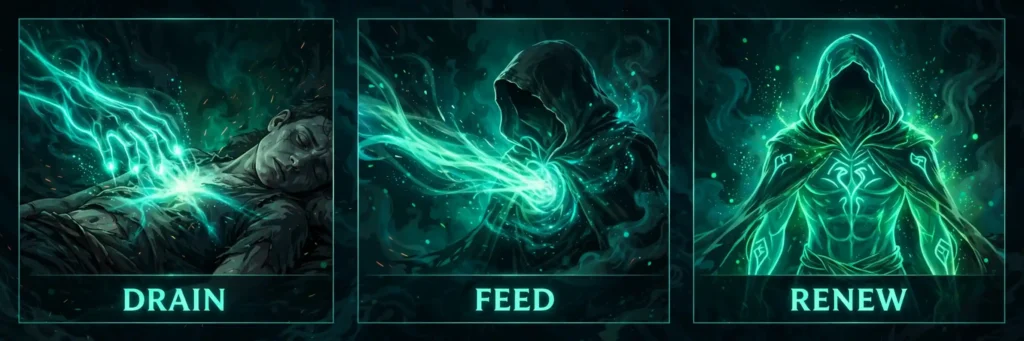
The Tap, Defined
A life drain user is a life-force thief: someone who absorbs life-force from another being and spends it like currency. Fan catalogs file the power as Life-Force Absorption, also called Life-Force Draining or Vampiric Draining: the user absorbs life-force, energy, vitality and health out of a source and into their body, either temporarily or permanently. It is not blood drinking alone (that is one delivery method) and not generic power theft (which steals abilities, not aliveness). The Charmed canon names it Life Draining: the power to drain the life force out of other beings to sustain or rejuvenate oneself.
Drain, Feed, Renew: The Three Moves
Every life drain runs three moves. First, DRAIN: make contact (touch, bite, kiss, claws, tentacles, energy vines, weapons, spells, fields) and pull life-force out, weakening the victim. Second, FEED: route the stolen life into the self as stamina, strength, or fuel: Big Mom extracts lifespan and spends it; Samehada shares eaten chakra with Kisame to replenish him. Third, RENEW: spend it on what the body needs, healing wounds, rejuvenating youth, or regenerating lost tissue.
Life Drain vs Other Powers
Drain-adjacent powers blur together in fan discussions: is stealing life the same as drinking blood, or the same as absorbing energy attacks? The tap, the drink, the bite, and the battery are four different tools, and this section separates them. For the Bleach side of life-stealing, see our Soul Reaper Powers guide; for Naruto’s chakra-absorbing Preta Path, see Naruto Best Rinnegan Abilities.
The Family Comparison
| Power | What it does | What it cannot do | How life drain differs |
|---|---|---|---|
| Life Drain | Steals life force from the living: drain, feed, renew | Take non-living energy; drain without a living source | This is the home row: the tap itself |
| Life-Force Absorption | The canonical filing: absorb life-force, energy, vitality, health | Defined more broadly than any single technique | Absorption is the umbrella filing; life drain is the street name |
| Vampiric Draining | Drains through bite, claws, or blood (Evangeline, Moka, Vladats) | Drain without the bite | The bite is one delivery method; life drain owns them all |
| Energy Drain | Drains energy from individuals or objects | Use drained energy for intricate control | Energy is the generic fuel; life force is the premium kind |
| Health Drain | Steals HP directly (game mechanics) | Drain beyond raw hit points | Health drain is the game stat; life drain is the full vitality |
What Can Life Drain Do? Applications
The applications flow from the three moves: drain wins fights, feed sustains, renew erases damage. The same tap serves the brawler and the tyrant, which is why the power shows up in so many different stories. For the Pokémon side of life-stealing, see our Legendary Pokémon Signature Abilities guide.
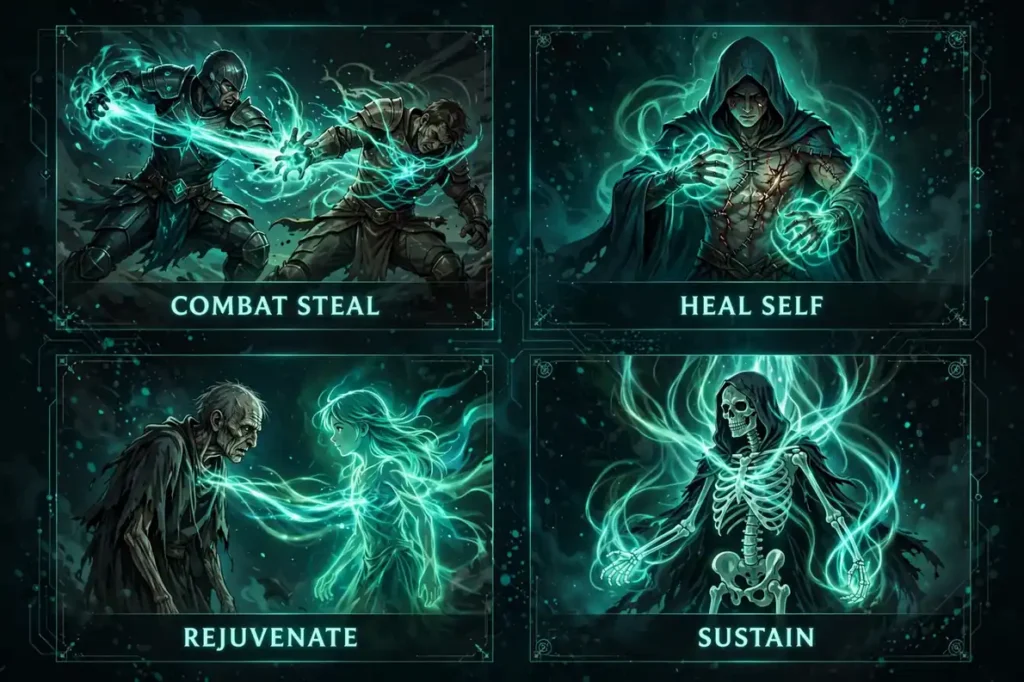
Drain: The Siphon
The drain needs a channel, and fiction has tried them all. Touch is the classic: Rogue and Selene take life-force through skin contact, and Moira O’Deorain drains health with her extended right hand. Bite and kiss are the intimate variants: the Vladats feed through their bite, and Fūka’s Execution by Kiss drains chakra until her victims die. Weapons extend the reach: Kisame’s sentient sword Samehada eats chakra through its cuts, Madara’s Wood Release Wood Dragon drains victims of chakra strongly enough to capture a Tailed Beast, and Yhwach’s Auswählen takes powers and life-force from other Quincy at range. Area fields go widest: Kurumi Tokisaki’s City of Devouring Time absorbs the life-force of everyone inside it.
Feed: Stolen Strength
Once absorbed, stolen life becomes the drainer’s fuel. Cell’s tail feeds him life energy from stabbed or swallowed victims; Cole MacGrath’s Bio Leech drains life-force and bioelectricity to restore him. The bigger prize is power, not just stamina: Big Mom extracts lifespan from her targets, Damien Darhk uses life-siphoning magic to empower himself, and Omega Red’s Carbonadium tentacles drain life-force to boost his healing factor. For the desperate, the feed is survival itself: Necron, a skeletal being hovering between life and death, requires life-force to sustain himself, and Javna must regularly steal it to keep his youth.
Renew: Heal, Rejuvenate, Revive
The renew move spends stolen life on repair. Healing is the baseline: Talion restores his health by draining orc life-force, and Imhotep regenerates himself from victims he reduces to mummified husks. Rejuvenation is the crueler use: Javna steals life-force from young women to remain youthful, and his victims are rapidly aged into frail elderly versions of themselves, the classic Life Drinker trope of draining youth from others. At the high end comes revival: Yhwach uses Auswählen to revive his fallen Sternritter elites with stolen life-force. The games literalize the accounting: Robin’s Nosferatu feeds drained life energy straight back into him, and Pulcinella’s Life Drain Extra skill converts a defeated target’s energy into the user’s own strength.
The Tap Toolkit
| Drain move | What it does | Who embodies it |
|---|---|---|
| Touch | Drain life force through direct skin contact | Rogue (Marvel), Selene (Marvel), Moira (Overwatch) |
| Bite / kiss | Drain through bite or lip contact | Vladats (Ben 10), Fūka (Naruto Shippuden): Execution by Kiss |
| Weapon | Drain through a blade or spell medium | Kisame (Naruto): Samehada; Yhwach (Bleach): Auswählen; Madara (Naruto): Wood Dragon |
| Field | Drain everyone inside an area | Kurumi Tokisaki (Date A Live): City of Devouring Time |
| Siphon spell | Drain through cast magic | Damien Darhk (Arrow); Dark Ranger (Warcraft III): Life Drain |
| Soul harvest | Extract lifespan itself | Big Mom (One Piece): Soru Soru no Mi |
Real Science: Nature’s Own Drainers
Fiction gives the drainer a tap; nature has been running taps for hundreds of millions of years. Parasites siphon vitality from hosts every day, and the drainer’s trick is the same transaction at fantasy speed. The two meet where biology turns one organism into another’s battery.
Parasitism: The Zero-Sum Contract
The drainer’s deal is nature’s oldest contract. Parasitism is a close relationship where one organism, the parasite, lives on or inside another organism, the host, causing it some harm: parasites “increase their own fitness by exploiting hosts for resources necessary for their survival, in particular by feeding on them.” Unlike predators, parasites are much smaller than their hosts, do not kill them, and often live in or on their hosts for an extended period. The fictional drainer breaks that patience: same transaction, zero wait. (Parasitism)
The Micropredators
Nature’s closest thing to a life drainer is the micropredator: mosquitoes, fleas, ticks, leeches, lampreys, and vampire bats, which attack more than one host and are only in contact with any one host intermittently, most of them feeding on blood. They take a little from many, while the fictional drainer takes everything from one, but the bookkeeping is identical: vitality leaves the host and arrives in the feeder. The cultural shadow is long: Bram Stoker’s 1897 novel Dracula featured a blood-drinking parasite, and every screen drainer since drinks from that well.
The Mistletoe’s Tap
The plant kingdom runs a tap too. Mistletoe is a hemiparasite that prefers to siphon water and nutrients from other trees and shrubs, using “false roots” to invade its hosts. It can photosynthesize, but it is mostly heterotrophic and “can switch if they want to,” and when two mistletoes share one host they can reduce the virulence of their attack (2021 Current Biology study, via ScienceDaily). The fictional version just skips the slow part: where mistletoe siphons sap across a season, a life drainer drains a lifetime across a heartbeat.
Weaknesses and Limitations
The tap has leaks, and the zero-sum deal cuts both ways. Every entry on this list is a way the drain fails, backfires, or costs the drainer more than the victim. Know the leaks and the power stays a story instead of an instant win.
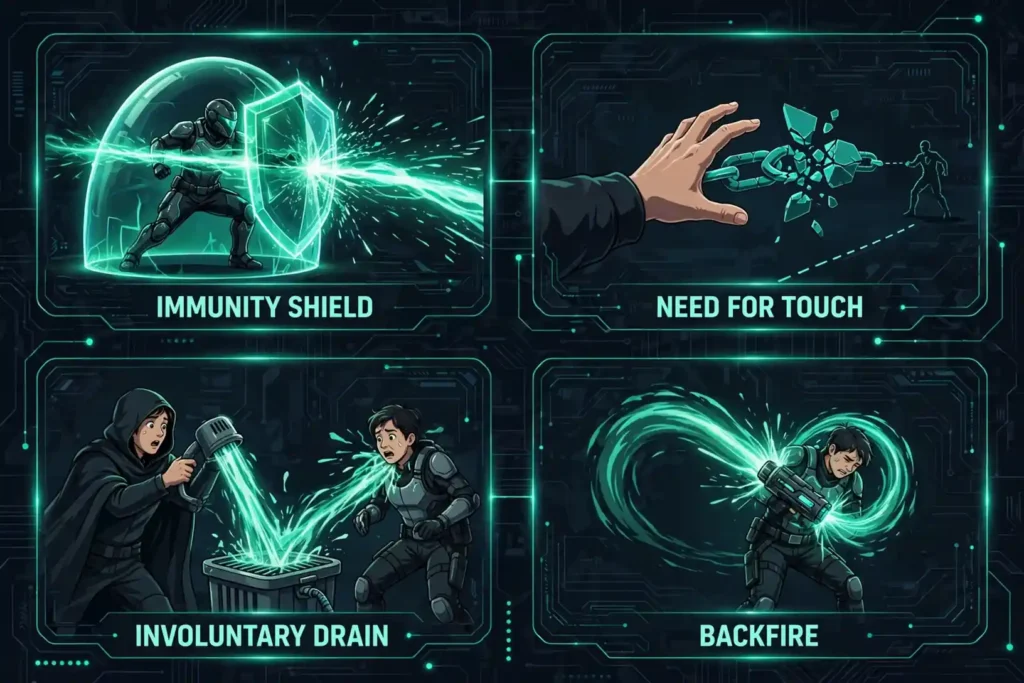
What Can Stop a Life Drainer?
The tap has leaks, and the zero-sum deal cuts both ways. First, the hard immunities: users of Energy Independence are immune, Absorption Immunity and Absolute Life-Force block the siphon, and Absorption Negation ends the tap outright. Second, the contact rule: drain usually needs touch or proximity, so breaking contact breaks the drain (hence Rogue’s tragedy: anyone she touches). Third, the moral price: victims drained dry die, which turns a user into a killer, and involuntary drain poisons allies, as Bo Dennis proves when feeding kills. Fourth, the control problem: drained energy does not grant intricate control, and the tool can turn on its master (Itachi’s Susanoo drains his own life-force while he uses it). For more ways to humble a powerhouse, try our random weakness generator.
Famous Life Drainers in Fiction
From anime to games to film to comics, these are the characters who defined the art of the tap. Some drain with a touch, some with a weapon, and one with a kiss, but each of them shows a different face of the same three moves. For the Jujutsu Kaisen side of healing through stolen energy, see our Reverse Cursed Technique guide.
Icons of the Tap in Anime, Games, Film, and Comics
The tap’s masters span every medium. In anime and manga: Yhwach (Bleach), whose Auswählen takes the powers and life-force of other Quincy and revives fallen Sternritter elites; Cell (Dragon Ball Z), whose tail absorbs life energy from stabbed or swallowed victims; Kisame Hoshigaki (Naruto), whose sentient sword Samehada eats chakra and shares it to replenish and regenerate him; Nagato/Pain (Naruto), whose Preta Path absorbs chakra from techniques and held enemies; Madara Uchiha (Naruto), whose Wood Release Wood Dragon drains victims of chakra; Charlotte “Big Mom” Linlin (One Piece), whose Soru Soru no Mi extracts one’s soul, effectively lifespan, once stripping a lethal 40 years from her son Moscato; and Kurumi Tokisaki (Date A Live), whose City of Devouring Time absorbs other people’s life-force. In film and TV: Imhotep (The Mummy), who sucks the life out of victims while reducing them to mummified husks, and Javna (Charmed), who steals the life-force of young women to remain youthful while his victims are rapidly aged. In comics: Rogue (Marvel), who drains the life-force of anyone she directly touches; Selene (Marvel), who drains by physical touch; and Omega Red (Marvel), whose Carbonadium tentacles drain life-force to boost his healing factor. In games: Moira O’Deorain (Overwatch), who drains health with her right hand; Yveltal (Pokémon), whose Oblivion Wing absorbs life energy from living targets; and Cole MacGrath (inFAMOUS), whose Bio Leech drains life-force out of his victims. Each as depicted in their own universe.
Conclusion
Life drain is the zero-sum power: drain the victim, feed the self, renew the body. It is the most honest transaction in fiction, because the price is always visible in somebody else’s eyes. Whether it arrives as Rogue’s touch, Cell’s tail, or Big Mom’s soul harvest, it runs on the same three moves: drain, feed, renew. Want to give the power to your own character? Try our superpower generator and see what your tap would take.


