
Nano-Tech Superpower Explained: The Micro-Army
Every other power is one body. Nano-tech is billions of bodies: the user does not wear a suit, the user commands the swarm that becomes the suit. A nanite is a machine at or near the scale of a nanometre, and a nano-tech user holds complete control over nanites, directing an invisible army to build, destroy, protect, and repair. The framework of this guide is THE MICRO-ARMY: assemble the swarm, command the swarm, rebuild with the swarm. This is the first post of our Technology-based collection.
In this guide:
- What Is Nano-Tech?
- Nano-Tech vs Other Powers
- What Can Nano-Tech Do? Applications
- Real Science: From Feynman to the NNI
- Weaknesses and Limitations
- Famous Nano-Tech Users in Fiction
- Conclusion
What Is Nano-Tech?
Every other power is one body. Nano-tech is billions of bodies: the user does not wear a suit, the user commands the swarm that becomes the suit. A nanite is a machine at or near the scale of a nanometre, and a nano-tech user holds complete control over nanites, directing an invisible army to build, destroy, protect, and repair. The framework of this guide is THE MICRO-ARMY: assemble the swarm, command the swarm, rebuild with the swarm. This is the first post of our Technology-based collection.
The Micro-Army, Defined
A nano-tech user is a swarm commander: someone who can create, shape, control, and manipulate nanites, the way powerlisting files Nanite Manipulation, also called Nanokinesis or Nanotechnosis. Nanorobotics is the engineering discipline of designing nanorobots, devices from 100 to 1 nanometer built of nanoscale components, which allows manipulation of matter on a molecular and atomic scale. The wider filing is Micro-Tech Manipulation: control of inorganic technology in the microscale ranges. It is not a gadget power (one device, one trick) and not Technopathy alone (talking to machines); the swarm IS the machine, and it answers to one mind.
Assemble, Command, Rebuild: The Three Moves
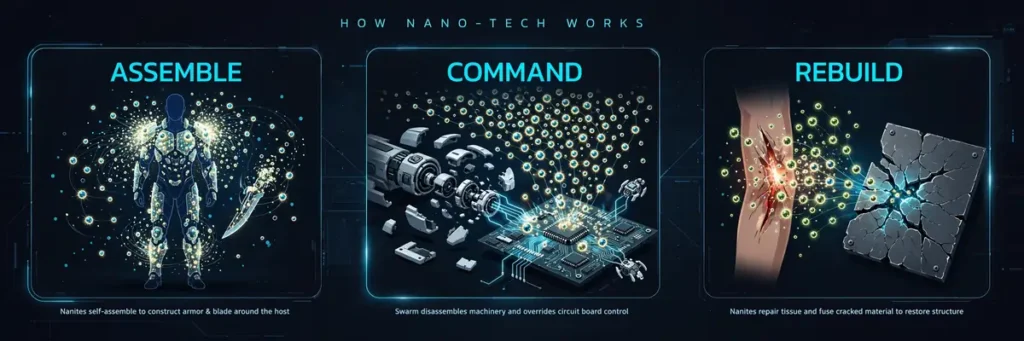
Every nano-tech runs three moves. First, ASSEMBLE: the swarm forms into various tools as needed by the wearer, from cyber armor to blades to boosters, the way the Mark L forms a booster rocket on the legs, gun emplacements, and blades. Second, COMMAND: the user directs the swarm to build, destroy, infiltrate, or override, like shooting a cylindrical bullet that releases nanites to override electrical programming, or Cluster Cells that change hardness, plasticity, and density. Third, REBUILD: nanites in the bloodstream heal injuries at an accelerated rate, letting the user regenerate before normally fatal injuries land, while the swarm repairs itself.
Nano-Tech vs Other Powers
Tech powers blur together in fan discussions: is a nanite swarm the same as a gadget, a hack, or a costume change? The swarm, the suit, the hacker, and the shapeshifter are four different tools, and this section separates them. For the swarm’s greatest enemy, the pulse that fries it, see our Electromagnetic Pulse guide; for tech-flavored quirk ideas, try Emitter Quirk Ideas.
The Family Comparison
| Power | What it does | What it cannot do | How nano-tech differs |
|---|---|---|---|
| Nano-Tech | Commands a micro-army of nanites: assemble, command, rebuild | Work without a nanite source; beat an EMP | This is the home row: the swarm itself |
| Nanite Manipulation | The canonical filing: manipulate nanoscopic robotic machines | Defined more broadly than any single technique | The filing is the umbrella; nano-tech is the street name |
| Technopathy | Communicates with and controls machines | Build its own machines from nothing | The hacker borrows machines; the swarm IS the machine |
| Power Suit / Exoskeleton | One wearable machine with fixed abilities | Rearrange itself into new tools mid-fight | The suit is one shape; the swarm is every shape |
| Shapeshifting | Changes the user’s own body | Split into billions of independent units | The shapeshifter is one body; the swarm is billions |
What Can Nano-Tech Do? Applications
The applications flow from the three moves: assemble wins fights, command controls the battlefield, rebuild keeps the user alive. The same micro-army serves the soldier, the spy, and the survivor, which is why the power shows up in so many different stories.
Assemble: Armor, Weapons, Tools
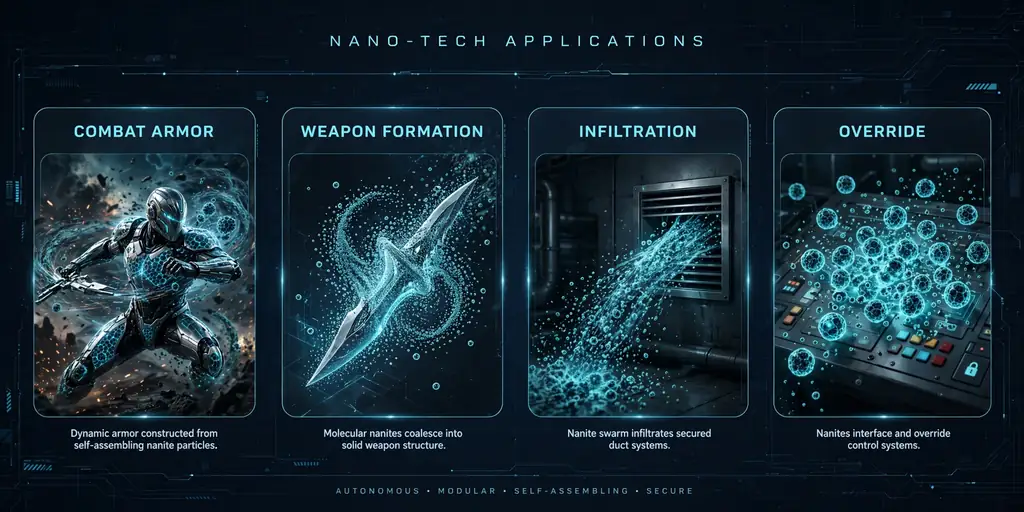
Assemble is the signature move. The Mark L deploys from a detachable housing unit of nanoparticles over Stark’s body with a simple push, then forms blades, a booster rocket, and gun emplacements as the fight demands, as depicted in the film. Cyborg manifests weapons and technology from his own body; Eve (Black Cat) manifests wings or a fish-tail from the nanotechnology in her body; and the Mark LXXXV goes further, creating mini Infinity Stone holders in one of the gauntlets. The armor is nearly indestructible yet agile, and it increases physical attributes many times that of the average human.
Command: The Swarm at Work
Once assembled, the swarm works. Nanites are programmed to build and destroy: they can upgrade vehicles, with a cable coming out from the arm (more cables, faster the upgrade), or take over electrical objects through nanite bullets that override the electrical object programming. Infiltration is the quiet version: swarms slip through vents and cracks, the way Borg Nanoprobes assimilate ship systems, as depicted in Star Trek. At the dark end sits Brother Eye‘s nanotech virus, which converts living tissue into biomechatronic alloy drones, as depicted in DC Comics.
Rebuild: Healing and Self-Repair
Rebuild is the move that refuses death. Nanites in the bloodstream heal the user’s injuries at an accelerated rate, allowing the user to regenerate before any normally fatal injuries could kill them, and Bloodshot‘s nanite-infused blood does exactly this, as depicted in the comics. Steven Armstrong‘s line says the rest: “Nanomachines, son. They harden in response to physical trauma.” The swarm also repairs itself: the T-3000 can dissolve into a swarm of nanobots to phase through attacks, then reform whole, as depicted in the film.
The Micro-Army Toolkit
| Move | What it does | Who embodies it |
|---|---|---|
| Assemble armor | Swarm forms a full suit on demand | Iron Man Mark L (MCU): nanoparticle housing unit |
| Assemble weapons | Blades, guns, and tools from the swarm | Cyborg (DC): manifests weapons from his body |
| Phase swarm | Dissolve into nanobots, pass through attacks, reform | T-3000 (Terminator Genisys): phase-matter body |
| Command swarm | Change the swarm’s hardness, plasticity, density | Kamen Rider Zero-One: Cluster Cells |
| Bloodstream heal | Nanites heal injuries at an accelerated rate | Bloodshot (Valiant): nanite-infused blood |
| Harden on trauma | Nanomachines harden in response to physical damage | Steven Armstrong (Metal Gear Rising) |
Real Science: From Feynman to the NNI
Fiction gives the user a swarm. Science has been building the first real nanites since 1959, one atom at a time. The two meet at the 100-nanometer line: everything smaller than that is nanotechnology, by definition.
There’s Plenty of Room at the Bottom
The story starts with a talk. On December 29, 1959, Richard Feynman addressed the American Physical Society at Caltech with “There’s Plenty of Room at the Bottom“, describing direct manipulation of atoms to build smaller instruments. In 1974, Norio Taniguchi first used the term nano-technology for semiconductor processes with nanometer-level control. Then in 1986, K. Eric Drexler popularized it with “Engines of Creation: The Coming Era of Nanotechnology“, proposing a nanoscale assembler that could build a copy of itself, and publishing the term “grey goo” for runaway self-replicating machines. (Nanotechnology)
The Machines We Actually Built
Feynman’s vision became hardware. The scanning tunneling microscope arrived in 1981 (Gerd Binnig and Heinrich Rohrer, IBM Zurich; Nobel Prize in Physics 1986) and was used to manipulate individual atoms in 1989. In 2000, the United States National Nanotechnology Initiative began, and the field split into two approaches: top-down (breaking bulk material down via precision engineering and lithography) and bottom-up (building nanostructures atom-by-atom). The fictional swarm is bottom-up building with a commander: billions of tiny machines assembling on order, the way Drexler’s assembler was always supposed to work.
Weaknesses and Limitations
The swarm is mighty but fragile: kill the signal, kill the swarm. Every entry on this list is a way the micro-army fails, gets hijacked, or eats its own commander. Know the leaks and the power stays a story instead of an instant win.
What Can Stop a Nano-Tech User?
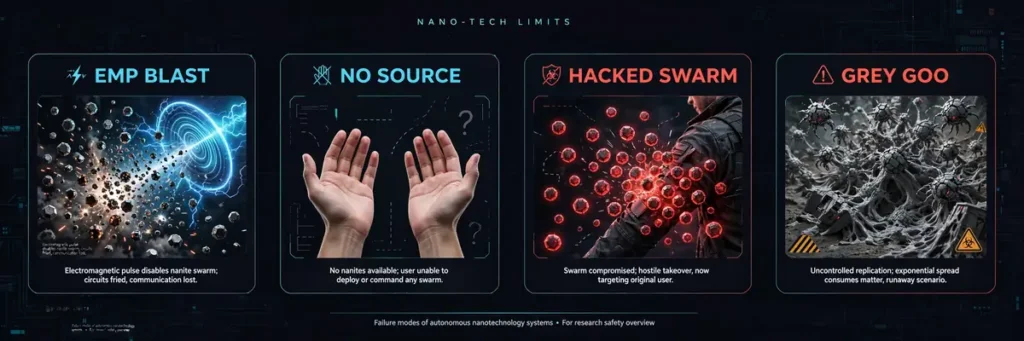
The catalogs’ hard counters come first: most Micro-Tech can be fried by EMPs and similar effects, so an electromagnetic pulse is the classic off-switch; the power may be weakened by users who can crash technological powers. Supply is the second leash: the user may be unable to create nanites, being limited to manipulating only from already existing sources, and distance, mass, and precision depend on the user’s knowledge, skill, and strength. Then the hijack risk: nanites are susceptible to hacking, and a stolen swarm turns on its master. Finally the nightmare: grey goo, out-of-control self-replicating nanobots, which the Center for Responsible Nanotechnology (2005) warned is not part of modern plans for building things atom by atom by molecular manufacturing. For more ways to humble a powerhouse, try our random weakness generator.
Famous Nano-Tech Users in Fiction
From the MCU to anime to comics to games, these are the characters who made the swarm iconic. Some wear it as armor, some bleed it, and one dissolves into it entirely, but each shows a different face of the same three moves.
Icons of the Micro-Army in Film, Anime, Games, and Comics
Tony Stark/Iron Man (MCU) is the textbook user, as depicted in the films: the Mark L, his fiftieth suit, uses a detachable housing unit of nanoparticles that deploys over his body with a simple push, forming blades, a booster rocket, and gun emplacements during the fight with Thanos on Titan; the Mark LXXXV adds mini Infinity Stone holders in a gauntlet. Rex Salazar (Generator Rex) builds his body around the Omega-1 Nanite. The T-3000 (Terminator Genisys) is the nightmare version: a machine phase matter body that can dissolve into a swarm of nanobots to phase through attacks, unleash a flurry of nanobots to shred flesh from bone, and sprout blades sharp enough to sever a T-800’s arm. Cyborg (DC) manifests weapons from his cybernetics; Bloodshot (Valiant) heals through nanite blood; Eve (Black Cat) shapes wings and a fish-tail; Borg Nanoprobes (Star Trek) assimilate; Screaming Mantis and Armstrong (Metal Gear) harden on trauma; and Kamen Rider Zero-One commands Cluster Cells. For the Dragon Ball side of machine-enhanced fighters, see our God KI Abilities guide; for Bleach’s mad scientist of tech, try the Bleach Hollow Powers Maker.
Conclusion
Nano-tech is the micro-army: assemble the swarm into armor and weapons, command it to build, infiltrate, and override, and rebuild with it when everything breaks. It is the most flexible power in fiction, because a billion tiny machines can be anything, and the most fragile, because an EMP ends the argument in a heartbeat.
Want to give the swarm to your own character? Try our superpower generator and see what your micro-army would build.


