
Electromagnetic Pulse Superpower Explained: The Tech-Killer Burst
Some powers burn cities. Electromagnetic pulse turns them off: a single burst of energy that kills every unshielded circuit in range. It is the tech-killer burst of the electricity family, the power that makes modern civilization its victim. This guide, part of our Energy Powers collection, explains what an electromagnetic pulse is, the two ways it kills technology, what it can do, the real science of HEMP and Faraday cages, and which famous characters wield the blackout.
In this guide:
- What Is an Electromagnetic Pulse?
- Electromagnetic Pulse vs Other Electricity Powers
- How EMP Works: Two Ways to Kill Technology
- What Can an EMP Do? Applications
- Real Physics: The Science Behind the Pulse
- Weaknesses and Limitations
- Famous Electromagnetic Pulse Users
- Conclusion
What Is an Electromagnetic Pulse?
An EMP is not a bolt, a blast, or a field. It is a wave of electromagnetic energy with one job: unmaking machines. The sections below define the power, then show exactly what the pulse does to the devices it touches.
The Tech-Killer Burst, Defined
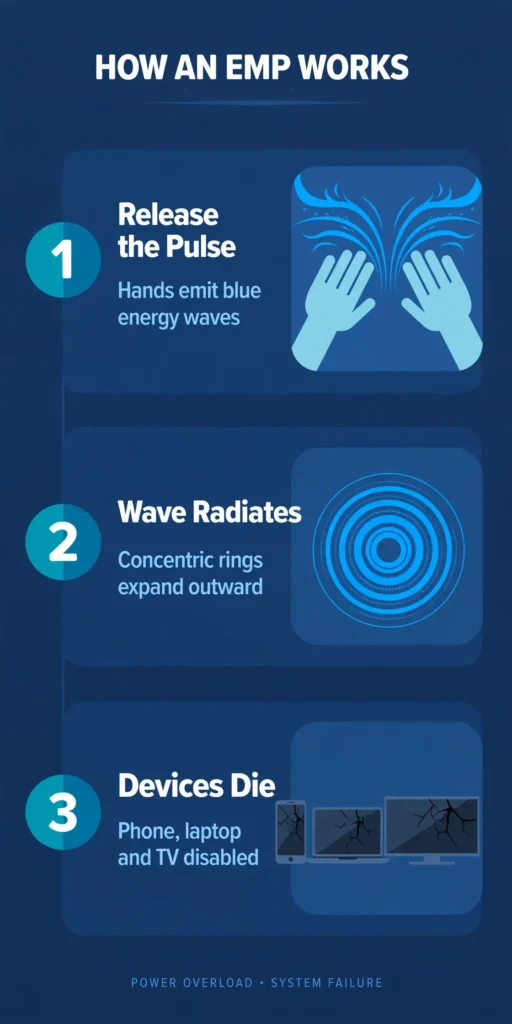
Electromagnetic Pulse Emission is the power to emit an electromagnetic pulse: the user can produce a surge of electromagnetic energy that can disrupt all technology nearby. The fan catalogs file it as a Sub-power of Electromagnetic Attacks and Electromagnetism Manipulation, a Combination of Electromagnetism Generation and Pulse Manipulation, also calling it EMP Emission, EMP Generation, or an Electromagnetic Energy Surge (Electromagnetic Pulse Emission).
The pulse may come from the user’s hands or even from their entire body, radiating outward as a wave of Electric Field Waves that kills machines instead of bodies. That is the power’s signature: where other electricity powers burn, shock, or build, the EMP user simply turns the modern world off.
How an EMP Disables Electronics
A real electromagnetic pulse is a brief burst of electromagnetic energy that induces high currents and high voltages in anything conductive. Modern circuits are tiny and fragile, so the surge overwhelms them: it fries electronics permanently, corrupts data, and leaves permanently damaging failures behind, because the circuits act like little antennas drinking in the wave.
Fiction loves a gentler version: a temporary disable where everything reboots minutes later. The honest physics is harsher. As one fan-science breakdown notes, movies show a flicker while reality shows a funeral, and that gap between the trope and the truth is exactly what makes the power so dramatic to write.
Electromagnetic Pulse vs Other Electricity Powers
Readers meet eight electricity specialists across our guides: bio-electricity, bio-lightning, electric discharge, electric field manipulation, electric shield, electric surge, electrokinetic constructs, and electrokinetic flight. EMP is the tech-killer of the family: where the others fire, burst, shield, sense, build, or fly, the EMP user simply switches the world off.
The Family Comparison
Every other electricity specialist on this site attacks people or builds things; EMP is the only one whose signature victim is a machine. Electric Surge vents raw charge in a sudden burst, Electric Discharge fires aimed zaps, Electric Field Manipulation shapes sustained invisible zones, Electrokinetic Constructs builds solid forms, Bio-Lightning projects bolts, and Electric Shield raises barriers. The table below shows where the tech-killer burst stands apart.
| Power | What it does | How EMP differs |
|---|---|---|
| Electromagnetic Pulse | Emits a radiating wave of EM energy | The baseline: kills technology, not bodies |
| Electric Surge | Vents built-up charge in a sudden burst | Bursts raw charge; the burst harms people, not just machines (guide) |
| Electric Discharge | Releases charge as aimed sparks and arcs | Fires at targets; does not radiate an area wave (guide) |
| Electric Field Manipulation | Shapes invisible zones of charge | Sustains a field; EMP is one violent pulse, not a held zone (guide) |
| Electrokinetic Constructs | Shapes charge into solid objects and beings | Builds things; EMP builds nothing, it erases function (guide) |
| Bio-Lightning | Projects lightning bolts from the body | Throws bolts at people; EMP has no bolt, only the wave (guide) |
| Electric Shield | Raises defensive barriers of charge | Shields the user; EMP is an offensive area attack (guide) |
How EMP Works: Two Ways to Kill Technology
Fiction gives EMP users two paths to the same blackout, and both mirror real physics: the city-killing pulse from the sky and the surgical device in a palm.
HEMP: The Nuclear Pulse
A Nuclear electromagnetic pulse, or NEMP, is the abrupt pulse of electromagnetic radiation from a nuclear explosion, and its high-altitude variant, HEMP, is the most devastating form: detonated far above the Earth, the blast throws gamma rays into the mid-stratosphere, and the freed electrons slam into Earth’s magnetic field, producing a far stronger pulse than any ground-level blast (Nuclear electromagnetic pulse).
History proved the range by accident: the 1962 Starfish Prime test knocked out electronics in Hawaii, 1,445 kilometres away. Long wires act as antennae, which makes telecommunication utilities the most vulnerable targets, and only a few nations, the United States, China, and Russia, are considered HEMP capable.
NNEMP: Devices and Superhumans
A Non-nuclear electromagnetic pulse, or NNEMP, needs no mushroom cloud: a large low-inductance capacitor bank discharged into an antenna, a microwave generator, or an explosively pumped flux compression generator can all produce a focused pulse, and vircators convert high-energy pulses into microwaves for maximum coupling into a target (Electromagnetic pulse).
The tradeoff is scale. Nearly all NNEMP devices produce only one millionth the energy of a comparable nuclear explosive, so their range is short, but they fit as payloads on bombs, cruise missiles (such as the CHAMP missile), and drones, and they allow fine target discrimination. The concept dates to 1951, when Andrei Sakharov conceived it in the Soviet Union, and it is the closest real-world model for a superhuman who fires an EMP from their hands.
The Two Pulses Compared
Real science gives the power two distinct sources, and fiction borrows both: the city-killing blast from the sky and the surgical device in a hero’s palm. The table below maps how they differ in source, scale, and story use.
| Aspect | HEMP (nuclear) | NNEMP (non-nuclear) |
|---|---|---|
| Source | Nuclear detonation high above the Earth | Capacitor banks, microwave generators, flux compression devices |
| Energy scale | Enormous; continental range | About one millionth of a nuclear explosive of similar weight |
| Range | Vast; Starfish Prime reached 1,445 kilometres | Short; carried on bombs, missiles, and drones |
| Typical use | Warfare, infrastructure destruction | Targeted strikes: disabling vehicles, aircraft, control systems |
| Superpower parallel | The god-tier user who blacks out a country | The street-level user who kills one room’s tech |
Fiction’s Favorite Trick: The Temporary Blackout
Movies love the EMP as a heist tool: Ocean’s Eleven (2001) uses the pinch to black out a slice of Las Vegas, The Matrix (1999) turns the hovercraft EMP into humanity’s last weapon against the sentinels (knowing it kills friendly tech in Zion too), and even Leverage carries an EMP gun that takes electronics down for 30 minutes. Games do it too: the Call of Duty: Modern Warfare 2 killstreak EMP strips enemy radar and HUD for about two minutes (EMP trope roundup).
The catch is that this is a trope, not physics. Real EMPs fry electronics permanently; the temporary disable is an acceptable break from reality so the heroes can keep using their own gear. Writers who know the difference get the best of both: the drama of the blackout plus the dread of knowing nothing comes back on.
What Can an EMP Do? Applications
The applications list is short but devastating: anything with a circuit is a target, and anything alive inside a circuit is a casualty.
Disabling Machines, Vehicles, and Grids
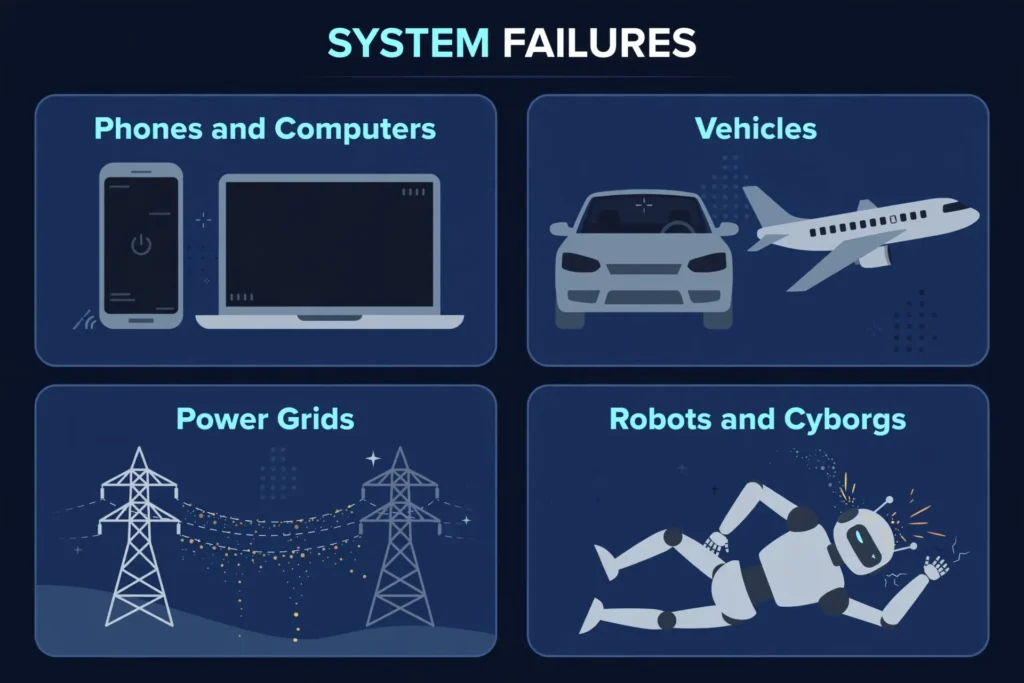
The core application is Electronic Disruption: one pulse, and every unshielded device in range goes dark. The fan catalogs frame it as an Electromagnetic Blast that fries rather than strikes, and fiction scales it wildly: the MUTOs of the MonsterVerse shut down all electrical appliances within a 5-mile radius, while Paramount’s Sonic generates an EMP potent enough to knock out power across the western US and Mexico just by running, as depicted in their stories.
Vehicles and grids are the juiciest targets because they cannot run from the wave. Power line surges already show how a few kilovolts can cascade through a grid, and an EMP user is a walking version of that surge: cars stall, planes lose instruments, and substations trip. Against a modern army or city, that is worth more than any fireball.
Crashing Living Technology
Where EMP gets cruel is against enemies who ARE technology. The fan catalogs list the victims explicitly: users of Bionic Physiology, Cyber Mind, Digital Form, High-Tech Exoskeleton, Robot Arm, Technorganic Physiology, and Vehicle Physiology can all be crashed outright, and Electronic Communication can be silenced by destroying the machines it talks to.
The applications get surgical from there. A pulse can turn off nanites built by a Nanite Manipulation user, and No Time To Die shows the personal scale: Bond’s EMP wristwatch shorts out Primo’s bionic eye at close range. Against cyborgs, androids, and powered armor, the EMP user does not fight the body; they delete the advantages.
Real Physics: The Science Behind the Pulse
The Three Phases of a Nuclear EMP
Experts describe a nuclear EMP as arriving in three waves, and each one hunts different prey. E1 is the fast pulse: gamma radiation knocks electrons free in the upper atmosphere in nanoseconds, and that violent shock is what kills microelectronics, the phones, computers, and avionics. Surge protectors cannot even see it coming; the pulse is through them before they react, as one U.S. Congressional Record briefing put it.
Then comes E2, an intermediate pulse lasting milliseconds, similar to lightning in duration and effect, dangerous mainly because E1 has already disabled the protections. Finally E3 is the slow pulse, lasting seconds to minutes: it deforms Earth’s magnetic field like a geomagnetic storm and injects a heavy, DC-like current into transmission lines, saturating transformers until they overheat and the grid goes black.
Faraday Cages: The Only Shield
If the pulse is the perfect anti-technology weapon, the Faraday cage is the perfect answer. A conductive enclosure, the classic Faraday shield, disrupts the alternating wavelengths that damage circuitry, and the trick scales down to almost nothing: on the cheap, a cardboard box wrapped in aluminum foil genuinely works as a basic shield.
That is why the counterplay writes itself. Military equipment is designed and tested against EMP (Sandia National Laboratories runs a dedicated “friendly” EMP simulator for exactly this), while older electronics with chunky circuits may survive where fragile modern circuits die. An EMP user facing a prepared enemy is a god facing an empty temple: the power still works, but there is nothing left to kill.
Weaknesses and Limitations
No power is complete without its counters. The tech-killer burst is spectacular but narrow: it has one trick, and prepared enemies only need to survive it once.
What Stops an EMP User?
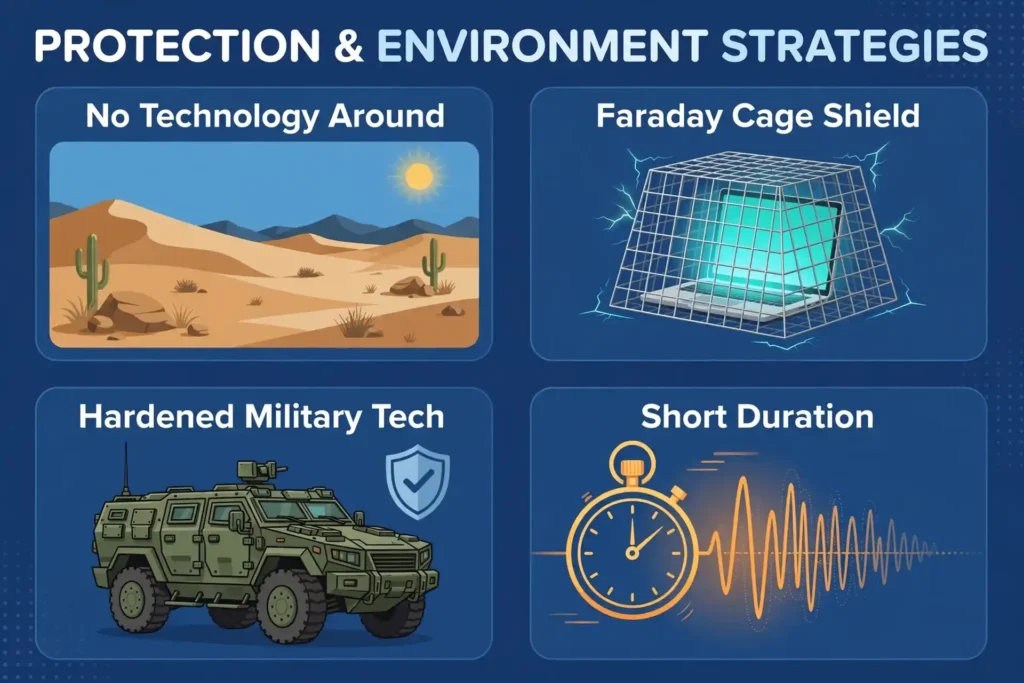
The power’s first weakness is built into its definition: it is useless without technology around, so a fight in the wilderness is a fight without a power. Then the fan catalogs add the practical limits: the range varies, concentration might be needed, some technologies might be resistant or immune (hardened military gear, Faraday-caged bunkers), and the duration of the effects might be uncontrollable.
Edens Zero shows the cost at the personal scale: E.M. Pino can cancel electronics, machinery, and even Ether Gear by releasing a surge of electromagnetism from her body, but the effect has a short duration of only a few seconds, as depicted in the story. The tech-killer burst is mighty, but it is a single trick, and prepared enemies only need to survive it once.
Famous Electromagnetic Pulse Users
From kaiju to speedsters to anime androids, these are the characters who defined the art of the blackout.
Icons of the Tech-Killer Burst in Comics, Anime, and Games
The icons each found a signature blackout, as depicted in their stories: the MUTOs (MonsterVerse) blanketing cities in a 5-mile radius of dead electronics; Sonic (Paramount’s Sonic the Hedgehog) blacking out the western US and Mexico at a run; Storm and Onslaught (Marvel Comics) generating electromagnetic pulses from weather and psionic might; Ted Sprague (Heroes) emitting a pulse that disabled the company’s system.
The deeper cuts: E.M. Pino (Edens Zero) canceling Ether Gear in seconds; the Thunder Twins, Max and Phoebe (The Thundermans) joining hands to fry nanochips; Clark Kent (My Adventures with Superman) venting his bio-electric aura as an EMP; Blackout and Soundwave (Transformers) weaponizing the pulse against machines; the Night Lights (Dragons: The Nine Realms) shocking fields that act as EMPs. For more electricity-themed fighters, see Thunder Breathing; for gadget-heavy heroes, ODM gear techniques; for power variety, emitter quirks and hero tech.
Conclusion
The electromagnetic pulse is electricity at its most modern: not the bolt but the blackout, the power that turns civilization’s greatest strength into its greatest weakness. Whether it arrives as a nuclear flash over a continent or a hero’s palm over a server room, it runs on one truth: everything electric can be unmade. Want to give the power to your own character? Try our superpower generator and see what you would switch off.


