
Electrokinetic Constructs Superpower Explained: Weapons, Armor & Living Lightning
Some electricity powers fire lightning. Electrokinetic constructs build with it: shaping raw charge into swords, armor, wings, and even living guardians. It is the Green Lantern power of the electricity family, except the ring is willpower and the light is lightning. This guide, part of our Energy Powers collection, explains what electrokinetic constructs are, what you can build with them, the rules that govern them, the real physics behind the fantasy, and which famous characters shape lightning best.
In this guide:
- What Are Electrokinetic Constructs?
- Electrokinetic Constructs vs Other Electricity Powers
- What Can You Build? The Construct Arsenal
- How Constructs Work: The Rules
- Real Physics: Can Electricity Hold a Shape?
- Weaknesses and Limitations
- Famous Electrokinetic Construct Users
- Conclusion
What Are Electrokinetic Constructs?
The Shaping Power, Defined
Electrokinetic Constructs is the power to create objects out of electricity and create constructs out of electricity, giving lightning solid, structured form. The fan catalogs file it as a Sub-power of Electricity Manipulation and a Variation of Elemental Constructs and Energy Constructs, also calling it Creation Via Electrokinesis or Formulated Lightning Blasts (Electricity Constructs).
The user can turn electricity into different shapes and forms of varying detail and permanence, from simple images to functional items like Tools and Weapons, to living entities and even architectural structures. A master can create anything they need, which is why the catalogs treat shaping as one of the most versatile branches of electricity powers.
Green Lantern but Lightning
If the definition sounds abstract, borrow a famous one: Green Lantern‘s power ring creates hard light constructs, solid objects shaped purely by will (Green Lantern). Electrokinetic Constructs are the electricity-family equivalent: instead of green light, the raw material is crackling charge, and instead of a ring, the tool is the user’s own imagination and control.
The comparison also sets expectations. Like hard light constructs, lightning constructs are energy given solid form, which means they hit like real objects and shock like live current at the same time. That double nature, a sword that cuts and electrocutes, is what makes the power so feared in fiction.
Electrokinetic Constructs vs Other Electricity Powers
Readers meet six electricity specialists across our guides: bio-electricity, bio-lightning, electric discharge, electric field manipulation, electric shield, and electric surge. Constructs are the builder of the family: where the others fire, burst, shield, or sense, the construct user shapes charge into lasting form.
The Family Comparison
The electricity family on this site now has six specialists, and constructs are the builder. Electric Discharge is the release mechanism, Electric Surge the sudden burst, Electric Shield Construction the barrier branch (covered in our electric shield guide), Electric Field Manipulation the shaping of invisible zones, and Electrokinesis total command. Constructs take the charge and give it lasting shape.
| Power | What it does with electricity | Where constructs differ |
|---|---|---|
| Electrokinetic Constructs | Shapes charge into solid objects and beings | The baseline: lasting, structured form |
| Electric Discharge | Releases charge as sparks and arcs | Fires it; does not shape it (guide) |
| Electric Surge | Vents built-up charge in a sudden burst | Bursts it; no lasting structure (guide) |
| Electric Shield | Raises defensive barriers of charge | Shields only; one branch of constructs (guide) |
| Electric Field Manipulation | Shapes the invisible field around charges | Shapes the field, not solid objects (guide) |
| Electrokinesis | Total command: generate, shape, direct | The whole art; constructs are one application |
What Can You Build? The Construct Arsenal
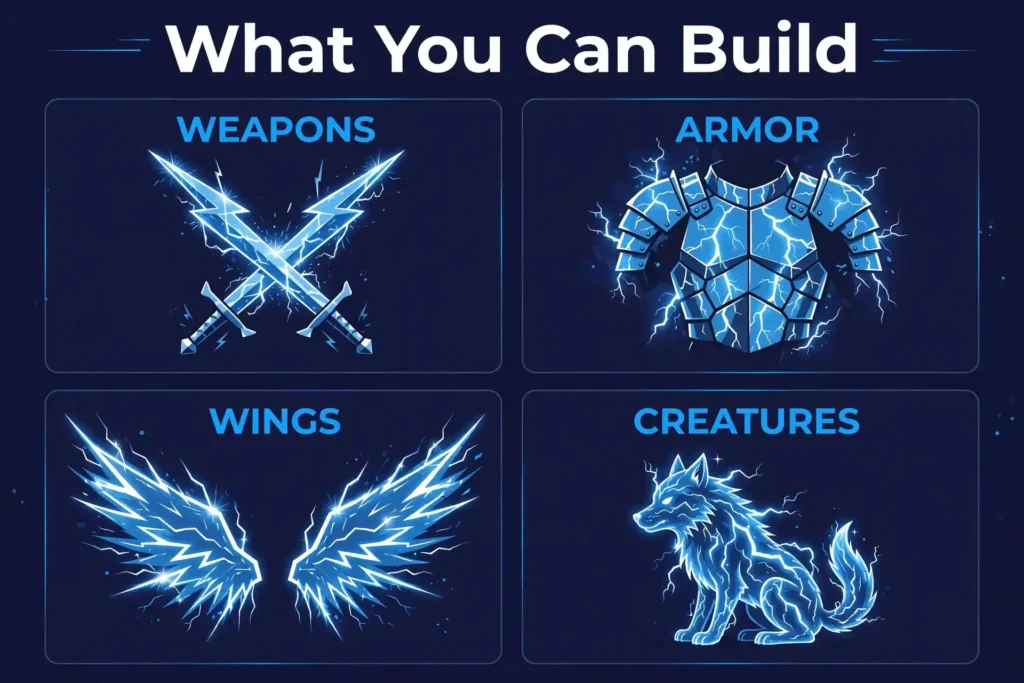
The catalog’s applications list reads like a toy box: weapons, armor, wings, creatures, barriers, tools, restraints, even vehicles. Here are the branches that matter most in stories.
Weapons of Living Lightning
The most famous constructs are weapons. Electricity Weaponry, the catalog’s name for it, is the ability to wield or create weapons with electricity, a Sub-power of Electrical Constructs (Electricity Weaponry). Users create weapons made of electricity from nothing or by shaping existing electricity, and can make virtually any weapon: Electrokinetic Blade Construction for swords, Electrokinetic Whip Generation for whips, Lightning Bow Construction for bows, Electrokinetic Polearm Construction for spears, even Electrokinetic Claws.
Fiction’s armory is deep, as depicted in each story: Sasuke Uchiha (Naruto) extends a sword of electricity with his Chidori Sharp Spear and fires electrical needle bullets with Chidori Senbon; Killer B‘s Super Vibrato Lightning Blades cut with high frequency cutting power; Ivan Vanko‘s Whiplash (Iron Man 2) swings Arc Reactor-powered electric whips; Laxus Dreyar (Fairy Tail) raises the Lightning Dragon’s Heavenward Halberd; Trafalgar Law (One Piece) wields the Radio Knife and Gamma Knife.
Armor, Wings, and Wearable Charge
Not every construct is held; some are worn. Armor Creation lets users coat themselves in living charge, like the Fourth Raikage Ay (Naruto) and his armor out of pure electricity, or Virgil Hawkins (Static Shock, DCAU), who can manipulate electricity to the form of his desire. The armor shocks attackers on contact, turning defense into punishment.
For mobility, there is Electrokinetic Wing Manifestation: the power to form electrical energy into pair of wings for Flight (masters reach High-Speed Flight), while the wings double as shields or blades through high-frequency vibrations. Even subtler, Wally West (DC Comics) uses Speed Force energy to create costume itself, proving constructs can be as everyday as clothing.
Creatures, Clones, and Guardians
The strangest branch makes constructs that move on their own. Electrokinetic Creature Creation is the power to create beings out of electricity with varying levels of detail (from simple to intricate), independence (controlled, programmed, semi-independent, or autonomous), and existence (momentary to permanent), and the user can delete the entities when done. Golem Creation and the Manifested Guardian are the classic forms: a protector that never sleeps because it was never alive.
Then there is the self, copied: Electrokinetic Cloning lets users create clones using electricity, from a single Electric Duplicate to a full army. The catalogs warn that Clones can be shorted out or nullified by another form of energy, and users may not even be able to touch their own replicas. As depicted in their stories, Larxene (Kingdom Hearts) and Kakashi Hatake (Naruto) show how shocking a copy can be.
Construct Types Compared
With so many forms, it helps to see the whole arsenal at once. The table below maps each construct family to the job it does best, with a signature user for each.
| Construct type | Best for | Example user |
|---|---|---|
| Weapons | Melee and ranged offense | Sasuke Uchiha’s Chidori blade (Naruto) |
| Armor | Personal defense that punishes contact | Fourth Raikage Ay (Naruto) |
| Wings | Flight plus aerial offense | Electrokinetic wing users (fan catalogs) |
| Creatures and clones | Autonomous fighters and decoys | Larxene’s clones (Kingdom Hearts) |
| Barriers | Holding positions and blocking | Electric Shield users (see our electric shield guide) |
| Tools and restraints | Utility, binding, and traps | Electrokinetic Web Creation users (fan catalogs) |
How Constructs Work: The Rules
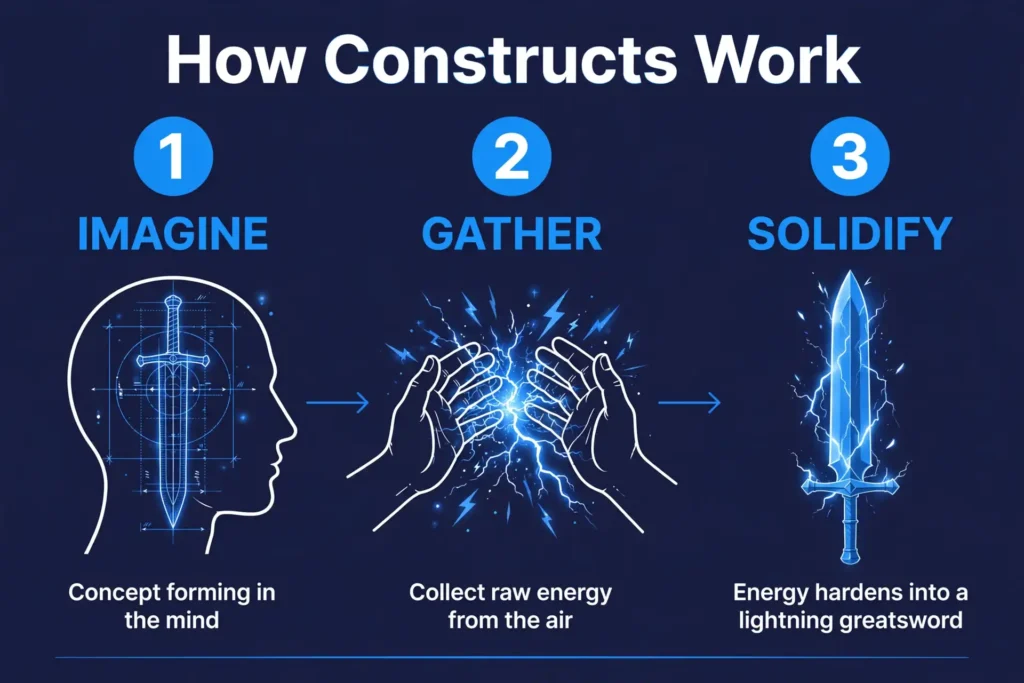
Imagination Is the Blueprint
The catalogs give a striking rule: users can generally create anything they have seen or can imagine, provided they have a good idea how it functions. That makes imagination the blueprint and general knowledge the building code: a swordsmith’s son builds better blades than a farmer because he knows how a blade works.
The same rule sets the ceiling. Constructs may be limited to certain shapes and forms or particular types of constructs, and limited complexity and detail means little to no moving parts and an inability to replicate certain properties. A construct is also unchangeable after creation in most tellings: you build it right the first time, or you build it again.
Concentration Is the Glue
Building the shape is only half the power; holding it together is the other. Constructs are difficult to create and sustain, relying on physical condition and mental condition, with concentration and willpower deciding permanence and durability. Through Electricity Solidification, raw current is forced to behave like matter, but only for as long as the mind insists.
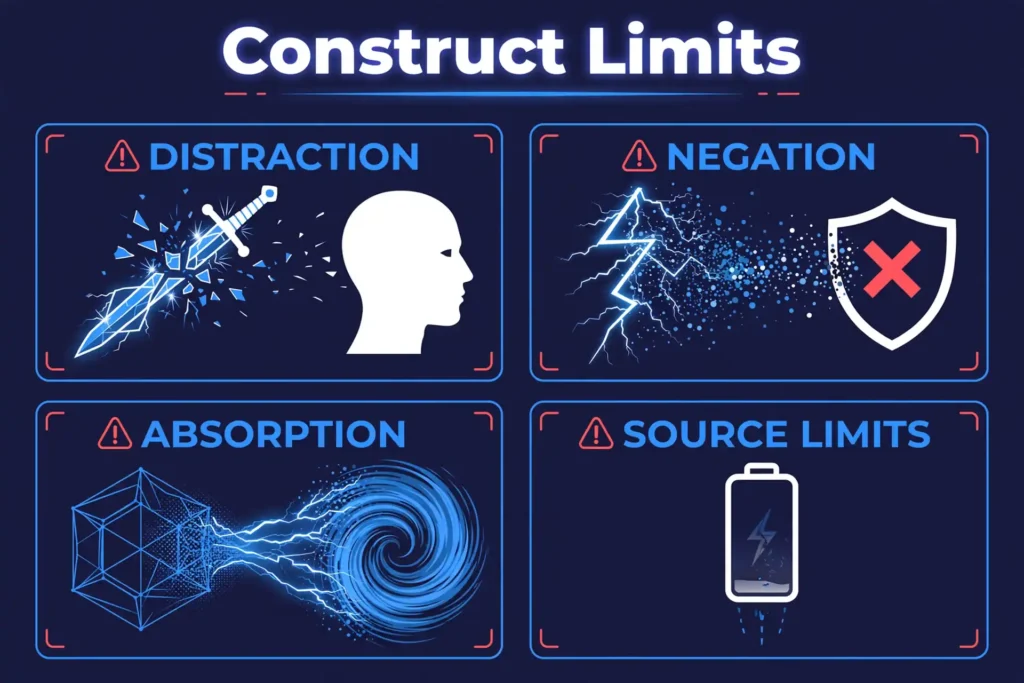
Break the focus and the form fails: constructs return to original state when the user is distracted or unconscious, leaves proximity, or loses contact and control. That is why fictional construct users are so often pictured calm in chaos: the battle is won twice, once in the mind and once on the field.
Real Physics: Can Electricity Hold a Shape?
Plasma, the Fourth State
Real science offers no lightning swords, but it offers the next best thing: plasma, the fourth state of matter, an ionized gas that is electrically conductive (Plasma). Lightning is partially ionized plasma, which means every fictional construct is, physically speaking, a shaped piece of the same stuff as a lightning bolt.
Better still, plasmas can be shaped: magnetic fields shape plasma in the real world through magnetic confinement research, making it the closest real analogue to shaping electricity into stable forms. Fiction just skips the magnets and lets willpower do the shaping.
Weaknesses and Limitations
No power is complete without its counters. Constructs are mighty but brittle: break the mind’s grip or starve the charge, and the shape dissolves.
What Breaks a Construct?
Every construct has a breaking point. The catalogs list the hard counters first: Electrical Immunity ignores them outright, and anything that negates or absorbs electricity starves the form. A user limited to manipulating already existing electricity is helpless in a dead zone, and one who may need an adequately powerful source of electricity builds paper swords in a blackout.
The softer limits are personal: building big can drain the user, damage the user, or leave the user vulnerable, and the catalogs warn constructs may not be able to overpower Transcendent Weaponry. Like every power in this family, the construct is only as strong as the charge behind it and the mind shaping it.
Famous Electrokinetic Construct Users
From anime to comics to games, these are the characters who defined the art of shaped lightning.
Icons of Shaped Lightning in Comics, Anime and Games
The icons each found a signature shape, as depicted in their stories: Sasuke Uchiha (Naruto) and his Chidori blade; Cole MacGrath (inFamous) and his Gigawatt Blades, solidified electricity given an edge; the Fourth Raikage Ay (Naruto) in armor out of pure electricity; Virgil Hawkins (Static Shock, DCAU) shaping charge into anything from beams to a heart; Wally West (DC Comics) forging gear from Speed Force energy.
The deeper cuts: Laxus Dreyar (Fairy Tail) and his halberd; Trafalgar Law (One Piece) and his Radio Knife; Ivan Vanko‘s Whiplash (MCU) and his electric whips; Skinn Bolic (D.Gray-man) with chains and armor of solidified white and purple electricity; Luck Voltia (Black Clover) and his Thunder God’s Gloves. For more electricity-themed fighters, see Thunder Breathing; for energy-shaping variety, emitter quirks and chlorokinesis.
Conclusion
Electrokinetic constructs are electricity at its most creative: not the strike but the sculpture, charge given edge, armor, wings, and guardians. The power runs on two fuels, imagination for the blueprint and concentration for the glue, which is exactly what makes it so fun towrite. Want to give the power to your own character? Try our superpower generator and see what you would build from lightning.


