
Electric Surge Superpower Explained: Bursts, Triggers & Limits
Some electricity powers are about precision. Electric surge is about the moment precision ends: the sudden spike when built-up charge releases all at once as a burst. It is the overload made visible, the grid event worn as a power. This guide, part of our Energy Powers collection, explains what an electric surge is, how it differs from discharges and electrokinesis, what triggers one, the real physics of power surges, and which famous characters embody the burst.
In this guide:
- What Is an Electric Surge?
- Electric Surge vs Discharge vs Electrokinesis
- What Triggers a Surge?
- Electric Surge Powers and Abilities
- Real Power Surges: The Physics Behind the Fiction
- Weaknesses and Limitations
- Famous Electric Surge Users
- Conclusion
What Is an Electric Surge?
The Spike, Defined
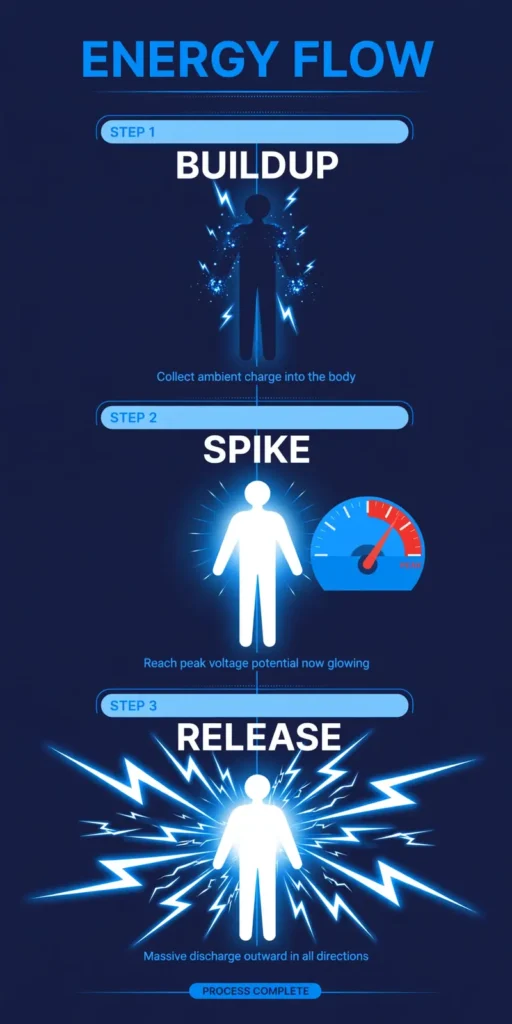
An Electric Surge is a sudden spike of electrical output: charge builds, then releases all at once as a burst. Where other electricity powers are about steady control, the surge is about the moment control breaks or is deliberately abandoned. It is the overload made visible, a high-voltage discharge that hits harder than the user normally could because every stored volt leaves in a single instant.
Think of it as the difference between pouring and dropping. A controlled zap is poured. A surge is dropped: the full container, empty in a heartbeat, often in every direction at once.
Build Up, Then Let Go
Every surge has two halves. First comes Electric Accumulation: the user gathers charge from any source, storing electricity in the body like a living capacitor. Fan catalogs call this phase Electric Build-Up, and it can be deliberate (drawing from power lines) or involuntary (absorbing ambient static).
Then comes the release. At the point of release, the user lets everything go simultaneously, and that all-at-once quality is what makes it a surge rather than a stream. The buildup can take minutes; the surge takes a fraction of a second.
Electric Surge vs Discharge vs Electrokinesis
Readers mix these up constantly, so here is the clean split. Our electric discharge guide covers the release mechanism itself: the “fire” moment, which can be a careful aimed zap or a wild blast. Electrokinesis is total command over electricity: generating, shaping, and directing current with precision. Electric Accumulation is the storing half of the story.
A surge sits at their intersection: it is a discharge defined by suddenness and scale, usually bigger than intended and harder to aim. Every surge involves a discharge, but not every discharge is a surge, and a true electrokinetic surges only when they choose to stop being careful.
The Three-Way Comparison
| Power | What it is | Trigger | Control level |
|---|---|---|---|
| Electric Surge | A sudden, large-scale burst of electricity | Overload, emotion, or deliberate release | Low to none at the moment of release |
| Electric Discharge | The release mechanism itself, any scale | User’s choice to fire | Can be fully aimed and controlled |
| Electrokinesis | Total command over electricity | Always available to the user | Complete: shape, direct, modulate |
| Electric Accumulation | Storing charge from any source | Absorption over time | High during buildup, lost at release |
What Triggers a Surge?
Emotion: The Anger Switch
Some surges do not need buildup; they need a trigger. The fan catalogs describe Super Electric Charge: intense emotions, especially extreme anger, amplify electrical output, sending currents of electricity through the body while increasing strength, speed, and raw power. The mechanism reads like a Fight or Flight Response with lightning attached.
The gallery examples are vivid, as depicted in their stories: The Flash and Wally West (DC Comics) both Super Charge lightning from their bodies when angered, Thor Odinson (Marvel Comics) vents storms of rage, and Sheev Palpatine (Star Wars) turns hatred into crackling torrents. The price is volatility: the surge ends when the feeling fades.
Overload: Too Much Charge, Nowhere to Go
The most famous surge user never chose the power at all. Noriko Ashida, codename Surge (Marvel Comics), automatically absorbs electricity from everything around her: static in the air, appliances, wall outlets. She stores electricity in her body until her energy stores are full, and then the surge comes whether she wants it or not.
Marvel’s official character page describes the result: at full charge she speaks, moves, and thinks at uncontrollable speeds, then vents everything in a destructive burst. Beast built her special metallic gauntlets, later refined by Forge, to regulate absorption and regulate discharge, turning random overloads into aimed lightning blasts. Wikipedia’s profile adds the cost: when drained completely, she grows weak and ill. Without regulation she could not touch electronics or even take a shower, which makes her the definitive story of the surge as curse.
Electric Surge Powers and Abilities
Burst Attacks: The Omnidirectional Blast
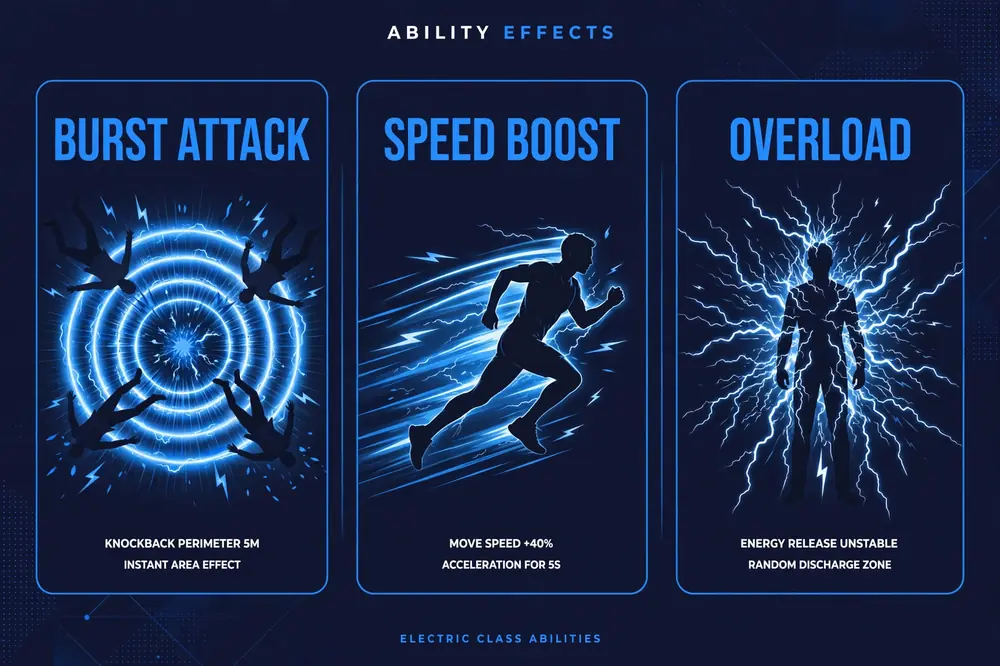
In a fight, the surge is the area-clearing move. Instead of an aimed bolt, the user detonates: Omnidirectional Electricity Waves that radiate outward, the fan-cataloged Prevalent Discharge that devastates a wide zone. Electric Pressure scales the same idea up further, generating enormous amounts of electric power to crush the surrounding area.
Games and anime love this shape. Loomian Legacy’s Power Surge zaps every surrounding opponent with a high-voltage discharge that can paralyze, and Trafalgar Law’s Counter Shock (One Piece) delivers a defibrillator-like surge straight to the chest. The pattern is consistent: no aiming required, everything nearby pays.
Surge-Enhanced Body: Speed and Strength
A surge does not have to leave the body. Channeled inward, it becomes Electrically Enhanced Condition: increasing strength and increasing speed as current floods nerves and muscle. The fan catalogs frame this as Personal Energy Amplification, the body briefly running on lightning instead of chemistry.
Surge herself demonstrates both modes, as depicted in her stories: full charge grants bursts of superhuman speed and sharpened reflexes alongside the destructive blasts. The tradeoff is always the same: the enhancement lasts exactly as long as the charge does, and the crash afterward can leave the user helpless.
Surge Types Compared
Not all surges behave alike. The trigger determines everything: how much warning the user gets, whether the burst can be aimed, and what it costs. The table below maps the four recurring patterns across fiction and games.
| Surge type | Trigger | Control | Example user |
|---|---|---|---|
| Emotional surge | Intense anger or stress | None while feeling lasts | The Flash, Wally West (DC) |
| Accumulation release | Deliberate charge buildup | High until the moment of release | Electro, Livewire (Marvel/DC) |
| Involuntary overload | Passive absorption with no outlet | None without regulators | Surge (Marvel), via gauntlets |
| Healing surge | Focused bioelectric venting | Deliberate and restorative | Bioelectric Surge (DC Universe Online) |
Real Power Surges: The Physics Behind the Fiction
Surge vs Spike: A Matter of Nanoseconds
Real electrical engineering uses the same word, and the parallel is instructive. A power surge is a sudden increase in voltage flowing through a system; engineers draw the line precisely: a voltage rise lasting at least three nanoseconds counts as a surge, while a shorter flicker of one to two nanoseconds is merely a power spike, as HowStuffWorks explains.
The damage mechanism is heat. Excess voltage drives excess current, and the great heat generated can burn up wires outright. Smaller hits are subtler: repeated surges accumulate damage over time and shorten device life, which is why surge protectors exist. Fiction’s electric surge follows the same shape at human scale: a brief, violent excess that the system was never built to carry.
What Causes a Real Surge?
Real surges come from two directions. External sources start outside the building: lightning strikes on power lines, power grid issues, utility switching, and the jolt of power restoration after power outages. Internal sources start inside: large appliances switching on and off, faulty wiring, and short circuits, as detailed in Newark’s surge protection guide.
The magnitudes are startling. Surges typically last microseconds to milliseconds but can push thousands of volts with current spikes exceeding a hundred amperes through lines built for a tenth of that. Every fictional surge user is, in effect, a walking grid event: the same physics, worn as a power.
Weaknesses and Limitations
What Can Stop an Electric Surge User?
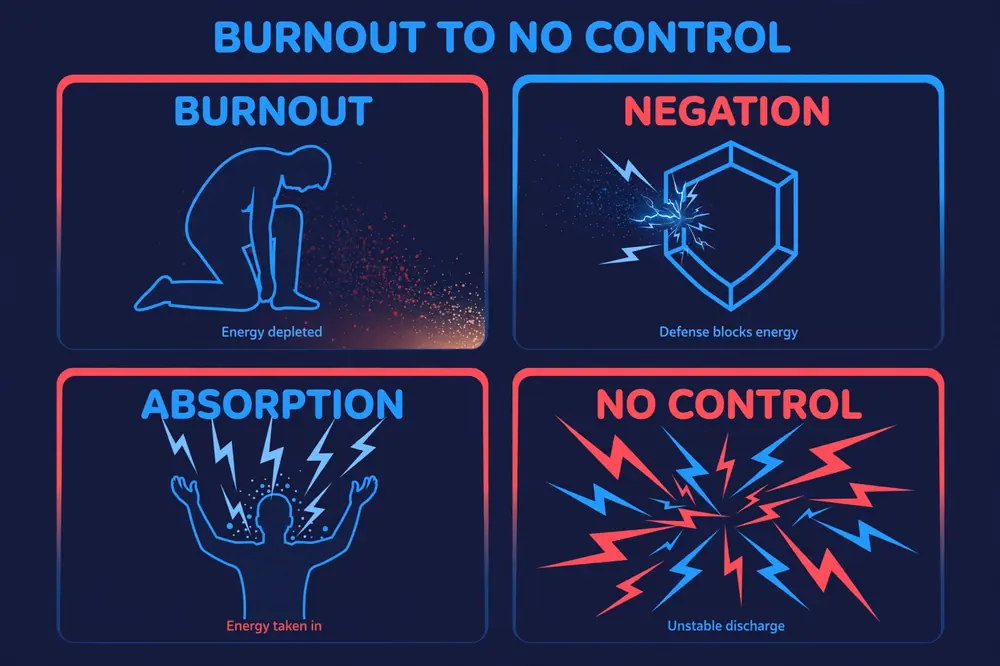
A surge is mighty but brittle. Because it is defined by excess, anything that removes the excess ends it: Electricity Negation shuts the power down outright, and Electricity Absorption can drink the surge before it lands, which the fan catalogs list as a hard counter. Grounding the user works on the same principle as a lightning rod.
The subtler limits are internal. Fan sources note the effects may be temporary, tied to the user’s emotional state or charge level, and that pushing too far can burn out the user. Surge’s own stories add the honest cost: after the burst comes the crash, and a drained user is weaker than an ordinary person. Unlike the sustained barriers in our electric shield guide or the shaped fields in our electric field manipulation guide, a surge cannot be held; it can only be spent.
Famous Electric Surge Users
Icons of the Burst in Comics, Anime and Games
The definitive surge user is Noriko Ashida, Surge (Marvel Comics): involuntary absorption, regulator gauntlets, and destructive bursts when full, as described on Marvel’s official character page. Close behind are the angered speedsters: The Flash and Wally West (DC Comics), whose Super Charge lightning erupts with their temper, and Thor Odinson (Marvel Comics), whose storms answer his fury.
The accumulation school is represented by Livewire and Electro, who stockpile charge and spend it in devastating releases, and Static (Virgil Hawkins), who learned to meter his reserves. Killua Zoldyck (Hunter x Hunter) weaponizes stored lightning with assassin precision, Laxus Dreyar (Fairy Tail) answers with devastating lightning bolts of pure pressure, and Trafalgar Law (One Piece) turns the surge surgical with his Counter Shock. For more electricity-themed fighters, see Thunder Breathing. Each, as depicted in their own universe, shows a different face of the same spike.
Conclusion
The electric surge is electricity at its most honest: no finesse, no shaping, just the spike. Whether it arrives as an angered speedster’s eruption, a mutant’s involuntary overload, or a fighter’s deliberate last resort, it runs on the same shape as a grid surge: buildup, spike, aftermath. And like a grid surge, it always costs more than it gives. Want to give the power to your own character? Try our superpower generator and see what kind of surge you would unleash.


