
Electric Field Manipulation Superpower Explained: Barriers, Senses & Limits
Some superpowers throw lightning. Electric field manipulation never touches a bolt — it shapes the invisible zone where charges push and pull, turning empty air into barriers, senses, and weapons. It is the quietest power in the electricity family and, in the right hands, the most versatile: the field is everywhere, so the battlefield is everywhere. This guide, part of our Energy Powers collection, explains what electric field manipulation can do, the real physics behind it, where it falls short, and which famous characters wield it best.
What Is Electric Field Manipulation?
Before the barriers and the sensing, the definition — and the distinctions every writer gets wrong.
Electric Field Manipulation vs Electrokinesis: What’s the Difference?
Electrokinesis is total command over electricity itself — generating current, firing bolts, draining power lines, riding lightning. Electric field manipulation — also called Electric Field Control — is narrower and stranger: the art of shaping the invisible zone of influence around charges. Power catalogs class it as a Sub-power of Electricity Manipulation, and that hierarchy tells the whole story.
The difference is scope. An electrokinetic throws lightning; a field manipulator learns to create electric fields and shape electric fields — sculpting the force that holds atoms together into walls, barriers, and sensing webs. One wields the current; the other commands the field it travels through.
Electric Field Manipulation vs Bio-Electricity vs Bio-Lightning vs Electric Discharge
Think of the Energy Powers family as four specialists. Bio-electricity is electricity that lives inside the body — the currents of the nervous system, heart, and muscles, explored in our bio-electricity guide. Bio-lightning narrows that to raw high-voltage bolt projection, and electric discharge is the instant of release itself — the spark leaving the body, as covered in our bio-lightning and electric discharge guides.
Electric field manipulation is the odd one out: instead of making or firing electricity, the user shapes the field around it — the invisible region where charges push and pull. A bio-electric user generates the charge; a field manipulator builds the arena it fights in.
How Electric Fields Work: The Real Physics
Real physics gives this power its rules — and its limits.
What Is an Electric Field?
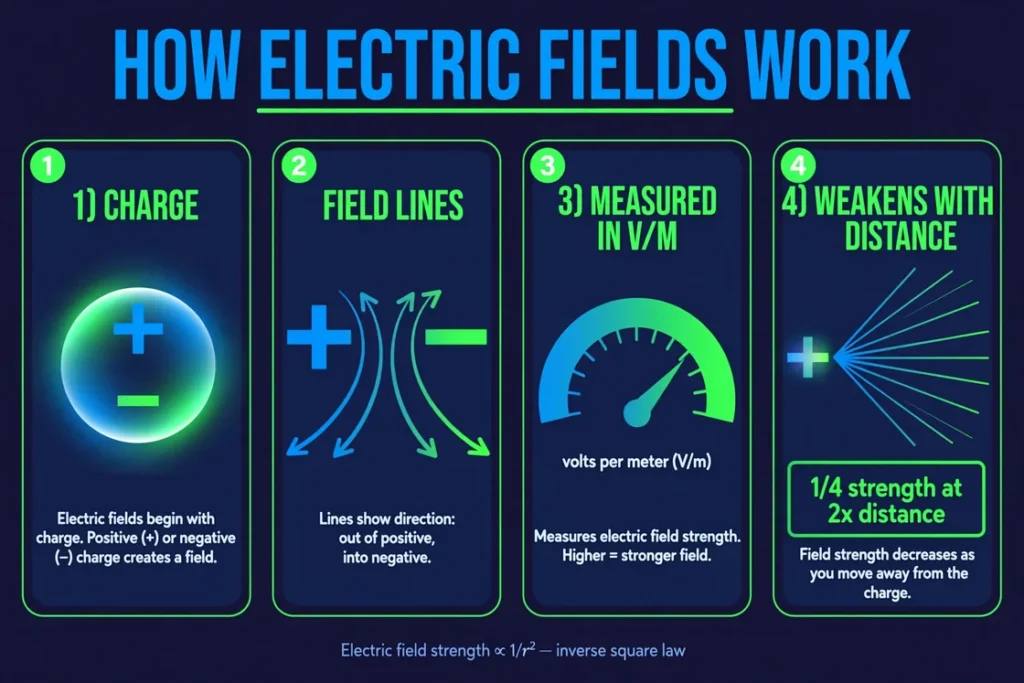
An electric field is a vector field — at every point in space it describes the force per unit charge that an infinitesimal positive test charge would feel there. Physicists measure it in volts per meter (V/m), equivalent to newtons per coulomb (N/C). The concept was introduced by Michael Faraday, who pictured the field as lines: field lines stream out of positive charges and into negative charges, and where the lines crowd closer together, the field is stronger.
Fields also fade with distance — and they fade fast. Coulomb’s law gives the rule, the inverse-square law: double the distance from a charge and the field drops to one-quarter the strength. That single law is why every field manipulator in fiction has a range limit, whether the story admits it or not.
The Faraday Cage: Why Fields Can Be Blocked
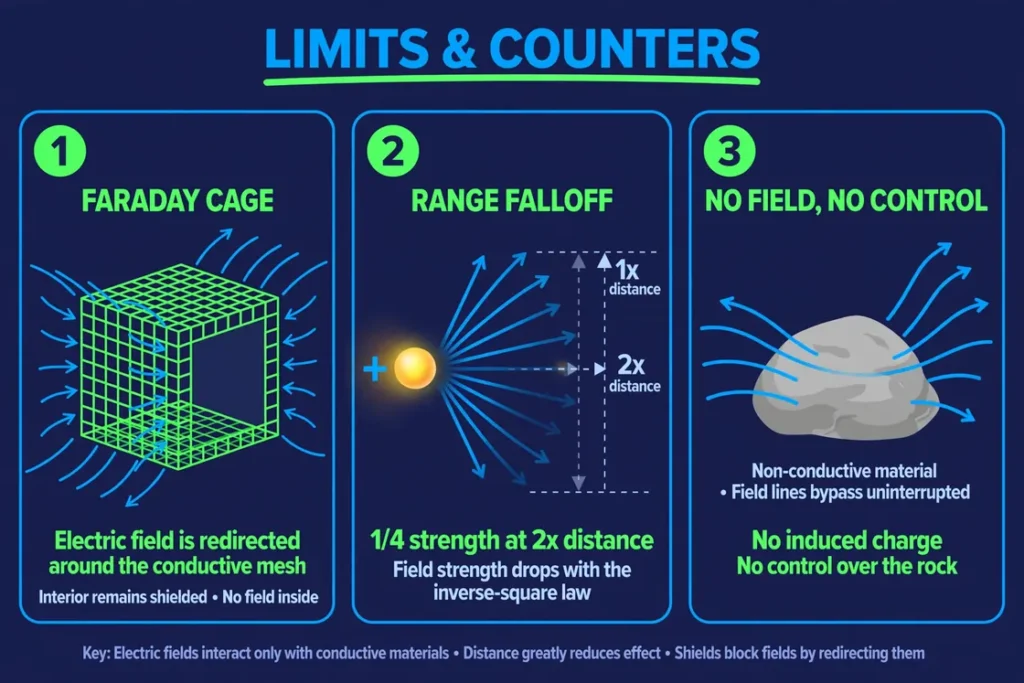
If electric fields are invisible and everywhere, what stops them? A Faraday cage — a conductive enclosure first built by Michael Faraday in 1836. When an external field hits the cage, charge rearrangement in the metal cancels the field inside, leaving the interior in electrical silence. Real cages protect electronics from interference and shield people and equipment from lightning strikes and electrostatic discharges.
That makes the cage the hard counter to this entire power: it blocks external electric fields outright. One popular claim needs a caveat — Wikipedia flags its “cage stops an EMP” line as needing citation, so treat EMP-shielding as contested rather than certain.
Electric Field Powers and Abilities
From invisible walls to field-sight, here is what shaping the field can do.
Barriers and Shields: Making the Invisible Visible
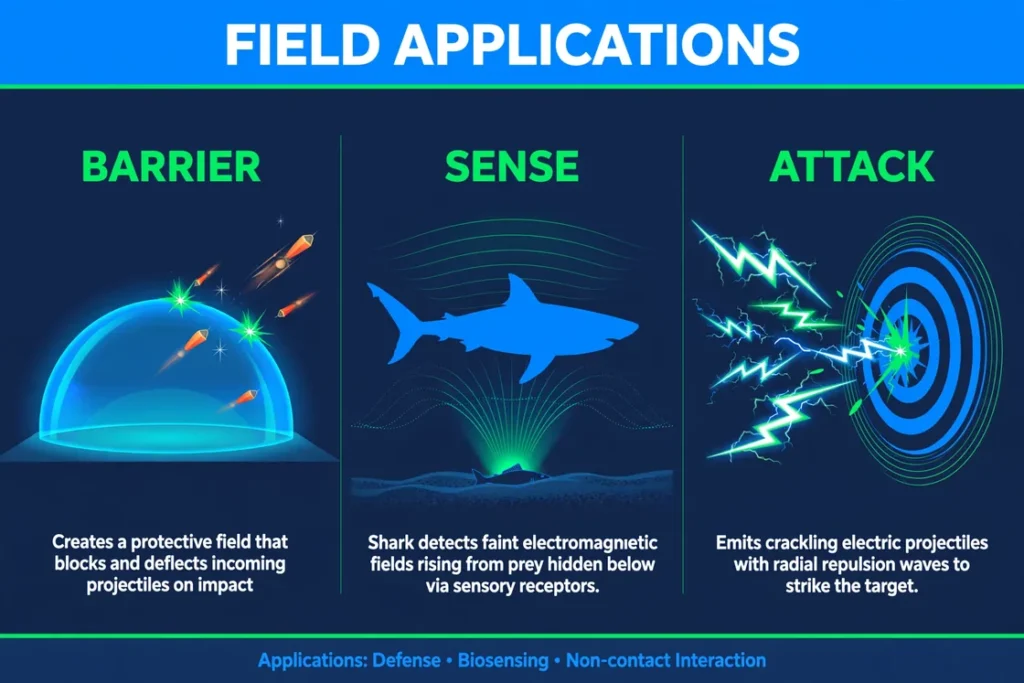
The signature move of field manipulation is defense: Force-Field Manipulation turns empty air into a wall. The user learns to generate electrical fields and field waves that harden into tangible force-fields — an Electric Aura hugging the skin, or full Electric Shield Construction thrown up to block attacks and knock away opponents. Fans call the fantasy the “big glowing purple shields” for a reason: it is the most visual use of an invisible force.
Static Shock gave the definitive image: Virgil Hawkins can make the electrical fields and auras surrounding people visible as crackling halos — as depicted in the series, per the fan-wiki gallery caption. The field made legible, beautiful, and unmistakably his.
Sensing the Invisible: Electroreception and Field Sight
Before a field can be shaped, it must be felt — and nature already does this. Sharks and rays hunt with electroreception, detecting bioelectric fields as faint as 5 nV/cm through the ampullae of Lorenzini, jelly-filled pores on their snouts. Electric eels sweep murky water with low-voltage pulses, reading the distortions for navigation and prey detection.
Fiction scales the same sense up: sensing current and sensing conductivity lets a character find concealed weapons, diagnose machines, or read electrical signals in nerves and wires — and at the extreme, Electrical Telepathy, eavesdropping on the brain’s own chatter through Electro-Psionics. The quietest application is often the most useful.
Field Attacks: Projectiles, Repulsion and EMP
Fields hit back, too. An Electric Projectile is charge hurled inside a shaped field; Attraction & Repulsion turns the field into invisible hands that shove or snare; Ionization strips electrons to carve conductive paths for Physical Lightning Manipulation. At the cruel end sits Electric Field Negation — collapsing the very field that holds matter together, a disintegration art in the fan catalogs.
Then there is the EMP: a violent field pulse that fries electronics across a wide area. It is one application among many here — a dedicated Electromagnetic Pulse guide is planned next in our Energy Powers series and will give it the full deep-dive it deserves.
Weaknesses and Limitations
No power is complete without its counters — and fields have some of the hardest.
What Can Stop an Electric Field Manipulator?
Every field has edges. First, the hard rule from the power catalogs: anything without an electric field cannot be controlled — no charge, no handle. Second, the Faraday cage, which blocks external electric fields by canceling them at its conductive skin; insulators and plain distance do the quieter work.
Third, physics taxes everything: the inverse-square law means double the distance and the field falls to one-quarter the strength, so range is always limited. And as one community analysis put it, what a user can actually do comes down to four costs — field strength, precision of control, speed of change, and range. Power without precision is just weather.
Famous Electric Field Manipulators
From comics to anime to games, these are the characters who defined the art of the field.
Icons of the Field in Comics, Anime and Games
Fiction’s field-shapers each found a signature. Virgil Hawkins — Static Shock (DCAU) — visualizes the fields and auras around people; Misaka Mikoto (A Certain Scientific Railgun) wields her Electromaster ability to observe and manipulate fields, sensing her surroundings through her AIM diffusion field. Max Dillon, alias Electro (Marvel Comics), and Storm (Marvel Comics) weaponize the sky’s charge, while Doctor Manhattan (Watchmen) is cataloged as a field negator who unmakes matter itself.
The deeper cuts: Harvest (Darker Than Black) collapses fields to destroy; Coldcast (DC Comics) wields electromagnetism on a scale that threatens even Superman, per fan catalogs; Paramount’s Sonic the Hedgehog once vented an EMP that blacked out power; and Azari (Next Avengers: Heroes of Tomorrow) raises an electrical panther shield — each as depicted in their own universe.
Conclusion
Electric field manipulation is the thinking person’s electricity power: no lightning bolts required, just the invisible architecture that lightning travels through. It runs on real physics — volts per meter, field lines, the inverse-square falloff, the Faraday cage that says “no further” — which is exactly what makes it so satisfying to write. And when the field finally surges into an electromagnetic pulse, that’s a story for our coming EMP guide. Want to give the power to your own character? Try our superpower generator and see what kind of field-shaper you’d become.


