
Electrokinetic Flight Superpower Explained: Levitation, Lightning Rides & Limits
Some superpowers burn. Electrokinetic flight lifts: the power to fly using electricity, turning charge into lift and lightning into a runway. No wings, no engines, just current defying gravity. This guide, part of our Energy Powers collection, explains what electrokinetic flight is, the five ways it works, what real physics says about it, and which famous characters fly on lightning.
In this guide:
- What Is Electrokinetic Flight?
- Electrokinetic Flight vs Other Powers
- How Electrokinetic Flight Works: Five Ways to Fly
- Real Physics: Can Electricity Lift You?
- Weaknesses and Limitations
- Famous Electrokinetic Flight Users
- Conclusion
What Is Electrokinetic Flight?
The Flying Power, Defined
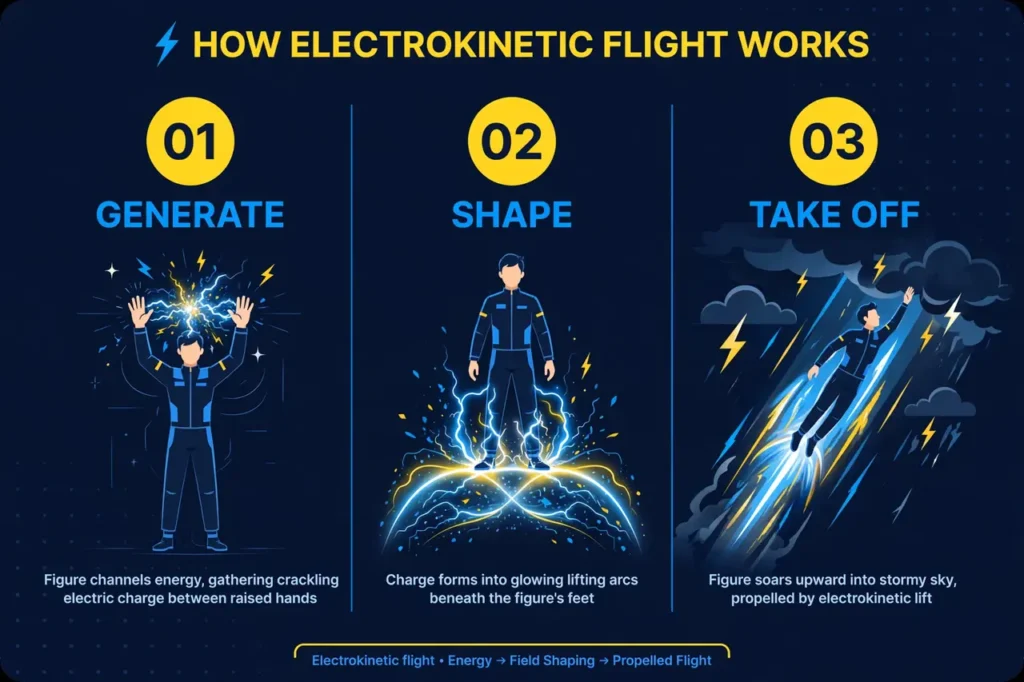
Electrokinetic Flight is the power to fly using electricity: the user generates or gathers charge and turns it into lift, thrust, or both. The fan catalogs file it as a Sub-power of Electricity Manipulation, and its simplest form is levitate using electricity, rising and hovering unassisted in open defiance of gravity (Gravity Defiance).
Unlike wings or jets, there is no visible engine. The flyer might arc current beneath their feet, wrap themselves in a crackling aura, or simply will themselves upward on a cushion of charge. Speeds vary by telling, from a slow hover to varying speeds that rival aircraft, but the signature is always the same: no wings, no rotors, just lightning doing the lifting.
Electrokinetic Flight vs Electrokinesis: What’s the Difference?
Electrokinesis is total command over electricity: generating it, shaping it, directing it, sensing it. Electrokinetic Flight is one application of that command, the branch devoted entirely to getting airborne. Every electrokinetic flyer is doing electrokinesis, but not every electrokinetic ever leaves the ground.
The distinction matters for storytelling. An electrokinetic might hurl bolts, drain power lines, or read machines; a flight specialist spends the same power budget on lift and thrust. Flight is the end goal, and everything else the character can do with electricity is secondary to staying in the sky.
Electrokinetic Flight vs Other Powers
Readers meet seven electricity specialists across our guides: bio-electricity, bio-lightning, electric discharge, electric field manipulation, electric shield, electric surge, and electrokinetic constructs. Flight is the traveler of the family: where the others fire, burst, shield, sense, or build, the flyer simply leaves.
The Family Comparison
| Power | What it does | How electrokinetic flight differs |
|---|---|---|
| Electrokinetic Flight | Flies using electricity | The baseline: airborne by charge alone |
| Electrokinetic Surfing | Rides pillars, slides, and bolts of shaped electricity | Riding constructs; the ride is the power, flight is incidental |
| Electrical Transportation | Travels through wires and circuits as living current | Moves through conduits; not open-air flight |
| Electromagnetic Flight | Flies using electromagnetism | Magnetism-based lift; a cousin, not a twin |
| Electrokinetic Wings | Flies on wings of shaped lightning | Winged flight; covered in our electrokinetic constructs guide |
| Generic Flight | Flies by any means at all | Any method works; electricity is optional |
How Electrokinetic Flight Works: Five Ways to Fly
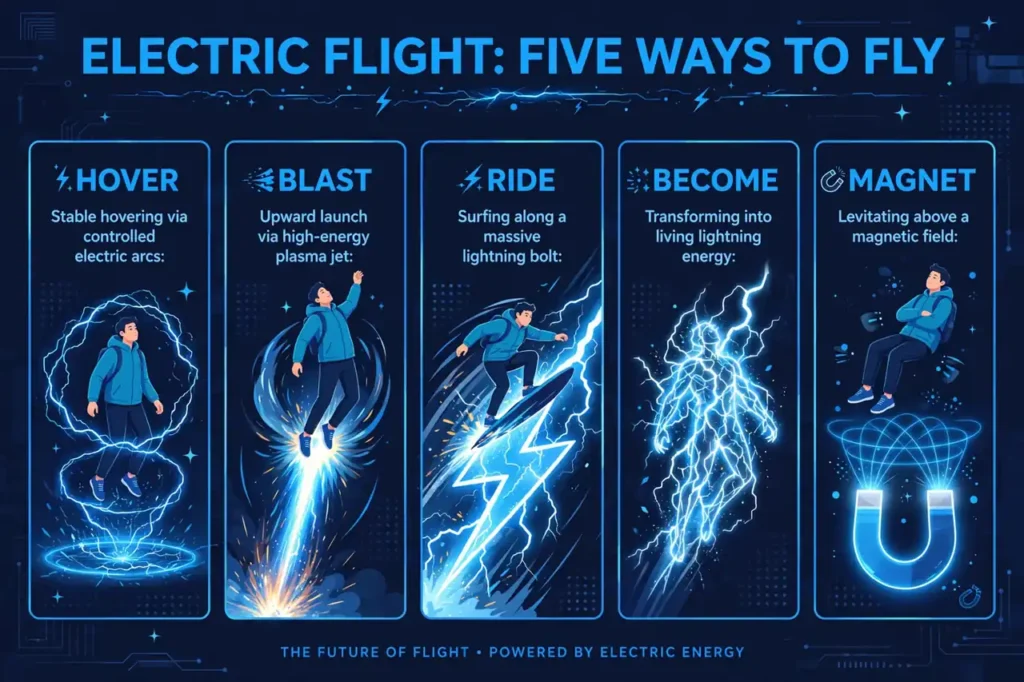
The catalogs describe five distinct mechanisms, and they feel nothing alike in a story. The table below maps each method to its signature user, and the sections after it unpack how each one flies.
Five Ways to Fly
| Method | How it works | Example user |
|---|---|---|
| Levitation | Arcing electricity underneath the body, or magnetic generation, holds the user aloft | Misaka Mikoto (Railgun), ionizing water molecules with electrons |
| Propulsion | A burst or continuous jet of energy fired downward | Ergokinetic flyers (fan catalogs) |
| Riding lightning | Shaping a pillar, slide, or bolt and riding it | Laxus Dreyar (Fairy Tail), Cole MacGrath (inFamous) |
| Becoming lightning | Transforming into living current and traveling as electricity | Enel (One Piece), Living Lightning (Marvel) |
| Magnetic lift | Manipulating electromagnetism to fly, glide, and levitate | Magneto (Marvel), Static (DCAU) |
Levitation: Hovering on Arcs
Electrical Levitation is the quietest form of electric flight: the user levitates using electricity by arcing electricity underneath themselves, creating a crackling cushion that holds them hovering unassisted. No forward motion is required; the trick is simply refusing to fall. The catalogs file it as a Technique of Electrokinetic Flight, also called Arc Levitation, Electrokinetic Levitation, or Lightning Levitation (Electrical Levitation).
As depicted in A Certain Scientific Railgun, Misaka Mikoto achieves it by ionizing water molecules with electrons, a neat trick that turns ambient moisture into lift. Like all flight in the family, it is weak against Flight Negation and Electrical Absorption: ground the charge or drink it, and the hover ends.
Propulsion: Riding the Blast
Energy Propulsion turns the flyer into their own rocket: emitting a burst of energy into the ground that sends them flying into the air, or sustaining a continuous stream (or pulsating jet) for powered flight. The catalogs file it as a Sub-power of Energy Manipulation and a Variation of Jet Propulsion.
The same shelf holds the Ergokinetic Flight style: an aura of energy that levitates the user, or a beam of energy to the ground for thrust. The price is fuel: users may require an outside source of elements to keep blasting, and like all energy flight it is weak against Flight Negation and Energy Negation. No charge, no climb.
Riding Lightning
Electrokinetic Surfing is the showiest way to fly: the user shapes electricity into a pillar, slide, or bolt and rides it. The catalogs call it Electric Surfing, Lightning Surfing, or Electro-Surfing, a Sub-power of Electricity Manipulation that trades free flight for style and speed (Electrokinetic Surfing).
The signature moves are vivid: creating a lightning bolt to ride on, riding a wave of electricity for Enhanced Speed, or skating across a storm without board or skates. As depicted in their stories, Laxus Dreyar (Fairy Tail) and Cole MacGrath (inFamous) ride lightning into battle. The catch: the rider must generate electricity or draw it from other sources, and staying aloft means staying close to the charge.
Becoming Lightning
The most extreme method skips vehicles entirely: the user stops being a passenger and becomes electricity itself. Through Electrical Transportation (Electroportation), the flyer travels by riding the flow of electrons or transforming into living current, moving at the speed of the charge itself.
As depicted in One Piece, Enel uses the Rumble-Rumble Fruit (Goro Goro no Mi) to transform into lightning and levitate; Miguel Santos, Marvel’s Living Lightning, takes a pure electrical energy form capable of sub-light speed flight. The catalogs warn of the cost: difficulty controlling the intense speed of electricity, and starting and arrival points may be damaged by the passage. Arriving as lightning means landing like it too.
Magnetic Lift
Electromagnetic Flight flies on a different force: manipulating electromagnetism to fly, glide, and levitate. Filed as a Sub-power of Electromagnetism Manipulation and a Variation of Elemental Flight, it covers everything from High-Speed Flight to Enhanced Gliding, Air Dashing, and Surface Hanging (Electromagnetic Flight).
Its icons are magnetism specialists first: Max Eisenhardt (Magneto) and Lorna Dane (Polaris) of Marvel Comics bend magnetic fields into flight, while Virgil Hawkins (Static, DCAU) rides electromagnetic force with characteristic style. It is weak against Flight Negation like every flight power, but it needs no storm: any magnetic field will do.
Real Physics: Can Electricity Lift You?
Ion Thrusters: Real Electric Propulsion
Real science offers a genuine, working version of electric flight: the ion thruster (ion drive, ion engine), a form of electric propulsion for spacecraft propulsion that creates thrust by accelerating ions with electricity (Ion thruster). A cloud of positive ions is made from neutral gas (usually xenon, an inert gas); electrostatic grids accelerate the ions via the Coulomb force, and a neutralizer reinjects electrons so the exhaust stays neutral.
The numbers are real and humbling: 1 to 7 kW of power, exhaust velocities of 20 to 50 km/s, but only 25 to 250 millinewtons of thrust. Deep Space 1 changed velocity by 4.3 km/s on 73.4 kg of xenon; Dawn managed 11.5 km/s on 425 kg. Electricity truly can push a spacecraft; it just pushes very, very gently.
Why You Cannot Fly on Lightning
Here is the honest physics: no device lets a person fly on lightning in atmosphere. An ion thruster’s 25 to 250 millinewtons would not lift a paperback book, let alone a human, and it only works in airless space where there is no drag to fight.
The deeper problem is Newton’s third law: to rise, you must push something down, and lightning has no mass to throw downward. Add the catalogs’ own warnings, the difficulty of controlling the intense speed of electricity and the need to constantly generate electricity or draw it from other sources, and the verdict is clear: electric flight is a glorious fiction, and the fiction is the point.
Weaknesses and Limitations
No power is complete without its counters. Electric flight is spectacular but fragile: cut the charge, and the sky lets go.
What Grounds an Electrokinetic Flyer?
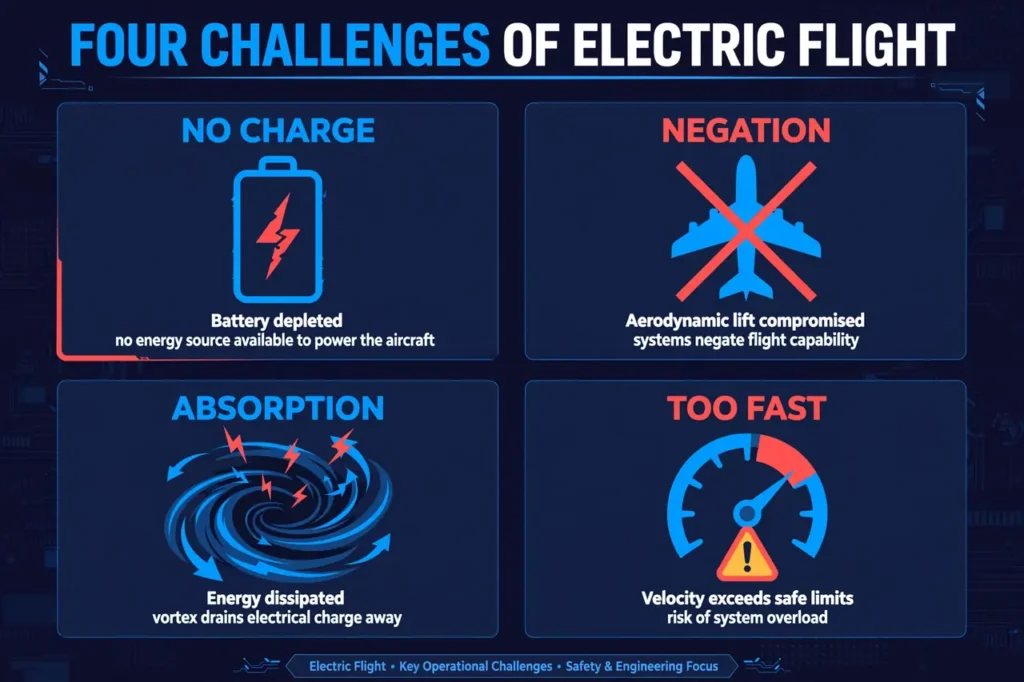
Every flyer has a ceiling, literal or otherwise. The catalogs list the hard counters first: Flight Negation ends any flight power outright, Electrical Absorption drinks the charge midair, and Energy Negation starves propulsion-style flyers. A flyer who must generate electricity or draw it from other sources is grounded in a dead zone with nothing to draw on.
Softer limits finish the job: difficulty controlling the intense speed of electricity turns high velocity into a hazard, and for transportation-style flyers the starting and arrival points may be damaged by the passage. Even the sky has rules, and electricity obeys all of them.
Famous Electrokinetic Flight Users
From anime to comics to games, these are the characters who defined the art of flying on lightning.
Icons of Electric Flight in Comics, Anime and Games
The icons each found a signature way to fly, as depicted in their stories: Virgil Hawkins (Static Shock, DCAU) surfs on shaped electricity; Cole MacGrath (inFamous) rides lightning currents into battle; Jefferson Pierce (Black Lightning, DC Comics) takes to the sky on raw charge; Laxus Dreyar (Fairy Tail) rides lightning like a storm given legs.
The deeper cuts: Enel (One Piece) becomes lightning itself through the Rumble-Rumble Fruit; Misaka Mikoto (Railgun) levitates on ionized electrons; Maxwell Dillon (Electro, Marvel) and Livewire (DC) ride their own arcs; Jay Walker (Ninjago) flies on lightning in battle; Miguel Santos (Living Lightning, Marvel) crosses skies at sub-light speed in energy form. For lightning-fast fighting styles see Thunder Breathing; for technology that mimics flight, ODM gear techniques; for flight by other energies, God Ki abilities; and for the perils of thin air, Atmospheric Adaptation.
Conclusion
Electrokinetic flight is electricity at its most liberating: not the strike but the soaring, charge turned into lift. Whether it arrives as a quiet hover, a lightning ride, or a transformation into living current, the power runs on one fantasy, that lightning could carry you. Want to give the power to your own character? Try our superpower generator and see how high your charge takes you.


