
Eco-Teleportation Superpower Explained: The Green Network
Some powers move the body through space. Eco-teleportation moves it through the living world: the power to merge with nature, ride its hidden web, and emerge anywhere the green reaches. It is the quietest road in fiction: no flash, no portal, just a step into a tree and a step out of another. Fan catalogs know it as Ecoportation, a way of traveling that treats the forest as infrastructure, and a few of its users have made it iconic by the way they ride it: Keyleth through the trees she knows, Azuma through the trees of Fairy Tail’s world, and White Zetsu through roots and water veins. This guide, part of our Transformation collection, explains what eco-teleportation is, the three moves that power it, what it can do, the real science of the wood wide web, and which famous characters embody the network traveler. For the site’s plant powers, see our Chlorokinesis guide.
In this guide:
- What Is Eco-Teleportation?
- Eco-Teleportation vs Other Powers
- What Can Eco-Teleportation Do? Applications
- Real Science: The Wood Wide Web
- Weaknesses and Limitations
- Famous Eco-Teleporters in Fiction
- Conclusion
What Is Eco-Teleportation?
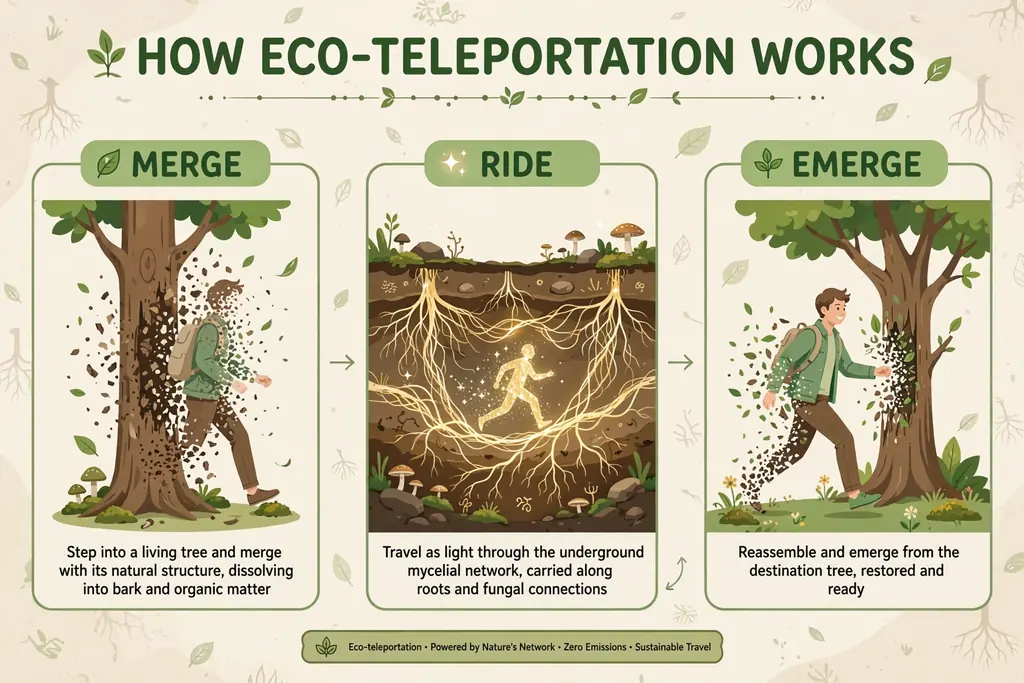
Other travel powers blink through empty space. Eco-teleportation travels through the living world: by merging with nature, riding its web, and emerging elsewhere, the user turns the forest into a road. The requirement is strict and simple: the traveler must be in or touching nature, because the medium is the message. A concrete wall has no doors for this power, but a single familiar tree has one. The sections below define the power, then map its three moves.
The Green Network, Defined
An eco-teleportation user is a network traveler: someone who teleports via nature by merging into nature and appearing anywhere else from the same. The fan catalogs file the power as Nature Teleportation, also called Ecoportation or Ecokinetic Teleportation, a Technique of Nature Manipulation and a Variation of Sympathetic Teleportation. Its plant-angled cousin is Plant Teleportation, also called Chloroportation or Botanical Teleportation, a Technique of Plant Manipulation and a Variation of Organic Teleportation. It is not merely Teleportation (instant relocation with no medium) and not plant control; the green is the road, not the cargo.
Merge, Ride, Emerge: The Three Moves
Every eco-teleportation runs the same three moves. First, MERGE: the user merges into element, stepping into a tree the way Keyleth uses trees as a magical portal, or sinking through moss the way Hakea does. Second, RIDE: the traveler moves through the living web, the way Azuma travels through trees or White Zetsu uses Mayfly to move through roots and the water vein network. Third, EMERGE: the user appears elsewhere from the same element, emerging from tree like a Dryad, or arriving in a flurry of flower petals like La Muerte.
Eco-Teleportation vs Other Powers
The site’s Avian Teleportation guide covers the flock scatter, and our Chlorokinesis guide covers plant control. Eco-teleportation is the network traveler: the body itself rides the green. Where plant teleportation is limited to plants alone, and organic teleportation covers any organic substance, eco-teleportation sits at the sweet spot of the natural world: the living network of nature. The table below places it against its closest neighbors.
The Family Comparison
| Power | What it does | How Eco-Teleportation differs |
|---|---|---|
| Eco-Teleportation | Teleports via nature: merge, ride, emerge | The baseline: the green network traveler |
| Teleportation | Instant relocation with no medium | The blink: instant anywhere, but no nature, no network |
| Plant Teleportation | Teleport via plants only (Plant Teleportation) | The narrow version: plants only, not the whole of nature |
| Avian Teleportation | Scatters into a flock, flies, reforms | The flock: travels as birds above, not as roots below |
| Organic Teleportation | Teleport via organic substances | The wider family: any organic matter, not just the living green |
What Can Eco-Teleportation Do? Applications
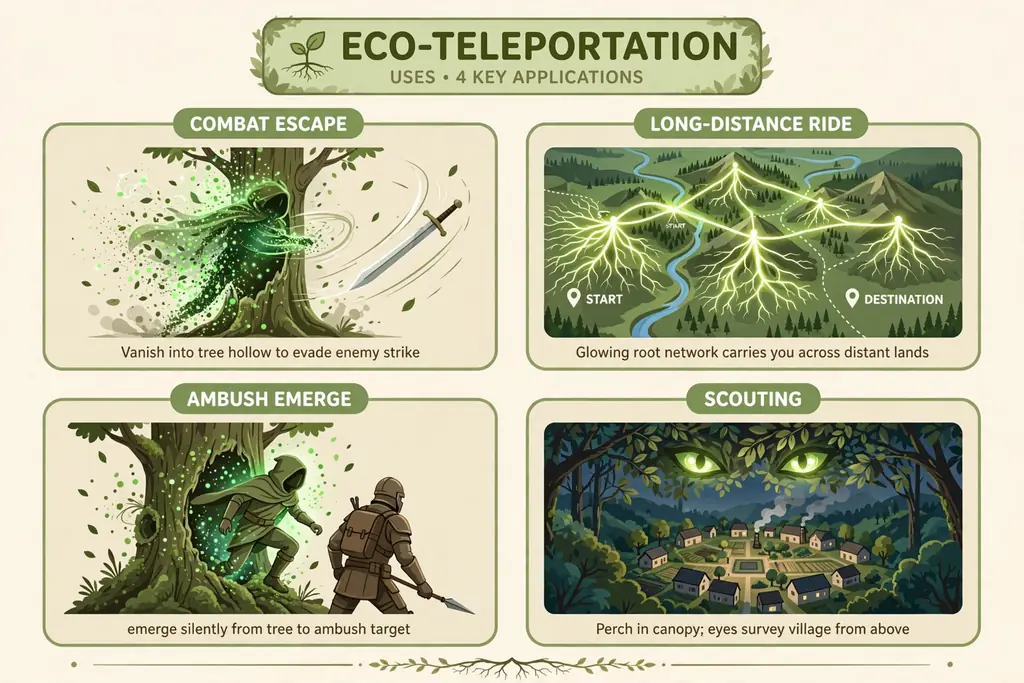
The applications flow from the three moves: merge to vanish, ride to travel, emerge to arrive. Because the journey runs through living tissue rather than empty space, the traveler gains something the blink can never give: cover, information, and range that scales with the forest itself.
Merge: Step In and Vanish
Merge is the vanishing act. The user steps into a tree, sinks into moss, or dissolves into flora, and the forest closes behind them. Keyleth shows the rule that governs it: the portal works best with trees she knows, so familiar anchors beat strange ones. In combat the merge is a dodge with roots: the blow lands where a person stood, and the person is already merging into organic substance.
Ride: The Living Web
Once merged, the user must ride the green between here and there. Azuma can merge with the trees and travel through them to any area where there is trees; White Zetsu travels the roots and water vein network of the organic ground. The ride is real travel through living tissue, which means the traveler’s range is the network’s range: where the mycorrhizal network runs unbroken, the traveler runs with it. Unlike Electrokinetic Flight, which rides the sky, this ride runs underground.
Emerge: Step Out Anywhere
Emerge is the arrival: the user steps out of a tree, a flower, or a drift of petals at the destination, whole and unscathed. Meg McCaffrey, daughter of Demeter, teleports using plants; Alex does it by using a flower. A skilled emerge is an ambush or a rescue, and the namesake flourish belongs to Jak, whose Eco Teleport hops short distances, slips through windows, and can even bypass forcefields, as depicted in the game.
Real Science: The Wood Wide Web
Fiction gives the traveler a living network. Science shows the network is real, just slower. The two meet underground, where mycorrhizal fungi have wired forests into a single communicating system for 450 million years. If the power existed, this is the road it would take.
The Forest Internet
The science starts underground. Mycorrhizal networks of underground fungal networks link tree roots into living webs: scientists estimate 80 percent of trees in a forest are connected, and 90 percent of land plant species form these partnerships. Hyphae carry electrical signals at about 0.5 millimeters per second when neighbors are stressed, plus chemical warnings, in a symbiosis some 450 million years old. The fictional ride is this Wood Wide Web with a traveler on it (mycorrhizal network).
Mother Trees and Kin
The network has hubs. Suzanne Simard‘s 1997 work with radioactive isotopes showed Douglas fir and paper birch exchanging carbon underground, and large mother trees feeding seedlings 100 feet away. Kin recognition steers 30 to 40 percent more resources to relatives, and the forest behaves as a cooperative community, a forest superorganism sharing nutrients, water, and warnings. For the traveler, hubs are doors: the oldest tree in the wood is the best exit.
The Network’s Toolkit
Every network, real or fictional, runs on the same hardware. The table below maps it.
| Network feature | Real-world basis | Fictional use |
|---|---|---|
| Mycorrhizal web | 80 percent of forest trees connected | The ride itself: the road the traveler takes |
| Electrical signaling | Hyphal pulses at 0.5 mm/s under stress | Sensing through the network while riding |
| Mother-tree hubs | Nutrient routing to seedlings 100 feet away | Known-tree anchors, the best doors |
| Kin recognition | 30 to 40 percent more resources to relatives | The network favoring its traveler |
Weaknesses and Limitations
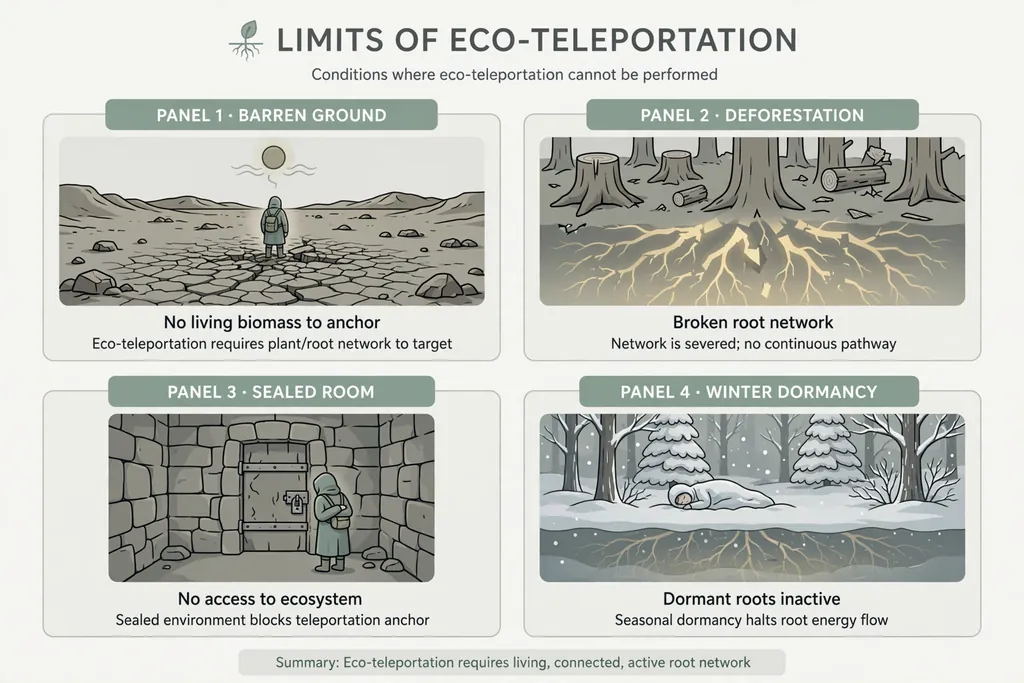
No power is complete without its counters. The network is mighty but rooted: cut the green, and the traveler is stranded. Every weakness on this list flows from the same root truth: the road only runs where nature grows, and anything that harms the living world harms the traveler too.
What Can Stop an Eco-Teleporter?
The catalogs’ hard counters come first: the user must be in nature and touching nature, and Plant Teleportation can only teleport through plants, so barren ground, deserts, paved cities, and vacuum strand the traveler. Deforestation and fire break the living webs; winter dormancy slows them. Sealed rooms with no plant matter are walls, and the Keyleth rule holds: unknown trees may refuse the merge. Direct counters include defoliants, salted earth, and Nature Negation. For more ways to humble a powerhouse, try our random weakness generator.
Famous Eco-Teleporters in Fiction
From anime to games to tabletop to myth, these are the characters who defined the art of the green road. Some ride trees, some ride roots, and one rides petals, but each of them shows a different face of the same three moves.
Icons of the Green Network in Games, Anime, Film, and Myth
Keyleth (Critical Role/The Legend of Vox Machina) is the textbook user: trees as a magical portal, but only if she knows the tree, as depicted in the series. Azuma (Fairy Tail) merges with the trees to travel; White Zetsu (Naruto) rides Mayfly through roots; La Muerte (The Book of Life) arrives in flower petals; Meg McCaffrey (Trials of Apollo) teleports as a daughter of Demeter; the Dryad (AD&D) steps out of bark; Nymphs (Charmed) slip through the wild; and Jak (Jak and Daxter) hops with Eco Teleport, as depicted in each universe. For nature-themed quirk ideas, see emitter quirk ideas; for more power variety, god ki abilities.
Conclusion
Eco-teleportation is travel at its most rooted: not the blink or the portal, but the merge, the ride, and the emerge. It trades the freedom of instant relocation for the wisdom of the network: vanish into the green, travel its web, and step out where the forest lets you. Whether it arrives as Keyleth’s tree portal, Azuma’s forest road, or Jak’s eco hop, it runs on the same three moves: merge, ride, emerge. Want to give the power to your own character? Try our superpower generator and see where your green road would take you.


