
Cyborg Enhance Superpower Explained: The Upgrade
What Is Cyborg Enhance?
Every other tech power borrows machines. Cyborg enhance becomes the machine. The user rebuilds the body with technology, part by part, until the person is the upgrade: a cybernetically augmented body that is stronger, sharper, and stranger than the flesh it replaced. The framework of this guide is THE UPGRADE: restore what is broken, enhance what works, and integrate until the machine is the body. This is the second post of our Technology-based collection, after our Nano-tech guide; where nano-tech commands a swarm of machines, cyborg enhance rebuilds the self into one.
In this guide:
- What Is Cyborg Enhance?
- Cyborg Enhance vs Other Powers
- What Can Cyborg Enhance Do? Applications
- Real Science: The Cyborg Is Already Here
- Weaknesses and Limitations
- Famous Cyborgs in Fiction
- Conclusion
The Upgrade, Defined
A cyborg enhance user is a self-rebuilder: someone with the power to gain a technologically enhanced body, the way powerlisting files Cybernetic Enhancement, also called Cybernetic Augmentation or Bionic Enhancement. The filing sits under Bionic Physiology and Technorganic Physiology as a variation of Artificially Enhanced Physiology: the user’s bodily structure has been augmented by technology, through cybernetic implants and mechanical body parts, granting a variety of abilities. It is the opposite of Bio-Augmentation (which grows the body stronger through biology) and is not Technology Augmentation (which upgrades machines, not people). It is not a gadget power (one device, one trick); the body IS the device.
Restore, Enhance, Integrate: The Three Moves
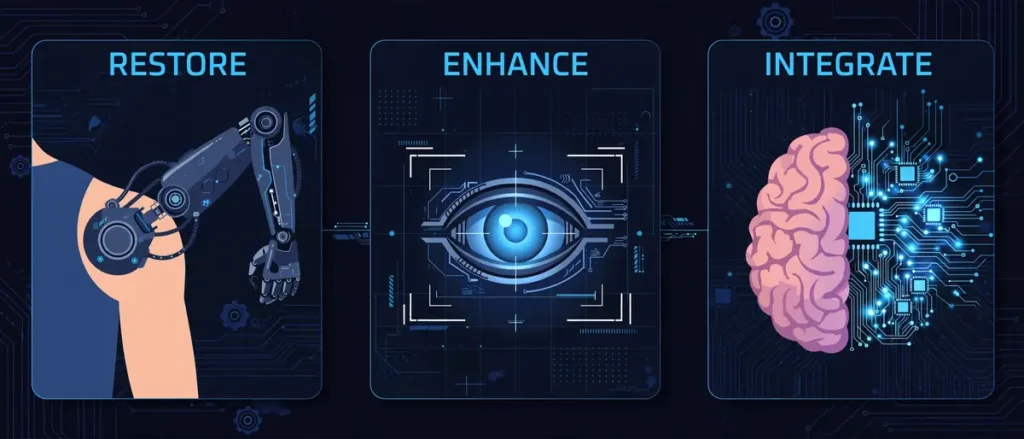
Every cyborg enhance runs three moves. First, RESTORE: replace what is broken. Robotic body parts stand in for lost limbs, a cybernetic spine replaces a shattered one, and electronic eyes restore sight; the way Khalil Payne‘s metal spinal cord gave him back his walk after Tobias Whale’s bullet left him paraplegic. Second, ENHANCE: push past human limits. Cybernetic strength, cybernetic speed, and cybernetic stamina stack on the frame, electronic eyes add augmented reality vision with a heads-up display, and an augmented brain runs an internal computer. Third, INTEGRATE: the machine becomes the body. The cyber mind interfaces with external computers, the user self-modifies and discovers new abilities, and the upgrade keeps upgrading.
Cyborg Enhance vs Other Powers
Tech powers blur together in fan discussions: is a rebuilt body the same as a swarm of machines, a hack, or a robot? The upgrade, the swarm, the hacker, the android, and the clone are five different tools, and this section separates them. For the sibling power, see our Nano-tech guide; for the classic off-switch that fries them all, see our Electromagnetic Pulse guide.
The Family Comparison
| Power | What it does | What it cannot do | How cyborg enhance differs |
|---|---|---|---|
| Cyborg Enhance | Rebuilds the body with technology: restore, enhance, integrate | Work without a body to upgrade; beat an EMP | This is the home row: the upgrade itself |
| Cybernetic Enhancement | The canonical filing: gain a technologically enhanced body (Cybernetic Enhancement) | Defined more broadly than any single technique | The filing is the umbrella; cyborg enhance is the street name |
| Nano-Tech | Commands a micro-army of nanites | Become the machine itself | The swarm is commanded; the upgrade is worn |
| Technopathy | Communicates with and controls machines | Rebuild the user’s own body | The hacker borrows machines; the upgrade becomes one |
| Android / Robot | A fully artificial being | Start as a living organism | The android is built; the cyborg was born and then rebuilt |
| Bio-Augmentation | Grows the body stronger through biology | Add machine parts | Biology is grown; the upgrade is installed |
What Can Cyborg Enhance Do? Applications
The applications flow from the three moves: restore returns the broken, enhance arms the willing, and integrate crowns the machine-born. The same upgrade serves the soldier, the survivor, and the scientist, which is why the power shows up in so many different stories.
Restore: Limbs, Spine, Senses
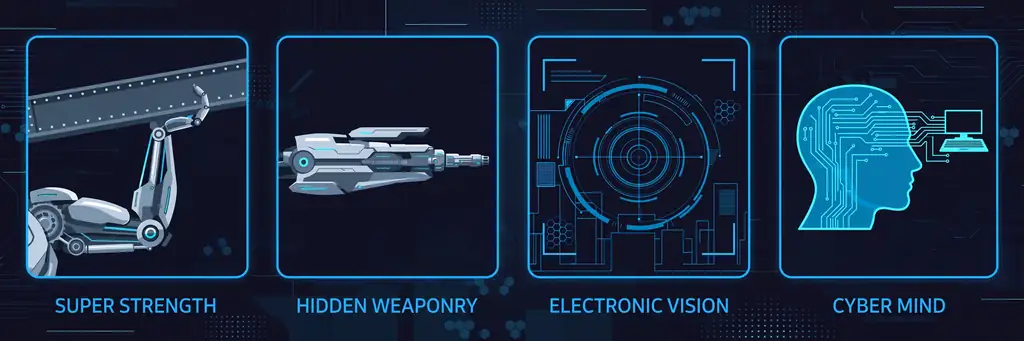
Restore is the power’s humblest and most human face. The classic is the limb: Genos (One-Punch Man) fights with incredibly sophisticated bionic body parts like his arms, and Franky (One Piece) carries super sophisticated bionic body parts with weaponry built in. The spine is the miracle case: Khalil Payne‘s makeshift metal spinal cord turned a paraplegic back into a walker, as depicted in the series. Senses come back too: electronic eyes replicate vision at a superhuman level, and in the real world cochlear implants restore hearing through the same feedback loop the fictional upgrades use. Restoration is where the upgrade starts, because every cyborg was a person first.
Enhance: Strength, Speed, Senses, Mind
Enhance is where restoration becomes ambition. Cybernetic strength, cybernetic speed, and cybernetic stamina are the big three: Cyborg‘s enhancements grant him superhuman strength, endurance, and durability, and Brixton Lore (Hobbs and Shaw) runs on cybernetic enhancements of the same kind, as depicted in each universe. Senses get the sci-fi treatment: electronic eyes with augmented reality vision and a heads-up display put “important information, directions, and class notes” in the field of view, exactly the upgrade Gizmodo readers were wishing for. The mind goes last: an augmented brain with an internal computer, the way Cyborg’s IQ of 170 pairs with systems that interface with external computers. And weapons hide everywhere: Metallo‘s metal body, Vash the Stampede‘s hidden gun in his cybernetic left arm, Franky‘s artillery arms, and Cyborg’s sound amplifier, which can stun foes or deliver blasts “potent enough to shatter rock and deform steel.”
Integrate: The Machine Becomes You
Integrate is the point of no return, where the upgrade stops being worn and starts being the self. The cyber mind is the signature: a computer-like consciousness that interfaces with external computers, hacks and commands technology by thought. The real seed is already planted: Neuralink‘s first patient controlled a computer cursor with his thoughts in 2024, the fictional version of the same feedback loop. Then comes self-modification: Cyborg is “consistently depicted as making adjustments to his cybernetic parts, enhancing his functions and abilities,” discovering new powers like flight and boom tubes as the story needs them. At the high end, the body becomes a living extension of the machine: Mother Box-born cybernetics add EMP blasts, technology absorption, and underwater adaptation, as depicted in the comics.
The Upgrade Toolkit
| Upgrade | What it does | Who embodies it |
|---|---|---|
| Cybernetic strength | Superhuman strength, speed, stamina, durability | Cyborg (DC): Promethium body |
| Hidden weaponry | Guns, blades, and artillery built into the body | Metallo (DC): metal body; Franky (One Piece): artillery arms |
| Electronic eyes + HUD | Superhuman vision with augmented reality overlay | Cyborg (DC): electronic eye |
| Spinal restore | Metal spine returns the ability to walk | Khalil Payne (Arrowverse): spinal implant |
| Cyber mind | Interface with and command computers by thought | Cyborg (DC): internal computer system |
| Full-body rebuild | The dead rebuilt as a cyborg law enforcer | RoboCop (1987): Alex Murphy revived by OCP |
Real Science: The Cyborg Is Already Here
Fiction gives the user a new body. Science has been installing the first upgrades since 1960. The two meet at the feedback loop: the wire that listens back.
A Word Coined for Space
The story starts with a word. In 1960, Manfred Clynes and Nathan S. Kline coined cyborg, a portmanteau of cybernetic and organism, while planning how to technologically enhance humans for space travel. Their definition still rules: a living organism that has undergone restoration of function or enhancement of abilities through artificial components that rely on feedback. Unlike bionics, biorobotics, or androids, a cyborg starts as an organism and gains technology. And the original purpose was almost tender: with homeostatic systems handling “robot-like problems… automatically and unconsciously,” man would be left “free to explore, to create, to think, and to feel.” (Cyborg)
The First Real Cyborgs
The first real cyborgs are already walking around. Neil Harbisson, born color-blind, has an antenna implanted in his skull that perceives colors beyond the normal human spectrum: he can hear infrared and ultraviolet, and after winning the right to appear with the antenna in his passport photo he became the world’s first legally recognized cyborg. Moon Ribas developed the Seismic Sense, a sensor that vibrates when there is an earthquake, and after removing it she felt like a “phantom cyborg.” Then came the brain: Neuralink implanted its first patient, Noland Arbaugh, in January 2024, and within weeks he was controlling a computer cursor with his thoughts, browsing the internet, and playing chess online, describing it as using “the Force.” The N1 chip is coin-sized with 64 extremely fine electrode threads woven into the brain by a surgical robot; some threads later shifted, and software updates recovered much of the performance. Even the quiet implants count: pacemakers and cochlear implants combine mechanical modification with a feedback response, which is the textbook definition. The fictional upgrade is this hardware with the gain turned up.
Weaknesses and Limitations
The upgrade has a maintenance schedule, and the machine half has appetites the flesh half does not. Every entry on this list is a way the rebuild fails, gets hijacked, or costs the user more than the flesh it replaced.
What Can Stop a Cyborg?
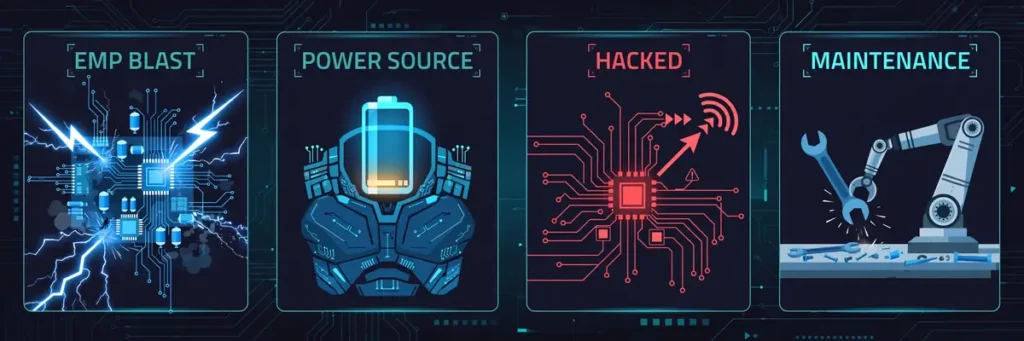
The catalog-style counters come first: EMPs and similar effects fry cybernetics, so an electromagnetic pulse is the classic off-switch; the user may require a power source to use the enhancements; extended use may strain the body; and despite the cybernetic body, the user can still be harmed or demolished by certain means. Then the hijack risk: cybernetics are susceptible to hacking, and a stolen body turns on its owner. Then the dependency: the user relies on the tech that rebuilt them, and parts need maintenance. Finally the identity question: Scientific American’s brain drain warns that replacing too much of the brain with microchips could end the self, RoboCop wrestles with the lingering fragments of his humanity, and Metallo‘s kryptonite heart, the source of his power, is also his greatest weakness. For more ways to humble a powerhouse, try our random weakness generator.
Famous Cyborgs in Fiction
From comics to film to anime, these are the characters who defined the upgrade. Some were rebuilt to save a life, some to win a war, and one to sell a product, but each of them shows a different face of the same three moves.
Icons of the Upgrade in Comics, Film, Anime, and Games
Cyborg / Victor Stone (DC) is the textbook user, as depicted in the comics: a Mother Box explosion destroyed most of his body, and his father rebuilt him with alien technology into a living extension of the machine, a Promethium body (depleted Promethium of titanium and vanadium) granting superhuman strength, speed, stamina, and flight, an electronic eye, a sound amplifier, EMP blasts, technology absorption, underwater adaptation, and boom tubes, with an IQ of 170. RoboCop / Alex Murphy (1987) is the tragic version: murdered by a gang, revived by OCP as a cyborg law enforcer, fighting crime while coming to terms with the lingering fragments of his humanity. Metallo / John Corben (DC) is the villain’s upgrade: a brain in a metal robot body powered by kryptonite, able to absorb other metals and change size and shape. General Grievous (Star Wars) fights from a cybernetic body; Alita (Alita: Battle Angel) wakes in one; Franky (One Piece) arms his with artillery; Genos (One-Punch Man) rebuilds his around his mission; Khalil Payne (Arrowverse) walks again on a metal spine with a paralysis venom; Brixton Lore (Hobbs and Shaw) runs on cybernetic speed enhancements; and Android 17 and Android 18 (Dragon Ball) are the Red Ribbon cyborgs. For the Dragon Ball side of machine-enhanced fighters, see our God KI Abilities guide; for Bleach’s mad scientist of tech, try the Bleach Hollow Powers Maker.
Conclusion
Cyborg enhance is the upgrade: restore what is broken, enhance what works, and integrate until the machine is the body. It is the most personal power in fiction, because the machine is not a tool the hero carries but the body the hero lives in. Whether it arrives as Cyborg’s Mother Box rebuild, RoboCop’s second life, or Khalil Payne’s new spine, it runs on the same three moves: restore, enhance, integrate. Want to give the upgrade to your own character? Try our superpower generator and see what your machine half would become.


