
Nature’s Fury Superpower Explained: The Cataclysm
When the sky breaks open and the ground splits in the same hour, someone stopped holding back. Nature’s Fury is the superpower of unleashing nature’s violent extremes as overwhelming force: hurricanes, earthquakes, floods, and volcanic eruptions, summoned and aimed by a single will. Catalogs file the mechanics under Disaster Manipulation, also called Calamity Control or Marvellokinesis. This guide follows THE CATACLYSM framework: SUMMON the disaster, UNLEASH it, EMBODY it. This is the sixth post of our Elemental Manipulation collection, and the first of a two-post pair: its sibling, Nature’s Wrath, takes the opposite lane, deliberate retribution instead of raw outburst.
In this guide: What Is Nature’s Fury? | Nature’s Fury vs Nature’s Wrath | What Can Nature’s Fury Do? Applications | Real Science: Measuring the Fury | Myths of the Cataclysm | Weaknesses and Limitations | Famous Nature’s Fury Users in Fiction | Conclusion | FAQs
What Is Nature’s Fury?
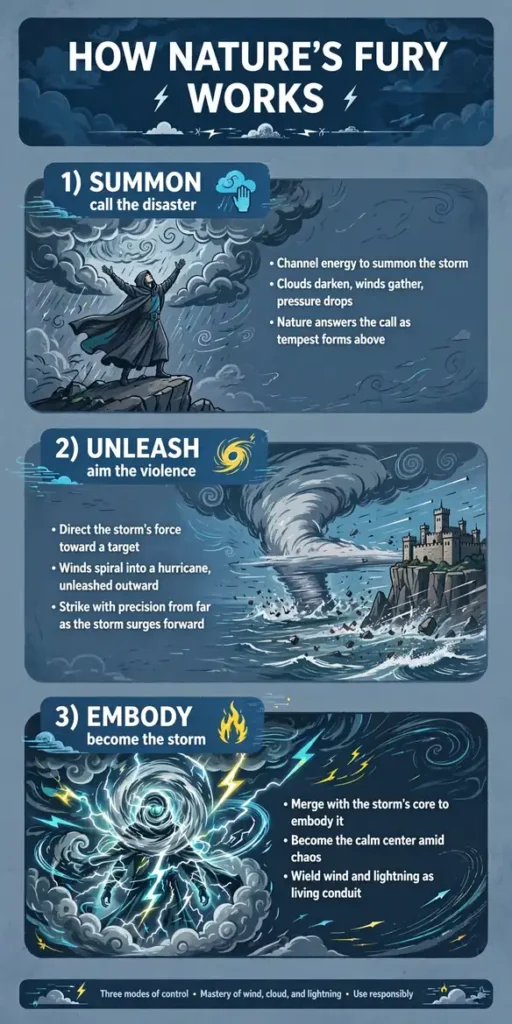
Forget precision strikes and surgical powers. The fury-bearer fights with the planet’s own violence, borrowed at full volume. It is the loudest of the elemental powers and the least discriminating, because the “element” here is not a handful of rock or a gust of wind but the cataclysm itself. The framework of this guide is THE CATACLYSM: three modes (summon, unleash, embody) that every version of the power plays in some combination.
The Cataclysm, Defined
Nature’s Fury is the superpower of unleashing nature’s violent extremes as overwhelming force: the moment the sky breaks, the ground splits, and the sea rises, all through one will. Catalogs file the mechanics under Disaster Manipulation, also called Calamity Control, Natural Disaster Control, or Marvellokinesis: the power to create, shape, and control all forms of disasters. Where Nature Manipulation in general covers the whole web of life, the fury is its violent edge: not the garden, but the cataclysm.
It is the difference between holding weather and becoming it. A fury-bearer does not negotiate with the storm; the storm is what happens when they stop holding back. The filing is blunt about the scale: earthquakes that shatter landscapes, hurricanes that ravage coastlines, volcanic eruptions that reshape the land, and floods that engulf entire regions. This guide follows THE CATACLYSM framework, and it keeps one rule in view: the fury has no moral compass, which is exactly what separates it from its sibling power, Nature’s Wrath.
Summon, Unleash, Embody: The Three Modes
Every Nature’s Fury runs three modes. First, SUMMON: the user calls the disaster into being, coaxing pressure systems, fault lines, and magma chambers toward violence. Second, UNLEASH: the user aims the violence, pointing the hurricane at a fleet or the tremor at a fortress, which is where aim matters more than raw strength. Third, EMBODY: the user becomes the storm, a living tempest wreathed in wind and lightning, and often the only thing standing calmly at the center of the ruin.
The three modes explain why the power feels different at different scales. Summon is the patient mode, the gathering dark on the horizon. Unleash is the weapon, the strike that topples cities. Embody is the terror: the figure walking out of the hurricane’s eye, stronger, faster, and more durable for the rage that feeds them, the way fan write-ups describe fury-bearers empowered by a righteous cause and fanatical belief. Calm the bearer, and the storm starves.
Nature’s Fury vs Nature’s Wrath
The two names sound like synonyms, and even fan catalogs mix them up, but they are opposite powers. One is force without judgment; the other is judgment with force. If you came here unsure which one you meant, the table below settles it, and each guide links to the other so you can compare.
The Fury-Wrath Comparison
| Aspect | Nature’s Fury (this guide) | Nature’s Wrath (sibling guide) |
|---|---|---|
| Core idea | Raw catastrophic outburst: nature’s violent extremes unleashed | Deliberate ecological retribution: nature as judge and punisher |
| Moral stance | Indiscriminate; neither benign nor malignant, it simply advances and destroys | Selective; targets polluters and transgressors, spares the innocent |
| Instruments | Storms, quakes, floods, eruptions: the disaster arsenal | Poisoned flora, vengeful fauna, the Green passing sentence |
| Emotional fuel | Rage and conviction; the bearer grows stronger the angrier they get | The land’s wound; the power answers despoilment, not temper |
| Fiction anchors | Storm (Marvel), Aquaman’s storm-casting, the Harpies, Pompeii | Poison Ivy, Godzilla (2014), Swamp Thing, dryads |
| Real-world spine | The Saffir-Simpson hurricane scale | The Gaia’s Vengeance trope lineage |
What Can Nature’s Fury Do? Applications
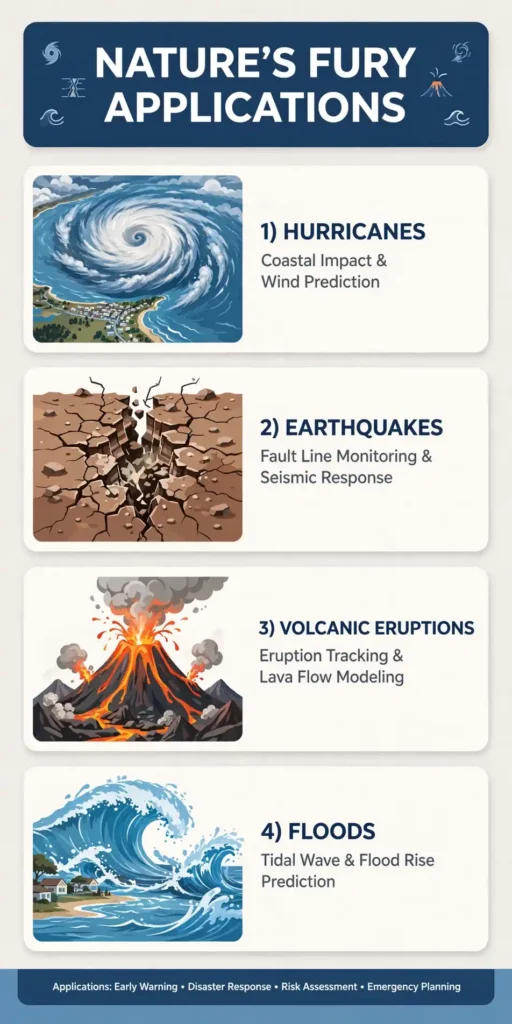
The applications flow from the three modes. Summon gathers the violence, unleash aims it, and embody wears it. Together they make the fury-bearer a one-person natural disaster, which is both the power’s promise and its problem: there is no version of this power that stays small.
Summon: Call the Disaster
The summon mode is where Nature’s Fury begins: not with the blast, but with the invitation. The user reads the sky and the soil the way a conductor reads a score, then calls the disaster forward. Catalogs list the vocabulary: Hurricane Creation, Tornado Creation, Thunderstorm Creation, Storm Generation, Earthquake Generation, Eruption Inducement, Flood Creation, Tidal Wave Generation, Avalanche Creation, Blizzard Creation, and Drought Creation. Each is a different instrument, and the summoner picks the one the landscape is already humming. Reading the sky first is half the art, which is why storm-sense and this power pair so naturally with our Weather Forecasting guide.
This is also the mode that separates masters from novices. A novice summons a storm over a desert and gets rain that evaporates before it lands. A master summons it over warm water and a low-pressure trough and gets a monster. The power respects physics even when it cheats it, which is why the fury feels so much more real than a generic energy blast: every disaster it calls has a genuine shape, drawn from the planet’s own repertoire.
Unleash: Aim the Violence
Unleash is the strike. Where summon gathers the violence, unleash aims it, and that is the only thing that makes Nature’s Fury a weapon instead of a weather report. A summoned hurricane is a hazard; an unleashed one is steered at the enemy fleet, its eye guided like a lens. A summoned quake rattles dishes; an unleashed one finds the fault under the fortress wall, the ground-shaking lane our Earth Manipulation guide covers in full. The filing’s language turns military here: disasters become devastating forces wielded with intent, and the difference between accident and artillery is the bearer’s will.
The honest cost of this mode is precision. A hurricane does not do surgical strikes, and a flood does not check identifications at the door. The more violence the bearer unleashes, the wider the ruin spreads, which is why fury-bearers in fiction so often stand alone in the wreckage they made. Unleash is the mode that wins the battle and loses the argument about whether it was worth it.
Embody: Become the Storm
Embody is the power’s signature image: the bearer stops directing the disaster and becomes it. Wind wraps their body, lightning crawls across their skin, and the storm moves where they move. Fan catalogs of the concept keep returning to the same mechanic: the bearer grows stronger, faster, and more durable with rage, fed by a righteous cause or a fanatical belief, and goes weaker if calm. The Superpower Fanon filing says it plainer: the earth itself responds to one’s emotions and desires, skies turning stormy when the bearer is angry. For the lightning-riding side of this mode, see our Lightning Rod guide.
This is also the mode with the strangest defense. A fury-bearer in full embody does not dodge the hurricane; they are the reason the hurricane is there. Lightning does not strike them because the lightning is theirs. But the state is a bargain: the longer the bearer wears the storm, the harder it is to take off, and more than one fictional tempest has forgotten where the storm ended and they began.
The Cataclysm Toolkit
| Disaster | What it does | Anchor |
|---|---|---|
| Hurricane Creation | Ravages coastlines with sustained superstorm winds | Aquaman’s storm-casting with the Trident of Neptune, as depicted |
| Tornado Creation | Rips a narrow corridor of ruin through anything standing | Storm (Marvel Comics), as depicted |
| Thunderstorm Creation | Drowns the battlefield in lightning and flash floods | Storm (Marvel Comics), as depicted |
| Earthquake Generation | Shatters landscapes along fault lines | Disaster Manipulation filing: earthquakes that shatter landscapes |
| Eruption Inducement | Wakes volcanoes; reshapes the land in lava | Disaster Manipulation filing: eruptions that reshape the land |
| Flood Creation | Engulfs entire regions under rising water | Disaster Manipulation filing: floods that engulf entire regions |
| Tidal Wave Generation | Hurls the sea itself at the shore | Aquaman as Avatar of the Blue, as depicted |
| Blizzard Creation | Buries armies under snow and killing cold | Disaster Manipulation filing application |
| Drought Creation | Starves the land of rain for seasons | Disaster Manipulation filing application |
| Avalanche Creation | Sends the mountain down on everything below | Disaster Manipulation filing application |
Real Science: Measuring the Fury
The power is fantasy, but the disasters are real, and they come with measuring sticks. That is what makes the fury feel heavier than a generic blast power: every reader already knows, in their bones, what a Category 5 means.
The Saffir-Simpson Scale and the Fury Scale
Real hurricanes come with a rating system attached, and it gives Nature’s Fury a vocabulary no other superpower post on this site uses. The Saffir-Simpson Hurricane Wind Scale, developed in the early 1970s by engineer Herbert Saffir and meteorologist Robert Simpson, sorts hurricanes into five categories by 1-minute maximum sustained winds. Category 1 starts at 74 mph; Category 5 begins at 157 mph (252 km/h), winds that peel roofs, snap grids, and redraw coastlines.
Borrow that ladder and the fury becomes legible. A novice fury-bearer is a tropical storm with a temper. A master is a walking Category 5, the fury scale made flesh. It is a useful fiction precisely because the science is real: readers already know, in their bones, what those numbers mean.
The Disaster Arsenal, Cataloged
Beyond the hurricane ladder, the filing catalogs the full armory, and it is worth reading straight: Avalanche Creation, Blizzard Creation, Drought Creation, Earthquake Generation, Eruption Inducement, Flood Creation, Hurricane Creation, Storm Generation, Thunderstorm Creation, Tidal Wave Generation, Tornado Creation, and Whirlpool Generation. Each entry is a natural phenomenon the planet already performs; the fury-bearer just conducts the orchestra.
Notice what the list excludes. There is no mind control, no plant army, no magnetic field. The fury is the planet’s violence, not its mind and not its life. That boundary is what keeps the power distinct from its neighbors on this site, and it is why the applications section never reaches for a vine or a compass.
Myths of the Cataclysm
Every culture that lived under a violent sky invented the fury-bearer first. The myths below are the power’s oldest character sheets, and they still describe the three modes better than most modern write-ups.
Harpies and the Storm Gods
Long before comics, the Mediterranean had a name for the fury: the Greek Harpies, who represent the chaotic and unpredictable forces of nature and symbolize the destructive power of storms and winds, a reminder of humanity’s vulnerability in the face of nature’s fury. They were not villains with a plan; they were the storm with a face, which is the oldest version of the embody mode.
The sea gods worked the same beat. Poseidon’s tempests in the Odyssey turn the ocean into a weapon aimed at one man, the mythic ancestor of every unleash mode. The pattern is always the same: mortals offend, the sky darkens, and the bill comes due in wind and water. Three thousand years later, the comic-book tempest-bearer is still playing the same role, just with better lighting.
Pompeii and the Angry Sea
If the Harpies are the sky’s fury, Pompeii is the earth’s. The eruption of Mount Vesuvius stands in Roman memory as a powerful reminder of nature’s might, a city erased in a day by a mountain that had been quiet for centuries. No villain monologued; the ground simply decided. That is the summon mode at its most honest: the disaster was always loaded, and something pulled the trigger.
The sea answers the same way. Neptune’s wrath in the Aeneid shows a god steadying or smashing fleets on a whim, and the lesson the Romans drew was ritual and respect, not control. Every fury-bearer inherits that lesson whether they want it or not: the power is borrowed from forces that were violent long before anyone learned to aim them.
Weaknesses and Limitations
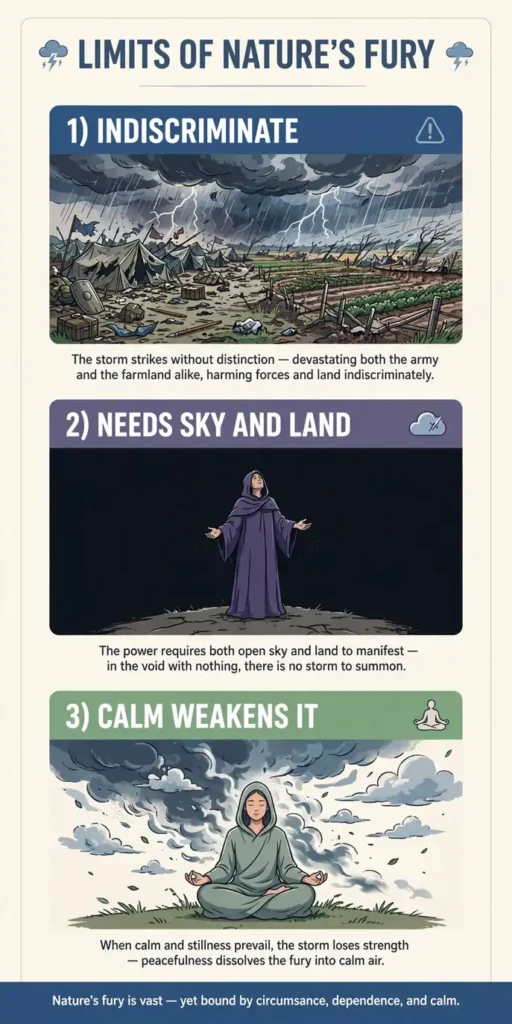
Every power needs its counters, and the cataclysm has honest ones. They fall into three groups: the fury cannot aim, it needs a stage, and it runs on the bearer’s own emotional fuel.
What Can Stop a Fury-Bearer?
Three things check the cataclysm. First, its own indiscriminate nature: a hurricane aimed at an army still drowns the farmland behind it, so the bearer fights alone or not at all. Second, the power needs a stage: no atmosphere, no storm; no fault line, no quake; a fury-bearer marooned in a void or a dead calm is just a person shouting at the sky.
Third, and strangest, is the bearer’s own heart. The fan write-ups agree: the fury feeds on rage and fanatical belief and goes weaker if calm. Talk the bearer down, break their conviction, and the storm starves. If the matchup still looks bad, a quick visit to a random weakness generator beats standing in the open. The cataclysm is mighty, but it is honest: it tells you exactly what it needs, and what it needs is fury.
Famous Nature’s Fury Users in Fiction
The filing names the disasters, but fiction names the faces. Two tempest-bearers define the power so clearly that they lead every telling, and one mislabeled fan page proves why this guide’s split from Nature’s Wrath matters.
Storm, Aquaman, and the Tempest-Bearers
Fiction’s favorite fury-bearers are the ones who made weather a personality. Storm of Marvel Comics, Ororo Munroe, is the standard: the white-haired rain goddess who controls the weather, lightning, wind, rain, the works, described as perhaps the strongest weather elemental in her universe, able to accurately direct lightning at her opponents and ride the wind. She is summon, unleash, and embody in one character, often pictured calm at the center of a storm she is feeling rather than forcing.
The seas answer with Aquaman, who with the Trident of Neptune can manipulate the atmosphere to cast mighty storms and hurricanes, and as Avatar of the Blue channels a multiversal elemental force through all water in existence. Both are presented as depicted in their own universes, with no cross-continuity claims. They prove the concept’s range: the fury can wear a hero’s calm or a king’s command, and the storm obeys either way.
The Fan Catalog That Proved the Point
Here is the confusion that proves the split this guide is built on. A fan catalog’s “Nature’s Wrath” describes its subject this way: “It is not a benign or malignant force, nor righteous or cruel. It simply advances and destroys.” That is not wrath. Wrath judges; this thing does not. Its listed powers, Magma Manipulation, Earthquake Manipulation, Plant Manipulation, Earth Manipulation, are catastrophic, not judicial.
The page is useful precisely because it is mislabeled: it shows how easily the two concepts blur, and why this site keeps them in separate lanes. When the force simply advances and destroys, call it what it is: Nature’s Fury. When it picks its targets and passes sentence, that is the sibling post, Nature’s Wrath.
Conclusion
Nature’s Fury is the cataclysm: summon calls the disaster, unleash aims the violence, embody becomes the storm. It is the planet’s violence borrowed at full volume, with no moral compass and no off switch except the bearer’s own calm. If your character answers a wound instead of unleashing one, read the sibling guide, Nature’s Wrath. Want to hand the cataclysm to your own character? Try our superpower generator and see what the sky does when you stop holding back.
FAQs
What is Nature’s Fury as a superpower?
Nature’s Fury is the power of unleashing nature’s violent extremes as overwhelming force. Power catalogs file it under Disaster Manipulation, also called Calamity Control or Marvellokinesis, and it runs three modes: summon the disaster, unleash the violence, and embody the storm.
What is the difference between Nature’s Fury and Nature’s Wrath?
Nature’s Fury is a raw, indiscriminate catastrophic outburst with no moral compass: it simply advances and destroys. Nature’s Wrath is deliberate, targeted ecological retribution: nature as judge and punisher of polluters and transgressors. Our sibling guide covers Nature’s Wrath in full.
What disasters can a Nature’s Fury user create?
The cataloged arsenal includes hurricane creation, tornado creation, thunderstorm creation, earthquake generation, eruption inducement, flood creation, tidal wave generation, blizzard creation, drought creation, avalanche creation, and whirlpool generation.
Is there real science behind Nature’s Fury?
Yes. The Saffir-Simpson Hurricane Wind Scale, developed in the early 1970s by engineer Herbert Saffir and meteorologist Robert Simpson, sorts hurricanes into five categories by sustained winds, with Category 5 starting at 157 mph. A master fury-bearer is a walking Category 5.
What can stop someone with Nature’s Fury?
Three things: its indiscriminate nature makes allies unsafe, it needs a stage (no atmosphere means no storm, no fault line means no quake), and it runs on the bearer’s rage, so calming the bearer or breaking their conviction starves the storm.
Who are famous examples of nature’s fury in fiction?
Storm of Marvel Comics and Aquaman with the Trident of Neptune lead the modern examples, each as depicted in their own universe. The oldest examples are mythic: the Greek Harpies as storm personifications and the eruption of Mount Vesuvius that destroyed Pompeii.


