
Solar Beam Superpower Explained: Charge, Focus & Fire
Some powers swing sunlight. Solar beam fires it: the power to gather sunlight, concentrate it into a single point, and project it in the form of a beam of destructive force. It is the living version of a solar furnace, the body as mirror array. This guide, part of our Energy Powers collection, explains what a solar beam is, the three steps that power it, what it can do, the real physics behind focused sunlight, and which famous characters embody the living furnace.
In this guide:
- What Is a Solar Beam?
- Solar Beam vs Other Powers
- What Can a Solar Beam Do? Applications
- Real Physics: How Sunlight Can Be Focused into a Weapon
- Weaknesses and Limitations
- Famous Solar Beam Users
- Conclusion
What Is a Solar Beam?
Other sun powers scatter light. The solar beam narrows it: by charging sunlight, concentrating it to a point, and projecting it as one devastating line, the user turns the most abundant energy on Earth into a weapon. The sections below define the power, then break it into its three steps.
The Living Solar Furnace, Defined
A Solar Beam user is a living solar furnace: someone who can project a beam of solar energy/substances gathered from the sun. The fan catalogs file the power as Solar Beam Emission, a Sub-power of Solar Attacks and a Variation of Stellar Beam Emission, also calling it Heliokinetic Beam Emission, Solakinetic Beam Emission, or Sun Beam Emission. The defining trait is focus: while other sun powers scatter light, the beam user narrows it into one devastating line (Solar Beam Emission).
The catalog’s capability statement is the core of the power: users gain power from a source of solar energy/substances from a sun, concentrate it into a single point, and project it in the form of a beam of destructive force that is capable of incinerating anything unfortunate to be within its range. Sunlight is free, constant, and everywhere by day, which makes the beam one of fiction’s most sustainable weapons.
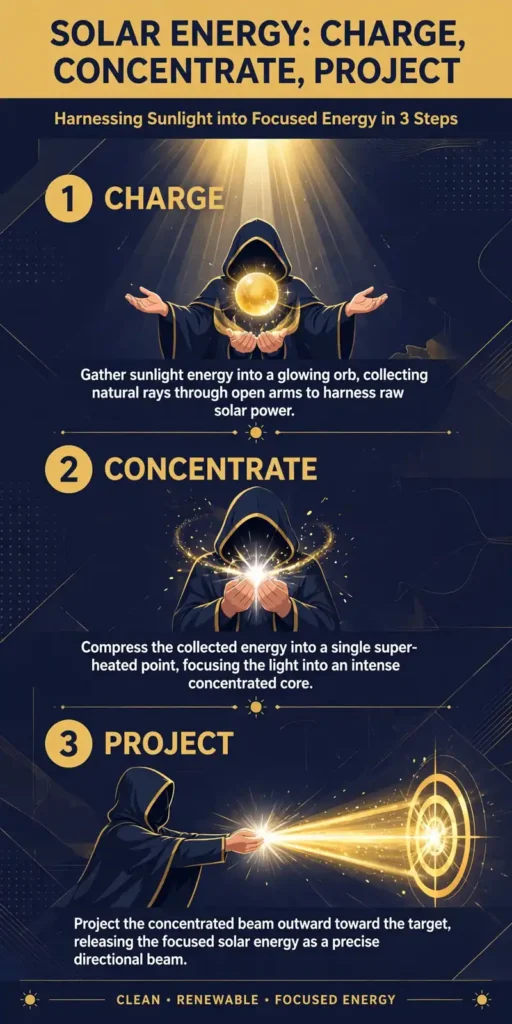
Charge, Concentrate, Project: The Three Steps
Every solar beam runs the same three steps. First the user charges up light, gathering sunlight and converting it into energy, the way Pokemon’s move runs as a two-turn attack where the user charges up sunlight for a round before firing. Second comes concentration: the catalogs describe users who concentrate it into a single point, and fiction’s best visual is Nuova Shenron of Dragon Ball GT, who focuses the sun’s energy through a lens to project it as his Nova Death Ray.
Third comes the projection: a beam of pure solar energy that can cut, pierce, or burn. Superman does the same with stored charge, as he focuses the solar radiation from his body into his eyes and releases it as lasers. Charge, concentrate, project: skip a step and you have a different power, but run all three and you have the beam.
Solar Beam vs Other Powers
Readers meet ten electricity specialists across our guides: bio-electricity, bio-lightning, electric discharge, electric field manipulation, electric shockwave, electric surge, electrokinetic constructs, electrokinetic flight, electromagnetic pulse, and lightning rod. Solar Beam is the site’s first pure-sun power: where the others fire lightning, the beam fires focused sunlight.
The Family Comparison
The table below places the beam against its closest neighbors. Heat Vision is the stored-sunlight cousin, the Solar Flare is the unfocused cousin, and Electric Discharge is electricity’s own beam analogue.
| Power | What it does | How Solar Beam differs |
|---|---|---|
| Solar Beam | Gathers sunlight, concentrates it to a point, projects it as a focused beam | The baseline: the living furnace, sunlight into a single line |
| Heat Vision | Releases stored solar energy as beams from the eyes | One user’s version: stored charge, not fresh sunlight (catalog) |
| Laser/Heat Beam | Projects generic photon or heat beams | No solar source required; any energy works |
| Solar Flare | Emits an omnidirectional burst of solar energy | Unfocused: everything nearby, not one line |
| Lunar Beam Emission | Projects a beam of moonlight | The catalog’s stated opposite: night energy, not sun |
| Solar Blast | Fires a wide wave of solar energy | Area damage; the beam trades width for precision |
| Electric Discharge | Releases charge as aimed sparks and arcs | Electricity’s beam; the solar beam fires sunlight, not current (guide) |
What Can a Solar Beam Do? Applications
The applications flow from the three steps: gather enough light, compress it, and choose what the beam does on arrival. Precision, charging, and fuel each shape a different battlefield.
Precision Strikes: Cutting, Piercing, Incinerating
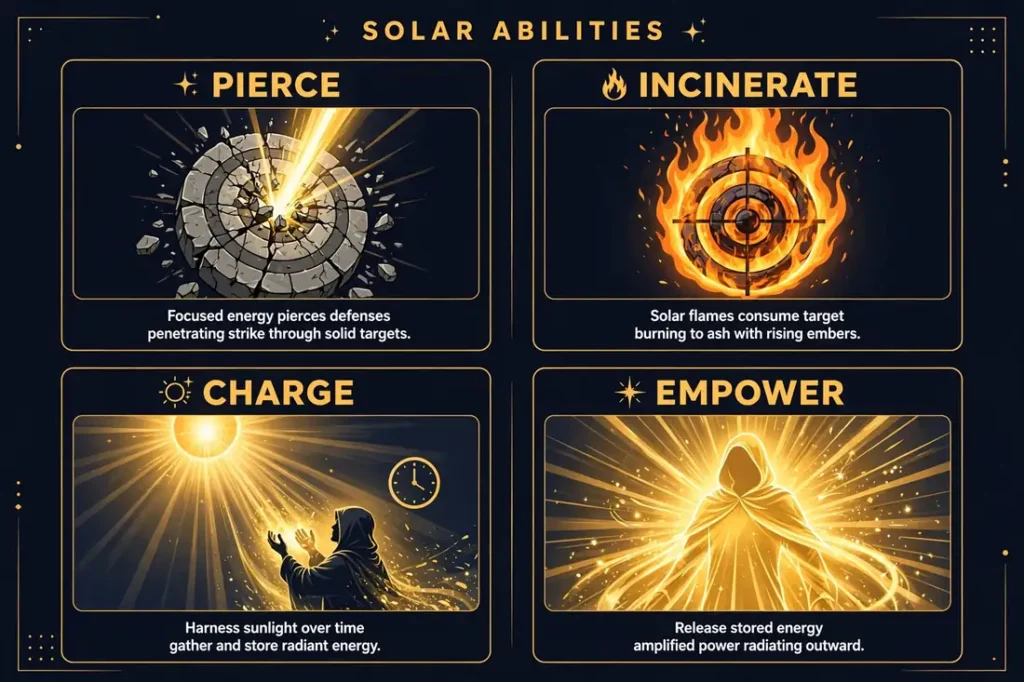
A beam is defined by what it does on contact: it pierces virtually anything it touches, with explosive properties at high intensity. The catalogs list Incineration as the flagship application, and Amaterasumon of Digimon shows why, as depicted in its story: its All-Encompassing Sunbeams concentrates the power of the sun into a beam of light that incinerates everything without even ashes remaining. The user can control the intensity of their beam, choosing between harmless effects and deadly burning effects (Light Beam Emission).
Finer work is just as deadly. The catalogs add Solar Cutting, Solar Strike, Disintegration, and even Ricochet Inducement via mirrors, since a beam of photons bounces like light. A sword of focused sun is also a scalpel of it, and that precision is what separates the beam from the flare.
The Charge Mechanic: Why Charging Matters
Charging is the beam’s signature tradeoff. Pokemon’s Solar Beam is the textbook case: a two-turn attack where the user gathers light, then blasts a bundled beam on the second turn, at 120 power, 100 accuracy, 10 PP. That charge turn is the cost of gathering enough sunlight, and the catalog echoes it with its limitation: users may require time to charge. Venusaur shows the pose that made it famous: head flower open, light pouring in, then the shot.
Weather rewrites the cost. Under harsh sunlight the charge-turn is eliminated entirely, which is why the Sunny Day combo (intense sunlight for 5 turns) creates the fearsome Sunnybeamers. But the reverse applies too: in rain, hail, fog, or a sandstorm, the move’s power falls by 50 percent. The beam is only as strong as the sky that feeds it.
Solar Empowerment: The Sun as Fuel
Behind every beam is a battery. The fan catalogs call it Solar Empowerment and Solar Physiology: the user absorbs sunlight until their cells hum with it, and depending on the type of sun the user absorbs energy from, the beam’s power can be varied. Superman is the definitive example, as depicted in the comics: his cells store large amounts of the solar energy under a yellow sun, released as heat vision in focused beams from his eyes, while under a red sun he is weak, drained of everything the yellow star gave him.
Simpler versions of the same fuel tank appear everywhere. Birdman of Hanna-Barbera needed sunlight to recharge his powers, firing solar rays from his fists only until the tank ran dry, as depicted in the show. The rule is universal in these stories: no sun, no beam, and the beam never exceeds what the battery holds.
Real Physics: How Sunlight Can Be Focused into a Weapon
The Odeillo Furnace: 10,000 Suns in One Spot
Real science built the solar beam first. The Odeillo solar furnace in the Pyrenees-Orientales of France is a structure that uses concentrated solar power to produce high temperatures for industry: 63 heliostats of plane mirrors gather sunlight and reflect it onto a large curved mirror, which concentrates light onto a focal point barely 40 cm wide. The result is the equivalent of 10,000 suns striking a circular target 40 cm in diameter, with the temperature at the focal point reaching 3,500 C (6,330 F), at one megawatt of power (Solar furnace).
The furnace opened in 1970, built between 1962 and 1968, and still serves as a science research site testing materials at very high temperatures. Its heat can melt steel and generate electricity. A fictional solar beam user is, physically speaking, a walking Odeillo: the same focal point, the same concentrated solar power, worn as a weapon.
From Archimedes to Parabolic Dishes
The idea is ancient. Legendary accounts of the Siege of Syracuse (213-212 BC) tell of Archimedes’ heat ray, a set of burnished brass mirrors or burning glasses supposedly used to ignite attacking ships, though modern historians doubt its veracity. The ancient Greeks even had a word for it: Heliocaminus, meaning solar furnace, a glass-enclosed sunroom designed to trap the sun’s heat.
Modern engineering split the same idea into shapes: the parabolic dish with an 800 to 8000 concentration ratio running 500 to 1200 degrees C, and the power tower, whose field of heliostats heats molten salt between 550 C and 1500 C. Every version obeys one law, the smaller the focal point, the hotter the beam, and fiction’s beam users simply replace the mirrors with their own bodies.
Beam, Blast, Flare Compared
The solar attack family comes in three shapes, and the shape decides the battlefield role. The table below maps them: the beam is the sniper, the blast is the cannon, and the flare is the bomb.
| Shape | What it is | Best for | Example |
|---|---|---|---|
| Beam | A focused line of solar energy | Precision: piercing and incinerating single targets | Superman’s heat vision, Venusaur’s Solar Beam |
| Blast | A wide wave or cone of solar energy | Area damage at range | Solar Blast users (fan catalogs) |
| Flare | An omnidirectional burst of solar energy | Everything nearby at once, no aiming needed | Superman’s Solar Flare, Solar Flare power |
Weaknesses and Limitations
No power is complete without its counters. The beam is spectacular but conditional: take away the sun, interrupt the charge, or reflect the light, and the furnace goes cold.
What Can Stop a Solar Beam User?
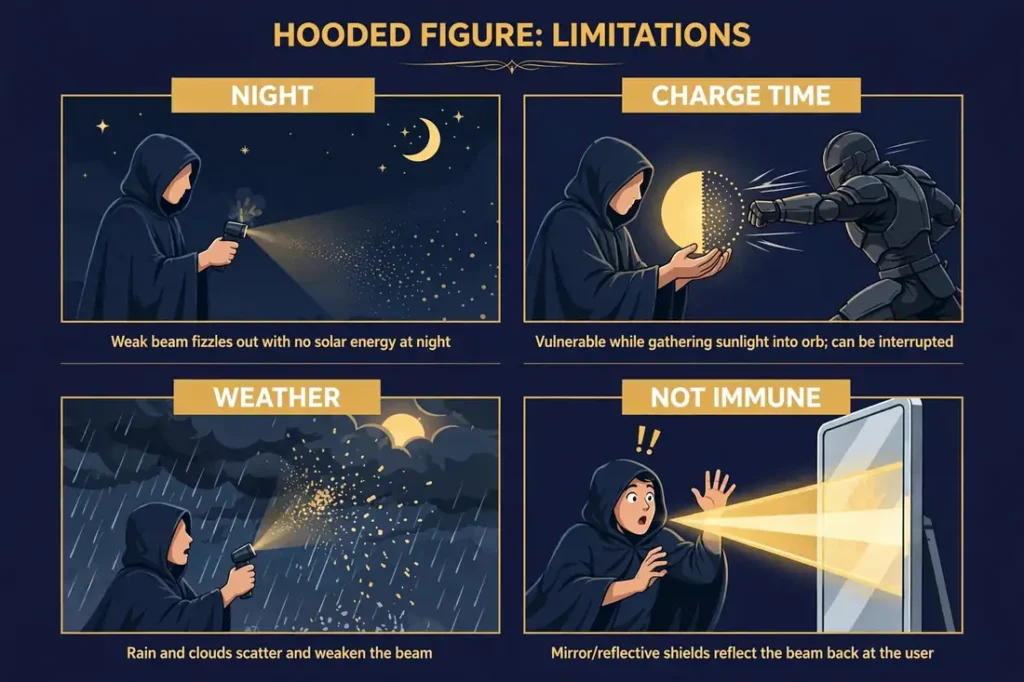
Every beam has an off switch. The catalogs list the hard limits first: users may require solar energy from a source, so night, caves, and deep shade starve the power; they may not be immune to the effects of their own attacks, so a reflected beam burns the firer too; and Photokinetic Immunity and Solar Immunity simply no-sell the whole concept. Solar Negation ends it outright.
The softer limits are the ones stories actually use. Charging takes time, and a charge interrupted is a beam that never fires; Pokemon’s two-turn rule is the gamified version of that truth. Overuse may cause exhaustion or strain if too much effort is exerted at once, because the body is a smaller furnace than Odeillo. And control is essential: users need control to avoid unnecessary destruction, since a misaimed beam does not care what it incinerates.
Famous Solar Beam Users
From comics to anime to games, these are the characters who defined the art of the focused sun.
Icons of the Solar Beam in Comics, Anime, and Games
The icons each found a signature way to weaponize the sun, as depicted in their stories: Superman (DC Comics) and his heat vision, focusing the solar radiation from his body into his eyes and releasing it as lasers, plus the New 52 Solar Flare that vents every stored cell at once; Apollo (WildStorm) and Sunfire (Marvel Comics), solar-powered blasters; Venusaur (Pokemon), charging sunlight on its back flower, and Lurantis with the Solar Blade; Amaterasumon (Digimon), whose All-Encompassing Sunbeams incinerates everything without even ashes remaining.
The deeper cuts: Nuova Shenron (Dragon Ball GT), who focuses the sun’s energy through a lens into the Nova Death Ray; Escanor (The Seven Deadly Sins), wielding the power of the sun through Sunshine; Birdman (Hanna-Barbera), firing solar rays from his fists until he must recharge; Captain Sunshine (The Venture Brothers), whose Sunbeams cause painful sunburns; BoBoiBoy Solar, with the Solar Eclipse Attack and the Multifold Solar Eclipse Attack; Vaarsuvius (The Order of the Stick), casting Empowered Sunburst (Solar Attacks). For lightning-fast fighting styles, see Thunder Breathing; for grass-type kinship with Pokemon’s version, chlorokinesis; for more power variety, God Ki abilities and emitter quirks.
Conclusion
Solar beam is sunlight at its most disciplined: not the scatter of day but the line of a weapon, charge gathered, concentrated to a point, and projected with intent. Whether it arrives as Superman’s heat vision, Venusaur’s charged shot, or a furnace mirror’s focal point, it runs on
the same three steps the Odeillo engineers built into steel and glass. Want to give the power to your own character? Try our superpower generator and see what your sunlight would burn through.


