
Static Cling Superpower Explained: Charge It, Stick It, Unstick It
Some powers throw lightning. Static cling sticks things down: the power to charge a surface or a body with static electricity and make things cling to it, from villains pinned to walls to heroes scaling skyscrapers. It is the quietest grip in the electric family, the balloon on the wall weaponized. This guide, part of our Energy Powers collection, explains what a static cling is, how the grip works, what it can do, the real science of sticking with electricity, and which famous characters embody the stick.
In this guide:
- What Is a Static Cling?
- Static Cling vs Other Powers
- What Can a Static Cling Do? Applications
- Real Physics: How Sticking With Electricity Actually Works
- Weaknesses and Limitations
- Famous Static Cling Users
- Conclusion
What Is a Static Cling?
Other electric powers fire current. The static cling holds it: by charging a surface, sticking things to it, and releasing the grip on command, the user turns the most ordinary phenomenon on Earth into a weapon. The sections below define the power, trace where the grip comes from, and map its two directions.
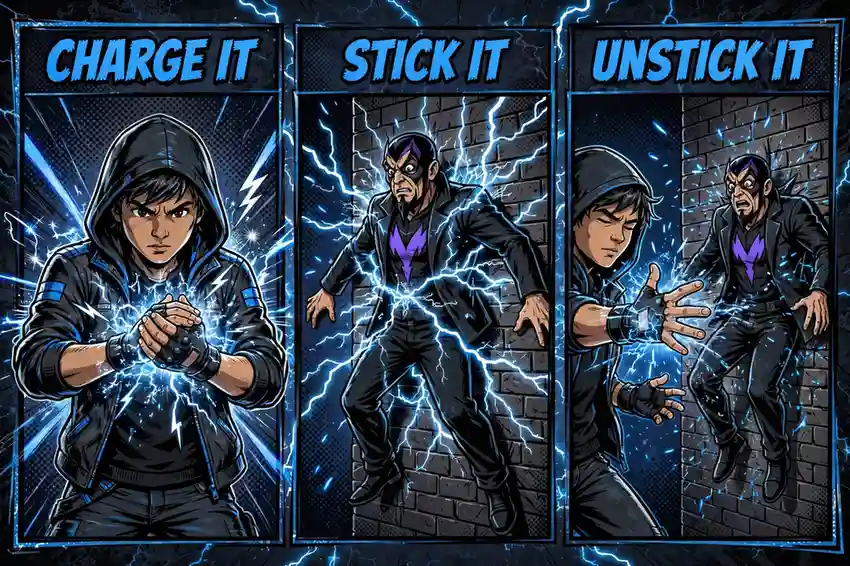
The Stick, Defined
A static cling user is someone who can scale walls using electricity: the fan catalogs file the power as Electrical Wall Crawling, a Technique of Electricity Manipulation and a Variation of Wall Crawling, also called simply Static Cling. The catalog’s capability statement is the core of the power: the user can crawl, walk, and run up walls using static electricity. But the power is bigger than climbing: Static Shock’s version can alter electromagnetic attraction so people or objects stick to one another, and adhere most objects or people to surfaces (Electrical Wall Crawling).
The defining trait is holding, not hurling. Where other electric powers fire current, the static cling user weaponizes attraction itself: charges produce electromagnetic fields, and those fields act on other charges, pinning a villain to a wall the way a balloon pins itself to a ceiling. It is electricity at its most patient: not the bolt, but the grip.
Charge It: How the Cling Gets Its Grip
No charge, no cling. A static cling user builds the sticking force the way the real world does: charges produce electromagnetic fields, and those fields pull on the charges in nearby surfaces. The everyday proof is the balloon: rubbing a balloon against your hair leaves it negatively charged, and it clings to a wall, suspended against gravity, until the charge leaks away. A fictional user simply banks that effect and aims it.
The catalog’s science section states the mechanism plainly: electrical currents generate magnetic fields, changing magnetic fields generate electrical currents, and moving charges additionally produce a magnetic field. The cling is electrostatic cling at its root, the same force that makes a charged comb lift paper bits, scaled up until it can hold a person against a wall.
Stick It, Unstick It: The Two Directions
The static cling is not a one-way trap. Static Shock’s technique runs both directions: he can make objects attract to a person, sticking a thug’s own gun to his hand, and he can reverse the effects of Static Cling entirely, leaving targets unable to stick onto surfaces at all. The power is a dial, not a switch: attraction up, attraction down, attraction off.
Real electroadhesion works the same way. The technology uses modulated adhesion that can be turned off for mobility or cleaning: power on, the pads grip; power off, the robot walks free. The catalog’s neighbor power states the general rule: users can make non-adhesive things sticky and also make adhesive objects not so adhesive. Stick it, unstick it: the user decides which.
Static Cling vs Other Powers
Readers meet thirteen electricity and energy specialists across our guides: bio-electricity, bio-lightning, electric discharge, electric field manipulation, electric shield, electric surge, electrokinetic constructs, electrokinetic flight, electromagnetic pulse, lightning rod, solar beam, solar flare, and static charge. Static Cling is the family’s grip: where the others fire, burst, shield, sense, build, fly, focus, or accumulate, this power sticks. The table below maps the sticking powers against their neighbors.
The Family Comparison
The table below places the cling against its closest neighbors. Static Charge is the buildup side, Adhesion Manipulation is the generalist, and Wallcrawling is the parent power.
| Power | What it does | How Static Cling differs |
|---|---|---|
| Static Cling | Charges surfaces and bodies so things cling to them | The baseline: the grip, stick it and unstick it on command |
| Static Charge | Builds an imbalance of electric charges, then releases shocks | The buildup: charge first, cling is one use of it (guide) |
| Electric Discharge | Releases stored charge as aimed sparks and arcs | The zap: discharge ends the charge, cling sustains it (guide) |
| Electrokinetic Flight | Flies by riding electric charge | The ride: Static sticks to his saucer with cling, then flies it (guide) |
| Electric Field Manipulation | Controls electric fields around the user | The field: shaped space versus a charged grip (guide) |
| Adhesion Manipulation | Manipulates all types of adhesion | The generalist: glue, tape, and stickiness of every kind, not just electric |
| Wallcrawling | Fastens onto and climbs surfaces without falling | The parent: every way of climbing, of which electric cling is one |
What Can a Static Cling Do? Applications
The applications flow from the two directions: charge it, stick it, and decide when to let go. Pinning, climbing, holding, and releasing each shape a different confrontation.
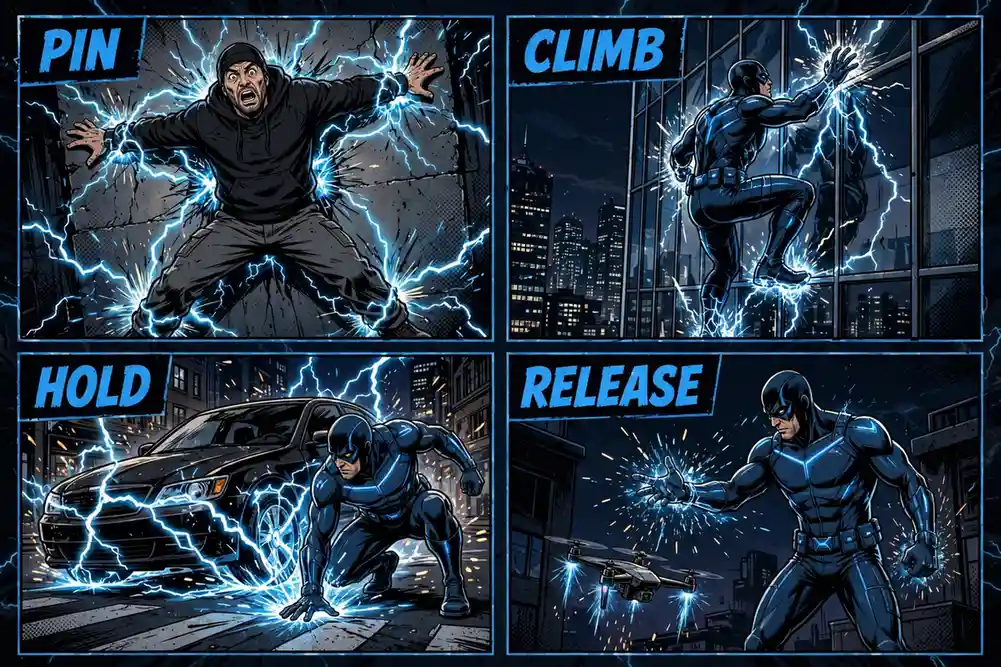
Pin Them: Sticking Opponents to Walls
The static cling user’s signature move is the pin. Static Shock uses it the way other heroes use handcuffs: he can alter electromagnetic attraction to cling opponents to walls or bind them, detaining them until the police arrive, as depicted in the comics and the animated series. Restraining people or objects and attaching people or objects to various surfaces is quieter than a punch and harder to escape: struggling only presses the target flatter against the charged surface.
The catalogs extend the pin into full immobilization. Magnetism Manipulation lets a user turn a human body into a magnet as a method of immobilization, and the power list adds Binding and Entity Tethering for holding targets in place. The pin is the static cling at its most tactical: no broken bones, no collateral damage, just a villain stuck to a wall waiting for the sirens.
Climb Anything: Electrical Wall Crawling
The catalog’s headline application is the climb: the user can stick to walls and scale walls and ceilings, fastening onto vertical surfaces and climbing vertical surfaces and horizontal surfaces without falling. They do not deny gravity; they simply adhere to surfaces unaided, which is why the catalog files it as Surface Scaling, a Variation of Wall Crawling.
Some users are limited to ferrous platforms, able only to move on ferrous walls and ceilings, like Misaka Mikoto in the catalog’s gallery. Others climb anything: rough surfaces and smooth surfaces alike. The real-world parallel is already walking: Harvard’s HAMR-E robot climbs vertical surfaces and even upside-down conductive surfaces on electroadhesive feet, the laboratory version of what fiction does with a thought.
Hold Everything: Objects, People, Vehicles
The cling is not limited to the user’s own body. Static Shock can adhere most objects or people to surfaces and cause people or objects to stick to one another through a strong static cling: a getaway car fused to the street, a weapon glued to a wall, two henchmen stuck back to back. He even uses it on himself in transit, choosing to stick onto his Static Saucer while flying so turbulence cannot throw him off.
The catalogs file the broader holding power under Adhesive Skin, Surface Hanging, and Ceiling Adhesion: the ability to hang from surfaces and keep objects hanging with you. Friction Enhancement and Surface Energy Manipulation round out the grip, letting the user tune how hard things hold. The static cling is a universal fastener: if it can be charged, it can be stuck.
The Reverse: Unsticking on Command
Every grip needs a release. Static Shock can reverse the effects of Static Cling, making targets unable to stick onto surfaces: the villain slides off the wall, the stuck door swings free, the cling simply lets go. The catalog’s neighbor power states it as a general principle: users can make adhesive objects not so adhesive.
Real electroadhesion is built around the same release. The pads use modulated adhesion that can be turned off for mobility or turned off for cleaning, drawing only a small amount of power while holding. The reverse is what makes the power usable instead of a curse: a hero who could never let go would be a statue, not a savior. Stick it, unstick it: the second half is what keeps the first half heroic.
Real Physics: How Sticking With Electricity Actually Works
Electroadhesion: The Robots That Climb Walls
Real science built the static cling first, and it climbs walls for a living. Electroadhesion is an electrically controllable adhesion technology: inducing electrostatic charges on a wall substrate with a power supply connected to compliant pads on a moving robot. SRI International demonstrated it in a 2008 IEEE paper, with clamping forces of 0.2 to 1.4 Newton per 1 square centimeter of clamp area, on building substrates from concrete and brick to glass and drywall, both electrically conductive substrates and insulating substrates (SRI electroadhesive robots).
The numbers are the selling point: the technology holds weight for about 20 microwatts per Newton of weight held, a small amount of power by any measure, and it can repeatably clamp to dust-covered surfaces and debris-covered surfaces that would defeat suction cups or glue. Unlike conventional adhesives or dry adhesives, the grip can be switched off. A fictional static cling user is, physically speaking, a walking electroadhesive pad: the same power supply, the same compliant pads, worn as hands and feet.
HAMR-E: The Micro-Robot on the Jet Engine Wall
The laboratory proof has a name: HAMR-E, the Harvard Ambulatory Micro-Robot with Electroadhesion, built by Harvard‘s Wyss Institute and School of Engineering. Its electroadhesive foot pads, origami ankle joints, and walking gait let it climb vertical surfaces and upside-down conductive surfaces, including the inside walls of a commercial jet engine, a job no human inspector can reach without dismantling the machine (ScienceDaily).
The robot was born from a Rolls-Royce challenge: build an army of micro-robots that can inspect the inaccessible guts of jet engines. Climbing upside down is the hard part, because it demands constant adhesive force against gravity, and electroadhesion supplies it on demand. HAMR-E is the static cling made real: no webs, no glue, just charge holding a climber to the wall.
The Limits: What Real Static Cling Cannot Stick To
Fiction sticks to everything; reality is pickier. The table below compares the fictional cling with real sticking methods.
| Method | How it sticks | Strength and scale | Limit |
|---|---|---|---|
| Fictional static cling | Electrostatic charge aimed by the user | Whatever the plot needs | Only as strong as the story allows |
| SRI electroadhesion | Induced electrostatic charges on pads | 0.2 to 1.4 N per square centimeter | Needs a power supply |
| Static cling vinyl | Triboelectric charge on plastic film | Clings to smooth glass and metal | Fails on paper, wood, and rough surfaces |
| Gecko setae | Van der Waals force on nanoscale hairs | Holds many times body weight | Needs dry, clean surfaces |
| Glue | Chemical adhesion | Very strong | Permanent and messy |
Our static charge guide covers the buildup side of the family; this is the stick side of the same spark.
Weaknesses and Limitations
No power is complete without its counters. The static cling is mighty but fragile: take away the charge, insulate the target, or ground the grip, and the stick lets go.
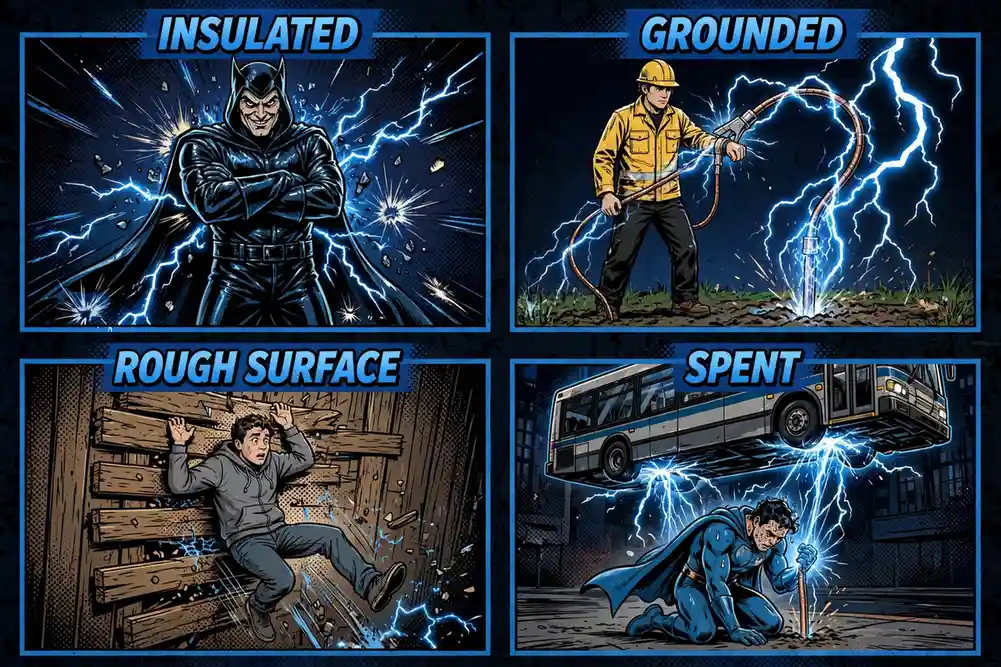
Unstick Me: What Stops a Static Cling User?
Every grip has a counter. The catalog’s own limitation is insulation: Static once faced a room designed to inhibit his powers via insulation, and the catalog notes some users may be unable to create adhesion, limited to manipulating only from already existing sources. Ground the charge or insulate the target and the cling never forms; distance, mass, and precision all bow to the user’s knowledge, skill, strength, and natural limits (Adhesion Manipulation).
The hard counters mirror other energy powers: Adhesion Immunity and Anti-Adhesion no-sell the grip outright, and the catalog warns the power is weak against Adhesion Immunity. The subtler limits are the ones stories actually use: the cling needs charge to work, so a drained user is just a person, and sticking the wrong thing (a live wire, a fuel tank) turns the grip into a hazard. For more ways to humble a powerhouse, try our random weakness generator; for power variety, see emitter quirks and god ki abilities.
Famous Static Cling Users
From comics to anime to games, these are the characters who defined the art of the stick.
Icons of the Static Cling in Comics, Anime, and Games
The icons each found a signature way to weaponize the stick, as depicted in their stories: Virgil Hawkins, Static Shock (DC Comics), whose named technique alters electromagnetic attraction to cling opponents to walls or bind them until the police arrive, and who sticks to walls and his Static Saucer himself; Peter Parker, Spider-Man (Marvel Comics), whose wall-crawling is electrostatic per the catalog and per Marvel’s official in-universe explanation (control of inter-atomic attraction, concentrated in hands and feet, several tons per finger, as reported via fan discussion); Maxwell Dillon, Electro (Marvel Comics), catalog-listed for the electrical climb; Misaka Mikoto (Toaru Kagaku no Railgun), who manipulates electromagnetism to move on ferrous walls and ceilings (Electrical Wall Crawling).
The deeper cuts, as listed in the fan catalog: Haumea (Fire Force); Kaladin Stormblessed and the Windrunners (The Stormlight Archive, adhesion via the catalog’s Adhesion Manipulation page); Trapster (Marvel Comics, the classic adhesion villain); Link (Legend of Zelda: Tears of the Kingdom). For lightning-fast fighting styles, see thunder breathing; for plant-powered variety, chlorokinesis.
Conclusion
Static cling is electricity at its most patient: not the bolt or the burst, but the grip, the charge held and spent on sticking with intent. Whether it arrives as Static Shock’s wall pin, Spider-Man’s ceiling crawl, or a micro-robot clinging to a jet engine wall, it runs on the same two directions: stick it, unstick it. Want to give the power to your own character? Try our superpower generator and see what your grip would hold.


