
Static Charge Superpower Explained: Build Up, Stick, Zap
Some powers throw lightning. Static charge saves it up: the power to build an imbalance of electric charges on the body, stick things together with it, and release it as a shock. It is the quietest power in the electric family, the doorknob spark weaponized. This guide, part of our Energy Powers collection, explains what a static charge is, the three moves that power it, what it can do, the real physics behind friction-born charge, and which famous characters embody the everyday spark.
In this guide:
- What Is a Static Charge?
- Static Charge vs Other Powers
- What Can a Static Charge Do? Applications
- Real Physics: How Static Charge Actually Works
- Weaknesses and Limitations
- Famous Static Charge Users
- Conclusion
What Is a Static Charge?
Other electric powers fire current. The static charge gathers it: by building charge through friction, sticking things with attraction, and releasing it as a zap, the user turns the most ordinary phenomenon on Earth into a weapon. The sections below define the power, trace where the charge comes from, and map its three moves.
The Everyday Spark, Defined
A static charge user is someone who can manipulate static electricity, defined by the fan catalogs as an imbalance of electric charges within or on the surface of a material. The catalogs file the power as a Technique of Electricity Manipulation, also calling it Electrostatic Manipulation, Friction Electricity Manipulation, Static Charge Manipulation, Static Electricity Control, or Static Electrokinesis (Static Electricity Manipulation). The defining trait is stillness: where other electric powers fire current, the static charge user gathers charge that waits.
The personal version gets its own name. Personal Static is the power to manipulate one’s personal static electricity, filed as a Sub-power of Personal Electricity Manipulation and a Technique of Personal Mastery, also called Personal Electrostatic Energy or Self-Static Electricity Manipulation. The catalog’s capability statement is the core of the power: the user can manipulate their own electrostatic energy, channeling it towards any use, seen as the personal forces behind converting it into electrical energy. Charge first, use later: that patience is what separates the static charge user from every lightning hurler.
Friction: Where the Charge Comes From
No rubbing, no charge. A static charge user builds power the way the real world does: through the triboelectric effect, where electrons move from one material to the other when two surfaces touch and separate. The catalogs call this Friction Manipulation, and fiction’s best visual is the Tobi-Kadachi of Monster Hunter, which produces static electricity by rubbing fur against tree bark, as depicted in the game. Rubbing brings more surface into contact, so more electrons move, and the buildup of static electricity grows with every pass.
That buildup is a battery with no wires. The catalogs file the generation step as Electrostatic Energy Generation: the user harnesses kinetic forces from motion and friction and stores the result on skin, clothes, and hair. A charged body carries the imbalance until something gives it a path to ground, which is why a static charge user is always one touch away from a fight. The charge comes from friction, and friction is everywhere.
Build Up, Stick, Zap: The Three Moves
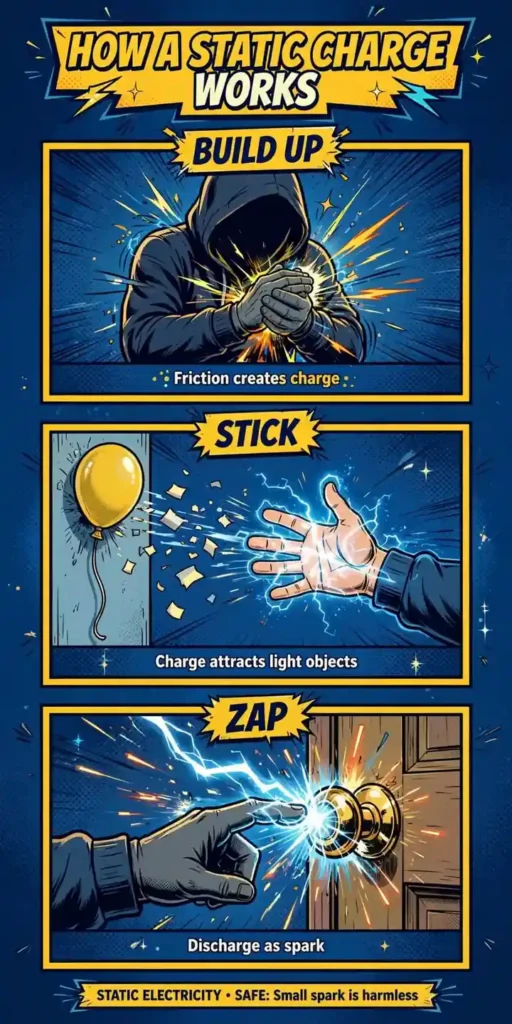
Every static charge runs the same three moves. First comes the build up: the user accumulates charge through friction and motion until the imbalance is weapon-ready. Second comes the stick: Attraction and Repulsion, the power to make charged things cling or flee, from Static Cling that pins a thug to a wall to a balloon that hangs in midair. Third comes the zap: the Electric Shock, the sudden Zap as the user disperses the static from their body in the form of a shock.
The catalogs file the release as Electric Discharge: the user can create static discharges on demand, turning stored imbalance into a directed spark (Static Electricity Manipulation). Electric Touch and Electric Conductivity extend the zap through anything the user holds, so a charged handshake becomes a weapon. Build up quietly, stick strategically, zap decisively: skip the buildup and you have a different power, but run all three and you have the static charge.
Static Charge vs Other Powers
Readers meet twelve electricity and energy specialists across our guides: bio-electricity, bio-lightning, electric discharge, electric field manipulation, electric shield, electric surge, electrokinetic constructs, electrokinetic flight, electromagnetic pulse, lightning rod, solar beam, and solar flare. Static Charge is the family’s quiet one: where the others fire, burst, shield, sense, build, fly, or focus, this power accumulates. The table below maps the charge side against its neighbors.
| Power | What it does | How Static Charge differs |
|---|---|---|
| Static Charge | Builds an imbalance of electric charges on the body, sticks things, releases shocks | The baseline: the accumulator, charge before discharge |
| Electric Discharge | Releases stored charge as aimed sparks and arcs | The release side: discharge is what static charge does last (guide) |
| Electric Surge | Vents built-up electricity in a sudden burst | The burst: a surge spends everything at once, static charge meters it out (guide) |
| Electric Field Manipulation | Controls electric fields around the user | The field: shaped space versus stored surface charge (guide) |
| Electrokinetic Flight | Flies by riding electric charge | The ride: Static’s saucer is applied static charge, not raw flight (guide) |
| Lightning Rod | Attracts and channels lightning strikes | The magnet: draws the sky’s charge instead of building its own (guide) |
| Bio-Electricity | Generates electric current inside the body | The generator: internal current versus surface imbalance (guide) |
What Can a Static Charge Do? Applications
The applications flow from the three moves: build the charge, choose what sticks, and decide when the zap lands. Sticking, shocking, sensing, and lifting each shape a different confrontation.
Stick: Attraction, Repulsion, and Static Cling
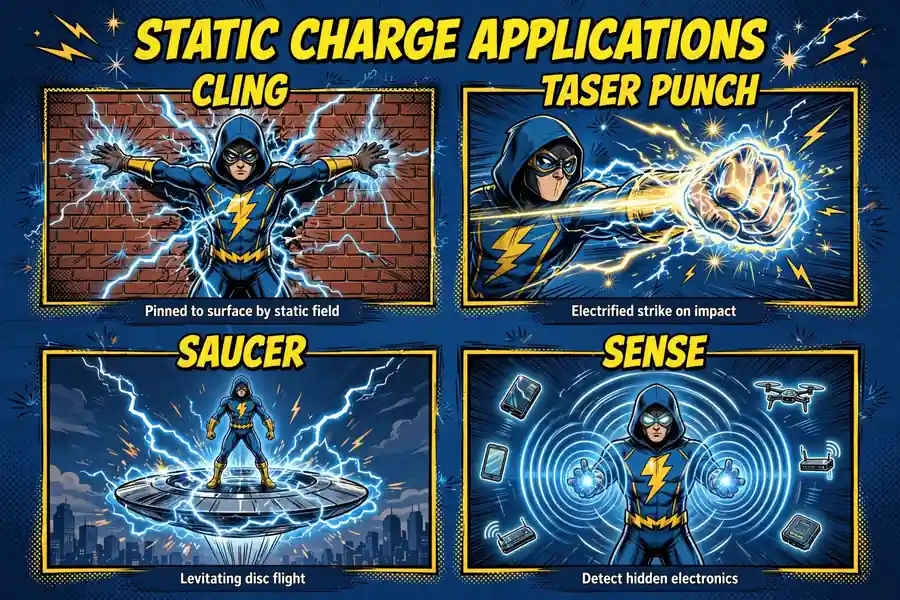
The stick is the static charge user’s signature, and no sibling power does it. Attraction and Repulsion let the user pull charged objects close or hurl them away without touching them: Attraction for the paper bits flying to a charged hand, Repulsion for scattering them. The catalogs file this under Charged Particles Manipulation, the fine control of the charged particles themselves, and add Electrical Wall Crawling for users who charge their own bodies and scale walls like a balloon on a ceiling.
Static Shock named the technique, as depicted in the comics and show: Static Cling alters electromagnetic attraction so people and objects cling to surfaces, and he uses it to bind opponents to walls until police arrive, then reverse it to let them go. The real world does the same trick daily: a balloon rubbed against hair becomes negatively charged and clings to a wall, suspended against gravity, and Styrofoam peanuts cling to a cat’s fur. The stick is humble, quiet, and inescapable: once the charge holds you, struggling only builds more friction.
Zap: Shocks, Discharges, and the Taser Punch
The zap is where patience pays off. An Electric Shock from a static charge user is the sudden equalization of everything they stored: the catalogs file it as Zap, the strike by static discharge, and as Electric Discharge, the ability to create static discharges at will. Static discharges range from a stinging fingertip spark to a bolt that drops a grown fighter, and the user chooses the dose the way an archer chooses the draw.
Static Shock’s Taser Punch is the textbook application, as depicted in the comics: an electrically charged body delivers amped physical attacks with effects similar to a stun gun, and at full charge enough power to send opponents flying. For range he compresses the charge into Ball Lightning, electromagnetic energy compressed into a thrown ball, and he has stated he can generate at least 20,000 volts of power. The catalogs add Electrostatic Disruption as the advanced technique: a focused discharge tuned to pierce or scramble. The zap is never random; it is the bill coming due for every bit of friction the user banked.
Sense and Siphon: The Subtle Side
A static charge user does not have to fight loud. Electroreception lets them feel electric fields the way a shark feels a heartbeat, and the catalogs extend this into Electro-Psionics: Electrical Telepathy for reading the crackle of nervous systems and Electrical Telekinesis for nudging charged objects at a distance. Electronic Disruption turns the subtlety into sabotage: a touch that scrambles circuits, kills cameras, and silences alarms without a sound.
The siphon runs both ways. Ambient Energy Absorption and Ambient Energy Conversion let the user drink stray charge from the environment, becoming a Living Power Plant that never needs an outlet. Static Shock shows the defensive side, as depicted in the comics: Electricity Resistance means he absorbs electrical attacks harmlessly, and his Mind Control Resistance comes from an enhanced bioelectric aura that interferes with telepaths. Add magnetize metals and demagnetize metals (he has stopped speeding bullets mid-air), the power to create electrical currents and manipulate electrical currents, and even reverse the polarity of machines to make them misfire, and the quiet user becomes the most versatile one in the room.
Move It: Levitation and the Static Saucer
Charge can lift. The catalogs note that a real buildup of static electricity in the human body can move lightweight objects: paper, wires, hair, strings, liquids. A static charge user scales that parlor trick into Electromagnetic Electricity Manipulation: the fine control of charge across metal, air, and flesh, lifting what the charge can grip.
Static Shock built a vehicle out of the principle, as depicted in the comics and show: he electromagnetically levitates metal objects, including his self-built metal saucer, flying at up to 200 mph by riding the charge he generates. The catalogs add Electromagnetic force fields and barriers for defense, turning levitated scrap into a shield wall. It is not the elegant flight of a bird; it is the stubborn lift of a balloon that refuses to come down, scaled up until it carries a person.
Real Physics: How Static Charge Actually Works
The Triboelectric Effect: Rubbing Makes Charge
Real science built the static charge first, and it starts with rubbing. The triboelectric effect is the transfer that happens when two surfaces contact and slide against each other and then separate: electrons move from one material to the other, leaving one surface positive and the other negative. Rubbing brings more surface into contact, so more electrons move, which is why shuffling across a carpet in socks charges you more than standing still (Static electricity).
The result is an imbalance of electric charges within or on the surface of a material, and the charge stays put because insulators give it nowhere to go. This is static vs current electricity: in current electricity the charge flows through a conductor, but static charge waits, held in place until something offers it a path. Every doorknob shock you have ever felt is this effect keeping its promise.
The Van de Graaff Generator: The Human Spark Machine
The Van de Graaff generator is the static charge made into a machine, and it works exactly the way a fictional user does. A moving belt runs over rollers of different materials; the triboelectric effect strips electrons onto the belt, and the belt carries them up into a hollow metal dome, where the charge accumulates until the dome holds several million volts (Van de Graaff generator). Touch the dome and your hair stands up, because like charges repel and every strand flees its neighbors.
The human body is a smaller, wetter version of the same machine. Physicists model a person as a 100-picofarad capacitor that can charge to 4,000 to 35,000 volts just by walking around, and the familiar static shock is an electrostatic discharge: the neutralization of the charge in less than a microsecond, felt as nerve stimulation while the current crosses the skin. The energy is tiny, measured in millijoules, yet it can still damage sensitive electronics, which is why chip factories issue antistatic wrist straps. A fictional static charge user is, physically speaking, a walking Van de Graaff: the same belt, the same dome, worn as a body.
Lightning: The Scaled-Up Spark
A lightning bolt is the static charge with the volume turned all the way up. Lightning is a dramatic natural example of static discharge: charge separation from contact between ice particles in storm clouds builds an imbalance so large that the air itself gives way. The air breaks down at around 10,000 volts per centimeter, the discharge superheats air into a bright flash, and the expanding air makes a shock wave we hear as thunder. As the science puts it, a lightning bolt is simply a scaled-up version of domestic static discharge sparks. The table below maps the family from fingertip to thunderstorm.
| Spark | Source | Voltage scale | What happens |
|---|---|---|---|
| Doorknob shock | Shoes on carpet | Thousands of volts | A tiny zap, gone in a microsecond |
| Balloon on hair | Rubbing | Enough to lift | Clings to the wall, suspended against gravity |
| Van de Graaff dome | Triboelectric belt | Several million volts | Hair stands up, arcs jump |
| Lightning bolt | Ice particles in storm clouds | Hundreds of millions of volts | Thunder, flash, the scaled-up spark |
Our lightning rod guide covers the lightning side of the family; this is the charge side of the same spark.
Weaknesses and Limitations
No power is complete without its counters. The static charge is patient but fragile: take away the friction, ground the buildup, or insulate the target, and the spark dies unlit.
Grounded: What Stops a Static Charge User?
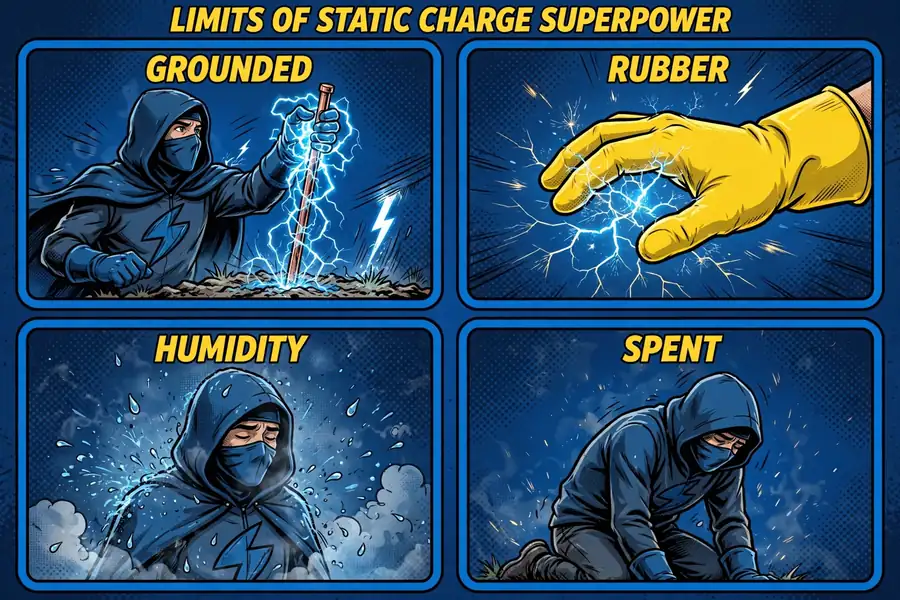
Every charge needs an exit, and the exit is the weakness. Grounded materials and insulated materials render him basically powerless, as Static Shock learned fighting Rubberband Man: elastic rubber stretches around his shocks without conducting them, and normal everyday wood also creates challenges, as documented in the comics and the animated series (Static). Ground a static charge user and the buildup drains away; insulate the target and the zap has nowhere to land.
The subtler limits are the ones stories actually use. Charge takes time and friction to build, and a user caught before the buildup is just a person. Humidity is a quiet killer: moist air conducts charge away before it can accumulate, which is why static shocks vanish in summer. And the power is indiscriminate up close: a big discharge can ignite flammable gas or dust, a real-world hazard behind grain silo and paint plant explosions, so the careless user is a walking fire risk. For more ways to humble a powerhouse, try our random weakness generator; for power variety, see emitter quirks and god ki abilities.
Famous Static Charge Users
From comics to anime to games, these are the characters who defined the art of the everyday spark.
Icons of the Static Charge in Comics, Anime, and Games
The icons each found a signature way to weaponize the everyday spark, as depicted in their stories: Virgil Hawkins, Static Shock (DC and Milestone Comics, Static Shock animated series), the kid the Big Bang gas charged with electricity, who named Static Cling, throws the Taser Punch, and rides his saucer; Superman (DC Comics), shown in the catalog gallery generating and firing a static electric bolt; Spark Man (Sparkler Comics #1, 1942), who wielded controlled usage of static electricity through gold balls in gloves at the tips of his index fingers and marked defeated criminals with his “=” chest symbol, as depicted in the Golden Age issues.
The deeper cuts: the Tobi-Kadachi (Monster Hunter), generating static by rubbing fur against tree bark; Hair Razor (The Fairly OddParents); Staticky Stacy (Codename: Kids Next Door); Adramelech (Akame Ga Kill!) and the Goro Goro no Mi (One Piece), catalog-listed objects; the Lightning Emperor (Hero Killer), a catalog-listed power. For lightning-fast fighting styles, see thunder breathing; for plant-powered variety, chlorokinesis.
Conclusion
Static charge is electricity at its most patient: not the bolt or the burst, but the buildup, the friction saved up and spent with intent. Whether it arrives as Static Shock’s cling, a Van de Graaff dome’s crackle, or the doorknob spark on a winter morning, it runs on the same three moves: build up, stick, zap. Want to give the power to your own character? Try our superpower generator and see what your spark would stick to.


