
Solar Flare Superpower Explained: The Omnidirectional Sunburst
Some powers aim sunlight. Solar flare detonates it: the power to vent all stored solar energy at once, in every direction, with no aiming and no holding back. It is the bomb to the solar beam’s sniper. This guide, part of our Energy Powers collection, explains what a solar flare is, its two shapes (the blinding flash and the incinerating burst), what it can do, the real physics behind it, and which famous characters embody the omnidirectional sun.
In this guide:
- What Is a Solar Flare?
- Solar Flare vs Other Powers
- What Can a Solar Flare Do? Applications
- Real Physics: How Solar Flares Actually Work
- Weaknesses and Limitations
- Famous Solar Flare Users
- Conclusion
What Is a Solar Flare?
Other sun powers focus light. The solar flare releases it all at once: a full-body venting that blinds or burns everything nearby, then leaves the user spent. The sections below define the power, split its two shapes, and map its three phases.
The Omnidirectional Sunburst, Defined
A Solar Flare is the power to emit a hyper disorienting/destructive solar cascade: the user vents solar energy from their whole body at once, in every direction. The fan catalogs file it as a Sub-power of Solar Manipulation and Stellar Manipulation, also calling it Solar Flare Generation, Solar Flare Emission, Solar Flare Blast, the Super Flare, The Flash of Solar Flare, or The Light of Solar Flare (Solar Flare).
The defining trait is omnidirectionality. Where a beam aims and a blast sweeps, the flare detonates: a wide-reaching blast wave that releases all stored up solar energy within the user’s cells in one event. There is no aiming a solar flare, only surviving one, which is why the catalog files it among Omnidirectional Waves.
Flash or Burst: The Two Shapes
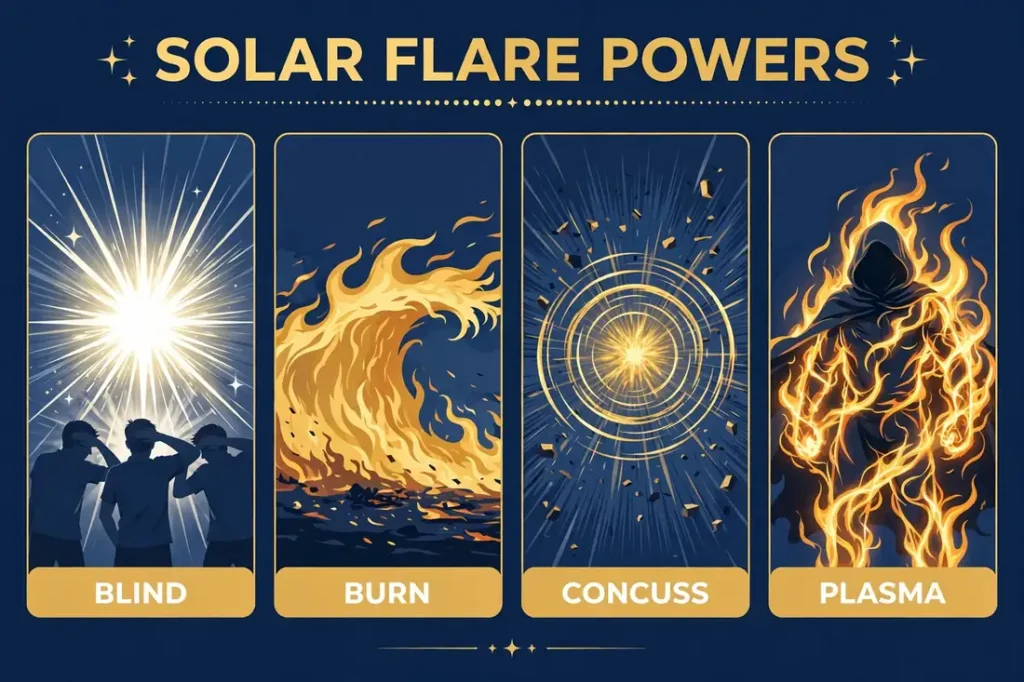
Not every fictional flare is the same shape. The catalog splits the power into two effects, and the split matters: the blinding flash and the incinerating burst. The flash variant emits a bright flash of high intensity solar ray emissions that outright blinds anyone unfortunate enough to get hit dead on by it, filed as Blindness Inducement. Dragon Ball’s Taiyoken is the textbook case, as depicted in the anime: a sudden white burst that blinds opponents without burning them.
The burst variant does what the flash only threatens. It brings Concussive Blast force that can badly concuss targets, concussive force that flattens a radius, and Incineration that can flash fry a stampeding herd. Superman’s Super Flare, as depicted in the comics, incinerates everything within a quarter mile and carries a Melting Presence that warps the air itself. One shape steals sight; the other steals the battlefield.
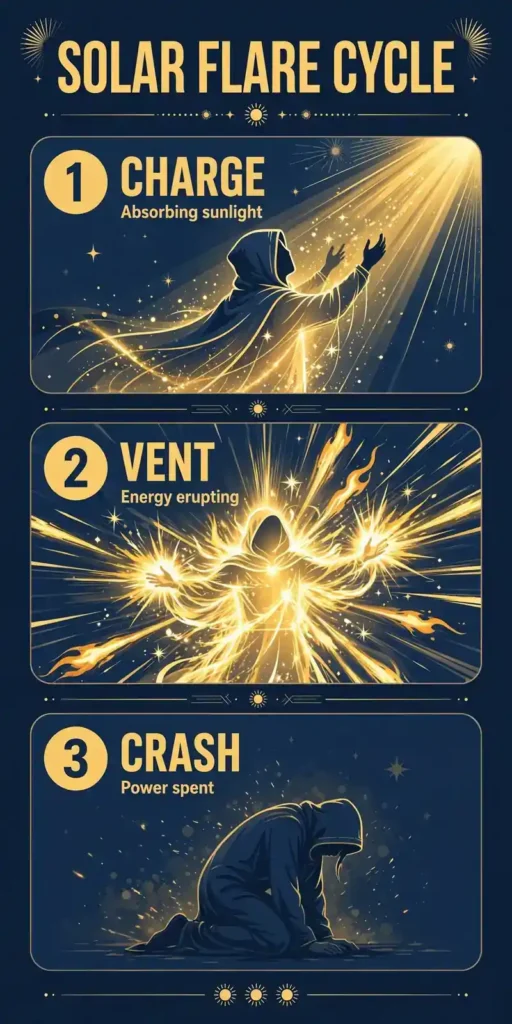
Charge, Vent, Crash: The Three Phases
Every solar flare runs the same three phases. First comes the charge: the user builds Personal Solar Energy, storing sunlight in the body through Solar Physiology until the cells are saturated. Second comes the vent: Personal Radiation erupts from every cell at once, the moment the catalog describes as unleashing the energy stored in every one of your cells.
Third comes the crash, and it is the phase that defines the power’s cost. Superman’s story, as depicted in the comics, shows the template: after venting, he is left drained, and the cells recharge only slowly under a yellow sun environment. Charge, vent, crash: the flare gives everything it has, and then it has nothing.
Solar Flare vs Other Powers
Readers meet eleven electricity and energy specialists across our guides: bio-electricity, bio-lightning, electric discharge, electric field manipulation, electric shield, electric surge, electrokinetic constructs, electrokinetic flight, electromagnetic pulse, lightning rod, and solar beam. The flare is the detonator of the family: where the others fire, burst, shield, sense, build, fly, or focus, the flare simply lets go of everything.
The Family Comparison
The table below places the flare against its closest neighbors. The Solar Beam is the focused cousin, Electric Surge is electricity’s own burst, and EMP is the Carrington connection.
| Power | What it does | How Solar Flare differs |
|---|---|---|
| Solar Flare | Vents all stored solar energy in every direction at once | The baseline: the omnidirectional sunburst, no aim, total self-depletion |
| Solar Beam | Gathers sunlight and projects it as a focused beam | Focused: the sniper to the flare’s bomb (guide) |
| Solar Blast | Fires a wide cone or wave of solar energy | Aimed area damage; the flare needs no direction at all |
| Heat Vision | Releases stored solar energy as controlled beams from the eyes | The precursor: controlled release versus total venting |
| Electric Surge | Vents built-up electricity in a sudden burst | Electricity’s burst; the flare burns with sunlight, not current (guide) |
| EMP | Disables electronics with electromagnetic energy | The Carrington connection: real flares cause EMP-like grid damage (guide) |
| Nova Flame | A distinct stellar attack power | The catalog’s stated not-to-be-confused power; not a solar vent |
What Can a Solar Flare Do? Applications
The applications flow from the two shapes. The flash blinds, the burst burns, and both run on the same battery: the body’s stored sunlight.
The Blind: Blinding Flash Techniques
The gentlest solar flare is also the most tactical. The blinding flash technique emits a bright flash of high intensity solar ray emissions that outright blinds anyone unfortunate enough to get hit dead on by it, filed by the catalog as Blindness Inducement and Light Generation. It is The Light of Solar Flare in its purest form: no heat, no shockwave, just overwhelming brightness.
Dragon Ball made the flash iconic, as depicted in the anime. Tien Shinhan, the inventor of the technique, created the Taiyoken; Krillin and Son Goku later used the Solar Flare technique to blind opponents and escape unwinnable fights. The lesson for writers: a flare does not need to kill to win; stealing the enemy’s sight for ten seconds is often enough.
The Burn: Concussive and Incinerating Bursts
The burst variant trades subtlety for devastation. A full solar flare delivers Concussive Blast force that badly concusses targets, with concussive force radiating outward in a sphere, and Incineration that can flash fry a stampeding herd. Superman’s Super Flare, as depicted in the comics, is the catalog’s flagship example: a massive blast of energy erupted out of Superman’s entire body that incinerated everything within a quarter mile and even destroyed his Kryptonian armor.
The catalog adds Flashover Inducement and Melting Presence to the burn profile: the air itself ignites and warps around the user. Note the catalog’s maximalist applications (Galaxy Destruction, Planet Destruction) are noted as fan-catalog extremes, not this article’s baseline; the standard fictional flare is a battlefield-scale event, not a cosmic one (Solar Attacks).
The Body as Battery: Stored Solar Energy
A flare can only vent what the body has stored. The defining mechanism is the body as battery: the user releases all stored up solar energy within his cells in one event, having spent hours or days absorbing sunlight. Superman’s physiology, as depicted in the comics, is the textbook case: his cells act as tiny solar panels, some 3.72 x 10^13 of them, and a University of Leicester fan-calc paper estimated the resulting Super Flare could release 3.86 x 10^10 joules every second, more than an atomic bomb in an hour.
Sunfire shows the plasma version of the same battery. The Marvel mutant absorbs solar and other radiation and converts ionized matter through a mentally-triggered unknown biochemical process until it becomes plasma, the superheated state of matter that makes up the sun, so he can sheath his body in flame. His Plasma Emanation reaches about 1,000,000 degrees Fahrenheit at maximum, and his full vent parallels Johnny Storm‘s Nova Burst, the Human Torch‘s own everything-at-once blast. Same battery, different chemistry.
Real Physics: How Solar Flares Actually Work
What Is a Real Solar Flare?
A real solar flare is one of nature’s own omnidirectional-ish bursts: giant explosions on the sun that send energy, light and high speed particles into space, often accompanied by solar magnetic storms known as coronal mass ejections (CMEs). They happen when the sun’s magnetic fields cross over each other and reconnect, a process called magnetic reconnection that hurls loops tens of times the size of Earth off the solar surface (NASA).
Astronomers rank flares on the GOES scale: A-class, B-class, C-class, M-class, and X-class, measured by GOES satellites in geosynchronous orbit via peak flux of soft X-rays (0.1 to 0.8 nanometres). The scale is logarithmic: X is ten times an M and 100 times a C, and X2 is twice the strength of an X1. The biggest events are staggering: the largest explosions in the solar system, releasing a billion hydrogen bombs of energy. In 2003 the most powerful flare ever measured overloaded the sensors measuring it; the sensors cut out at X28.
The Carrington Event: When the Sun Attacked Earth
The Carrington Event of September 1-2, 1859 is the closest reality has come to a fictional solar flare. During solar cycle 10, British amateur astronomer Richard Carrington was sketching sunspots at Redhill, England, when he witnessed the first recorded solar flare: a white light flare lasting about five minutes (independently observed by Richard Hodgson). The accompanying CME crossed 150 million km in just 17.6 hours, a transit that usually takes days (Carrington Event).
What followed was the most intense geomagnetic storm in recorded history. Telegraph systems went haywire across Europe and North America: sparking, igniting paper, delivering electric shocks to operators, while auroras in the tropics lit skies over Cuba, Hawaii, and the Caribbean. On the Boston-Portland line, two operators exchanged messages with their batteries disconnected, powered by the auroral current alone. On the modern scale it ranks G5, estimated twice as large as any other storm for 500 years, and a repeat today would mean widespread electrical disruptions and damage to the electrical power grid. Our electromagnetic pulse guide covers the Carrington Event from the EMP side; this is the flare side of the same storm.
Flare, Beam, Blast Compared
The solar attack family comes in three shapes, and the shape decides the battlefield role. The table below maps them from the flare’s side: the flare is the bomb, the beam is the sniper, and the blast is the cannon.
| Shape | What it is | Best for | Example |
|---|---|---|---|
| Flare | An omnidirectional burst of solar energy | Everything nearby at once, no aiming needed | Superman’s Super Flare |
| Beam | A focused line of solar energy | Precision: piercing and incinerating single targets | Superman’s heat vision; our solar beam guide |
| Blast | A wide cone or wave of solar energy | Area damage at range, still aimed | Solar Blast users (fan catalogs) |
Weaknesses and Limitations
No power is complete without its counters. The flare is spectacular but self-destructive: it spends everything, hits everything, and leaves the user empty.
The Crash: Powerlessness After the Flare
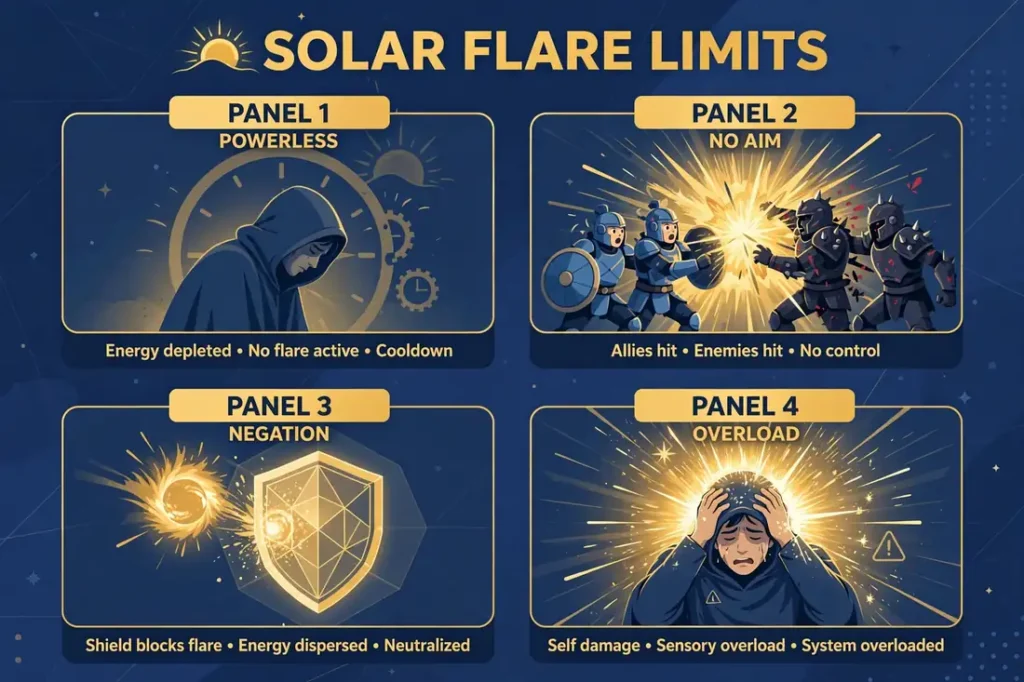
The flare’s price is the crash. Superman’s Super Flare, as depicted in the comics, leaves Superman essentially powerless for the next 24 hours while his cells recharge in a yellow sun environment, temporarily vulnerable to threats he would normally ignore. The technique is unstable, and he woke from his first use in the Bat-Cave, rescued by Batman after the venting knocked him out.
The TV version softens the blow. Kara Danvers‘ Supergirl flare in “Human For A Day”, as depicted in the show, works a little differently on TV: no giant explosion, and she did not lose consciousness. The crash is the power’s dramatic engine either way: every flare is a gamble that the fight ends before the user does, because after the light comes the dark.
What Can Stop a Solar Flare User?
A flare is mighty but brittle. The catalog’s own limitation is Sensory Overload: a user may end up experiencing sensory shutdown from their own glare. The subtler limits are tactical: the user may require solar energy from a source, so night, caves, and deep shade starve the battery, and an omnidirectional burst has no aim, meaning allies and cover burn with the enemies.
The hard counters mirror other energy powers: Solar Immunity and Photokinetic Immunity no-sell the light, Solar Negation ends the power outright, and absorption-type powers can drink the charge mid-vent. For the perils that follow the flash, see atmospheric adaptation; for more energy-power variety, god ki abilities and emitter quirks.
Famous Solar Flare Users
From comics to anime to games, these are the characters who defined the art of the omnidirectional sun.
Icons of the Solar Flare in Comics, Anime, and Games
The icons each found a signature way to vent the sun, as depicted in their stories: Clark Kent (Superman, DC Comics) and his New 52 Super Flare, venting every cell for a quarter-mile incineration at the cost of 24 powerless hours; Kara Danvers (Supergirl), whose TV flare is gentler; Krillin and Son Goku (Dragon Ball Z) with the Taiyoken blinding flash; Tien Shinhan (Dragon Ball), the technique’s inventor; Shiro Yoshida (Sunfire, Marvel Comics), sheathing himself in plasma flame; Johnny Storm (Human Torch, Marvel Comics), whose Nova Burst is the fire family’s answer.
The deeper cuts, as listed in the fan catalog: Leon and Rodrigo Roderick Caldias El Vivare (Disciple of the Holy Sword); Victoria (Hero Killer); GlyphX (NKOSI Publishing); Ryoh Grantz (Mashle); Starfire (Teen Titans Go). For lightning-fast fighting styles, see thunder breathing; for the flare’s electrical cousin, our electric surge guide.
Conclusion
Solar flare is sunlight at its most absolute: not the focused line or the aimed wave, but the everything-at-once detonation, the body as a brief and terrible star. Whether it arrives as Superman’s Super Flare, a Taiyoken flash, or the Carrington storm that set telegraphs sparking, it runs on the same three phases: charge, vent, crash. Want to give the power to your own character? Try our superpower generator and see how bright your sun burns.


