
Tidal Wave Superpower Explained: The Crashing Catastrophe
Tidal wave is the superpower of summoning a catastrophic wave: a wall of water (or lava, sand, or blood) called forth to crash down on everything in its path. Power filings call it Tidal Wave Generation, also known as Tsunami Generation. This guide is a technique deep-dive, not a power overview: what the wave is, how it works, its four uses, the real tsunami science behind it, its price, and its most famous wielders. For the full water power, see our Water Manipulation guide.
In this guide: What Is a Tidal Wave? | Tidal Wave vs Tsunami: What’s the Difference? | How a Tidal Wave Works as a Superpower | The Four Uses | Real Science: How Tsunamis Actually Work | Limits: The Price of the Wave | Famous Tidal Wave Users in Fiction | Conclusion | FAQs
What Is a Tidal Wave?
Forget precision. A tidal wave is the opposite of a scalpel: the user calls forth huge water waves to crash down at their targets, washing everything away in a powerful torrent. The filings class it as a sub-power of both Water Manipulation and Disaster Manipulation, which tells you everything: it is a water technique with a disaster’s footprint.
Three beats define it. Summon: gather the water, from lakefuls to oceanfuls. Crash: hurl it at the target. Wash away: let the torrent carry everything off. Master-level users become living natural disasters, flooding regions and overwhelming armies even on dry land.
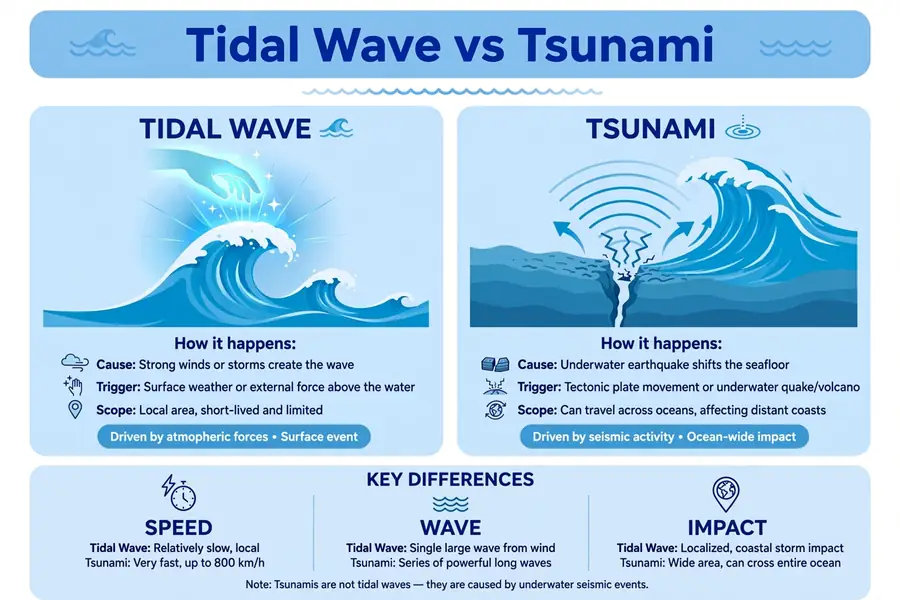
Tidal Wave vs Tsunami: What’s the Difference?
| Tidal Wave (pop name) | Tsunami (science) | |
|---|---|---|
| Meaning | Giant destructive wave | Japanese: harbor wave |
| Cause | User summons it | Earthquake, landslide, volcano, impact |
| Tides involved | None | None |
| Shape | Single crashing wall (fiction) | Wave trains over 10-60 minutes |
| Speed | Plot speed | Up to 800 kmh in deep ocean |
The Name Problem
Here is the correction every tidal wave post must make first: real tsunamis have nothing to do with the tides. “Tsunami” is Japanese for harbor wave, and “tidal wave” is just the popular nickname. The power filings use both names interchangeably: Tidal Wave Generation is also called Tsunami Generation or Torrent Generation.
In fiction, the distinction barely matters. When a character summons a tidal wave, readers picture a wall of water crashing down, and that is exactly what the power delivers. Science keeps the terms honest; storytelling keeps them dramatic.
The Science, Briefly
A real tsunami is not one wave but wave trains: multiple waves with wavelengths of 100 to 500 km racing across the deep ocean at up to 800 kmh, slowing near shore and piling up into runup heights of 40 meters or more, battering the coast for 10 to 60 minutes. The classic warning sign is the sea receding before the surge.
A superpowered tidal wave borrows this shape and skips the cause. No earthquake required: the user simply calls forth huge water waves and aims them. The physics of the crash stays the same.
How a Tidal Wave Works as a Superpower
The technique is simple in concept and absolute in execution. What varies is the scale, the medium, and the intent, and each variation changes what the wave does.
| Wave medium | Damage type | Flavor |
|---|---|---|
| Water | Blunt force, drowning | The classic |
| Lava | Heat, burning | Volcanic catastrophe |
| Sand | Abrasion, burial | Desert apocalypse |
| Blood | Horror, ritual | Dark fantasy |
Summon, Crash, Wash Away
The technique has three beats. Summon: gather or generate the water, from lakefuls to oceanfuls at master level. Crash: hurl the mass at the target, the crushing waves doing the damage through sheer momentum. Wash away: the powerful torrent carries everything off, which is why the filing’s first application is “wash everything away.”
Scale is the point. Filings describe users who flood large areas and overwhelm enemies even on dry land, becoming living natural disasters. A tidal wave is not a punch; it is a weather event with a target.
Not Just Water
The filing adds a twist: various fluid elements can form the wave. Lava wave brings magma’s heat, sand wave brings desert mass, blood wave brings horror. The mechanics are identical; only the medium changes, and each medium brings its own damage type.
This is why the power sits under both Water Manipulation and Disaster Manipulation. The wave is a delivery system. What it delivers is the user’s choice.
The Four Uses
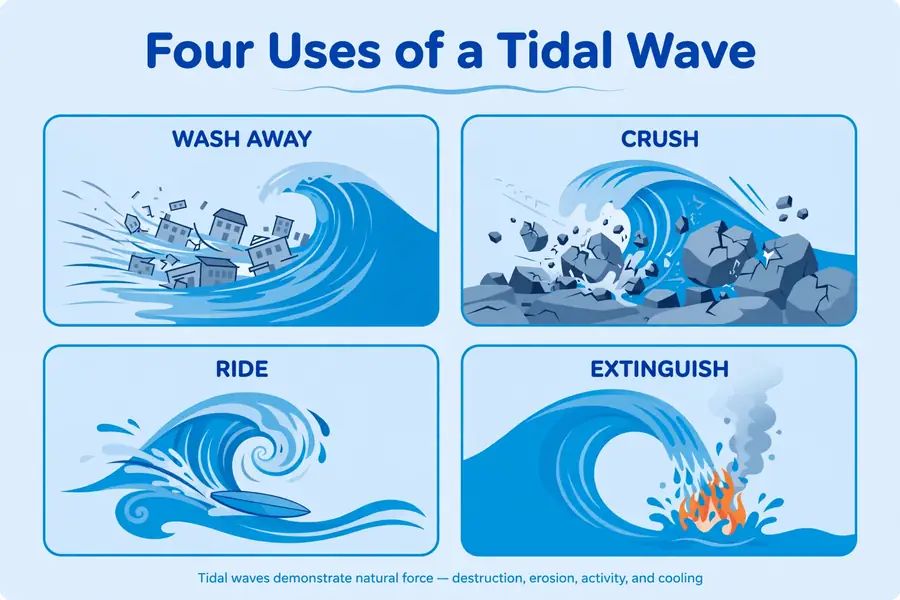
The filings give the wave four jobs: two destructive, two useful. The same surge that levels a city can save one, depending on where it lands.
Wash Away and Crush
The first two uses are offensive. Wash away clears the field: fortifications, armies, vehicles, all carried off in the powerful torrent. Crush uses the crushing waves themselves as the weapon, the water’s momentum doing what no fist could. Filings note users can produce extremely large tidal waves capable of extensive destruction across whole regions.
Both uses share a trait: area of effect. A tidal wave does not pick targets. It picks a direction.
Ride and Extinguish
The last two uses are utility. Ride the waves for quick travel: the user surfs their own surge, outrunning anything on foot. Extinguish turns the catastrophe into rescue: a wave big enough to level a town can also drown raging infernos in seconds, which is why the filing lists firefighting among the applications.
The same wave that destroys can save. It depends entirely on where it lands.
Real Science: How Tsunamis Actually Work
The power is fantasy, but the oceanography is real. Everything below is established science, and it is why the superpower lands with weight: the ocean really does this, unprompted.
What Causes a Tsunami
Real tsunamis start with rapid displacement: seismic activity (most commonly undersea earthquakes in subduction zones, where tectonic plates collide), landslides, volcanic eruptions, or meteoroid impacts. The displaced seawater moves with violent motion and surges overland with great destructive power. Read the science on tsunamis.
The deadliest recorded tsunami struck the Indian Ocean in 2004; Japan in 2011 showed the same physics on a modern coastline. Fiction’s tidal waves skip the geology and keep the surge. For the earthquake half of the story, see our Earth Manipulation guide.
Wave Trains and Runup
Two details make tsunamis deadlier than they look. First, wave trains: the danger is multiple waves, not one, arriving over 10 to 60 minutes, so the first wave is rarely the last. Second, runup: as the wave slows near shore, its energy piles upward into runup heights that can exceed 40 meters, funneled higher by bays and valleys.
A superpowered tidal wave inherits both traits. The target does not survive the first wave only to be safe; the water keeps coming, and the shore keeps amplifying it.
Limits: The Price of the Wave
Every catastrophe has a cost, and the tidal wave’s is steep. The filings name two hard limits, and physics adds the counters.
The Price of the Wave
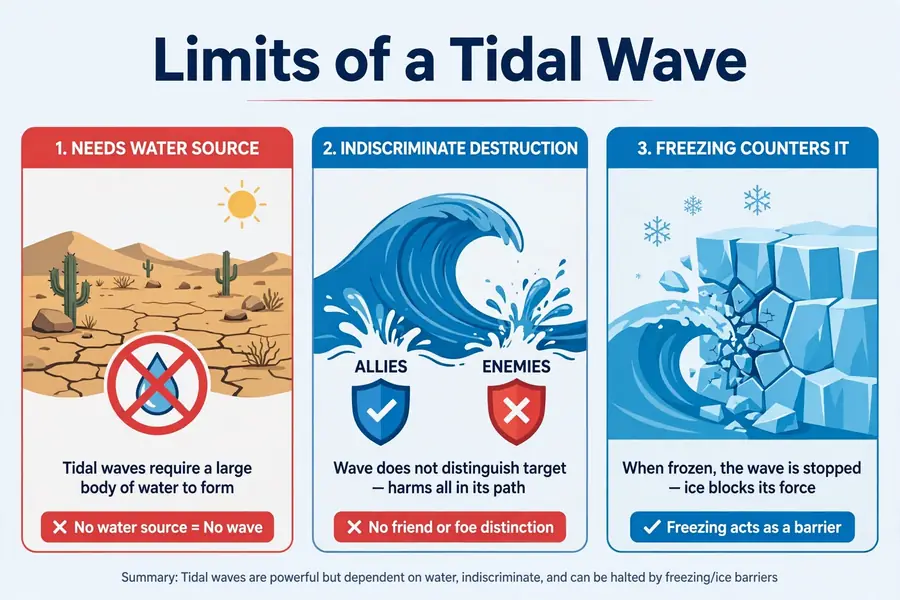
The filings name two hard limits. First, lack of water source prevents the tidal wave from being formed: no water, no wave, and dry land far from any source starves the technique. Second, destruction may be indiscriminate: the wave does not distinguish friend from foe, which makes it as dangerous to the user’s allies as to their enemies.
Counters follow from the physics: earth barriers can break or redirect the surge, freezing locks the medium solid, and evaporation or sheer heat shrinks the supply. Distance, mass, precision, and energy cost all scale with user skill. If the matchup looks bad, a quick visit to a random weakness generator beats a fair fight.
Famous Tidal Wave Users in Fiction
The filing’s own Known Users section is empty, which says something: the tidal wave is usually a feat, not an identity. These wielders made it theirs anyway.
The Wave Riders
The wielders span comics, anime, and film, each as depicted in their own universe. Miya Shimada, codenamed Tsunami (DC Comics, debut All-Star Squadron #33, May 1984, created by Roy Thomas and Rick Hoberg), generates tidal waves alongside superstrength and superspeed. Kisame Hoshigaki (Naruto) uses Water Release: Exploding Water Colliding Wave to raise an ocean-scale surge. Percy Jackson (Percy Jackson) summons tidal waves through his water powers. Katara and Aang (Avatar) bend waves at tidal scale. Aquaman (DC Comics) has turned the sea itself into a weapon.
Each shows the technique at a different register: Tsunami as identity, Kisame as jutsu, Percy as demigod feat, the Avatars as bending mastery, Aquaman as oceanic authority. The wave stays the same; only the hand changes.
Conclusion
Tidal wave is the water family’s doomsday button: summon, crash, wash away. It is indiscriminate, it is spectacular, and it is the rare technique that can drown a fire as easily as a fortress. No other single attack in the elemental set carries a disaster’s footprint. Want to hand the crashing catastrophe to your own character? Try our superpower generator and see what surges.
FAQs
What is a tidal wave as a superpower?
A tidal wave is the superpower of summoning a catastrophic wave: a wall of water called forth to crash down on targets and wash everything away. Filings call it Tidal Wave Generation.
Is a tidal wave the same as a tsunami?
In fiction they are used interchangeably, and filings list Tsunami Generation as another name. In science, tsunamis have nothing to do with the tides; tsunami is Japanese for harbor wave.
What is the difference between Tidal Wave and water manipulation?
Tidal Wave is one specific technique: the catastrophic wave. Water manipulation is the full umbrella power covering every way of controlling water.
Can a tidal wave be made of lava or sand?
Yes. Filings note that various fluid elements can form the wave, including lava, sand, and blood. The mechanics stay the same; only the medium changes.
What are the limits of a tidal wave?
Lack of water source prevents the wave from forming, and the destruction may be indiscriminate, endangering allies. Earth barriers and freezing can counter it.
Who are famous tidal wave users in fiction?
Miya Shimada aka Tsunami (DC Comics), Kisame Hoshigaki (Naruto), Percy Jackson, Katara and Aang (Avatar), and Aquaman (DC Comics), each as depicted in their own universe.


