
Vine Whip Superpower Explained: The Classic Plant Strike
Vine whip is the signature plant technique: striking with slender, whiplike vines. It is the most famous single attack in the green family, immortalized as a Pokémon move and echoed across anime, comics, and games. This guide is a technique deep-dive, not a power overview: the move’s stats, its six combat uses, its wielders across fiction, the real-world botany behind it, and how to beat it. For the full family of plant powers, see our Plant Manipulation guide.
In this guide: What Is Vine Whip? | Vine Whip in Pokémon: The Numbers | The Six Uses of a Vine Whip | Vine Whip Beyond Pokémon | Real World: Why Vines Make Great Whips | Limits: How to Beat a Vine Whip | Conclusion | FAQs
What Is Vine Whip?
Strip plant powers down to one attack and you get the vine whip: a living vine, grown or commanded, used as a lash. It strikes, grabs, snares, and tethers. The plant manipulation filings describe users who “manipulate tree branches to use them as whip-like weapons,” and every green fighter in fiction eventually learns the lash.
The technique’s fame comes from Pokémon, where Vine Whip is the definitive Grass-type attack: “the target is struck with slender, whiplike vines to inflict damage.” But the idea is older and wider than any one franchise. A vine is nature’s rope, and a rope swung with intent is a whip.
Vine Whip in Pokémon: The Numbers
The move’s data is public record on Bulbapedia. It is the rare technique with an exact stat block, which makes it the perfect anchor for understanding what a vine whip does.
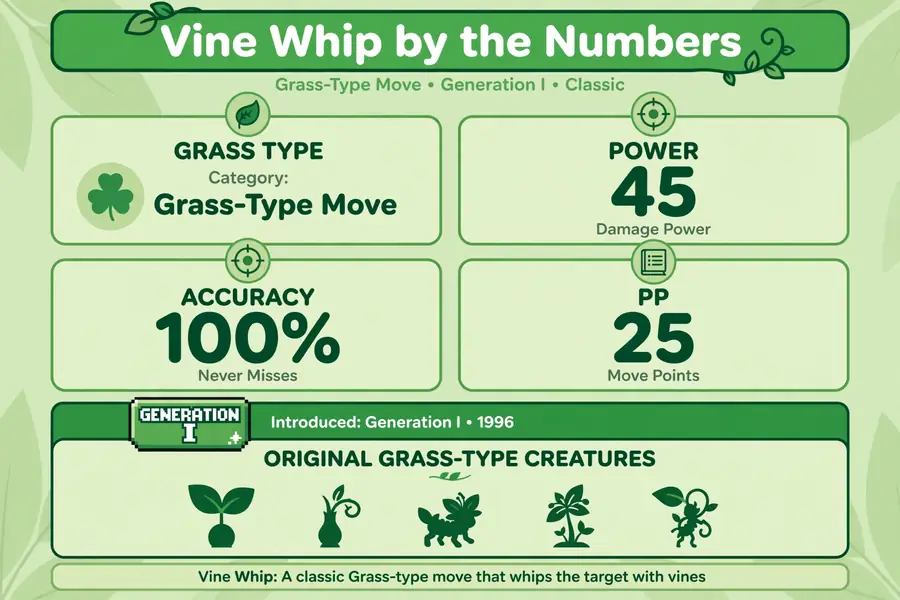
| Gen I-III | Gen IV-V | Gen VI onward | |
|---|---|---|---|
| Type | Grass | Grass | Grass |
| Category | Physical | Physical | Physical |
| Power | 35 | 35 | 45 |
| Accuracy | 100% | 100% | 100% |
| PP | 10 | 15 | 25 (max 40) |
| Effect | None | None | None |
The Stats Across Generations
The move’s numbers are public record on Bulbapedia. Vine Whip is a Grass-type Physical move with 100 percent accuracy and no secondary effect. In Generations I through III it had Power 35 and 10 PP; Generations IV and V raised PP to 15; from Generation VI onward it sits at Power 45 with PP 25 (max 40). It makes contact, so it is affected by Protect, Mirror Move, and King’s Rock.
The arc tells a story: a modest starter move that stayed honest. It never gained a flashy effect, which is exactly why it endures: 100 percent accuracy means it always lands, and in the early game that reliability beats raw power.
Who Learns It
The learnset is a Grass-type hall of fame. The Bulbasaur line learns it first, at low levels, and it spreads across Ivysaur, Venusaur, Bellsprout, Weepinbell, Victreebel, Tangela, Tangrowth, Carnivine, Snivy, Servine, Serperior, Pansage, Simisage, Chespin, Quilladin, Chesnaught, Chikorita, Skiddo, Gogoat, Comfey, Zarude, and Ogerpon. In Super Smash Bros., it is Ivysaur’s Up Special, with tether functionality for grappling ledges; in Pokémon GO it is a fast attack with 0.6 second duration.
What unites them is body plan: every learner has vines, tendrils, or prehensile growths to whip with. The move is the body weaponized.
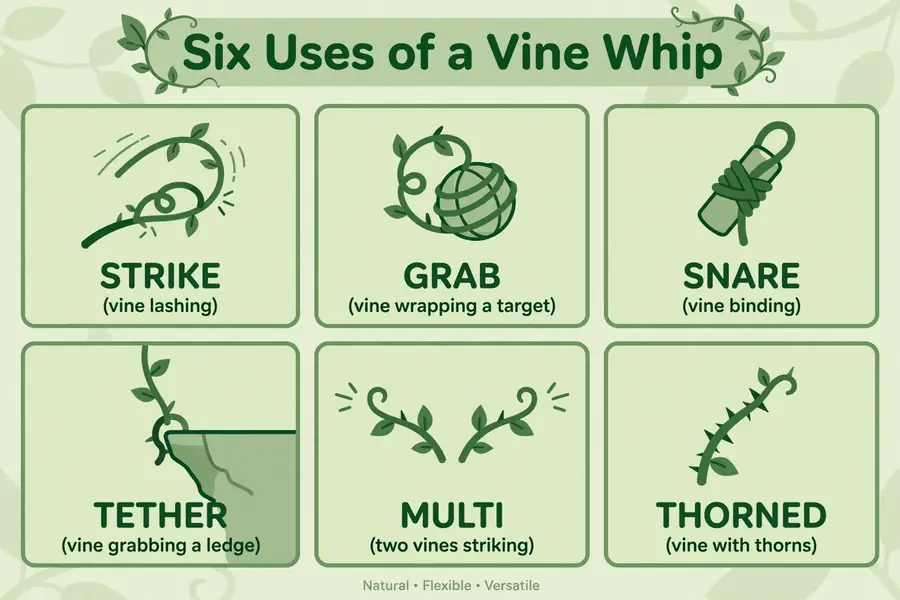
The Six Uses of a Vine Whip
| Use | What it does | Example |
|---|---|---|
| Strike | Basic lash, slashing or bludgeoning damage | The Stadium “cruel whips” |
| Grab and slam | Wrap, lift, and slam the target | Ash’s Bulbasaur vs Pikachu |
| Snare and bind | Immobilize, choke, or disarm | Victreebel entangling prey |
| Tether and rescue | Grab allies or objects, swing gaps | Smash Bros. ledge tether |
| Multi-whip | Two vines, or one vine striking twice | Snivy whipping twice |
| Thorned whip | Thorns or blades along the vine | Kurama’s Rose Whip |
Strike, Grab, and Snare
The first three uses are the combat core. Strike is the basic lash: a slashing or bludgeoning hit at reach, the “cruel whips” of the Stadium description. Grab and slam upgrades it: wrap the target, lift, and slam, exactly as Ash’s Bulbasaur did to Pikachu, wrapping it and slamming it to the ground repeatedly. Snare and bind trades damage for control: immobilize, choke, or disarm by wrapping limbs or weapons.
Each use answers a different problem: strike for damage, grab for dominance, snare for control. A skilled user chains all three in one exchange.
Tether, Multi-Whip, and Thorned Whip
The last three uses show the technique’s range. Tether and rescue turns the whip into a lifeline: grab allies or objects at range, swing across gaps, or grapple to ledges, the Smash Bros. application. Bulbasaur’s anime feats include saving Pikachu from Team Rocket’s balloon and shaking vines in celebration. Multi-whip doubles down: two vines striking at once, or one vine whipping twice, as Snivy demonstrates.
Thorned whip is the lethal upgrade: thorns or blades grown along the vine, turning a lash into a saw. Kurama’s Rose Whip is the famous example, a rose stem made razor.
Vine Whip Beyond Pokémon
The technique belongs to the whole green family, and its wielders span every medium. What changes is the flavor; the lash stays the same.
The Rose Whip and Other Icons
Beyond Pokémon, the technique has icons, each as depicted in their own universe. Kurama (Yu Yu Hakusho) wields the Rose Whip, a rose stem transformed into a bladed lash that cuts like a sword. Poison Ivy (DC Comics) uses strangling vines as whips, blending the lash with toxins. Ibara Shiozaki (My Hero Academia) whips and snares with her prehensile vine hair. Cornelia Hale (W.I.T.C.H.) commands vine lashes at guardian scale.
Each icon tweaks the formula: Kurama adds the blade, Ivy adds poison, Ibara adds the hair-as-weapon body plan, Cornelia adds scale. The technique stays recognizable through every variation.
Real World: Why Vines Make Great Whips
The power is fantasy, but the botany is real. Everything below is established natural history and physics, and it is why the technique feels plausible.
Why Vines Make Great Whips
Nature built the prototype. Lianas are woody vines in tropical forests that hang like natural ropes, strong enough for animals to swing on; a vine whip is just a liana with intent. Climbing vines like ivy and grapevines grip with tendrils, the natural model for the snare function: wrap, tighten, hold.
The physics cooperates too. A whip crack happens because the tip exceeds the speed of sound, and a long flexible vine delivers the same leverage and reach mechanics: speed at the tip, control at the handle. Fiction exaggerates the material; the mechanics are honest.
Limits: How to Beat a Vine Whip
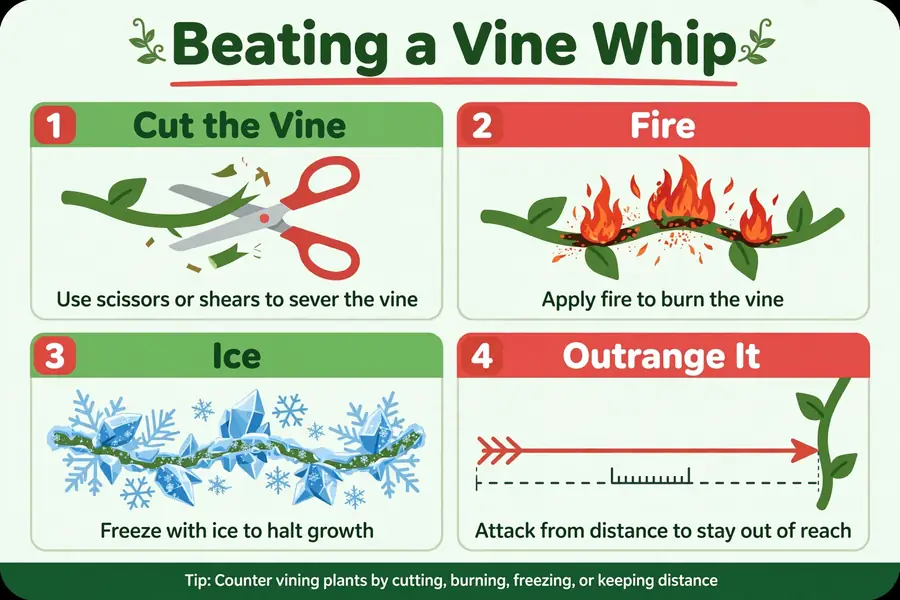
Every technique has counters, and the vine whip’s are practical. They fall into three groups: destroy the vine, outrange the user, or turn the whip against them.
How to Beat a Vine Whip
Every whip has a weak point, and this one has several. Cut the vine: it is still plant matter, and a blade ends the threat at the cost of one swing. Fire burns vines faster than they regrow, ice freezes them brittle, and herbicide kills the medium. Limited reach is structural: the whip only extends as far as the vine, so outranging the user wins.
The subtlest counter is contact risk: a whip that grabs can be grabbed back. An enemy who seizes the vine controls the user through it. And with no plants, no power: strip the vegetation and the technique starves. If the matchup looks bad, a quick visit to a random weakness generator beats a fair fight.
Conclusion
Vine whip is the green family’s signature strike: one technique, six uses, endless variations. Strike for damage, grab for dominance, snare for control, tether for rescue, multi-whip for pressure, thorned whip for the kill. From Bulbasaur’s first lash to Kurama’s bladed rose, it proves that the simplest plant attack is also the most versatile. Want to hand the classic plant strike to your own character? Try our superpower generator and see what lashes out.
FAQs
What is Vine Whip as a superpower?
Vine Whip is the signature plant technique: striking with slender, whiplike vines. It is a single attack, not a full power, used to strike, grab, snare, and tether.
What are Vine Whip’s stats in Pokémon?
Vine Whip is a Grass-type Physical move with Power 45, 100% accuracy, and 25 PP in Generation VI onward. It makes contact and has no secondary effect.
Which Pokémon can learn Vine Whip?
The Bulbasaur line, Bellsprout line, Tangela, Tangrowth, Carnivine, Snivy line, Pansage line, Chespin line, Chikorita, Skiddo, Gogoat, Comfey, Zarude, and Ogerpon, among others.
How is Vine Whip used outside of Pokémon?
Kurama’s Rose Whip (Yu Yu Hakusho) is a bladed vine lash, Poison Ivy uses strangling vine whips, Ibara Shiozaki whips with vine hair, and Cornelia Hale commands vine lashes at scale.
What is the difference between Vine Whip and plant manipulation?
Vine Whip is one specific technique: the vine lash. Plant manipulation is the full umbrella power covering growth, shaping, sensing, and every plant technique.
How do you defend against a vine whip?
Cut the vine, burn it with fire, freeze it with ice, or outrange the user. A whip that grabs can also be grabbed back, turning it against the user.


