
Nature’s Wrath Superpower Explained: The Reckoning
Nature’s Wrath Superpower Explained: The Reckoning
The forest noticed. The river remembered. And one day the bill came due. Nature’s Wrath is the superpower of deliberate ecological retribution: nature as judge and punisher, answering despoilment with targeted, inescapable vengeance. Trope catalogs call the archetype Gaia’s Avenger: one who takes it as a personal quest to fight polluters, all in the name of Mother Earth. This guide follows THE RECKONING framework: SENSE the wound, JUDGE the guilty, PUNISH the crime. This is the seventh post of our Elemental Manipulation collection, and the second of a two-post pair: its sibling, Nature’s Fury, takes the opposite lane, raw catastrophic outburst instead of deliberate judgment.
In this guide: What Is Nature’s Wrath? | Nature’s Wrath vs Nature’s Fury | What Can Nature’s Wrath Do? Applications | The Eco-Avengers: Nature’s Wrath in Fiction | When the Forest Fights Back: Myth and Folklore | Weaknesses and Limitations | Conclusion | FAQs
What Is Nature’s Wrath?
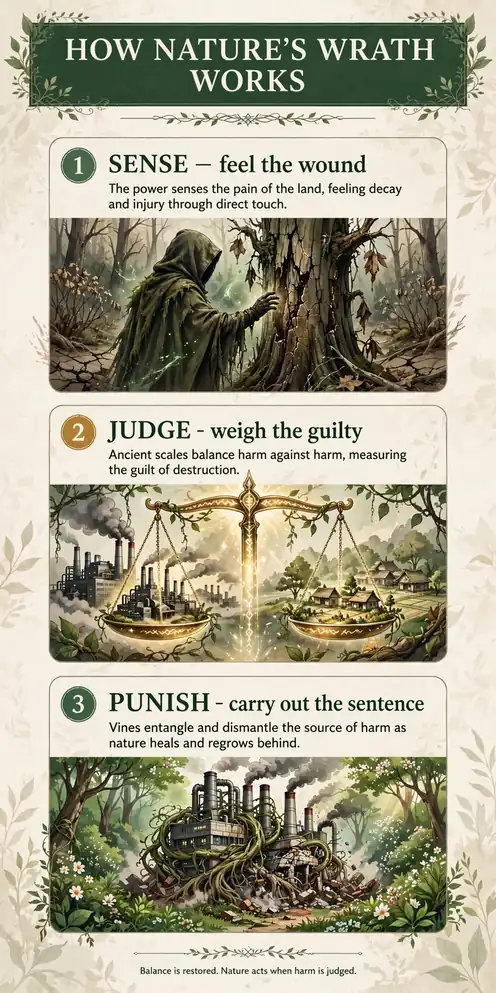
Forget indiscriminate destruction. The wrath-bearer does not level cities; they audit them. It is the most moral of the elemental powers and the most uncomfortable, because its justice is the land’s accounting, not human law. The framework of this guide is THE RECKONING: three moves (sense, judge, punish) that every version of the power plays in some combination.
The Reckoning, Defined
Nature’s Wrath is the superpower of nature as judge and punisher: the forest that noticed, the sea that remembered, the Green that passed sentence. Where Nature Manipulation in general is the neutral art of commanding the natural world, and Nature’s Fury is its indiscriminate violence, the wrath is its targeted, moralized retribution. Trope catalogs call the archetype Gaia’s Avenger: a person who takes it as a personal quest to fight polluters, all in the name of Mother Earth.
The key word is selective. A wrath-bearer does not flood the valley; they flood the dam the conglomerate built illegally, and the village downstream stays dry. The power’s fantasy is not destruction but accountability: the fantasy that the planet keeps receipts. This guide follows THE RECKONING framework: sense the wound, judge the guilty, punish the crime.
Sense, Judge, Punish: The Three Moves
Every Nature’s Wrath runs three moves. First, SENSE: the bearer feels the wound, the despoiled forest, the poisoned waterway, the clear-cut hillside, the way a nerve feels a burn. The World Anvil write-up of the concept’s avatar says it is summoned by a scarred, grieving landscape, which means the power begins not with the bearer but with the land’s pain. Second, JUDGE: the bearer weighs the guilty, separating the conglomerate that knowingly externalizes damage from the struggling village that merely survives. Third, PUNISH: the sentence is carried out, and the land is restored after.
The three moves are what keep the wrath from sliding into the fury. Sense without judgment is just anger; judgment without punishment is just complaint. Together they make the power a courtroom the polluters never saw coming, with the planet itself as plaintiff, judge, and executioner.
Nature’s Wrath vs Nature’s Fury
The two names sound like synonyms, and even fan catalogs mix them up, but they are opposite powers. One is judgment with force; the other is force without judgment. If you came here unsure which one you meant, the table below settles it, and each guide links to the other so you can compare.
The Wrath-Fury Comparison
| Aspect | Nature’s Wrath (this guide) | Nature’s Fury (sibling guide) |
|---|---|---|
| Core idea | Deliberate ecological retribution: nature as judge and punisher | Raw catastrophic outburst: nature’s violent extremes unleashed |
| Moral stance | Selective; targets polluters and transgressors, spares the innocent | Indiscriminate; neither benign nor malignant, it simply advances and destroys |
| Instruments | Poisoned flora, vengeful fauna, the Green passing sentence | Storms, quakes, floods, eruptions: the disaster arsenal |
| Trigger | The land’s wound: despoilment, pollution, mindless harvesting | The bearer’s rage and conviction |
| Fiction anchors | Poison Ivy, Godzilla (2014), Swamp Thing, dryads | Storm (Marvel), Aquaman’s storm-casting, the Harpies, Pompeii |
| Trope lineage | Gaia’s Vengeance, the Gaia’s Avenger | The Saffir-Simpson fury scale |
What Can Nature’s Wrath Do? Applications
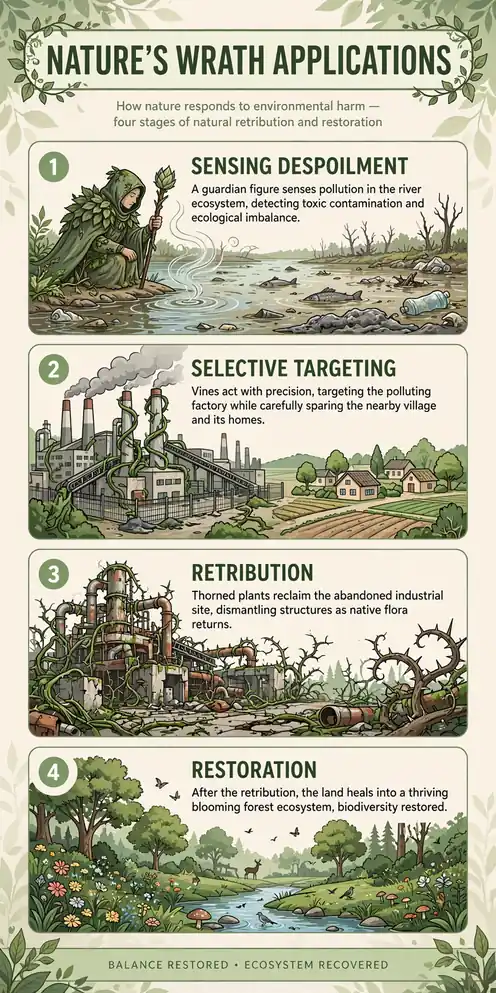
The applications flow from the three moves. Sense finds the wound, judge names the guilty, and punish delivers the sentence. Together they make the wrath-bearer less a weapon and more a verdict with roots, which is exactly why even sympathetic heroes find the avenger so hard to stand beside.
Sense: Feel the Wound
Sense is the power’s conscience and its radar. The wrath-bearer perceives despoilment the way others perceive sound: the forest thinning, the river warming, the soil going quiet. The Hero Games write-up of the Avenging Spirit of Nature says these manifestations appear specifically where nature, be it the forest, animals, waterways, and so on, is being despoiled and squandered. The wound calls the wrath into being; without a wound, there is no wrath, only a person standing in a healthy forest with nothing to avenge.
This is also why the wrath cannot be aimed like a weapon. A general can order an artillery strike anywhere; a wrath-bearer can only answer where the land is actually hurting. The power’s first limit is built into its first move: no genuine wound, no retribution. Manufactured outrage does not summon the Green.
Judge: Weigh the Guilty
Judge is the move that makes Nature’s Wrath a moral power instead of a natural disaster. The bearer weighs who actually caused the wound, and the fan write-ups are strikingly consistent about the verdict. The selective-wrath character David targets polluting conglomerates that knowingly externalize damage, corporations engaging in greenwashing while lobbying against reform, and politicians who trade environmental protections for campaign funding, and explicitly does not target small businesses, struggling communities, or individuals without systemic power.
That selectivity is the whole point, and it is also the power’s famous discomfort: as the write-up puts it, the wrath forces heroes to confront the reality that some evils persist precisely because they are legal. The judge’s logic is not human law; it is the land’s accounting. When the two disagree, the wrath sides with the land, which is why even sympathetic heroes find the avenger so hard to stand beside.
Punish: Carry Out the Sentence
Punish is the reckoning made visible, and it is always targeted. The sentence fits the crime in the land’s own language: the clear-cutter’s mill swallowed by the roots it tried to outrun, the poisoner’s own toxins turned back on their tanks, the dam that drowned a valley cracked by the river it chained. The Avenging Spirit write-up is blunt about the tone: it is a driven engine of retribution, ruthless in its vengeance, hunting down and destroying its foes without mercy, and it will combat what it perceives as evil, not necessarily what a human or elf might define as evil.
Then comes the part the fury never offers: restoration. The World Anvil avatar, for all its mangled vines and turgid stone, is a last line of defense, and the wrath’s fantasy ends with the wound healing, the forest returning, the river running clear. Punishment is not the point; the healed land is. The wrath is done when there is nothing left to avenge.
The Reckoning Toolkit
| Move | What it does | Who embodies it |
|---|---|---|
| Sense the wound | Perceives despoilment: thinned forests, poisoned waterways, squandered wilds | The Avenging Spirit of Nature (Hero Games), dryads of folklore, as depicted |
| Judge the guilty | Weighs transgressors; targets the powerful, spares the powerless | David, the selective-wrath character (fan write-up), as depicted |
| Punish the crime | Carries out targeted retribution in the land’s own language | Poison Ivy (DC Comics), as depicted |
| Restore the land | Heals the wound after the sentence: the last line of defense | Swamp Thing, defender of the Green (DC Comics), as depicted |
| The ultimate sentence | Kaiju-scale judgment against civilization-level transgression | Godzilla (2014), a representation of the wrath of nature, as depicted |
The Eco-Avengers: Nature’s Wrath in Fiction
The wrath is a character power before it is a weather event. Fiction keeps casting it the same way: someone the land chose, or someone who chose the land, standing between the despoilers and everything green. Three faces define the archetype, and a wider bench proves how deep it runs.
Poison Ivy, Nature’s Wrath Personified
If the wrath had a face in comics, it would be green. Poison Ivy, Dr. Pamela Lillian Isley, is often personified as nature’s wrath in DC Comics, one of the few characters willing to stand up against megacorps and worse, doing it all for the sake of the environment, more specifically, her beloved flora. Her story is the judge’s origin in miniature: in the animated continuity, the extinction of the rare wild thorn rose drove her to get revenge on the people whose acts of deforestation or extinction caused it. Her plant mastery runs on the same green logic as our Chlorokinesis guide, aimed at punishment instead of growth.
Ivy is the Gaia’s Avenger archetype at its purest: a personal quest to fight polluters, all in the name of Mother Earth, pursued past the point where heroes are comfortable following. She is presented as depicted in her own universe, and she is the reason this post treats the wrath as a character power, not just a weather event with opinions.
Godzilla, the Punishment We Deserve
The wrath also comes in kaiju size. Director Gareth Edwards said of Godzilla (2014) that the monster is definitely a representation of the wrath of nature, and his gloss is the single best definition of this post’s power: “The theme is man versus nature and Godzilla is certainly the nature side of it. You can’t win that fight. Nature’s always going to win… He’s the punishment we deserve.” In the film’s own logic, Dr. Serizawa believes nature sent Godzilla to restore balance, hunting the MUTOs that threaten the world’s order.
Note the moral shape: Godzilla only attacks humans after they deliberately antagonize him, and even then retaliates against the military. That is the judge’s logic at city scale: punishment with a trigger condition, not a rampage. The original 1954 film plays the metaphorical note: a monstrous byproduct of radioactive pollution that humanity has created and now has to deal with. Either way, the bill arrives, and it is itemized.
The Green, the Blue, and the Avenging Spirits
Ivy and Godzilla are the famous faces, but the archetype runs deeper. Swamp Thing, the plant elemental created by Len Wein and Bernie Wrightson, champions environmental protection, safeguards his swamp, and defends the Green, which represents Earth’s plant life, battling threats like pollution and deforestation. Where Ivy is the wrath’s anger, Swamp Thing is its patience: the guardian who punishes only when the Green itself is threatened.
The waters answer with Aquaman as Avatar of the Blue, a multiversal elemental force flowing through all water in existence, the ocean’s own avenger when its depths are despoiled. And the old tabletop write-ups give the archetype its purest form: the Avenging Spirit of Nature, a driven engine of retribution that appears where the wild is squandered, the beast-side of the same logic our Animal Empowerment guide covers. Different faces, one logic: the land keeps receipts, and eventually it collects.
When the Forest Fights Back: Myth and Folklore
The wrath is older than comics by a few thousand years. Folklore’s vengeful wilds are the power’s oldest character sheets, and they already understood the judge’s logic: the wound first, the sentence second, the innocent spared.
Dryads and the Forest’s Fury
The dryads are the forest’s own avengers and the reckoning’s oldest faces: while typically seen as benevolent spirits, their wrath can be fierce and unrelenting when their environment is jeopardized by deforestation, pollution, and climate change. The old stories read like case files: sudden storms, strange animal behavior, travelers lost in woods they disrespected, intense storms, wildfires, or localized disasters answering human carelessness.
The pattern is the reckoning in miniature: a wound (the felled grove), a judgment (the forest noticed), a sentence (the forest answers). The dryad never floods the innocent village downstream. She is selective the way the whole power is selective, which is why centuries of folklore kept telling her story: it is the fantasy that the wild is watching, and that it grades on a curve humanity cannot bribe.
The Furies, Vengeance’s Old Name
Even the word “wrath” has a pedigree. The Erinyes, the Furies of Greek myth, were deities of vengeance and retribution who punished crimes, and later discussion frames them as carrying out vengeance for crimes against the natural order. The parallel is etymological, not causal: nobody is claiming the superpower descends from the myth. But the shape rhymes, and it is worth naming: judgment, pursuit, and a sentence that cannot be appealed.
That is the oldest version of the judge’s logic, and it clarifies what the wrath is not. The Furies never punished accidents; they punished transgressions. So does the Green. The wrath is not weather with a temper. It is law with roots.
Weaknesses and Limitations
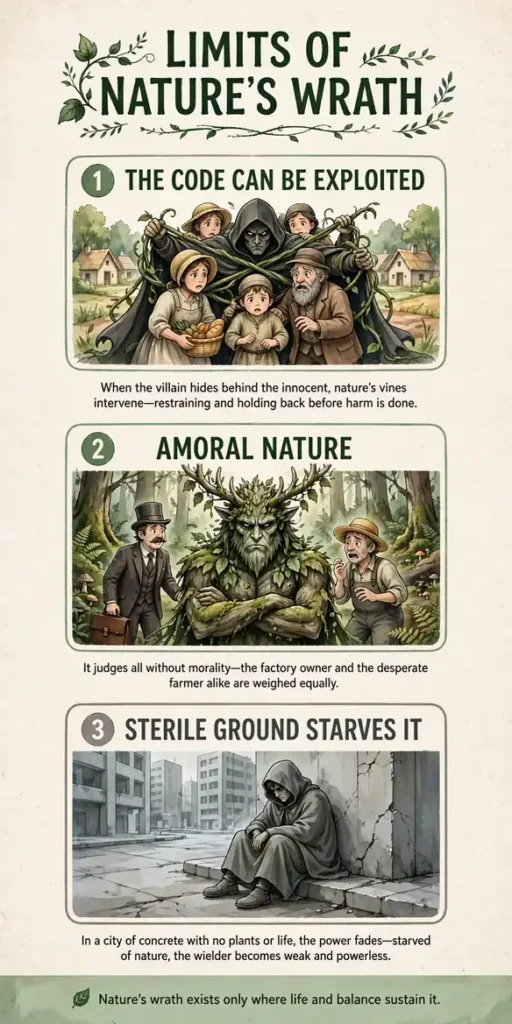
Every power needs its counters, and the reckoning has honest ones. They fall into three groups: the judge’s code can be exploited, the land’s justice is not human justice, and the power starves where nothing lives.
What Can Stop Nature’s Wrath?
Three things check the reckoning. First, its own code: because the wrath is selective, a clever enemy hides behind the innocent, and the judge must either hold fire or break its own law. Second, the land’s judgment is not human justice: the Avenging Spirit write-up warns it is amoral and uncaring from a human point of view and will combat what it perceives as evil, not necessarily what a human might define as evil, which means the wrath can condemn the sympathetic along with the guilty.
Third, the power starves on sterile ground. The filing sets Nature Manipulation as opposite to Technology and the urban world; a wrath-bearer in a concrete sprawl, far from any living system, has no court to convene, and the Earth Manipulation guide shows what the land can do only where the land is alive to answer. And when the matchup still looks bad, a random weakness generator beats facing the Green unprepared. The reckoning is mighty, but it needs a living plaintiff.
Conclusion
Nature’s Wrath is the reckoning: sense feels the wound, judge weighs the guilty, punish carries out the sentence, and the land heals after. It is the planet’s courtroom, convened wherever the wild is despoiled, and its verdicts cannot be appealed to human law. If your character unleashes the storm without asking who deserves it, read the sibling guide, Nature’s Fury. Want to hand the reckoning to your own character? Try our superpower generator and see who the Green finds guilty.
FAQs
What is Nature’s Wrath as a superpower?
Nature’s Wrath is the power of deliberate ecological retribution: nature as judge and punisher. It follows three moves: sense the wound, judge the guilty, and punish the crime, and trope catalogs call its archetype Gaia’s Avenger.
What is the difference between Nature’s Wrath and Nature’s Fury?
Nature’s Wrath is selective and moralized: it targets polluters and transgressors and spares the innocent. Nature’s Fury is a raw, indiscriminate catastrophic outburst with no moral compass. Our sibling guide covers Nature’s Fury in full.
Who does Nature’s Wrath target?
The judge’s logic targets polluting conglomerates that knowingly externalize damage, corporations that greenwash while lobbying against reform, and politicians who trade environmental protections for funding. It does not target small businesses, struggling communities, or individuals without systemic power.
Is Poison Ivy an example of Nature’s Wrath?
Yes. Poison Ivy, Dr. Pamela Lillian Isley, is often personified as nature’s wrath in DC Comics: one of the few characters willing to stand up against megacorps and worse for the sake of the environment, specifically her beloved flora, as depicted in her own universe.
What can stop Nature’s Wrath?
Three things: its selective code can be exploited by enemies hiding behind the innocent, the land’s judgment is amoral and can condemn the sympathetic along with the guilty, and the power starves on sterile ground far from any living system.
Is Nature’s Wrath the same as Gaia’s vengeance?
Gaia’s Vengeance is the trope lineage this power descends from: nature as a sentient being directing an ecosystem against its despoilers, or a Gaia’s Avenger taking up the fight personally. Nature’s Wrath is the superpower version of that archetype.


