
Weather Forecasting Superpower Explained: The Sky Reader
Some powers move the body. Weather forecasting reads the sky itself: the power to sense the atmosphere’s smallest shifts and turn them into prediction, knowing the storm is coming before the first cloud forms. It is the most outward-looking of the mind’s powers, quieter than any radar and older than any satellite. This guide, part of our Mental Powers collection, explains what weather forecasting is, the three moves that power it, what it can do, the real science of barometers in flesh and silicon, and which famous characters embody the sky reader. Where our dream manipulation guide rules the dreaming mind and our sleep manipulation guide owns sleep itself, this one looks up.
In this guide:
- What Is Weather Forecasting?
- Weather Forecasting vs Other Powers
- What Can Weather Forecasting Do? Applications
- Real Science: Barometers in Flesh and Silicon
- Weaknesses and Limitations
- Famous Weather Forecasters in Fiction
- Conclusion
What Is Weather Forecasting?
Other mental powers read minds or rule dreams. Weather forecasting reads the weather: by sensing the atmosphere, interpreting its patterns, and foreseeing what comes next, the user turns the sky into an open book. The sections below define the power, then map its three moves.
The Sky Reader, Defined
A weather forecasting user is a sky reader: someone who can physically and/or psychically sense weather patterns and related phenomena, as the fan catalogs define Weather Perception. The catalogs file the power under names like Weather Sense, Weather Sensing, Barometry, and Psychic Forecasting, rate it Rare, and list it as a variation of Enhanced Senses: the sense that predicts weather patterns (Weather Perception). Where Weather Manipulation (Meteorokinesis, Atmokinesis) controls the sky, weather forecasting only reads it, and that restraint is the whole power.
It is a perceptive power, not an elemental one. The sky reader does not summon the storm; they know it is coming before the first cloud forms, because they feel the air pressure fall, the humidity rise, and the wind shift while everyone else still sees blue sky.
Sense, Read, Foresee: The Three Moves
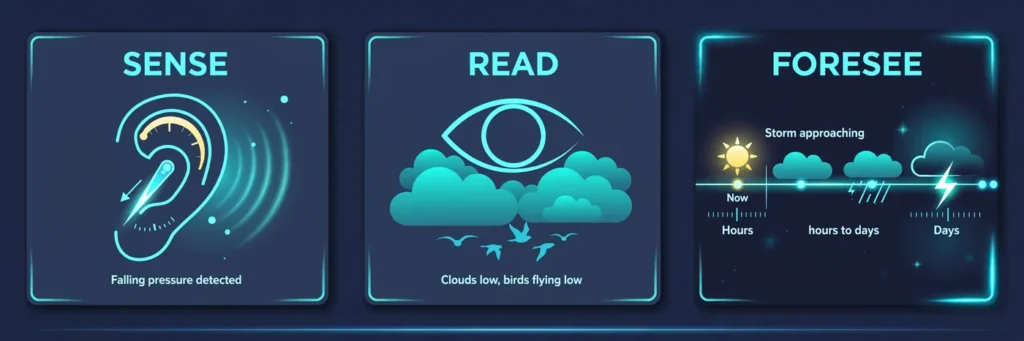
Every weather forecasting runs the same three moves. First, SENSE: the user reads the atmosphere directly, feeling air pressure, humidity, temperature, and wind the way others feel heat from a stove. Second, READ: the user interprets patterns, cloud types, animal behavior, and the weathervane effect, turning raw sensation into meaning. Third, FORESEE: the user converts the reading into prediction, from the storm hours away to the system days out, the psychic forecast made real.
Skip the sensing and you have a guesser; skip the reading and you have static; but run all three and you have the sky reader, the one mind in the storm’s path that already knows the ending.
Weather Forecasting vs Other Powers
The mind has many senses, and weather forecasting is only one of them. Our fourteen Energy Powers guides all cover physical energy, while the Mental Powers siblings cover dreams and sleep. The table below places the sky reader against its closest neighbors: the storm shaper, the future seer, the keen-eared, and the scientist.
The Family Comparison
| Power | What it does | How Weather Forecasting differs |
|---|---|---|
| Weather Forecasting | Senses and predicts weather patterns | The baseline: the sky reader, reads but never changes |
| Weather Manipulation | Controls the weather (Meteorokinesis, Atmokinesis) | Control, not sensing: shapes the sky instead of reading it (Weather Manipulation) |
| Precognition | Sees future events | All futures, no atmosphere: sees events, not weather systems |
| Enhanced Senses | Heightened natural senses | The parent: weather sense is one rare variation among many |
| Meteorology | Scientific weather prediction | The silicon version: instruments and models, not a living sense |
What Can Weather Forecasting Do? Applications
The applications flow from the three moves: sense the atmosphere, read its patterns, and foresee what comes next.
Sense: The Inner Barometer
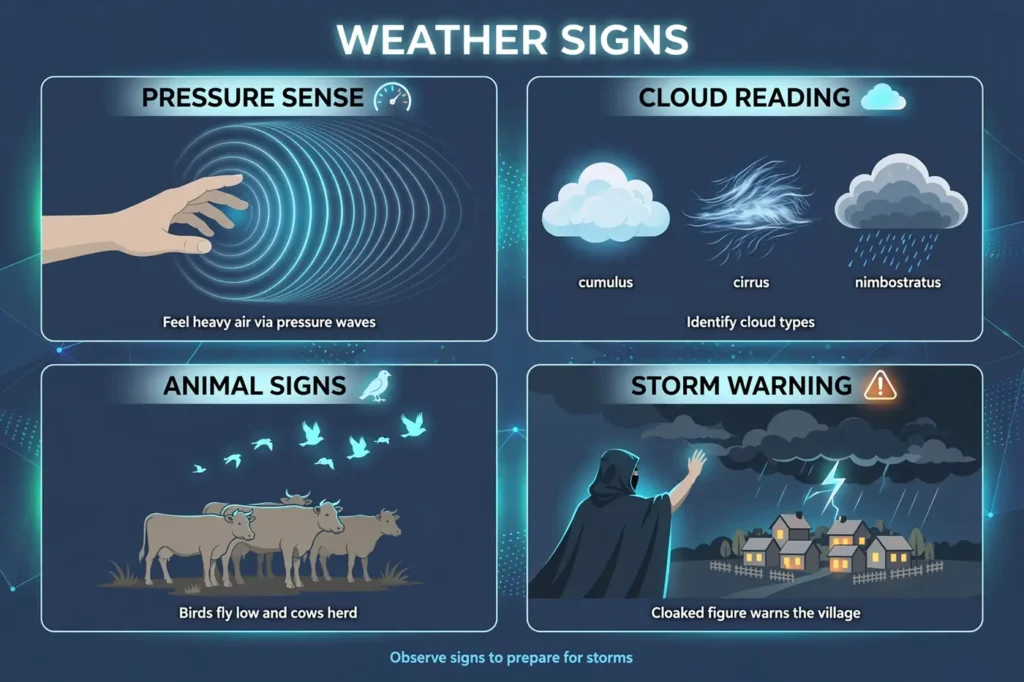
Sense is the signature: a living barometer tuned to the sky’s smallest shifts. The user feels air pressure fall before the storm the way a diver feels depth, notices humidity thicken into the heavy or sticky air that precedes rain, reads temperature gradients on the skin, and tracks wind speed and wind direction as the atmosphere rearranges itself. The catalogs describe this as an instinctive understanding of impending weather changes, and the sky reader’s version never needs a dial.
The sense is always on. While others check an app, the forecaster’s body is already logging the data: the pressure curve, the moisture climb, the wind’s turning. That constant feed is why the power feels less like a tool and more like a second sense.
Read: Clouds, Creatures, and the Weathervane Effect
Once sensed, the sky must be read. Cloud reading decodes the sky’s handwriting: cumulus piling into thunderheads, high cirrus streaking ahead of a front, low nimbostratus settling in for a long rain. Animal behavior is the second text: birds flying low when the pressure drops, cows lying down or herding before rain, ants fortifying nests, frogs croaking as humidity climbs. The catalogs call the whole talent the weathervane effect: the user as a living weather vane, swinging with every shift.
Beneath it all runs pattern recognition: the reader connects the falling pressure to the cloud deck to the restless animals and names the storm before it has a shape. The sense collects; the reading concludes.
Foresee: Storm Tracking and the Psychic Forecast
Foresee is the payoff: prediction with a lead time. Short-range, the forecaster feels the storm 2 to 3 hours out, the pressure crash arriving like a drumbeat. Medium-range, the reading stretches to 6 to 24 hours, the animal bioindicator window, enough to move a harvest, a fleet, or a battlefield. Long-range, the master reaches days ahead: the psychic forecast, tracking whole systems across the map the way GraphCast tracks Hurricane Lee ten days out.
The uses follow the lead time. Disaster warning saves towns; tactical forecasting picks the day of battle; everyday uses pick the picnic. The forecaster does not change the weather. They change what everyone does about it. For a sense tuned to storms, see our Lightning Rod guide.
Real Science: Barometers in Flesh and Silicon
Fiction gives the sky reader a perfect sense. Science shows the sense is real, just quieter. The two meet in the barometer: the instrument, the organ, and the algorithm.
The Inner-Ear Barometer
The science starts inside the skull. A 2025 study in Scientific Reports showed the mammalian inner ear, specifically the vestibular system and the superior vestibular nucleus, acts as a barometric pressure sensor: lowering pressure activated the brain’s pressure-processing center in mice (inner-ear barometer). Birds go further: they sense pressure with a dedicated middle ear mechanoreceptor, the paratympanic organ (PTO), a true barometer and altimeter wired through the facial nerve to the vestibular nuclei, built for reading weather and altitude on the wing.
The researchers note convergent evolution: different wiring, same job. A sky reader’s fictional sense is this hardware with the gain turned up: a PTO-like organ feeding a human brain, pressure rendered as directly as vision.
Animals as Bioindicators
The animal kingdom runs the oldest forecasting network on Earth. The Max Planck Institute’s ICARUS project, building on a 2018 Animal Biotelemetry review, found GPS-tagged animals showed behavioral shifts 6 to 24 hours before major weather events in over 70 percent of studied cases, and researchers now harvest that collective sensing as a supplementary forecasting tool. The mechanism is the same one the sky reader uses: exquisite pressure sensitivity and humidity sensitivity.
The signs are the classics: birds flying low when falling pressure makes the air unstable, cows lying down as humidity and pressure shift, ants fortifying nests against the coming rain, frogs croaking as moisture climbs. Animals do not predict like models do; they perceive, and their bodies answer. The forecaster simply reads the same signals with a human mind.
Humans Feel It Too
People are quieter instruments, but the needle moves. A 2025 systematic review of 14 studies covering 2,696 people found evidence that barometric-pressure changes may influence migraine frequency, and senior meteorologist Jonathan Belles notes storm systems produce pressure swings 5 to 10 times larger than an average day’s fluctuations, which is why the air feels heavy or sticky a day or two before the storm. Headaches, aching joints, and sinus pressure are the body’s crude forecast.
The extremes prove the channel exists. Discover Magazine documented a Parkinson’s patient whose phantosmia (phantom smells) intensified 2 to 3 hours before a storm and held through the thunderstorm. And Richard Heath at the University of Sunderland found one in four volunteers could predict temperature series, with the best reaching 80 percent next-day accuracy, noting accuracy faded with time “just as it seems to do in weather forecasting.”
How the Machines Do It
Humanity’s artificial sky readers work the same three moves with silicon. Doppler radar fires microwave pulses and reads the Doppler shift of the return to map cloud velocity, a trick discovered when WWII operators noticed clouds blocking their plane-spotting sets. Satellites, weather stations, and weather balloons feed computer models built on atmospheric physics and fluid dynamics, the numerical version of sense and read.
Then came the leap. GraphCast, DeepMind’s machine learning model reported in the journal Science, forecasts weather variables 10 days ahead in under a minute at a reported 90 percent accuracy, and called Hurricane Lee’s Long Island landfall 10 days in advance (GraphCast). The fictional sky reader is GraphCast in flesh: the whole pipeline, no supercomputer required.
The Forecaster’s Toolkit
Every forecaster, flesh or silicon, reads the same channels. The table below maps them.
| Sense channel | What it detects | Lead time | Real-world basis |
|---|---|---|---|
| Pressure drop | Storm approach | Hours | Inner-ear barometer; 2 to 3 hour phantosmia case |
| Humidity rise | Rain coming | Hours | Heavy or sticky air; frogs croaking |
| Cloud reading | System movement | Hours to days | Cumulus, cirrus, nimbostratus |
| Animal behavior | Major weather events | 6 to 24 hours | ICARUS tracking, 70 percent of cases |
| Psychic forecast | Whole weather systems | Days | GraphCast, 10-day AI forecasts |
Weaknesses and Limitations
No power is complete without its counters. The sky reader is mighty, but the sky is noisy: strip the atmosphere, scramble the signal, or stretch the lead time too far, and the reading fails.
What Can Stop a Weather Forecaster?
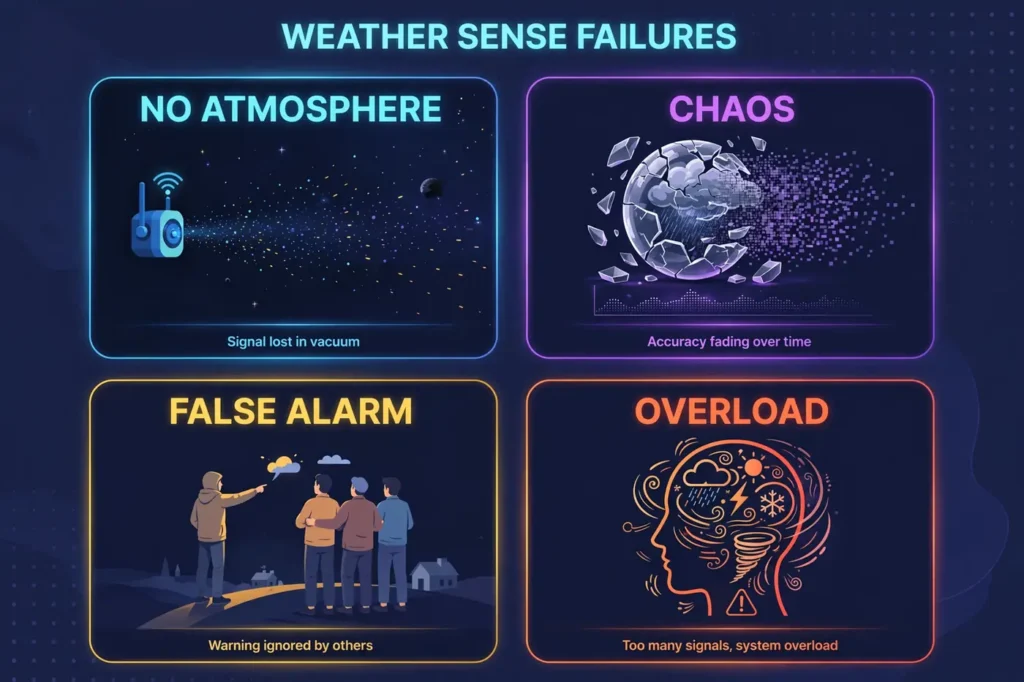
The catalog’s hard counters come first: Weather Negation and Weather Immunity can blind the sense entirely, and the power requires an atmosphere, so in vacuum or sealed artificial climates there is nothing to read. Distance, mass, and precision scale with the user’s knowledge, skill, and strength, and their power has natural limits: no sense reads forever.
The softer limits decide most stories. Weather is a chaotic system, so prediction accuracy drops off over time, exactly as Heath’s volunteers showed. The crying wolf problem haunts every forecaster: minor fluctuations trigger false alarms, and after enough false alarms nobody evacuates. Overload drowns the reader in signals during planet-scale events, and emotion-based instability can warp the reading. Even the machines bow to chaos; the sky reader just bows with better posture. For more ways to humble a powerhouse, try our random weakness generator.
Famous Weather Forecasters in Fiction
From myth to comics to anime to film, these are the characters who defined the art of reading the sky.
Icons of Weather Sensing in Comics, Anime, Games, and Myth
Storm (Ororo Munroe, Marvel Comics, X-Men), the Omega-level mutant, is the definitive sky reader: her innate connection to the Earth’s atmosphere lets her feel weather systems forming across continents, as depicted in the comics. Weather Wizard (Mark Mardon, DC Comics, The Flash) hears it: “the thunder-clouds talk to me. Begging me to let them rain,” as depicted in the comics. Nami (One Piece), the navigator called the Weather Queen, predicts storms by reading sky and sea with preternatural skill, Clima-Tact in hand, as depicted in the manga and anime.
Weather Report (Wes Bluemarine, JoJo’s Bizarre Adventure Part 6: Stone Ocean) wields absolute power over weather through his Stand, sensing and shaping it as one sense, as depicted in the manga. Hina Amano (Weathering With You), the sunshine girl, feels the sky’s mood and clears it with a prayer, as depicted in the film. Aeolus (Greek mythology), keeper of the four winds, reads and releases the winds at the gods’ command, as depicted in the myths. Vortex (Danny Phantom), the weather ghost whose body mimics the weather, is the sense made flesh, as depicted in the series. For storm-themed quirk ideas, see emitter quirk ideas; for more power variety, god ki abilities and thunder breathing.
Conclusion
Weather forecasting is the mind at its most far-seeing: not the thought, not the dream, not the sleep, but the sky itself, sensed, read, and foreseen. Whether it arrives as Storm’s atmospheric bond, Nami’s navigator instinct, or a barometer’s falling needle, it runs on the same three moves: sense, read, foresee. Want to give the
power to your own character? Try our superpower generator and see what your skies would tell you.


