
Electric Discharge Superpower Explained: Forms, Limits & Famous Users
Some superpowers are about control. Electric discharge is about the release — the split second when stored electricity leaves the body as a crackling spark, a searing arc, or a silent corona glow. It is the “fire” button of electricity powers: not the careful shaping of current, but the spectacular moment it is let go. This guide, part of our Energy Powers collection, breaks down what electric discharge can do, the three forms it takes in real physics, where it falls short, and which famous characters discharge best.
Electric discharge is the power to release electricity from one’s body — the “fire” button of electricity powers. Instead of controlling charge from any source, the user lets stored electricity go as sparks, arcs, or waves of current.
What Is Electric Discharge?
Before the lightning bolts, the definition — and the distinctions every writer gets wrong.
Electric Discharge vs Electrokinesis: What’s the Difference?
Electric discharge is the act of letting electricity go — the release of electricity from one’s body outward into the world. Power catalogs class it as a Technique of Electricity Manipulation and a Sub-power of Electricity Attacks: it is the “fire” button, not the whole weapon system. Electrokinesis — full Electricity Manipulation — is broader: the user can generate, shape, absorb, redirect, and sense charge from any source, acting as both conductor and generator.
The difference matters in a story. An electrokinetic might drain a power line or call down a storm; a discharge user only has the burst itself — the stored charge leaving their hands as sparks, arcs, or waves. One is total control over electricity; the other is the single, spectacular moment of release.
Electric Discharge vs Bio-Electricity vs Bio-Lightning
Think of the three powers as a family. Bio-electricity — or bio-electrokinesis — is electricity that lives inside the body: the living electricity manipulation of nerves, heart, and muscles, as explored in our bio-electricity guide. Bio-lightning narrows that further to raw high-voltage bolt projection, as covered in our bio-lightning guide.
Electric discharge is the common thread: the instant the stored charge is released. A bio-electric user builds the charge; a discharge user lets it rip. In many stories the same character does both — but the discharge is the visible event: the crackle, the flash, the current leaping from skin to target.
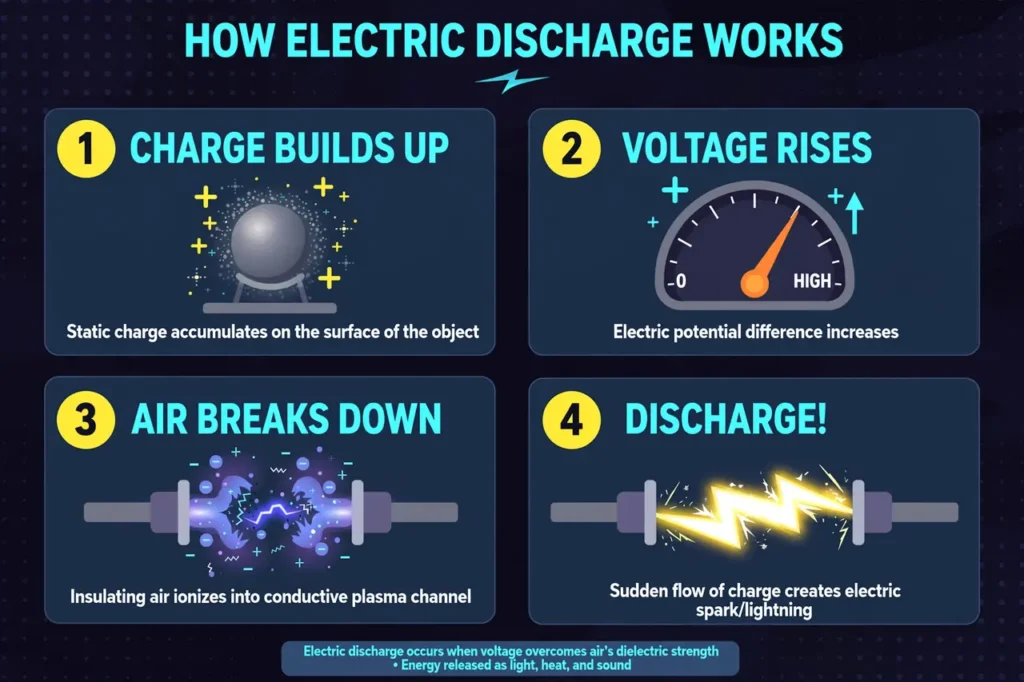
The Three Forms of Electric Discharge
Real physics gives this power three distinct shapes — and each one fights differently.
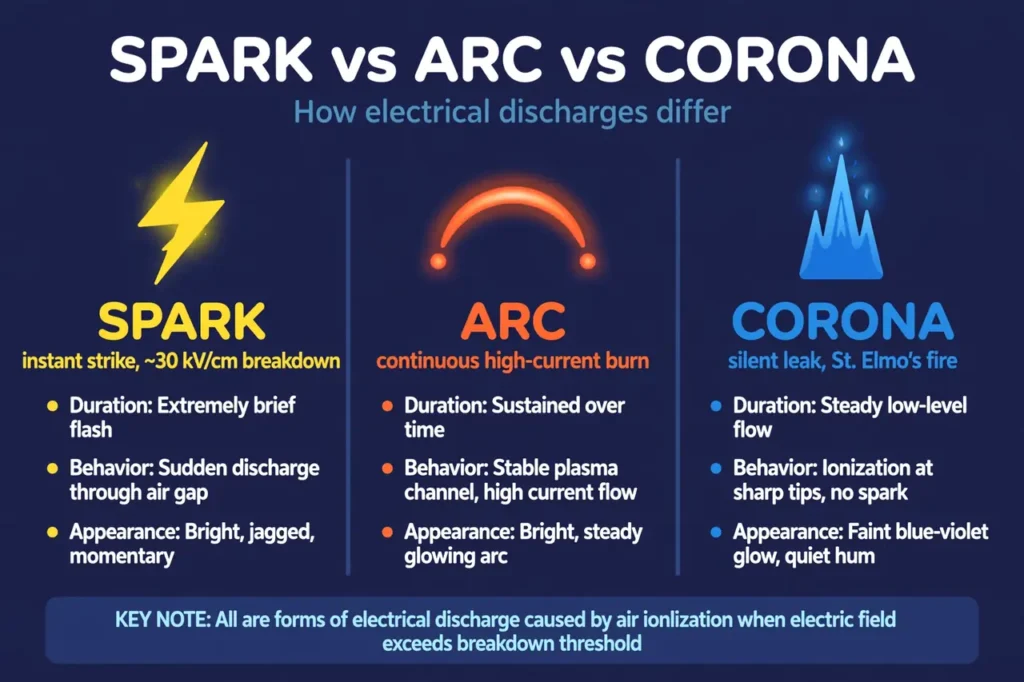
Sparks: The Instant Strike
A spark is the quickest discharge there is: an abrupt electrical discharge that happens when the electric field crosses the dielectric breakdown point of air — about 30 kV/cm at sea level. In that instant, an ionized conductive channel opens and current rushes across, producing light and a sharp crack. The static shock from a doorknob and a bolt of lightning are the same phenomenon at wildly different scales — both are electric sparks, as physicists define them.
In fiction, spark-type dischargers are the skirmishers: fast, precise, gone in a blink. Their strikes stun rather than incinerate — perfect for a hero who wants to drop a guard without leveling the block.
Arcs: The Sustained Burn
An arc is what happens when a spark refuses to stop: a sustained high-current discharge fed by a continuous power source. The air in the gap becomes a plasma channel — ionized and white-hot — and keeps conducting as long as current flows. Every arc begins as a spark, but not every spark becomes an arc; in the real world, electric arcs weld steel and light furnaces.
Fictional arc-users are the heavy artillery. Their discharge doesn’t flicker out — it chews through armor, melts cover, and holds a beam on target. The price is hunger: an arc needs constant fuel, so these users burn through their reserves fast.
Corona: The Silent Glow
Not every discharge is violent. A corona is a localized breakdown of air at the sharp points of a high-voltage conductor — a faint bluish glow that leaks charge without ever bridging the gap. Sailors called it St. Elmo’s fire when it danced on ship masts; it still flickers on aircraft edges today. Physicists class it as a single-electrode discharge: all leak, no strike.
In stories, corona-type users are the subtle ones — the assassin whose fingertips glow before the kill, the infiltrator who bleeds off excess charge to stay hidden. Less raw damage, far more control.
Electric Discharge Powers and Abilities
From battlefield bolts to delicate utility sparks, here is what the release can do.
Blasts, Bolts and Balls: Ranged Attacks
The classic discharge is the ranged strike. An Electric Blast is the workhorse — a palm-fired burst of deadly current — while Electrical Bolt Projection and Lightning Bolt Projection shape it into searing spears. Lightning Ball Projection compresses the charge into a slow, hungry sphere, and Electrical Arc Emission throws crackling arc-strands that branch like real lightning.
Masters don’t fire once. Multi-Beam Emission splits the burst into a Scatter Shot, and a Lightning Strike Barrage hammers an area until nothing stands. Even the humble Electric Zap earns its place — sometimes all a fight needs is one perfect spark. And the most theatrical users open with Arcing Blasts, lightning that visibly forks across the battlefield.
Auras, Waves and Area Bursts
Some users don’t aim — they detonate. An Electric Aura wraps the body in living current, so anything that touches them gets burned; push it outward and it becomes Electric Wave Emission, an Omnidirectional Electricity Wave that clears a room radius wise. Prevalent Discharge is the named art of exactly this: releasing massive damage in every direction at once.
At the extreme sits the Super Electric Charge — the body overloading until the ground itself becomes an Electrified Surface and the user’s very Electric Presence is a weapon. Devastating, indiscriminate, and almost impossible to dodge.
Utility Tricks: Signals, Heating and Healing Sparks
Discharge isn’t only destruction. Tiny pulses of current can detect ionizing radiation; Electrical Signal Manipulation lets a user hijack machines or send Electronic Communication through wires. Electric Heating and Electrolysis turn the current into a tool — cutting, welding, splitting compounds apart.
Gentler still are the medical tricks: Electric Stimulation to wake nerves, Electrical Healing to knit tissue, even Heart Restarting — the defibrillator as a superpower. And before any of it, the user must gather charge: Electric Charging and Electric Concentration, the quiet inhale before the lightning. Some settings even grant Electroreception, reading the world’s faint electric fields between discharges.
Weaknesses and Limitations
No power is complete without its counters — and discharge has some of the hardest.
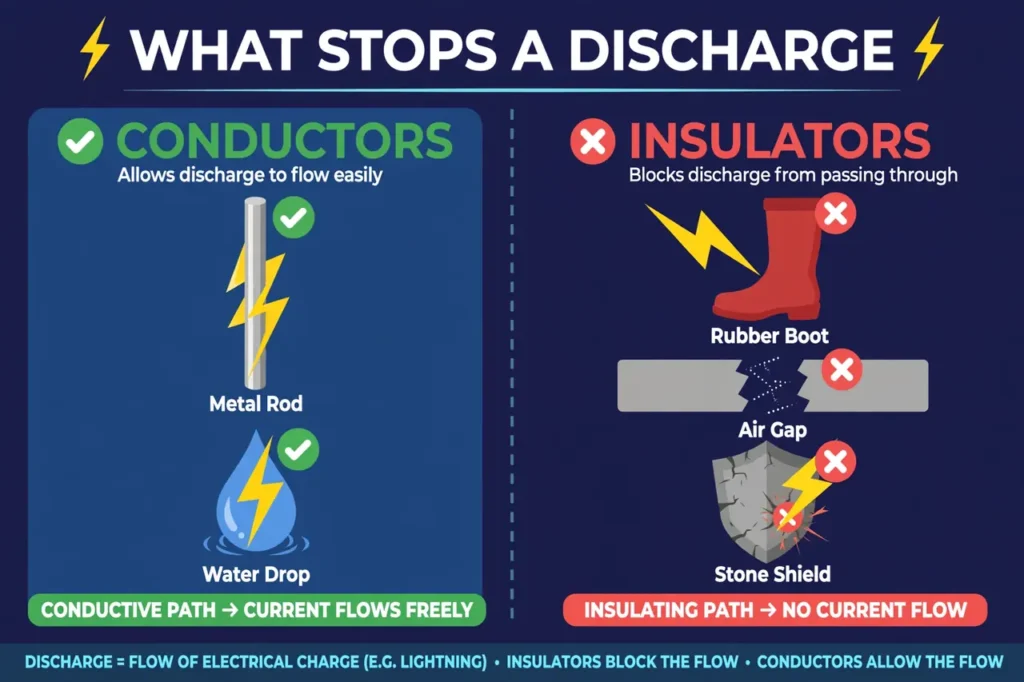
What Can Stop an Electric Discharge User?
Every discharge obeys physics, and physics provides the counters. Electricity needs a conductor — it follows the path of least resistance — so rubber boots, silicate armor, or even plain air gaps can leave a user swinging at nothing, since discharge is insulated by non-conductive matter. Contact with water can short-circuit the blast, sometimes back into the user — who may not be immune to effects of their own electric shock. A strong magnetic force can bend or scatter a bolt (hinderful as often as helpful), and true Electricity Negation or Electrical Immunity ends the fight outright.
The subtler limit is supply: some users do not generate electricity on their own — they only release what they’ve stored or channeled, so drain their reserves and the lightning stops. And without fine control, a discharge is a blunt instrument: spectacular, but as likely to black out a city block as to hit the target. Weak against Water Manipulation is the classic elemental counter for the same reason.
Famous Electric Discharge Users
From anime to comics to games, these are the characters who defined the art of letting go.
Icons of the Discharge in Anime, Comics and Games
Fiction loves the discharge. Hei (Darker Than Black) routes current through anything conductive — memorably blood — but not through air; Colonel Volgin (Metal Gear) electrifies entire metal floors. Luigi‘s Thunderhand (Super Mario) and the Elekings’ Electric Tail (Ultraman, claimed at 500,000 volts in fan catalogs) show the same idea across genres, while Lightningbending (Avatar: The Last Airbender) turns discharge into a martial art.
The heavy hitters scale up: Laxus Dreyar (Fairy Tail), Electro (Marvel Comics), Black Lightning (DC Comics), Thor (Marvel Cinematic Universe), and Enel (One Piece) all work wide-area discharge, and Paramount’s Sonic once vented an EMP that blacked out power across the western US and Mexico — each as depicted in their own universe, with fan-catalog feats labeled as such.
Conclusion
Electric discharge is the most cinematic half-second in the electricity family: the charge built, the air breaking down, the current finding its path. Whether it arrives as a duelist’s spark, a siege engine’s arc, or an assassin’s corona glow, the power runs on real physics — conductors and insulators, breakdown voltages, the path of least
resistance — which is exactly what makes it so fun to write. Want to give the power to your own character? Try our superpower generator and see what kind of discharger you’d become.


