
Mudslide Superpower Explained: The Burial Flow
The earth does not always fight back with rock. Sometimes it fights with soup: slopes that liquefy, rivers of mud that carry boulders like driftwood, valleys buried under twenty feet of slurry that sets like concrete. The mudslide superpower is the power to induce, command, and ride mudslides and debris flows: the wet-earth disaster, filed under Mud Manipulation as a combination of Earth and Water Manipulation, also called Mudbending or Láspikinesis. It runs on three moves: LIQUEFY (turn solid ground to slurry), FLOW (unleash the debris flow), BURY (smother and entomb). This guide follows THE BURIAL FLOW framework. This is the fifth post of our Elemental Manipulation collection.
In this guide:
What Is the Mudslide Superpower? | Mudslide vs Other Powers | What Can a Mudslide User Do? Applications | Real Science: When the Ground Flows | Famous Mudslide Users in Fiction | Weaknesses and Limitations | Conclusion | FAQs
What Is the Mudslide Superpower?
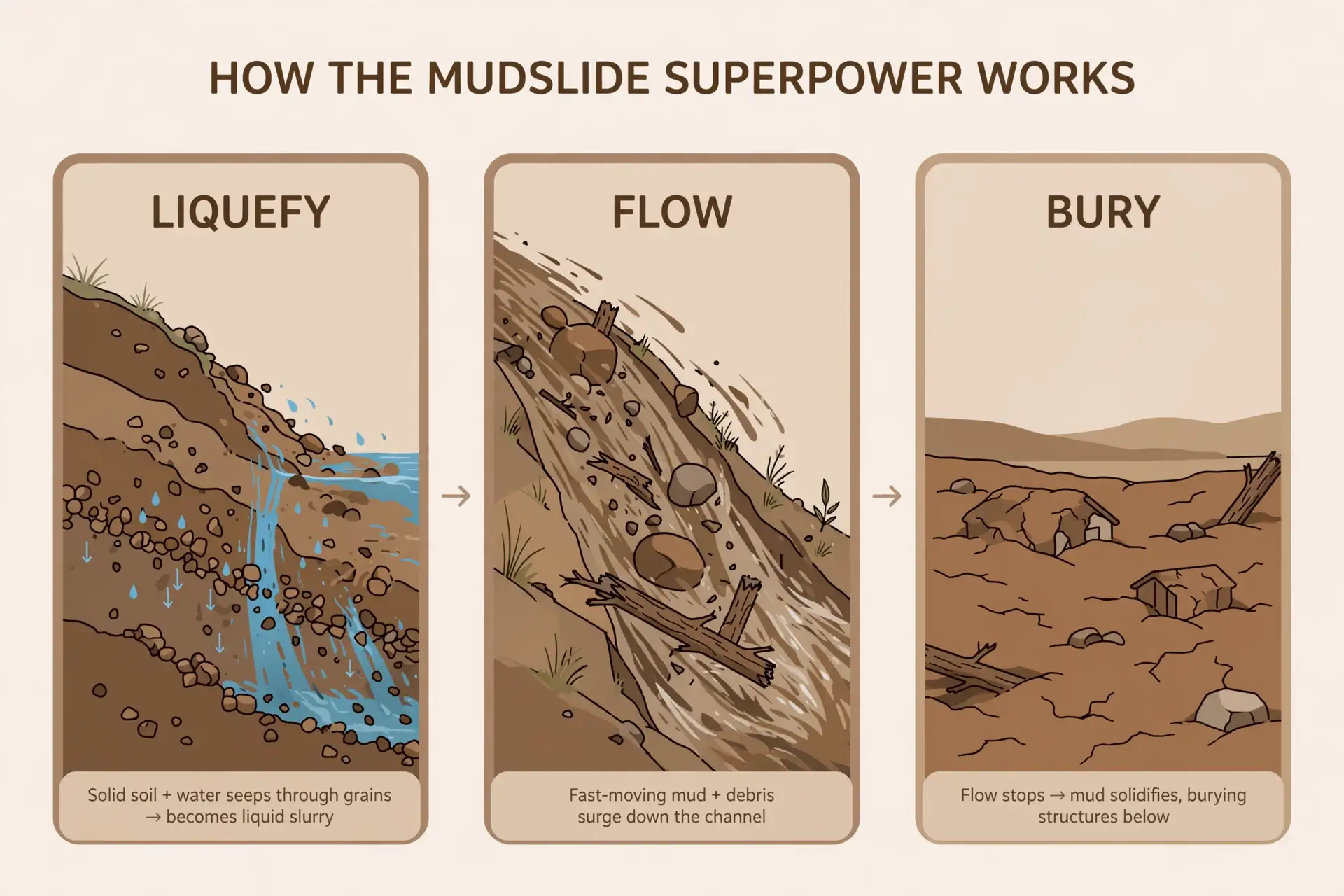
Forget raised stone walls and hurled boulders. The mudslide user fights with something that moves: saturated earth, weaponized by gravity. It is the messiest of the elemental powers and one of the most honest, because the “element” here is not a rock you shape but a disaster you start, steer, and finish. The framework of this guide is THE BURIAL FLOW: three moves (liquefy, flow, bury) that every version of the power plays in some combination.
The Wet-Earth Weapon, Defined
Mud Manipulation is the filed power behind it: the ability to manipulate mud as a combination of Earth and Water Manipulation, with mud defined as a mixture of water, soil, silt, and clay. But the mudslide power is narrower and meaner. It does not play with mud constructs or walls; it triggers and commands the debris-flow event itself: a mass of saturated earth that moves like a river and buries everything in its path.
Where general mud users shape, build, and mimic, the mudslide user weaponizes saturation and gravity. The signature is scale and motion: the ground rises and billows out, the slope lets go, and a moving wall of slurry, rocks, and broken trees does the fighting. It is not earth-shaping; it is burying flows, and the battlefield becomes the weapon.
Liquefy, Flow, Bury: The Three Moves
Every version of the power runs three moves. First, LIQUEFY: the user drives pore-water pressures up until solid ground crosses into a liquefied state, the filing’s Ground Liquefaction turned into a weapon. Saturated soil stops acting like soil and starts acting like a liquid, the way earthquake shaking makes solid land behave like a liquid in real science.
Second, FLOW: the slurry is unleashed down-slope as a fast-moving debris flow, and the user steers it, rides it (Geokinetic Surfing), or aims it like a siege engine. Third, BURY: the flow reaches its target and does what debris flows do: smother, entomb, and solidify the aftermath, the filing’s Burying using mud, until victims are trapped in a mass that sets like concrete. Liquefy the ground, flow the weapon, bury the result: the three moves never leave the wet-earth lane.
Mudslide vs Other Powers
Wet-earth powers blur together in fan discussions, so the lanes matter. Earth Manipulation (our Earth Manipulation guide) is the dry rock: shape it, sense through it, shake it, and its filing lists causing mudslides as one application among many. Mud Manipulation (the “Mud Manipulation” filing) owns mud as a material: attacks, constructs, mimicry. Water Manipulation owns the liquid alone. Avalanche Induction owns the frozen burial flow. Floral Explosion owns the armed bloom, and Geomagnetic Manipulation owns the invisible magnetic field. The mudslide is none of these. It owns the wet-earth event: the moment saturation turns a slope into a weapon. The table below keeps the lanes distinct.
The Family Comparison
| Power | What it controls | Signature move | How mudslide differs |
|---|---|---|---|
| Mudslide | The debris-flow event: saturation, flow, burial | Liquefying a slope and burying the battlefield | This is the home row: the wet-earth disaster as a weapon |
| Earth Manipulation | Rock, soil, and stone | Shaping, sensing through, and shaking the ground | The dry rock; the mudslide owns only the wet event |
| Mud Manipulation | Mud itself, the material | Mud attacks, constructs, and mimicry | The material; the mudslide owns the mass-flow event |
| Water Manipulation | Water | Currents, pressure, drowning | The water alone; the mudslide needs earth plus gravity |
| Avalanche Induction | Snow and ice flows | The white burial flow | The frozen analog; the mudslide is the wet-earth one |
What Can a Mudslide User Do? Applications
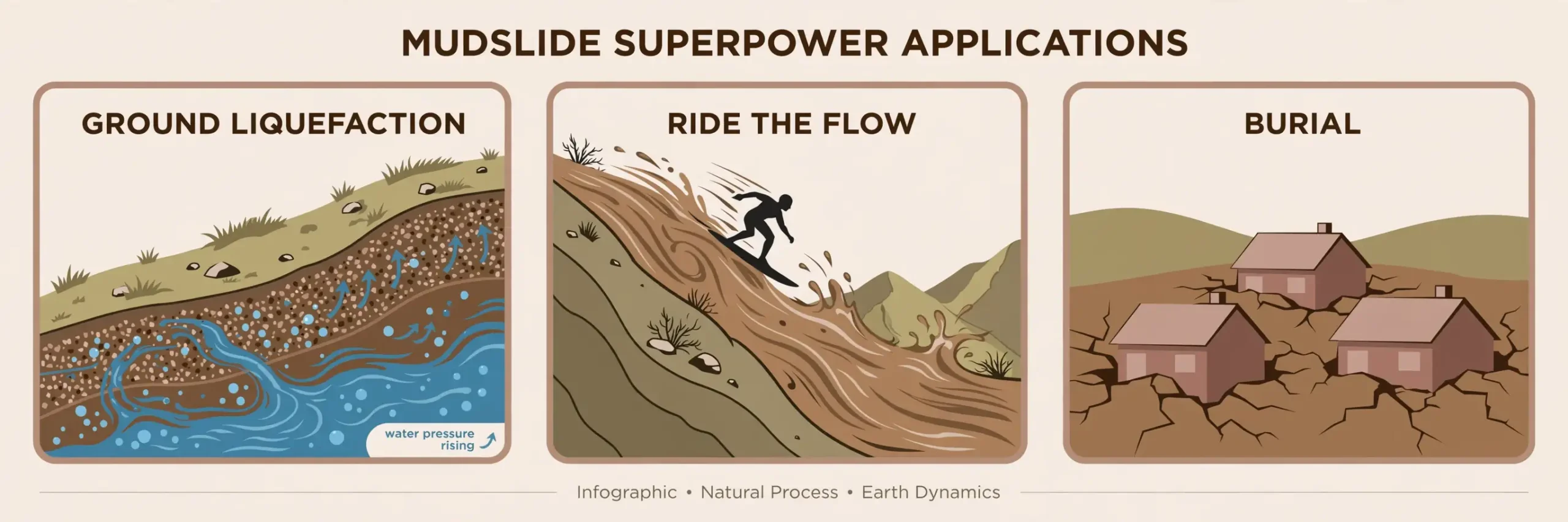
The applications flow from the three moves. Liquefy prepares the ground, flow delivers the weapon, and bury finishes the fight. Together they make the mudslide user a siege engine, a landslide surfer, and an undertaker, depending on which move they lead with.
Liquefy: Turn Solid Ground to Slurry
LIQUEFY is the setup move, and it is pure pore-water pressure. The user forces water through the gaps between soil grains until the pressure of the trapped water carries the load instead of the grains, which is exactly the USGS definition of soil liquefaction: the transformation of a granular material from a solid into a liquefied state as a consequence of increased pore-water pressures. Loose granular sediments that were saturated with water stop acting like ground and start acting like a heavy liquid.
In the field, the follow-through matches the real failure types: unlimited flow runs on as a flow landslide, while quick-condition failures strip the ground of its bearing capacity so structures tilt and sink. A battlefield that a moment ago held fortresses now holds only soup, and the user has not thrown a single punch yet.
Flow: Unleash and Steer the Burial Flow
FLOW is the attack: once the ground is slurry, gravity does the heavy lifting and the user does the aiming. A mudslide, also called a debris flow, is a fast-moving landslide that follows a channel, and a commanded one behaves like the real thing, only on schedule. USGS geologist Jaime Kostelnik’s line is the honest picture: it is like concrete moving downhill, at least half of the flow’s volume is sediment, and it can hit speeds of about 56 kilometers per hour (35 miles per hour), swelling to five times as high as a flood: a flood on steroids.
Masters do not just point the flow; they ride it. Avalanche of Marvel Comics made his name by learning to create and ride a mudslide across the ground, the filing’s Geokinetic Surfing in action, turning the weapon into transport. Steering matters because a debris flow is indiscriminate: aim it wrong and the burial flow buries the wrong side.
Bury: Smother, Entomb, Set Like Concrete
BURY is where the mudslide earns its name as a burial weapon. The filing lists Burying using mud as a core technique, and the physics agrees: debris flows kill by burial, abrasion, and the crushing drag of the dense fluid, exactly how USGS describes lahar damage. Targets are not cut or burned; they are swallowed by a moving wall that stops moving on top of them.
Then the trap closes. The flow loses water and locks up, and victims face the same problem fan-game designers formalize: prone and incapacitated under the mud, needing a Strength check to unbury themselves while the ground around them becomes difficult terrain. Solid mud is sticky and heavy, and once it sets, digging out is a rescue operation, not a combat move.
The Burial Flow Toolkit
| Move | What it does | Who embodies it |
|---|---|---|
| Liquefy | Drives pore-water pressure up until solid soil flows as slurry | Filing technique (Ground Liquefaction), as cataloged |
| Flow | Unleashes and steers the debris flow down-slope | Avalanche (Marvel Comics), as depicted |
| Bury | Smothers and entombs; the mud sets like concrete | Fūka (Naruto), as depicted |
| Mud Spore surge | Raises a river of mud and enhances it with water | Fūka (Naruto), as depicted |
| Ride the flow | Creates and rides a mudslide as transport | Avalanche (Marvel Comics), as depicted |
| Giants’ mud hands | Crushes, uproots, and throws entire buildings | High Priest (Toaru Majutsu no Index), as depicted |
| Mud walls and volleys | Defensive walls and fired mud projectiles | Gozu (Naruto), as depicted |
Real Science: When the Ground Flows
The power is fantasy, but the disaster is real, and it is more violent than most fiction dares. Everything below is established science, and it is the reason the superpower feels plausible: the ground really does liquefy, real burial flows really bury towns, and the volcanic cousin really flows like wet concrete.
Liquefaction: How Solid Soil Goes Liquid
Real liquefaction is picky about its ingredients. USGS lists three things it needs: loose granular sediments (swamps and marshlands, riverbanks and beaches, floodplains), ground saturated with water at high water tables, and strong shaking, usually from an earthquake. Shake that mix and the grains stop touching edge to edge; the pore water holds them up instead, and the ground behaves like a liquid: buildings sink, buried tanks float, and sand boils erupt at the surface.
USGS researchers describe debris flows mobilizing by three processes: widespread Coulomb failure inside the sloping soil, rock, or sediment mass, partial or complete liquefaction by high pore-fluid pressures, and the conversion of the slide’s energy into internal vibration (granular temperature). A fictional liquefier just skips the earthquake and supplies the shaking and the saturation directly.
Montecito and Oso: Two Deadly Burial Flows
Montecito 2018 is the post-fire burial flow. On January 9 2018, an intense burst of rain fell on the Thomas Fire burn scar above Montecito, California, triggering debris flows that mobilized roughly 680,000 m3 of sediment, including boulders larger than 4 m, at velocities up to 4 m/s. The toll: 23 fatalities, at least 167 injuries, and 408 damaged homes. Fire had stripped the slopes, rain supplied the water, and gravity supplied the rest. ScienceNews covers the post-fire debris flows after the LA fires with USGS geologists.
Oso 2014 is the saturation burial flow. On March 22 2014, a rain-soaked hillside near Oso, Washington collapsed from soil saturation from heavy rainfall, killing 43 people and destroying 49 homes: the deadliest single landslide event in United States history. The slide hit speeds averaging 40 miles per hour (64 km/h) and crossed the 2/3-mile floodplain in approximately 60 seconds, moving about 18 million tons of earth. No fire, no earthquake: just water, slope, and time.
Lahars: The Volcanic Cousin
Every burial flow has a volcanic cousin, and it is called a lahar. Lahars are slurries of volcanic ash, sand, and water that flow like wet concrete for approximately 60 miles, and USGS says they kill by impact from large boulders or logs, by high drag and buoyancy forces, by abrasion, and by burial: the same four ways a fictional mudslide kills. Past Mount St. Helens lahars have traveled from 50 to 100 km from source, far beyond any hillside.
The 1980 benchmark is staggering. The May 18 1980 eruption dumped about 2.3 billion cubic meters of material into the upper Toutle River valley, and the Pine Creek and Muddy River lahars hit initial velocities in excess of 30 m/s with slurries at 84% to 91% solids by weight. For a writer, the lahar is the power-fantasy version of the mudslide: same weapon, volcano-sized.
Famous Mudslide Users in Fiction
The filing names a deep roster of mud users, but three define the mudslide as an event so clearly that they lead every telling. The rest of the bench follows, each showing one facet of wet earth pushed to an extreme.
Fūka, Avalanche, and Terra
Three users define the power. Fūka of Naruto owns the most mudslide-specific feat in fiction: she creates a river of mud with her Earth Release: Mud Spore Technique and enhances it with Water Release techniques to create a powerful mudslide, plus a wave of water mixed with mud to attack her enemies. She is LIQUEFY and FLOW in one character: make it wet, then make it move.
Dominic Petros, Avalanche of Marvel Comics, is the rider: his Seismokinesis fires powerful vibrations that crack the earth, and his signature trick was to create and ride a mudslide across the ground. Terra of Teen Titans, a listed user of the Mud Arts and the team’s heavy hitter, shows the combat version: earth and mud thrown as battlefield artillery. All three are presented as depicted in their own universe, with no cross-continuity claims.
The Wider Roster
Beyond the big three, the roster shows every facet of wet earth. Caribou of One Piece takes the Numa Numa no Mi (Swamp-Swamp Fruit) to turn into and control mud; Wirth Mádl of Mashle: Magic and Muscles casts Mudorus Devilus; and the High Priest of Toaru Majutsu no Index raises giants’ hands of mud for crushing, uprooting and throwing entire buildings, and nearly destroyed most of Academy City.
The rest of the bench runs deep, each as depicted in their own universe: Secco of JoJo’s Bizarre Adventure Part V; Gozu and Nangō of Naruto, who fire mud from the mouth and turn their own bodies into it; the Earthbenders of Avatar, whose mudbending is a recognized subset; and the Mud Magic users of Black Clover. From artillery to armor to transport, the same wet element serves every role.
Weaknesses and Limitations
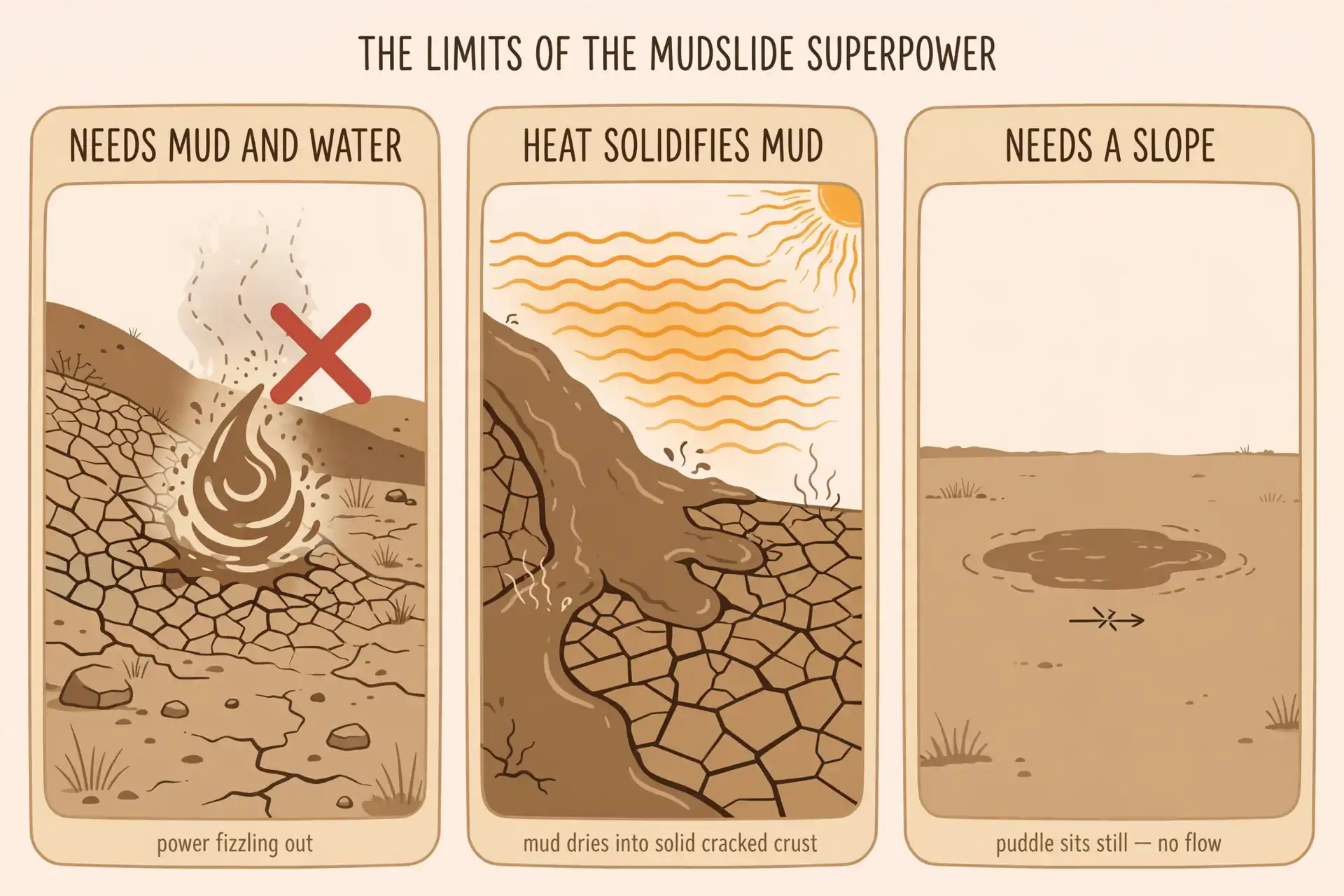
Every power needs its counters, and the burial flow has honest ones. They fall into two groups: the power needs the right ingredients, and the right counter-element turns the weapon against itself.
What Can Stop a Mudslide User?
The first limit is supply. The filing warns the user may be unable to create mud and be limited to manipulating only from already existing sources: on dry rock with no water, the burial flow never starts. That is the honest gate on the power, and writers should keep it.
The second limit is counter-element play. Mud is sensitive to moisture and very weak against water-based attacks (ironic, but the filing is explicit: uncontrolled water breaks the user’s grip), while Heat Manipulation can make mud solid, freezing the flow into useless crust; a mud form is affected by extreme temperatures and slows the user’s movements. And distance, mass, and precision all scale with the knowledge, skill, and strength of the user, so a novice triggers a puddle where a master triggers a mountainside. Real engineers answer with draining water off hillsides, armoring the bases of hills, and loading the toe: deny the water, deny the slope, deny the flow. If the matchup looks bad, even a quick visit to a random weakness generator beats a fair fight.
Conclusion
The mudslide is the burial flow: liquefy turns ground to slurry, flow aims the debris flow, bury entombs whatever it touches. It is the wet-earth weapon of the elemental family, the bridge between the ground you stand on and the river that swallows it. No dry rock, no petals, no invisible fields: just mud, gravity, and everything buried underneath. Want to hand the burial flow to your own character? Try our superpower generator and see what the mountain drops on them.
FAQs
What is the mudslide superpower?
The mudslide superpower is the power to induce, command, and ride mudslides and debris flows: the wet-earth disaster. Filed under Mud Manipulation as a combination of Earth and Water Manipulation, it runs on three moves: liquefy (turn solid ground to slurry), flow (unleash the debris flow), and bury (smother and entomb).
How is the mudslide superpower different from earth manipulation?
Earth manipulation is the dry rock: shaping, sensing through, and shaking the ground, and its filing lists causing mudslides as one application among many. The mudslide power owns only the wet event: saturation, the debris flow, and burial.
What is the difference between mud manipulation and a mudslide power?
Mud manipulation owns mud as a material: mud attacks, constructs, and mimicry. The mudslide power owns the mass-flow event: liquefying a slope and burying the battlefield with a moving wall of slurry.
Do real mudslides really move like concrete?
Yes. USGS geologist Jaime Kostelnik describes debris flows as like concrete moving downhill: at least half of the flow’s volume is sediment, they can hit 56 kilometers per hour, and they can swell to five times as high as a flood. Real burial flows buried Montecito in 2018 and Oso in 2014.
Who are famous mudslide users in fiction?
Fūka of Naruto creates a river of mud with her Mud Spore Technique enhanced by Water Release to create a powerful mudslide; Avalanche of Marvel Comics creates and rides mudslides across the ground; Terra of Teen Titans is a Mud Arts heavy hitter; plus Caribou, Wirth Mádl, the High Priest, and Secco, each as depicted in their own universe.
What can stop a mudslide user?
The user may be unable to create mud and be limited to existing sources, so dry rock with no water stops the power. Mud is sensitive to moisture and weak against water-based attacks, and heat manipulation can make mud solid. Distance, mass, and precision depend on the user’s knowledge, skill, and strength.


