Metal Manipulation Superpower Explained: The Metal-Shaper’s Craft
Metal Manipulation Superpower Explained: The Metal-Shaper’s Craft
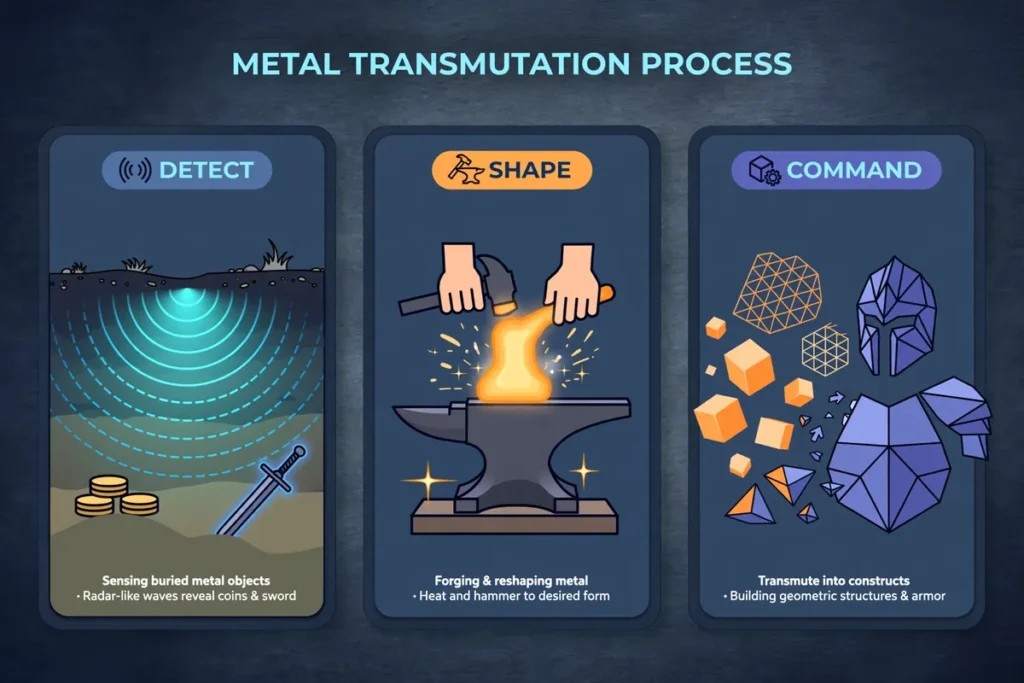
Every civilization has a smith, and every smith has the same dream: metal that obeys thought instead of hammer. Metal manipulation is that dream with the forge removed. It is the superpower of creating, shaping, and commanding metal as matter: finding it, working it, and mastering it. Also filed as Ferrokinesis, Metallokinesis, Metalkinesis, or Metal Bending, it runs on three moves: DETECT (find the metal), SHAPE (work the metal), COMMAND (master the metal). This guide follows THE METAL-SHAPER’S CRAFT framework. This is the fourth post of our Elemental Manipulation collection.
In this guide: What Is Metal Manipulation? | Metal Manipulation vs Other Powers | Detect: The Metal Sense | Shape: The Smith’s Moves | Command: Mastery Over Metal | The Blood-Iron Question | Weaknesses and Limitations | Famous Metal Manipulation Users in Fiction | Conclusion | FAQs
What Is Metal Manipulation?
Ferrokinesis, Defined
Metal Manipulation is the power to create, shape, and manipulate metal: a solid material (an element, compound, or alloy) that is typically hard, shiny, and features good electrical and thermal conductivity. Catalogs file it under many names, including Ferrokinesis, Metallokinesis, Metalkinesis, Metal Bending, Metal Control, and Metal Element Manipulation, per the Metal Manipulation filing. It is a sub-power of Magnetism Manipulation and a variation of Earth Manipulation (in the Avatar series it is called Metalbending), and it is the opposite of Nonmetal Manipulation.
What makes the power distinct is that it treats metal as matter, not as a magnet. A ferrokinetic does not need a magnetic field: they grip the substance itself. Malleable, fusible, and ductile are the three properties that define the playground. Metal can be hammered or pressed permanently out of shape without breaking, fused or melted, and drawn out into a thin wire, and the ferrokinetic performs all three moves with a thought.
Detect, Shape, Command: The Three Moves
Every version of the power runs three moves, and they follow the smith’s workflow. First, DETECT: the user finds and traces metal with a metal sense, locating ore, hidden weapons, or buried caches like a human metal detector. Second, SHAPE: the user works the metal the way a smith works stock, bending its malleable, fusible, and ductile nature into constructs, blades, armor, dust, and wire, or riding metal to fly. Third, COMMAND: the user masters metal at the highest level, with transmutation, absorption, empowerment, and metal mimicry, always against honest limits that keep the power fair.
The three moves keep the power coherent instead of sprawling. Detect answers “where is the metal,” Shape answers “what do I make of it,” and Command answers “how far can mastery go.” A novice might manage only Detect and simple Shapes; a master like Magneto (Marvel Comics), as depicted in his own universe, pushes all three to their extreme.
Metal Manipulation vs Other Powers
Metal-sounding powers blur together in fan discussions, so the lanes matter. Magnetism Manipulation is the general art of magnets: any magnet, anywhere, at any scale. Earth Manipulation (our Earth Manipulation guide) is the visible rock: shape it, sense through it, shake it, but not refined metal. Geomagnetic Manipulation owns a planet’s magnetic field: polarity, currents, storms. The Electromagnetic Pulse post owns the weaponized pulse: one brutal burst that fries electronics. And Electric Field Manipulation owns the electric field itself. Metal manipulation is none of these. It owns metals as matter: detection, shaping, transmutation. The table below keeps the lanes distinct.
The Family Comparison
| Power | What it controls | Signature move | How metal manipulation differs |
|---|---|---|---|
| Metal Manipulation | Metals as matter: detection, shaping, transmutation | Shaping blades, armor, and constructs from raw metal | This is the home row: the smith’s craft |
| Magnetism Manipulation | Magnets and magnetic materials generally | Lifting and shaping magnetic metals | The general magnet art; ferrokinesis grips the matter itself, not the field |
| Earth Manipulation | Rock, soil, and stone | Shaping, sensing through, and shaking the ground | The visible rock; metal manipulation starts where the forge begins |
| Geomagnetic Manipulation | A planet’s magnetic field: polarity, currents, storms | Flipping poles or riding field lines | The planetary field; metal manipulation never touches the field itself |
| Electromagnetic Pulse | A single weaponized burst | Frying electronics in one pulse | The one-shot weapon; metal manipulation is the standing craft, not the burst |
| Electric Field Manipulation | Electric fields and charges | Projecting bolts and shaping electric fields | The electric lane; metal manipulation touches it only via conductivity |
Detect: The Metal Sense
Finding Metal: Ore, Weapons, Caches
Detect is the quietest move and often the most useful. Metal Detection lets the user sense metal through walls, earth, and water: veins of ore underground, a hidden weapon on a stranger, a buried cache of coins. The filing treats it as a core application, and fiction gives it a face in Hazel Levesque of Heroes of Olympus, who senses and summons precious metals from underground and once detected a sword by the Stygian Iron in it.
Detection is also the move that needs the least metal to be dangerous. A ferrokinetic who can feel every blade in a room walks into every fight with a full inventory of the enemy’s arsenal. The counter is honest: meet in a room with nothing metal in it, and the sense finds nothing to report.
How Metal Detection Works in the Real World
The real world already has a metal sense, and it runs on electromagnetic induction. A metal detector’s oscillator coil generates a magnetic field; when metal enters it, eddy currents form inside the metal, producing a secondary field that the detector’s receiver coil picks up. Walk-through gates, beachcombers’ wands, and airport scanners all work this way: the metal announces itself by disturbing a field.
The most extreme version sits in hospitals. An MRI’s superconducting coils produce fields about 100,000 times stronger than Earth’s, strong enough that loose metal objects become projectiles. The fictional ferrokinetic is that detector with a mind behind it: not a coil sweeping a beach, but a person who feels every nail, blade, and buried coin the way you feel a tap on the shoulder.
Shape: The Smith’s Moves
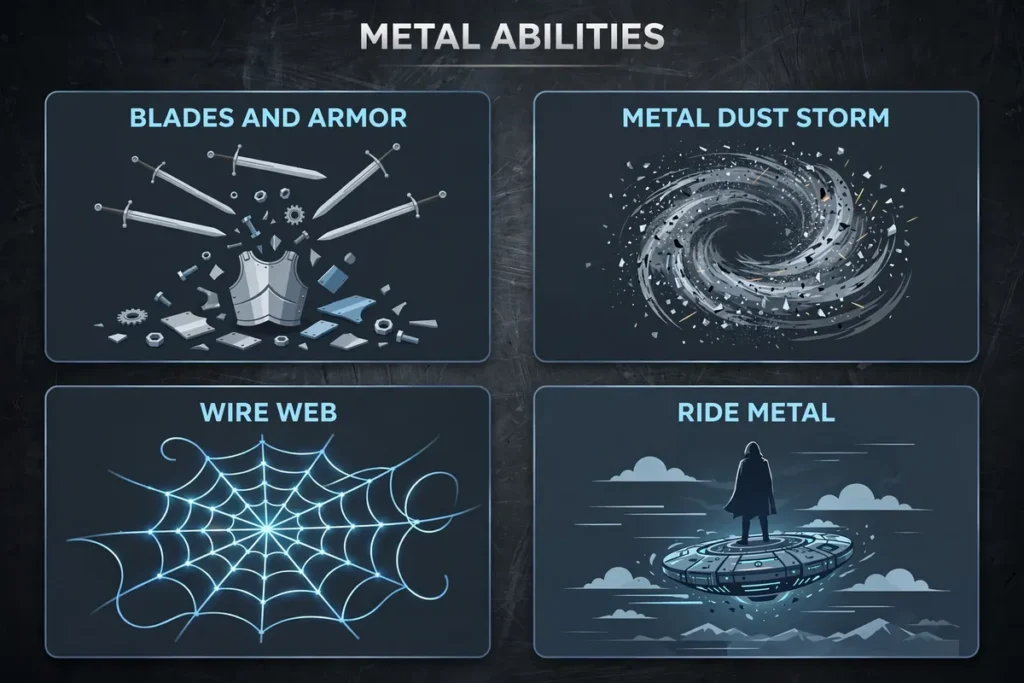
Shape is where the power becomes visible. The smith’s three moves, hammer, melt, and draw, become superhuman: a sword bent mid-swing, a lock melted in its keyhole, a railing pulled into wire as thin as thread. Everything in this section is built from the three properties of metal.
Malleable, Fusible, Ductile: The Three Properties
Shape works because metal has three gifts, and every smith in history has lived by them. Malleable metal can be hammered or pressed permanently out of shape without breaking or cracking: the anvil’s promise. Fusible metal can be fused or melted: the crucible’s promise. Ductile metal can be drawn out into a thin wire: the drawplate’s promise. The filing lists all three as the defining traits of the material, and the ancient craft of smelting and forging is the real-world proof.
The ferrokinetic is the smith without a forge. Where a human smith needs heat, hammers, and hours, the power delivers all three instantly: a sword bent mid-swing, a lock melted in its keyhole, a railing drawn into wire as thin as thread. The filing’s Ductility Manipulation, the ability to change the malleability of metal on the fly, is the formal name for the same trick.
Constructs, Blades, and Armor
Metal Constructs are the signature of the SHAPE move: weapons, walls, and armor raised from whatever metal is near. Metal Attacks and Blade Manipulation turn scrap into ordnance, while Metal Defense raises barriers and Dermal Armor wears the metal like a second skin. Fiction’s clearest showcase is Eustass Kidd of One Piece, who repels cannonballs and builds giant arms out of scrap metal and scavenged weapons, each as depicted in his own universe.
The move scales with the scrapyard. In a city, a ferrokinetic is surrounded by raw material: cars, girders, railings, rebar. On a battlefield, the enemy’s own weapons become the user’s arsenal, which is why the filing’s Weapon Manipulation sits so close to this power. The honest limit is the one the filing states plainly: a lack of metal may limit the user’s ability to fight.
Dust, Wire, and Liquid Metal
Shape does not stop at solid steel. Metal Dust Manipulation grinds metal into a storm of particles that can blind, choke, or flay, while Wire Manipulation turns ductile metal into cables, nets, and garrotes with surgical precision. Metal Solidification freezes the fluid back into form, and Molten Metal Manipulation keeps the metal heated into a near-fluid, molten state, a combination of Metal Manipulation and heat that the filing also calls Thermal Ferrokinesis.
The filing’s applications include Elemental Claws formed by elongating liquid metal and even filling others with liquid metal. The honest limit travels with the state: molten and liquid forms may require heat to maintain, and water or cold can quench them.
Command: Mastery Over Metal
Command is the master’s tier. Shaping changes the form; Command changes the nature: metal becomes other things, other things become metal, and the user’s own body joins the medium. It is the oldest dream of alchemy given a body.
Transmutation and Absorption
Metal Transmutation is the power to transform subjects into metal: matter, objects, even beings, turned to metal completely or partially, temporarily or permanently. The filing also names it Metal Touch and Castiopoeia, and fiction’s most famous practitioner is Edward Elric of Fullmetal Alchemist, whose transmutation-circle alchemy reshapes metal under the law of equivalent exchange, each as depicted in his own universe. The filing is honest: effects may be temporary or irreversible, may need constant contact, and some targets carry Transmutation Immunity.
Metal Absorption runs the other direction: the user drinks metal in, taking its mass and properties into themselves. Together the two moves make the master a walking refinery. Shaping changes the form; transmutation changes the nature.
Metal Mimicry and Empowerment
Metal Mimicry turns the body itself into metal: the user becomes a living statue, anatomically identical to their normal form but made of metal. The filing, under names like Ferro Body and Organic Metal Transformation, grants the transformed user Enhanced Durability (even Bulletproof Durability), Enhanced Strength, Dermal Armor, and Natural Weaponry. Carl Creel, the Absorbing Man of Marvel Comics, is the classic case: whatever he touches, his body becomes, each as depicted in his own universe.
Metal Empowerment and Ferrokinetically Enhanced Condition take the softer path: instead of becoming metal, the user draws on it to push their body to Peak Human, enhanced, or supernatural condition, with Auto-Reflexes and a Metal Aura as the visible tell. The honest price is in the filing: the state may last only a limited time, and the user may be damaged by their own power.
Flight by Riding Metal
Elemental Flight using metal and Matter Surfing are the filing’s names for the oldest ferrokinetic dream: stand on a disc, a blade, or a slab of scrap, and ride it through the sky. The user does not fly; the metal flies, and the user is its passenger. It is the move that turns every battlefield into a launchpad and every scrapyard into an airfield.
The trick is control, not power. Lifting a sheet of metal is the easy part; keeping it level, steering it, and landing is where skill shows. The filing pairs the application with Move metal and lift metal at its root, and the honest limit is the usual one: the ride needs metal beneath it, and the user’s concentration is the engine.
The Blood-Iron Question
Why the Iron in Blood Is Not What You Think
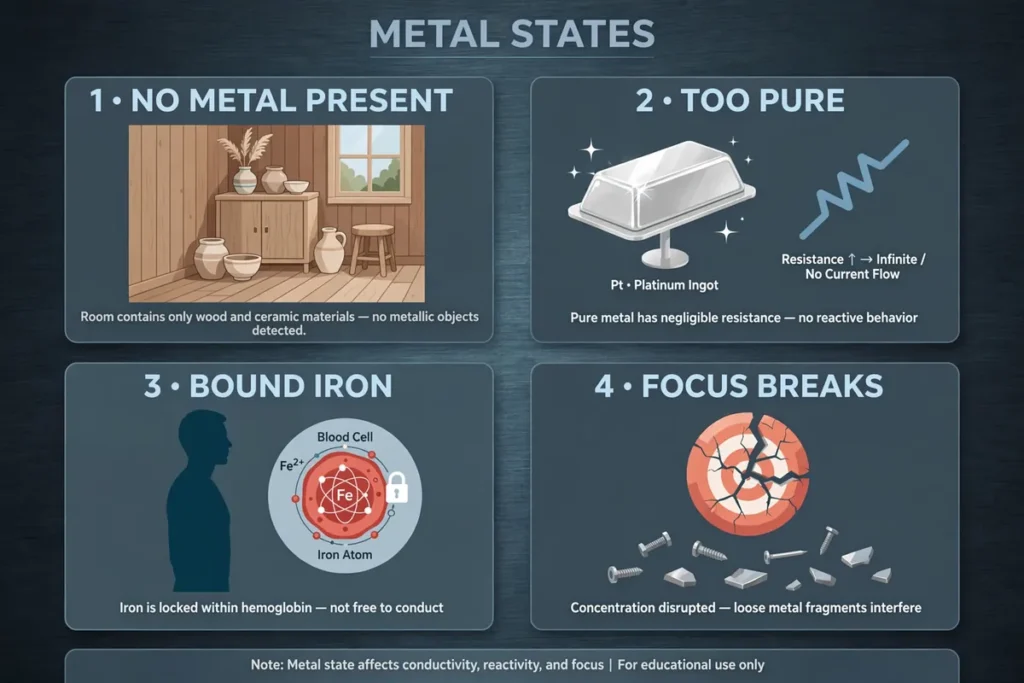
Real physics says no to blood-ripping, and the numbers are blunt. Almost all of the body’s small iron supply is locked inside hemoglobin, the metalloprotein in red blood cells that carries oxygen. Because of its molecular structure, that iron is not ferromagnetic: deoxygenated hemoglobin is only weakly paramagnetic and oxygenated hemoglobin is diamagnetic, so the interaction with any magnet is far too weak to notice. The iron in blood is not tiny metallic filings; it is individual atoms bound inside a protein, and a strong magnet held to skin does nothing dramatic. The Nerdist Brainiac75 experiment demonstrated exactly that.
Fiction cheats, and it cheats openly. In X2, Magneto escapes only because Mystique first injected the guard with liquid metal, which is what he actually manipulated, each as depicted in his own universe. Comics versions at peak power have manipulated trace non-magnetic iron in blood, but those are universe-specific feats, not physics. The rule for writers is simple: if the story wants blood-iron feats, it must earn them in-universe, because real blood will not cooperate.
Weaknesses and Limitations
No cosmic fine print: the counters are a locked room, a pure ingot, and the wrong kind of metal.
What Can Stop a Metal Manipulator?
First, starvation: the power needs metal present, and a wooden or ceramic room with no metal in it leaves the user with nothing to grip. Second, purity: in the Avatar universe, platinum is so pure that no metalbender can bend it, because the technique needs the unpurified fragments inside lesser metals.
Third, the magnetism trap: versions of the power that work through magnetism cannot move non-ferrous metals like aluminum, copper, or lead, which ignore magnets entirely. Fourth, skill: range, mass, and precision all depend on the user’s knowledge, strength, and concentration, and the state can fail if focus breaks. Finally, immunities: magnetism immunity and metal-transmutation immunity end the argument outright. If the matchup looks bad, even a quick visit to a random weakness generator beats a fair fight.
Famous Metal Manipulation Users in Fiction
Toph Beifong, Magneto, and Eustass Kidd
Three users define the power so clearly that they lead every telling. Toph Beifong of Avatar: The Last Airbender invented metalbending: imprisoned in a metal cage by Xin Fu and Master Yu, she sensed the unpurified earth particles inside the processed iron and bent those impurities to escape, founding the Metalbending Police Force of Republic City. She is the inventor, and her mechanism, bending the crude fragments inside refined metal, is the most thought-through version of the power ever put on screen.
Max Eisenhardt, Magneto of Marvel Comics, is the master class: he manipulates metal at the atomic level and once levitated an island by the iron ore within it, each as depicted in his own universe. Eustass Kidd of One Piece is the scrap-yard specialist: his Magnet-Magnet Fruit lets him repel cannonballs and assemble giant arms from scrap metal and weapons, and after Awakening he can turn other people into magnets, each as depicted in his own universe. The inventor, the master, and the brawler: between them, they cover the whole craft.
The Wider Roster
Beyond the big three, the bench runs deep, each as depicted in their own universe. Edward Elric (Fullmetal Alchemist) brings transmutation-circle alchemy and equivalent exchange. Risotto Nero (JoJo’s Bizarre Adventure) wields the Stand Metallica to manipulate iron, including trace iron in blood. Hazel Levesque (Heroes of Olympus), daughter of Pluto, senses and summons precious metals and once controlled tons of them at once. Peridot (Steven Universe), Wolfram (My Hero Academia), Shinki (Naruto), and Pyrrha Nikos (RWBY) each show the combat face of the craft.
The roster also reaches back to myth: Hephaestus and Vulcan, the smith-gods of Greco-Roman myth, and Hades and Pluto, the gods of wealth who command the metals under the earth, are the oldest metal manipulators in storytelling. From Olympus to Republic City, the craft is the same: find the metal, shape the metal, command the metal.
Conclusion
Metal manipulation is the metal-shaper’s craft: detect finds the metal, shape works it, command masters it. It is the craftsman’s power in the elemental family, the bridge between the forge and the battlefield, and the most honest of the superpowers, because its limits are things you can touch: an empty room, a pure ingot, a bound atom of iron. Want to hand the craft to your own character? Try our superpower generator and see what your metal becomes.
FAQs
What is Metal Manipulation as a superpower?
Metal Manipulation is the power to create, shape, and manipulate metal as matter. Also called ferrokinesis, it runs on three moves: detect (find the metal), shape (work the metal), and command (master the metal).
Is Metal Manipulation the same as Magnetism Manipulation?
No. Magnetism Manipulation is the general art of magnets and moves only the metals that answer to magnets. Metal Manipulation grips the metal itself as matter, with no magnetic field needed, and handles all metals.
How did Toph Beifong invent metalbending?
Imprisoned in a metal cage, Toph sensed the unpurified earth particles inside the processed iron and bent those impurities to escape. Platinum is so pure that no metalbender can bend it, each as depicted in the Avatar universe.
Can a metal manipulator control the iron in blood?
Real physics says no. The body’s iron is locked inside hemoglobin and is not ferromagnetic, so magnets cannot rip it out. In X2, Magneto moved injected liquid metal, not natural blood iron, each as depicted in his own universe.
What can stop a metal manipulator?
An empty room with no metal starves the power, highly purified metals like platinum can resist it, magnetism-based versions cannot move non-ferrous metals, and range, mass, and precision depend on the user’s skill and focus.
Who are famous Metal Manipulation users in fiction?
Toph Beifong (the inventor of metalbending), Magneto (the master class), and Eustass Kidd (the scrap-yard specialist) lead the roster, followed by Edward Elric, Risotto Nero, Hazel Levesque, and others, each as depicted in their own universe.