
Floral Explosion Superpower Explained: The Bloom Bomb
Flowers are supposed to be gentle. Floral explosion disagrees. Floral explosion is the superpower of growing flowers, petals, seeds, and pollen, arming them with volatile force, and detonating them on command: the bloom bomb. Fan catalogs file the mechanics under plant-matter attacks and plant bomb generation, the floral branch of the wider family of organic attacks. This guide follows THE BLOOM BOMB framework: grow the flower, arm the ammunition, detonate. This is the second post of our Elemental Manipulation collection.
In this guide:
- What Is Floral Explosion?
- Floral Explosion vs Other Powers
- What Can Floral Explosion Do? Applications
- Real Science: Nature Already Explodes
- Weaknesses and Limitations
- Famous Floral Explosion Users in Fiction
- Conclusion
What Is Floral Explosion?
Flowers are supposed to be gentle. Floral explosion disagrees. Floral explosion is the power to grow flowers, petals, seeds, and pollen, arm them with volatile force, and detonate them on command: the bloom bomb. The framework of this guide is THE BLOOM BOMB: three moves (grow, arm, detonate) that every version of the power plays in some combination.

The Bloom Bomb, Defined
Floral explosion is the power to grow flowers, petals, seeds, and pollen, arm them with volatile force, and detonate them on command. Fan catalogs file the mechanics under plant-matter attacks and plant bomb generation, a floral branch of the wider family of organic attacks. It is the bloom turned bomb: the flower is not decoration on the attack, it is the attack.
The signature image is the petal burst: blossoms tearing apart into shrapnel, a flower bomb blooming into a detonation, or a pollen cloud that bursts as it spreads. Catalogs separate it from flower attacks and petal attacks that merely cut or sting, because the defining move is the blast itself. Where chlorokinesis tends the garden, floral explosion burns it beautifully.
Grow, Arm, Detonate: The Three Moves
Every floral explosion runs three moves. First, GROW: the user grows the ammunition, flowers, petal clusters, and seed pods, sometimes from nothing at all. Second, ARM: the user charges the bloom, pumping it with volatile energy, the way Pop Greens grow from seeds to full-sized plants in moments. Third, DETONATE: the user triggers the blast, petals bursting outward or seeds squirting in every direction.
The three moves show up in every fictional version, even when the framing changes. A breath of cherry blossom petals that bursts at the opponent follows the same rhythm as a giant seed that blooms into a rainbow-colored rose. The plant grows, the plant arms itself, and the plant blows.
Floral Explosion vs Other Powers
Flower-adjacent powers blur together in fan discussions: is a bursting petal the same as plain flower control, a plain blast, or chlorokinesis? The bloom bomb, the garden path, the plain blast, the green road, and the quiet cloud are five different tools, and this section separates them. For the plant side of elemental power, see our Chlorokinesis guide; for the ground they grow in, try our Earth Manipulation guide. The table below places floral explosion against its closest neighbors.
The Family Comparison
| Power | What it does | What it cannot do | How floral explosion differs |
|---|---|---|---|
| Floral Explosion | Grows, arms, and detonates flowers, petals, seeds, and pollen | Control plain plants or detonate non-floral matter | This is the home row: the bloom bomb itself |
| Flower Manipulation | Controls flowers for beauty, binding, and camouflage | Detonate them | The garden path; floral explosion adds the blast |
| Explosion Manipulation | Creates blasts from any matter or energy | Grow botanical ammunition | The plain blast; floral explosion brings flowers to the fight |
| Chlorokinesis | Controls and grows all plant life: vines, trees, thorns | Arm plants with explosive force | The green road; floral explosion is the volatile off-ramp |
| Pollen Manipulation | Controls pollen for blinding, sleeping, and charming | Detonate the pollen | The quiet cloud; floral explosion makes it burst |
What Can Floral Explosion Do? Applications
The applications flow from the three moves: grow builds the ammunition, arm charges it, and detonate spends it. The same bloom serves the sniper, the trapper, and the siege engine, which is why the power shows up in so many different stories.
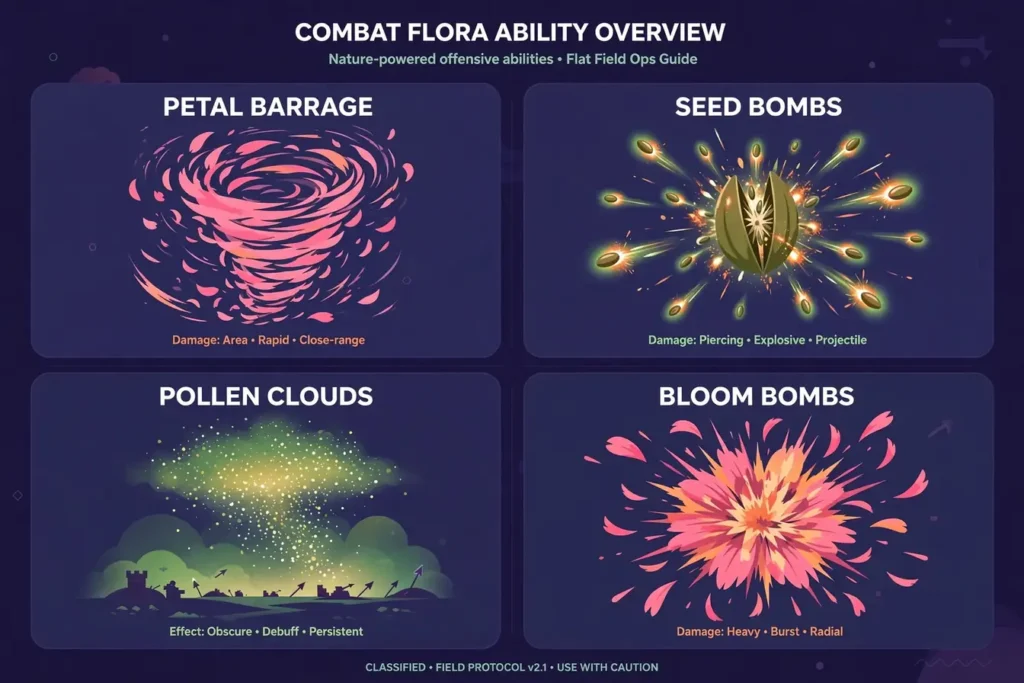
Petal Barrage: The Blooming Storm
The petal barrage is the move everyone recognizes: a whirling storm of petals flung at speed, each one edged like shrapnel or bursting on contact. Fiction loves the contrast, soft blossoms hitting like artillery, as seen in the danmaku patterns of Touhou, where screens fill with falling petals, and in BlazBlue, where an Astral Finish ends the fight in a shower of rose petals.
The barrage trades raw yield for coverage: it will not flatten a building, but it will cover a battlefield. Yuuka Kazami uses various flowers and petals as her bullets, and Sonic Heroes‘ Team Blast answers with an explosion of flower petals that hits everything nearby.
Seed Bombs and Pollen Clouds
The seed bomb is the planted charge: explosive seed pods grown ahead of time and detonated on approach, the way Usopp fires a Pop Green that bursts into a red skull-shaped explosion. Pollen clouds work the far end of the fight, drifting over the enemy and then bursting, with side effects borrowed from the plant world: sleeping flower spells that put opponents to sleep, and paralyzing pollen that drops them where they stand.
Both applications need setup time, and that is the trade-off. A petal barrage is instant; seed bombs and pollen clouds are traps. But the trap version scales up: one pod can seed a whole field of charges.
The Detonation: Bloom Bombs
The bloom bomb is the showpiece: a full flower grown to its most beautiful instant and then ripped apart into a detonation. The textbook version is the named attack from Yes! Pretty Cure 5 GoGo!, where the five Cures and Milky Rose fuse a red rose and a blue rose into a giant seed that blooms into a rainbow-colored rose and purifies the final boss. The table below lines up the toolkit.
The Bloom Toolkit
| Move | What it does | Who embodies it |
|---|---|---|
| Petal barrage | Fling bursting petals in a storm | Yuuka Kazami (Touhou): flower bullets; Rachel Alucard (BlazBlue): Astral Finish |
| Skull Bombgrass | A Pop Green that bursts into a skull-shaped cloud | Usopp (One Piece): Skull Bombgrass |
| Petal breath | Exhale petals that burst at the foe | Kurenai Yūhi (Naruto): Apricot Blossom Droop |
| Pollen drift | Flowering trees release knockout pollen | Hashirama Senju (Naruto): Advent of a World of Flowering Trees |
| Floral Explosion | A giant seed blooming into a purifying rainbow rose | Milky Rose and the Cures (Pretty Cure) |
| Petal escape | The body dissolves into petals that consume the enemy | Kurenai Yūhi (Naruto): Flower Petal Escape |
Real Science: Nature Already Explodes
Fiction gives the user a dial on the bloom. Science says the bloom moves on its own, driven by pressure, and we have been filming it with high-speed cameras for decades. The two meet at the seed pod, where the fantasy exaggerates a real mechanism.
The Dynamite Tree
Fiction’s bloom bombs have a real cousin. The sandbox tree, Hura crepitans, better known as the dynamite tree, grows pumpkin-shaped capsules that explode when ripe, splitting into segments and launching seeds at 70 m/s (250 km/h; 160 mph). One source records seeds thrown as far as 100 m (330 ft); another records up to 45 m (150 ft), most commonly 30 m (100 ft). High-speed video showed the seeds flying with backspin, which helps them minimize drag during flight.
The tree is a walking warning label: the trunk covered in long sharp spikes over an inch long, and the milky sap carries huratoxin. As documented by botanists, it is a real plant that throws its seeds like bullets.
Ballochory: The Ballistic Seed
Ballochory, or ballistic dispersal, is the scientific name for seeds forcefully ejected by explosive dehiscence of the fruit, usually powered by turgor pressure or hygroscopic tensions. The roster is long: Impatiens (touch-me-not), castor (Ricinus communis), balsam, the squirting cucumber (Ecballium elaterium) whose fruit bursts off its stalk and squirts seeds through the rupture, witch hazel squeezing seeds out at 45 km/h (28 mph), Cardamine hirsuta, Geranium, and more.
The speed records belong to flowers: bunchberry petals fly back in 0.2 milliseconds, and its stamens spring upward to 22 km/h in half a millisecond at an acceleration of 2400 g, eight hundred times the space shuttle at lift-off. The Hypenea macrantha flower even flings its pollen at hummingbird beaks with enough explosive force to dislodge rival pollen. Nature’s bloom bombs are small, but they are real.
Weaknesses and Limitations
The bloom bomb has a soft heart, and the strongest counter is simply burning the garden before it finishes blooming. Every entry on this list is a way the power fails, and every one of them flows from the same truth: no bloom, no bomb.
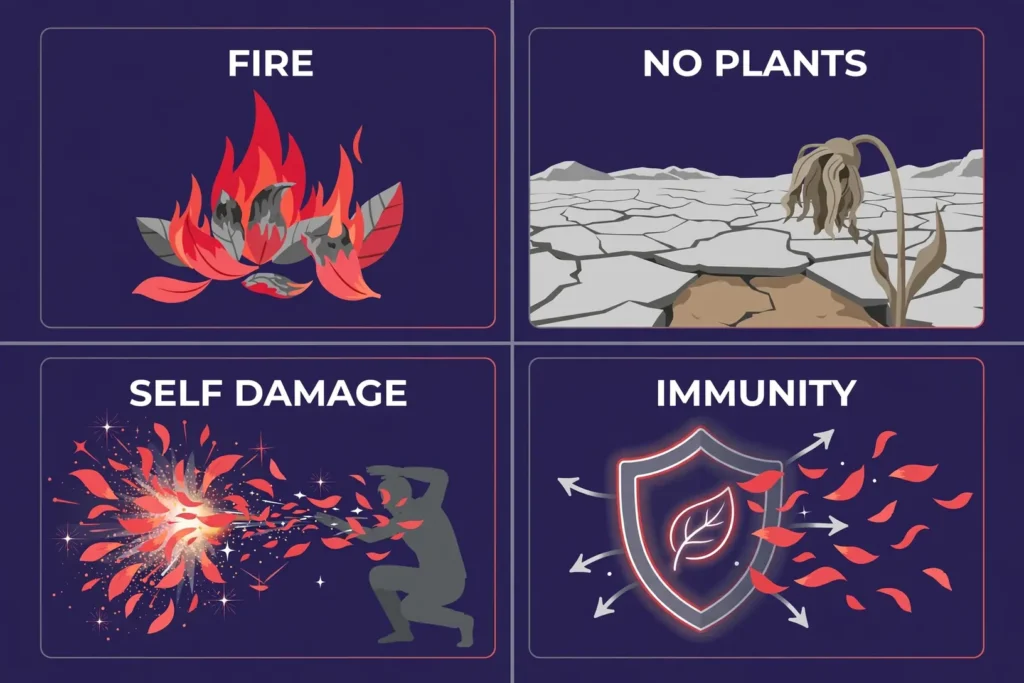
What Can Stop a Floral Explosion?
The bloom bomb has a soft heart. First, the ammunition is organic: fire destroys plant matter, so any fire user burns the petals before they burst, and desiccation kills the setup. Second, users may not be immune to the effects of their own attacks, so a trapped pollen cloud can backfire and a seed bomb can catch its own planter. Third, the setup is slow: users may require outside sources to release attacks, flowers take time to grow, and distance, mass, and precision depend on the user’s skill.
Counters also run through control: immunity to plants can shut the power down outright, and strong wind scatters pollen clouds before they arm. The flower is fastest when it surprises, so the classic answer is never to let the garden finish blooming. For more ways to humble a powerhouse, try our random weakness generator.
Famous Floral Explosion Users in Fiction
From anime to comics to games, these are the characters who defined the bloom bomb. Some throw petals like shrapnel, some grow the charge from a seed, and one turned a rose into a goddess, but each of them shows a different face of the same three moves.
Icons of the Bloom in Anime, Comics, and Games
Milky Rose (Yes! Pretty Cure 5 GoGo!) stands at the center of the trope, as depicted in the series: her Floral Explosion, performed with the five Cures using the Cure Fleurets and the Milky Mirror, turns a fused rose seed into a purifying rainbow bloom. Usopp (One Piece) fights from the gardener’s angle, as depicted: his Pop Greens include Skull Bombgrass, a seed that bursts into a red skull cloud. Yuuka Kazami (Touhou) treats flowers as ammunition, as depicted; Rachel Alucard (BlazBlue) ends her Astral Finish in a shower of rose petals, as depicted.
The list keeps growing: Kurenai Yūhi (Naruto) exhales the bursting Apricot Blossom Droop and dissolves into the Flower Petal Escape, as depicted; Hashirama Senju (Naruto) grows flowering trees whose pollen puts armies to sleep, as depicted (see our Naruto Sage Mode guide); Kurama (Yu Yu Hakusho) swings the Rose Whip, as depicted; Poison Ivy (DC Comics) weaponizes every plant in reach, as depicted; Flora (Winx Club) is a master of the art, as depicted; and Team Rose (Sonic Heroes) answers with its petal Team Blast, as depicted. Each as depicted in their own universe.
Conclusion
Floral explosion is the bloom bomb: grow the flower, arm the petals, seeds, and pollen, detonate. It is the prettiest way to start a war, and the fastest reminder that nature built the first explosive device long before we did. Want to hand the bloom bomb to your own character? Try our superpower generator and see what your garden would do.


