
Sleep Manipulation Superpower Explained: The Sleep Switch
Some powers move the body. Sleep manipulation owns the night itself: the power to flip the sleep switch in any mind, tuning how deeply they sleep, how long, and when they wake. It is the parent power of dream manipulation, subtler than mind control and quieter than any sedative. This guide, part of our Mental Powers collection, explains what sleep manipulation is, the three levers that power it, what it can do, the real science of the sleep cycle, and which famous characters embody the switchkeeper.
In this guide:
- What Is Sleep Manipulation?
- Sleep Manipulation vs Other Powers
- What Can Sleep Manipulation Do? Applications
- Real Science: The Sleep Cycle and the Sleeping Brain
- Weaknesses and Limitations
- Famous Sleep Manipulation Users
- Conclusion
What Is Sleep Manipulation?
Other powers fire energy or edit dreams. Sleep manipulation owns the state beneath them all: the on/off switch of consciousness itself. The sections below define the power, then map its three levers.
The Sleep Switch, Defined
A sleep manipulation user is a switchkeeper: someone who can control the sleep functions of oneself and in others. The fan catalogs file the power as Sleep Manipulation, a Sub-power of Consciousness State Manipulation and Mental Manipulation also called Hypnokinesis, Somnokinesis, or Sleep Control, and name its mirror image: Wakefulness Manipulation, its opposite. Where dream manipulation edits the dream, sleep manipulation owns the state around it, and the user stays totally conscious during sleep, able to wake themselves up at will.
That kept consciousness is the power’s signature. Ordinary sleepers surrender awareness; the hypnokinetic keeps it, turning sleep from a vulnerability into a workshop. The catalog’s framing is blunt: manipulate and enhance all aspects of sleep, in self or in others, including dreams, daydreams, and nightmares.
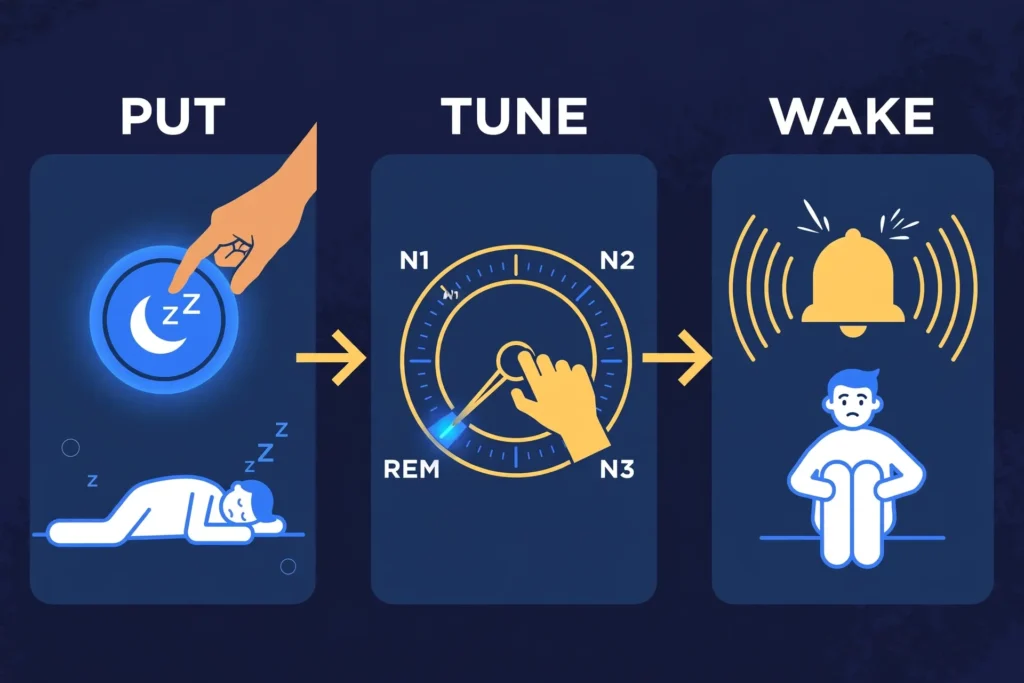
Put, Tune, Wake: The Three Levers
Every sleep manipulation runs the same three levers. First, PUT: Sleep Inducement, the targeted switch-off that drops a foe into safe unconsciousness, or the Drowsiness Aura (Somnolence Field) that accumulates fatigue across a crowd. Second, TUNE: Sleep Stage Control (REM/Non-REM Tuning) to tune sleep depth, Circadian Rhythm Adjustment to shift the internal clock, and full control to manipulate sleep patterns. Third, WAKE: Awakening that can force anyone sleeping to wake up regardless of the circumstances, Selective Wakefulness (Vigil Enhancement) that keeps allies sharp, or Insomnia Inducement that denies sleep entirely.
Skip the put and you have an alarm clock; skip the tune and you have a sedative; but run all three and you have the switchkeeper, the one mind that decides who sleeps, how deeply, and when they wake.
Sleep Manipulation vs Other Powers
The mind has many switches, and sleep manipulation is only one panel. Our dream manipulation guide covers its most famous child, and our fourteen Energy Powers guides all cover physical energy. The table below places the switchkeeper against its closest neighbors: the dream editor, the hypnotist, the alarm, and the sedative.
The Family Comparison
| Power | Which lever it owns | How Sleep Manipulation differs |
|---|---|---|
| Sleep Manipulation | The sleep state: induce, tune depth and stages, awaken | The baseline: the switchkeeper, owns sleep itself |
| Dream Manipulation | Dream content: enter, shape, rule dreams | The child: edits the dream, but needs the sleep first (catalog) |
| Hypnosis | Waking behavior: suggestion and trance while awake | Suggestion, not slumber: works on the waking mind |
| Wakefulness Manipulation | Alertness: enforces waking, denies sleep | The opposite: the alarm that never lets sleep come |
| Sedative Inducement | Chemical calm: tranquilized drowsiness | A narrower tool: sedation without stage control |
| Coma Inducement | Unconsciousness: the deep off-switch | The extreme: sleep with no dial and no waking |
What Can Sleep Manipulation Do? Applications
The applications flow from the three levers: put the target down, tune the sleep itself, and wake on command. (Hypnokinesis guide)
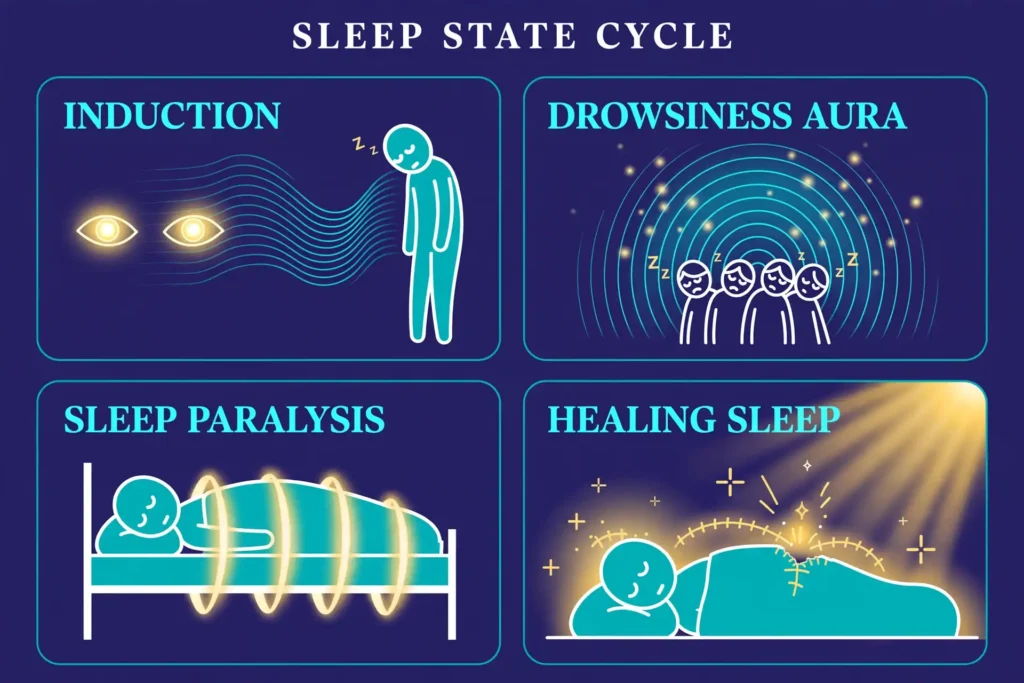
Put: Induction, Auras, and Paralysis
Instant Slumber Induction is the signature: a targeted switch-off delivered by gaze-based knockout, touch-triggered sedation, or radiating soporific waves that plunge targets into instant slumber. For crowds, the Drowsiness Aura (Somnolence Field) is a localized field where fatigue accumulates: slowed reactions, heavy limbs, micro-sleeps, the classic crowd control toolkit.
Sleep Paralysis Inducement and Release goes stranger: it decouples motor control from consciousness, holding a target in safe paralysis for capture or releasing a civilian from a panic episode. At the extreme sit Omni-Sleep Inducement and Eternal Slumber Inducement, which put a subject to sleep forever in a comatose-like state, the fairy-tale curse made literal.
Tune: Stages, Rhythms, and Healing
Sleep Stage Control (REM/Non-REM Tuning) is the dimmer switch: fine control over stages 1 to 4 and REM, used to deepen sleep for healing, suppress REM to reduce nightmares, or provoke REM to open dream interaction. Circadian Rhythm Adjustment shifts the internal clock forward or back: the fictional cure for jet lag, and the fictional weapon that leaves a squad drowsy at dawn.
The gentle face of the power is medical. Safe Sedation and Recovery applies medically precise sedation for surgery, then guides restorative sleep for accelerated recovery; the Healing Coma and Replenishment push further, with the catalog noting the user may even gain a Regenerative Healing Factor during sleep.
Wake: Awakening, Vigil, and Insomnia
Awakening is the alarm: the user can force anyone sleeping to wake up regardless of the circumstances, yanking targets out of slumber mid-dream. Selective Wakefulness (Vigil Enhancement) inverts the power, letting the user delay fatigue and sharpen alertness in allies so a team stays effective without stimulants. Insomnia Inducement is the cruel mirror, condemning a target to perpetual sleeplessness.
The user can also turn the power inward. Personal Sleep Manipulation can remove the need to sleep entirely, and Sleep Sense (Somnometrics) lets the user perceive who is awake, drowsy, or dreaming through walls, reading a building by its fatigue signatures.
Real Science: The Sleep Cycle and the Sleeping Brain
Fiction treats sleep as a switch. Science treats it as architecture: a 90-minute cycle of stages, chemistry, and timing. The two meet in the sleep cycle, the real control panel this entire power is built on.
The 90-Minute Sleep Cycle
Real sleep runs on a sleep cycle of about 90 minutes, a figure Nathaniel Kleitman popularized around 1963 (modern sources say 90 to 110 minutes), repeating 4 to 6 cycles per night. Each cycle descends through N1 (drowsy transition, 1 to 7 minutes), N2 (light sleep, 10 to 25 minutes, marked by sleep spindles and K-complexes), and N3 (deep slow-wave sleep, 20 to 40 minutes, the hardest to wake stage), then rises into REM: paradoxical sleep where the brain is awake while the body is paralyzed and dreams occur.
The architecture shifts through the night: deep NREM dominates early night for physical restoration, while REM dominates late night for cognitive and emotional processing, growing from a first REM of about 10 minutes to nearly an hour by morning and totaling 20 to 25 percent of total sleep. Specialists chart it all on a hypnogram. For a hypnokinetic, that chart is a control panel: every stage a dial, every transition a lever.
The Chemistry of Sleep and Waking
The chemistry is as real as the architecture. Melatonin is the night signal, and light suppresses melatonin, which is why the fictional Photokinesis counter works: flood the room and the sleep cues die. The flip-flop model of sleep/wake switching centers on GABA, an inhibitory neurotransmitter, with orexin holding the waking side; fictional GABAergic activity tuning is just this model with a dial attached.
And waking has a cost. Sleep inertia means waking from N3 leaves 30 to 60 minutes of impaired performance, the groggy penalty every alarm clock collects. A skilled sleep manipulator would never yank a target out of deep sleep by accident; they would tune the ascent, or weaponize the grogginess.
Sleep Stages Compared
The power works on every stage of sleep, but each stage plays by different rules. The table below maps them.
| Sleep stage | What it is | How long | What the power does with it |
|---|---|---|---|
| N1 | Drowsy transition between wake and sleep | 1 to 7 minutes | The doorway: easiest entry, lightest touch |
| N2 | Light sleep; spindles and K-complexes | 10 to 25 minutes | The corridor: steady induction, the bulk of the night |
| N3 | Deep slow-wave sleep; hardest to wake | 20 to 40 minutes | The vault: healing and restoration; waking here causes sleep inertia |
| REM | Paradoxical sleep; brain awake, body paralyzed; dreams | About 10 minutes growing to an hour; 20 to 25 percent of night | The stage: dream adjacency, nightmare work |
Weaknesses and Limitations
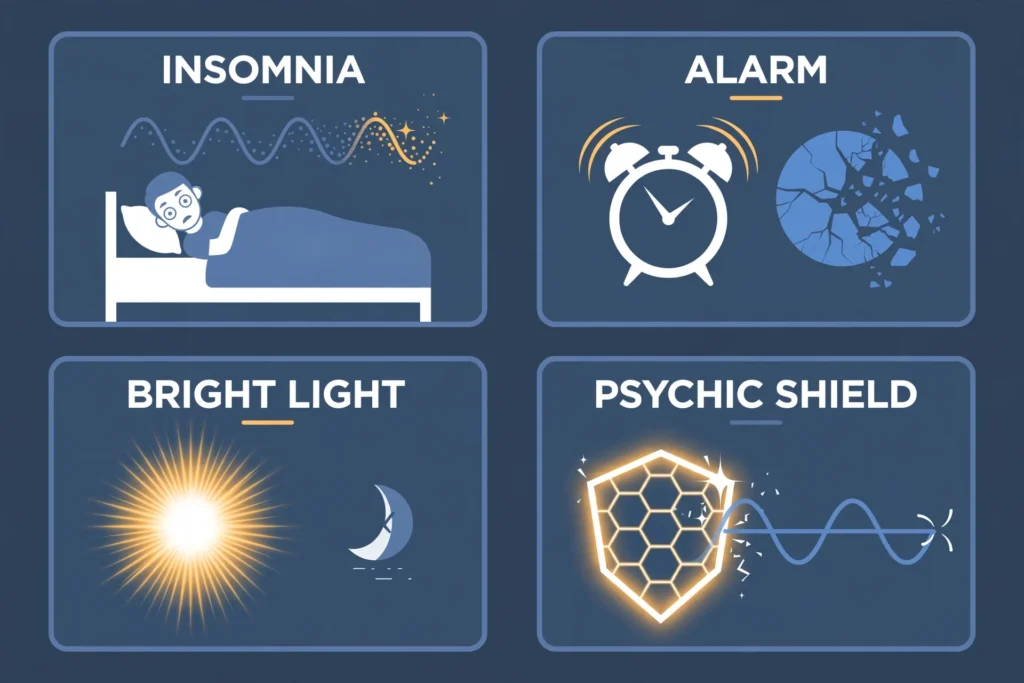
No power is complete without its counters. The switch is mighty but fragile: break the sleeper’s biology, flood the room with light, or sound the alarm, and the switchkeeper loses the night.
What Can Stop a Sleep Manipulator?
The catalog’s hard counters come first: insomnia (unable to sleep means nothing to manipulate), sleep-related disorders that break the mechanism, and the user’s own exposure, totally vulnerable during sleep. Awakening from outside forces still works: yelling, an alarm clock, floodlights, sonic alarms, or painful stimuli can yank a target out of induced sleep, and Sleep Negation users can switch the whole power off.
The softer limits decide most stories. Willpower and Training let disciplined targets and psionic resistors shrug off drowsiness; Biological Constraints mean synthetic beings and undead with no sleep cycles to exploit are immune. Stimulants and Adrenaline (combat drugs, heightened adrenaline) blunt the field; Concentration Costs mean a startled user drops control; and Overcorrection Risks warn that forcing wakefulness too long buys rebound crashes. Direct power counters include Psionic Shielding (Mental Barriers, iron will), Pain Inducement (acute pain forcibly wakes), Photokinesis (intense light suppresses melatonin), Sound Manipulation (high-decibel bursts), Wakefulness Manipulation (enforces alertness), and Cybernetic or Robotic Physiology. For more ways to humble a powerhouse, try our random weakness generator.
Famous Sleep Manipulation Users
From myth to comics to anime to games, these are the characters who defined the art of ruling sleep.
Icons of Sleep Manipulation in Myth, Comics, Anime, and Games
Hypnos of Greco-Roman mythology, the personification of Sleep, is the original switchkeeper, and his son Morpheus shaped dreams for gods and mortals alike, as depicted in the myths. Enmu (Demon Slayer / Kimetsu no Yaiba) is the nightmare conductor, lulling victims deeper with his whispering spell, as depicted in the anime. The Sandman (Sanderson Mansnoozie, Rise of the Guardians) sprinkles dream-sand over a sleeping world, as depicted in the film.
Comics supply the tacticians: Professor X (Charles Xavier) and Jean Grey (Marvel Comics) use telepathic sedation and mental sedation as non-lethal control; Saturn Girl (Imra Ardeen) quiets minds to impose sleep; and Doctor Destiny weaponizes sleep through the Materioptikon, each as depicted in their universes. Anime adds the sleep fighters: Zenitsu Agatsuma (Demon Slayer) and Sian (Rave Master) both fight while asleep, as depicted in their series. Mantis (Marvel Cinematic Universe) puts even titans to sleep with a touch; Wesley Dodds, the golden-age Sandman, did it tech-based with sleep gas; Clovis of the Hypnos cabin (Percy Jackson) naps through apocalypses; and the Slender Man (Creepypasta) stalks the edge of sleep itself. For sleep-themed quirk ideas, see emitter quirk ideas; for more power variety, god ki abilities and thunder breathing.
Conclusion
Sleep manipulation is the mind at its most fundamental: not the thought, not the dream, but the sleep itself, put, tuned, and woken at will. Whether it arrives as Hypn
os’s poppy, Enmu’s whisper, or a telepath’s gentle shutdown, it runs on the same three levers: put, tune, wake. Want to give the power to your own character? Try our superpower generator and see what your nights would build.


