
Dream Manipulation Superpower Explained: Enter, Shape, Rule
Some powers move the body. Dream manipulation moves through the mind: the power to enter another person’s dream, sculpt the dreamscape, and rule the night. It is the quietest battlefield in fiction, fought entirely while the target sleeps. This guide, part of our Mental Powers collection, explains what dream manipulation is, the three moves that power it, what it can do, the real science of lucid dreaming, and which famous characters embody the dream architect.
In this guide:
- What Is Dream Manipulation?
- Dream Manipulation vs Other Powers
- What Can Dream Manipulation Do? Applications
- Real Science: Lucid Dreaming and the Dreaming Brain
- Weaknesses and Limitations
- Famous Dream Manipulation Users
- Conclusion
What Is Dream Manipulation?
Other powers fire energy or move matter. Dream manipulation moves through the sleeping mind: by entering the dream, shaping the dreamscape, and ruling its rules, the user turns the most private place a person has into a stage. The sections below define the power, then map its three moves.
The Dream Architect, Defined
A dream manipulation user is a dream architect: someone who can enter, shape, and rule the dreams of oneself and the dreams of others. The fan catalogs file the power as Dream Manipulation, a Sub-power of Sleep Manipulation also called Oneirokinesis, Dream Control, or Dreamweaving, and warn not to confuse it with just Oneiropathy, which is dream telepathy, not dream control (Dream Manipulation). The catalog’s view of the raw material is poetic and precise: dreams are coded messages from the mind to itself, vivid expressions of the subconscious shaped by emotion, memory, trauma, desire, and thought, and the architect holds the cipher.
It is a metapsychic ability: the user interfaces with the dreaming mind across the dream state, from REM sleep to trance to induced sleep. Where telepathy reads the waking mind, dream manipulation rules the sleeping one, and that difference is the whole power.
Enter, Shape, Rule: The Three Moves
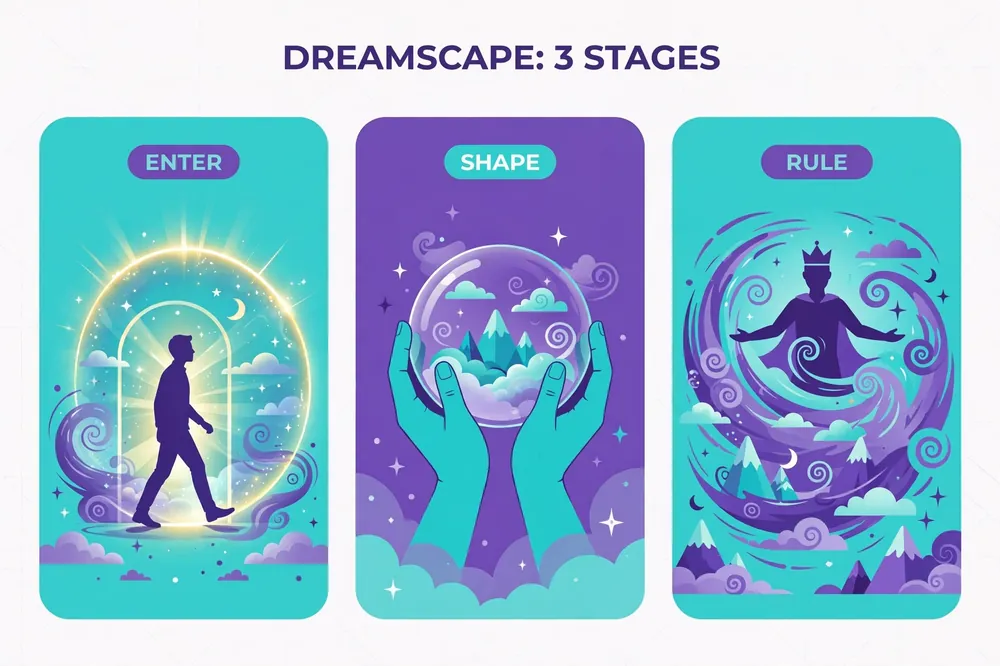
Every dream manipulation runs the same three moves. First, enter: the user steps into another person’s dream, arriving undetected or announcing their presence as a godlike force. Second, shape: Dream Sculpting, or Dream Weaving, edits the dreamscape itself, its landscapes, laws of physics, weather, lighting, and narrative arcs. Third, rule: at full mastery the user binds minds into shared dreams and stabilizes persistent dream realms that hold across nights, approaching absolute control over the realm of dreaming.
Skip the entry and you have a daydreamer; skip the shaping and you have a visitor; but run all three and you have the architect, the one mind in the dream that knows it is a dream and decides what happens next.
Dream Manipulation vs Other Powers
The mind has many doors, and dream manipulation is only one of them. Our fourteen Energy Powers guides all cover physical energy, fire, bursts, shields, flight, and charges. Dream manipulation is the site’s first power about the mind itself. The table below places it against its closest mental neighbors: dream telepathy, personal dream control, dream magic, and the waking-mind powers it is often confused with.
The Family Comparison
| Power | What it does | How Dream Manipulation differs |
|---|---|---|
| Dream Manipulation | Enters, shapes, and rules the dreams of self and others | The baseline: the architect, full control of the dreamscape |
| Oneiropathy | Receives and transmits information between dreaming minds | Communication, not control: telepathy knocks, the architect redesigns (catalog) |
| Dreamscape | Personal dream world under the user’s own control | Self only: rules one dream, not anyone else’s |
| Dream Materialization | Brings dreams into waking reality | The exit: makes dreams real instead of ruling them |
| Sleep Manipulation | Controls sleep itself: inducing, preventing, altering it | The parent: owns the door, not the room beyond it |
| Daydream Manipulation | Manipulates waking daydreams | Daylight only: no sleep, no deep dreamscape |
| Telepathy | Reads and influences waking minds | The waking cousin: no dream stage required |
What Can Dream Manipulation Do? Applications
The applications flow from the three moves: enter the dream, shape what happens there, and rule the rules themselves. Walking, shaping, and ruling each open a different kind of power.

Walk: Dreamwalking and Dream Entry
Dreamwalking is the entry move. The user enters another person’s dream as a dream observer or participant, and distance, consent, and mental defenses decide how hard the door is to open. Entry can happen during natural sleep, induced slumber, or synchronized meditation, and skilled walkers hop between linked sleepers or cross shared dream hubs the way commuters cross stations.
The walk is the power at its quietest: no flash, no sound, just one mind stepping into another’s night. That silence is why fiction loves it for spies, thieves, and therapists alike.
Shape: Sculpting, Nightmares, and Lucid Induction
Once inside, the user shapes. Dream Sculpting edits everything: spawn dream NPCs, replay memories as scenes, rewrite the plot mid-scene. Nightmare Inducement turns the dream toward weaponized fear, while Nightmare Resolution does the reverse, steadying the dream and comforting the dreamer. Lucid Induction grants lucidity to the sleeper, and Dream Projection sends a dream avatar into shared mindscapes.
Beneath it all runs Memory Playback and Symbolic Translation: decode dream symbols, extract usable data, plant therapeutic metaphors that guide without overwriting. The shaper does not just change what the dream looks like; they change what it means.
Rule: Shared Dreams, Time Dilation, and Dream Wards
Ruling the dream means owning its rules. Shared dreams bind several minds into one synchronized dreamworld, and persistent dream realms hold as pocket dimensions where time flows differently. Time Dilation stretches subjective time so minutes feel like days, and Narrative Looping replays a scene until it teaches, heals, or breaks.
Defense matters as much as offense: Dream Barriers and Dream Wards raise oneiric firewalls, decoy narratives, and alarms around the user’s own sleep, while Sleep Induction and deepened REM open the door in others. To rule dreams and never be ruled in them, the architect guards their own night first.
Real Science: Lucid Dreaming and the Dreaming Brain
Fiction treats the dream as a place you can visit. Science treats it as a state you can measure. The two meet in lucid dreaming, the one real phenomenon this entire power is built on.
The Proof That Lucid Dreaming Is Real
The science starts with Stephen LaBerge, who used eye-movement signaling to prove lucidity happens inside REM: pre-arranged eye movements, made from inside the dream, confirmed the REM timing of lucidity and showed that dream time matches real time (lucid dreaming). In 2021, four independent labs went further with real-time two-way REM communication: lucid dreamers answered questions through eye and facial signals while polysomnography-confirmed REM showed they were asleep, demonstrating volitional responding during dreams.
Brain imaging backs it up. fMRI work (Dresler et al., 2011) found sensorimotor activation during dreamed movements, and lucid REM shows elevated frontal gamma near 40 Hz with the dorsolateral prefrontal cortex, the seat of metacognition, partially awake. Demirel’s team, writing in the Journal of Neuroscience, found beta waves in the temporal and parietal lobes and gamma in the right precuneus during lucid dreams: a signature distinct from both waking and ordinary REM.
Dream Telepathy in Fiction
Fiction got there first. Oneironautics, the study of conscious dream travel, notes that dream telepathy, or telepathic lucid dreaming, is a genre staple: computer-mediated dream entry in Paprika and The Cell, one sleeper entering another’s mind in Inception, Dreamscape, and Waking Life, and the dreamwalkers of Wheel of Time. The oneironaut, the conscious traveler inside a dream, is the real-world cousin of every fictional dreamwalker.
The pattern is always the same: the dream is a place, and places can be visited. Fiction just skips the lab equipment.
Dream States Compared
The power works on every kind of dreaming, but each state plays by different rules. The table below maps them.
| Dream state | What it is | Who controls it | What the power does with it |
|---|---|---|---|
| Ordinary dream | The nightly REM narrative | Nobody: the subconscious runs it | The default target: entered and edited freely |
| Lucid dream | A dream the dreamer knows is a dream | The dreamer | Shared agency or a fight: the catalog warns it may not work on lucid dreamers |
| Nightmare | A dream built from fear | Fear itself | Weaponized or healed: inducement and resolution |
| Daydream | Waking fantasy, no sleep required | The daydreamer, lightly | Edited in the open: suggestion without slumber |
| Shared dream | Several minds in one dreamscape | The architect | The masterpiece: synchronized dreamworlds and persistent realms |
Weaknesses and Limitations
No power is complete without its counters. The dream is mighty but fragile: wake the target, ward the mind, or seize lucidity, and the architect loses the building.

What Can Stop a Dream Manipulator?
The catalog’s hard counters come first: Oneiric Immunity, Dream Negation, and Dream-Lock shut the door entirely, and the power is ineffective on lucid dreamers, who can seize control of their own dreams, and on insomnia, where there is no dream to enter. Psychic Shield, Psychic Immunity, and Indomitable Will block or blunt the entry before it begins.
The softer limits decide most stories. State Dependence means the target must be asleep, so Wakefulness Manipulation ends the threat; Dream Banishing collapses the dreamscape, Memory Lock seals the interrogation target, Nullification Fields sever the link, and Echo Tracking can follow the tether back to the intruder. And the power taxes its user: cognitive burn, symbolic ambiguity when a symbol is misread, and backlash from non-consensual entry. For more ways to humble a powerhouse, try our random weakness generator.
Famous Dream Manipulation Users
From myth to comics to anime to games, these are the characters who defined the art of ruling dreams.
Icons of Dream Manipulation in Comics, Anime, Games, and Myth
Morpheus, Dream of the Endless (DC Comics/Vertigo), is the definitive archetype: the King of Dreams and architect of the Dreaming, as depicted in the comics. Greek myth gave the first dreamwalkers: Hypnos and the Oneiroi, Morpheus, Phantasos, and Phobetor, the gods who shaped mortal dreams. Freddy Krueger (A Nightmare on Elm Street) is the nightmare weapon, entering teenagers’ dreams to kill them there, as depicted in the films.
Nightmare (Marvel Comics) rules the Dream Dimension and feeds on fear; Doctor Destiny (DC Comics) weaponizes dream control through the Materioptikon; Princess Luna (My Little Pony) guards the dream realm; Darkrai (Pokemon) haunts sleep with nightmares; Death 13 (JoJo’s Bizarre Adventure) drags victims into its dream world; Enmu (Demon Slayer) puts foes to sleep to rule their dreams; the Dream Lord (Doctor Who), Sandman (Rise of the Guardians), Nocturn (Danny Phantom), the Wind Fish (The Legend of Zelda: Link’s Awakening), and Steven (Steven Universe) each wield the power as depicted in their own universes. For dream-themed quirk ideas, see emitter quirk ideas; for more power variety, god ki abilities and thunder breathing.
Conclusion
Dream manipulation is the mind at its most sovereign: not the thought or the memory, but the dream itself, entered, shaped, and ruled. Whether it arrives as Morpheus’s Dreaming, Freddy’s nightmare, or a lucid dreamer’s sudden awareness, it runs on the same three moves: enter, shape, rule. Want to give the power to your own character? Try our superpower generator and see what your dreams would build.


