
Electric Shield Superpower Explained: Barriers, Blocks & Limits
An electric shield is one of the most satisfying defensive powers in fiction: a crackling barrier of living charge that stops attacks before they land. This guide explains what the power is, how it differs from force fields, energy shields, electric armor, and electric field manipulation, what real physics says about it, and which fictional characters wield it best. Like every electricity-themed ability we cover, it belongs in our Energy Powers category.
In this guide:
- What Is an Electric Shield?
- Electric Shield vs Force Field vs Energy Shield
- How an Electric Shield Would Actually Work
- Electric Shield Powers and Abilities
- Weaknesses and Limitations
- Famous Electric Shield Users
- Conclusion
What Is an Electric Shield?
The Defensive Construct, Defined
An Electric Shield is the power to create shields out of electricity, a defensive construct known in the fan catalogs as Electric Shield Construction and also filed under Electrokinetic Shield Construction or Lightning Shield Construction. In use, it works as a personal electric barrier: the user generates charge and shapes it into a protective wall of energy that sits between them and incoming harm.
Catalogs list the ability as a sub-power of Electrical Constructs, itself a variation of Elemental Shield Construction. In other words, the electric shield is the electricity-shaped defensive end product of a broader construct-forming power set, distinct because its material is raw charge rather than stone, ice, or pure force.
Shield Shapes: Walls, Domes, Bubbles and Skin
A defining feature of the power is shields of varying shapes and sizes: most often the classic wall shape that blocks one direction, a dome shape that covers a group, or a bubble shape/sphere shape that encloses the user completely while moving. These projected constructs read as tangible force-fields, solid enough to stop attacks yet visibly made of crackling charge, and they can protect self or protect others depending on where the user places them.
At the smallest extreme sits the Electric Aura, a skin-level field that coats the body rather than projecting outward. This passive, close-worn form trades coverage for mobility, letting a user stay untouchable in a melee fight without sacrificing movement speed.
Electric Shield vs Force Field vs Energy Shield
If you have read our guides to bio-electricity, bio-lightning, electric discharge, or electric field manipulation, you already know how versatile electricity is. This section maps exactly where the shield sits among the related powers.
The Five-Way Comparison
An electric shield is easy to confuse with its neighbors, but the catalog taxonomy draws clear lines. Under Force-Field Generation, the broader power covering barriers of any kind, the electric version is an electricity-specific subtype: Electric Shield Construction sits under Electrical Force-Field Generation, a sub-power of Electricity Manipulation (and by extension of Electromagnetism Manipulation), while a general force field may be made of plasma, telekinesis, or pure force. Energy Shield Construction is the parallel ladder: the electric shield is one variation among twelve energy-shield types, alongside fire, light, chi, and soul shields.
The worn-versus-projected line settles the rest. Electric Armor is body-worn, a field worn on the body that augments speed and defense, whereas shields are projected outward; a Bio-Electric Aura is a passive, reflex-driven, skin-level field rather than a consciously shaped barrier. And Electric Field Manipulation is the broad power of which the shield is only one defensive application, the rest being offensive or utility uses of electric fields.
| Power | What it is | Energy scope | Key difference from Electric Shield |
|---|---|---|---|
| Electric Shield | The electricity-shaped defensive construct | Electricity only | The baseline: a consciously shaped barrier of charge |
| Force Field (general) | Any energy barrier | Any energy type, incl. plasma and telekinesis | Broader concept, not electricity-specific |
| Energy Shield | A barrier of one energy type | One of 12 types, incl. fire, light, and chi | The electric shield is one variation of it |
| Electric Armor | A body-worn electric field | Electricity, worn on the body | Worn, not projected; often boosts speed |
| Electric Field Manipulation | Broad control of electric fields | All electric phenomena | The shield is one defensive application of it |
How an Electric Shield Would Actually Work
No laboratory can summon one on demand, but the physics behind it is real. The shared principle is electromagnetic shielding, the practice of reducing or redirecting electromagnetic fields with conductive materials such as copper, brass, nickel, silver, and steel.
The Faraday Cage: Nature’s Electric Shield
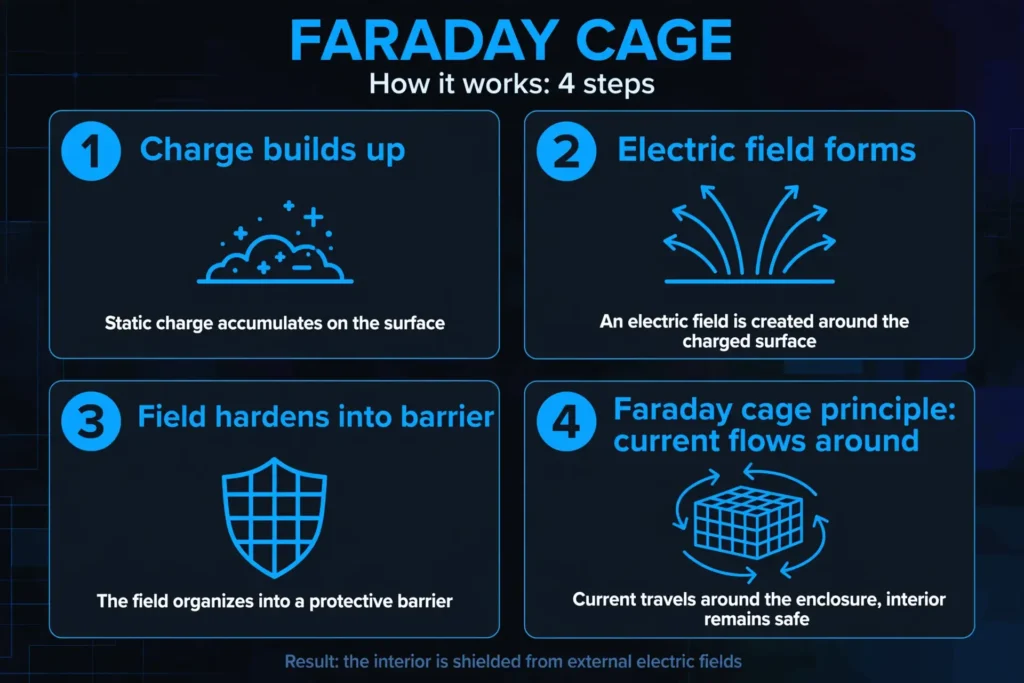
The closest real-world analogue to an electric shield is the Faraday cage, a conductive enclosure that blocks electromagnetic fields. When charge hits the outside, the Faraday shield conducts current around the outside of the enclosure, so none passes through to the interior; that is why car bodies and airplane bodies act as Faraday cages that protect against lightning strikes and electrostatic discharges.
The principle dates to Michael Faraday, who demonstrated it in 1836. A fictional electric shield simply takes the same physics further: instead of relying on an existing metal shell, the user generates their own conductive barrier from scratch.
Plasma Shields: From Sci-Fi to Spacecraft
Plasma, the fourth state of matter, is an ionized gas that is naturally electrically conductive; lightning is partially ionized plasma, which makes it a natural model for a barrier of living charge. The leap from fiction to lab work mirrors classic force fields in fiction, and researchers have sketched real versions. A NASA 2005 proposal imagined charged spheres around a spacecraft to bend charged particle streams for radiation protection, and University of Washington 2006 work proposed a charged plasma bubble around spacecraft.
Later milestones kept the idea alive: the 2008 mini-magnetosphere concept to deflect cosmic rays, 2014 University of Leicester work on plasma deflector shields, and 2016 Rice University research into teslaphoresis, which steers particles with Tesla coils (plasma). None of this is a personal shield you can summon, but each project treats an electric or magnetic field as a physical barrier, which is exactly how the fictional power is imagined to work.
Electric Shield Powers and Abilities
In fiction, an electric shield is more than a wall: it blocks, deflects, and sometimes fights back. Here is what the power can do in a fight, and which form suits each situation.
Blocking, Deflecting and Repelling Attacks
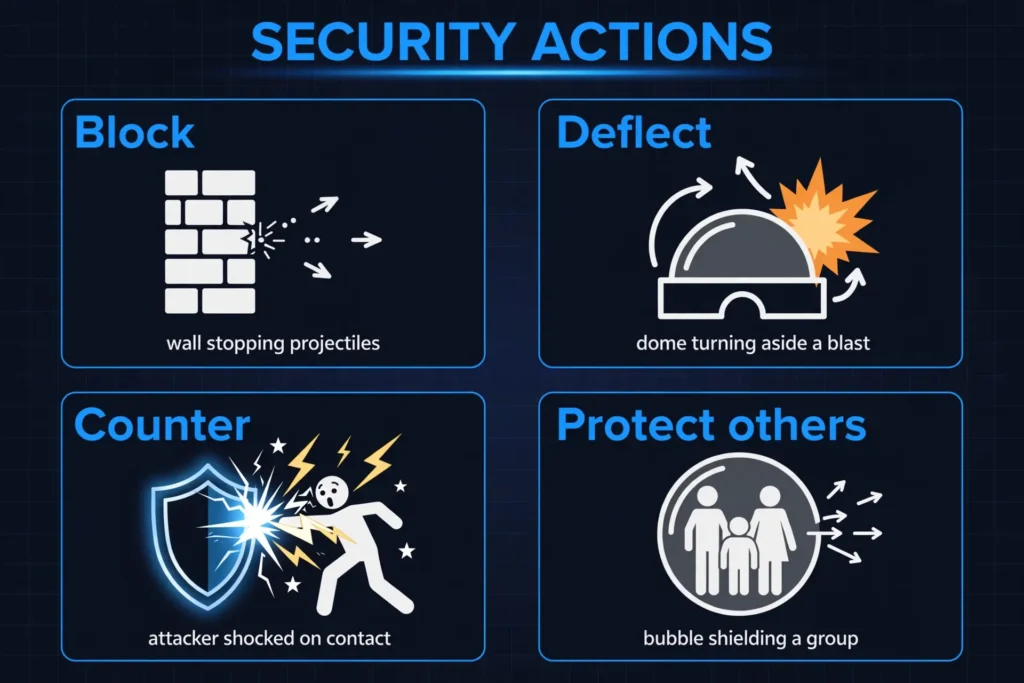
In a fight, the shield’s core job is Deflection: it prevents incoming damage by letting the user block attacks before they connect. Standard moves include block incoming projectiles, repels enemies on contact, and knock away opponents who press into the barrier, with Electrical Wall Generation raising a mobile cover the user can reposition around the battlefield.
An electrically charged bubble adds moving cover the user carries with them, and Surface Creation can extend that defense across walls, floors, or doorways. The theme is constant: stop the hit, push back the hitter, and keep the ground the user chooses to hold.
Shields That Fight Back
Some versions turn defense into offense: as depicted in fiction, the barrier can deflect an attack and punish contact, dealing lightning damage back to melee attackers who touch it. The fan catalog pairs the shield with Electricity Generation and Electric Wave Emission, so the wall crackles outward as well as inward.
The showcase example is Volt, the Warframe frame whose Electric Shield ability grants damage bonus to projectiles passing through it, turning the barrier into a weapon for allies behind it. A tabletop mechanic variant even lets players spend dice to deflect, treating each block as a resource choice rather than a free action.
Shield Forms Compared
No single form wins every fight, which is why the full comparison below lays out when each form earns its place. The wall shape holds a line in one direction, the dome shape gives 360-degree cover for a group, the bubble shape or sphere shape carries enclosed protection on the move, and the Electric Aura keeps a skin-level field for melee range. Whether the goal is to protect self or protect others, the right pick depends on who is behind the barrier and how fast the fight is moving.
| Form | Coverage | Best used for | Example user |
|---|---|---|---|
| Wall | One direction | Holding a line or corridor | Cole MacGrath’s Polarity Wall |
| Dome | 360° around the user | Protecting a group | Typical team shield |
| Bubble/Sphere | Enclosed, all-around | Mobile personal cover | Volt’s Electric Shield |
| Skin/Aura | Body surface only | Staying untouchable in melee | Remi’s electricity coating |
Weaknesses and Limitations
Every barrier has a price, and the electric shield is no exception. These are the limits the fan catalogs list most often.
What Can Break an Electric Shield?
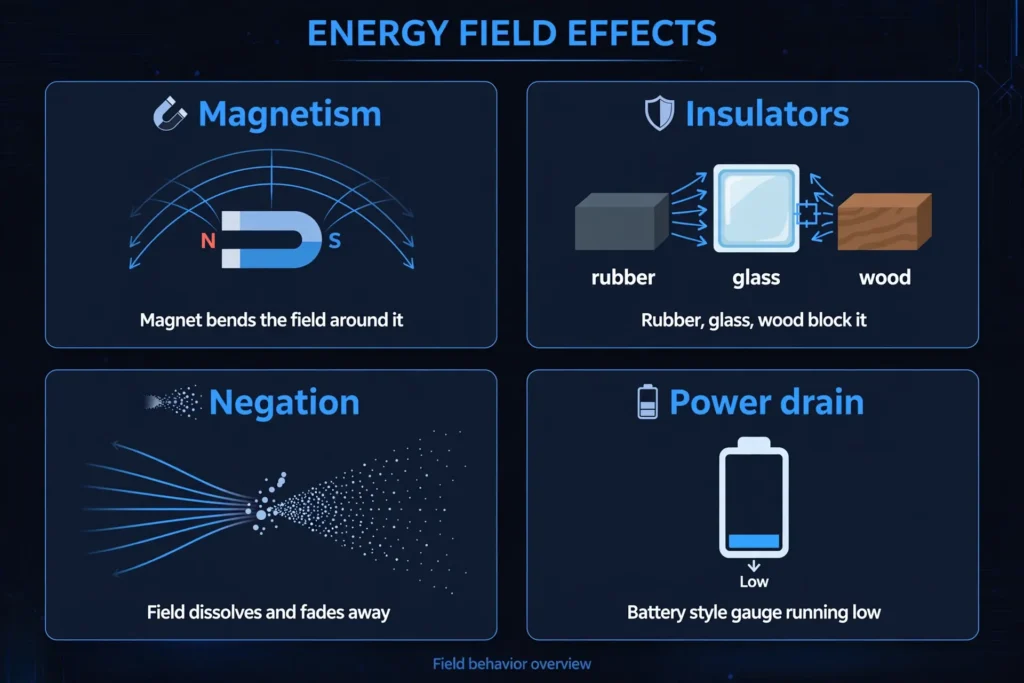
Fictional catalogs list consistent limits. Shields have limited size and only protect what is behind them, plus limited area coverage and a constant power cost that drains the user over time. Catalog entries also note that magnetism-based attacks may penetrate and that non-electrical materials may penetrate: earth, sand, glass, crystal, wood, plastic, and concrete are all listed as materials an electric barrier may fail against, since insulators do not interact with the field.
Harder counters include shield penetration powers, shield removal powers, energy negation, and energy absorption. The physics side adds honesty: kinetic energy remains even when charge is stopped, so beam weapons unaffected and laser weapons unaffected are listed as limits of a primitive beam shield, while real-world analogues like electrified tank armor only divert charge with a burst of heat and fast nanosecond response, diverting energy to ground rather than becoming invincible. As framed in the catalogs, the EMP shield vs surge protector comparison makes the same point: protection stops the surge, but projectile energy cooked away still costs the system dearly.
Famous Electric Shield Users
As depicted in their stories, these ten users show how the power looks across games, anime, and comics.
Icons of the Electric Barrier in Games, Anime and Comics
As depicted in their stories, the best-known users span games, anime, and comics, and the fan catalog credits each with a signature barrier feat. Cole MacGrath (inFAMOUS) raises his Polarity Wall to hold a position; Ash’s Pikachu (Pokemon) spins its Counter Shield to block attacks mid-battle; Volt (Warframe) deploys the game-defining Electric Shield ability; and Erza Scarlet (Fairy Tail) armors up with her Lightning Shield through the Lightning Empress Armor, as depicted in the series.
Misaka Mikoto (A Certain Magical Index) surrounds herself with an invisible electromagnetic barrier; Colonel Volgin (Metal Gear Solid 3) projects an electrical shield blocking gunfire; Magneton (Pokemon Adventures) raises an electrical wall stronger than steel (fan-catalog wording); the Seashockers and Skrills (How To Train Your Dragon) generate electric fields for protection; Static, also known as Virgil Hawkins (Milestone/DC), and BoBoiBoy Thunderstorm (BoBoiBoy) close the list with his Thunder Shield, as depicted in the series. These barrier specialists pair well with other defensive icons on this site: the defense theme of the Armored Titan, Gojo’s Infinity and the Limitless technique as barrier parallels, the defensive art of Quincy Blut, barrier quirks, and Thunder Breathing for the electricity theme.
Conclusion
Whether you want a fortress-grade dome or a skin-tight aura, the electric shield rewards creativity: it is defense that can punish anyone who touches it. For more electricity-themed abilities, spin the superpower generator and see what charge you get next.


