
Bio-Lightning: The Superpower of Throwing Lightning From Your Own Body
Most electric powers borrow their spark from somewhere else: a storm, a power line, a battery. Bio-Lightning doesn’t. It is the superpower of building up a huge electrical charge inside your own body and releasing it outward as a lightning-like arc or bolt. Think of the user as a living capacitor: the body has to make the charge, store it, release it and then recharge.
That cycle is what makes this power interesting to write about. Nature already has a small-scale version, the electric eel, but going from an eel’s shock to an actual bolt through open air is a huge leap. This guide covers how the power would work, what real biology does and doesn’t support, what it costs the user, and how to use it in stories, games and our generator.
What Is Bio-Lightning?
Bio-Lightning is the high-voltage, outward-discharge end of body electricity. The power is body-sourced, so the charge comes from the user’s own cells rather than the environment, and it is lightning-scale, meaning strong enough to jump through air instead of only working on touch. Fan wikis don’t always treat it as its own power: names such as Bio-Lightning Manipulation, Living Lightning Manipulation and Living Thunder Manipulation appear as alternate names for the broader Bio-Electricity entry.
Bio-Lightning vs Bio-Electricity
The two names overlap in fan taxonomy. The Superpower Wiki, for example, lists “Bio-Lightning Control” and “Living Electricity Manipulation” as alternate names for Bio-Electricity Manipulation rather than giving Bio-Lightning its own page. On this site we split them. Bio-Electricity is the broad control of the body’s internal currents: the signals in nerves and the heart, plus sensing and healing. That broader power is Bio-Electricity, and this guide leaves it there.
Bio-Lightning is the narrow, explosive part of that bioelectric spectrum. It isn’t about steering the currents inside you. It’s about pushing enough charge out of the body to break down the air and throw a bolt. If Bio-Electricity is the wiring, Bio-Lightning is the surge that leaves the building.
Bio-Lightning vs Electric Discharge and Other Electric Powers
Electric Discharge is the generic release of electricity from any source, while Bio-Lightning only counts when the body itself is the source and the output reaches lightning scale. An Electromagnetic Pulse (EMP) disables electronics rather than striking a target, so it counts as a separate power. An Electric Shield is a defensive barrier, which is a separate power from throwing a bolt. And Electrokinetic Flight uses electricity to move, which is beyond what this guide covers.
The Living Capacitor: How Bio-Lightning Works
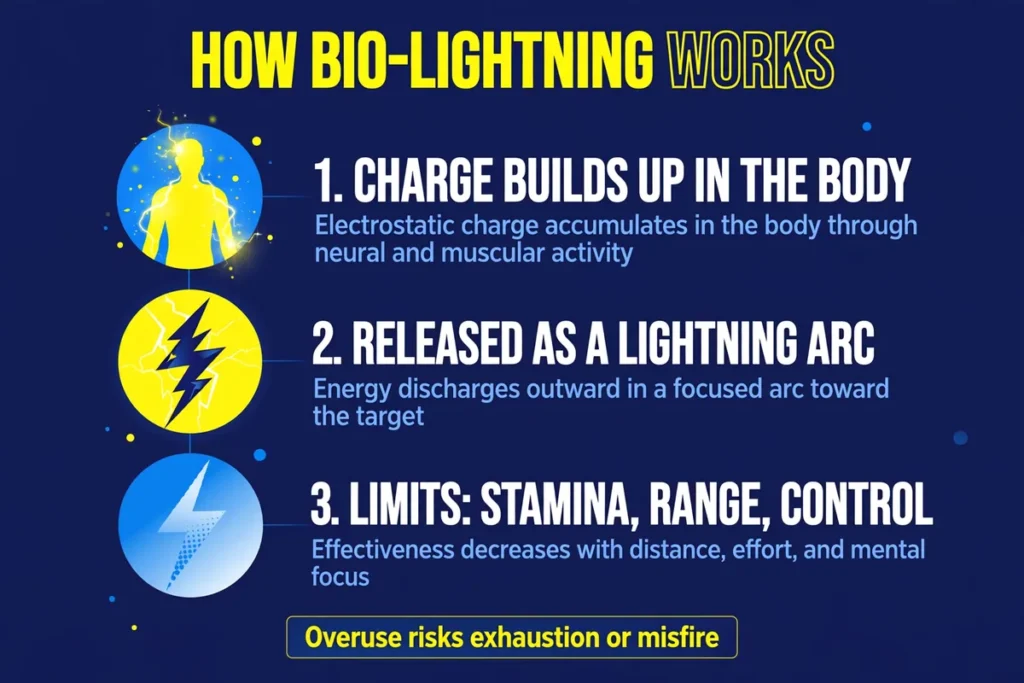
The cleanest way to understand the power is the four-step cycle: make, store, release, recharge. Every version of Bio-Lightning, from a comic panel to a tabletop rule, has to answer each step, even if it waves one away.
Make: Generating the Charge
First the body needs a power source, a step power guides often call electrogenesis. In real animals, that’s an electric organ built from stacked electrocytes, which are modified muscle cells lined up so their small voltages add together, according to the Natural History Museum. Fiction usually gives a Bio-Lightning user something similar: a mutated organ, an engineered implant, or an unexplained “spark” in the nervous system.
What matters for story logic is that charge is made by living tissue, so it draws on the user’s own energy. That’s the main difference from storm-callers, who borrow power from the weather.
Store: Holding Charge Without Frying Yourself
A capacitor stores charge and lets it go all at once. A Bio-Lightning user needs the same kind of charge storage, because a bolt is a sudden release, not a steady trickle. In a story this is where you decide how much the user can hold, how long they can hold it, and what holding it feels like. Tingling skin, raised hair and a crackling sound all make good cues.
Storage is also where the danger sits. The more charge a body holds, the more it needs some kind of insulation to keep that charge from leaking into its own organs. Writers who skip this step end up with a hero who could, by the same logic, electrocute themselves.
Release: Breaking Down the Air
This is the step that separates Bio-Lightning from an ordinary shock. NOAA’s National Weather Service describes lightning as a giant spark that happens when the charge difference gets large enough to overcome air’s insulating capacity. Air normally blocks electricity. A bolt only forms once the push is strong enough to force a path through it. The University Physics textbook from OpenStax puts the dielectric strength of dry air at about 3.0 million volts per metre (3.0 MV/m), which works out to roughly 3,000 V for a 1 mm gap in an even field. By that rough arithmetic (our calculation, and real gaps vary with shape and conditions), even the eel’s record 860 V would bridge well under a millimetre of dry air.
Real lightning heats the air around it to roughly 50,000 °F, according to NOAA, and the rapid expansion of that heated air is what we hear as thunder. So a convincing Bio-Lightning release should come with a flash, a crack and heat. If your character’s bolt makes no noise, readers who know this may notice.
Recharge: The Recovery Window
After the release, the store is empty. The Natural History Museum notes that electric eels don’t discharge continuously and need a long time to recharge. That gives Bio-Lightning a natural rhythm: build, strike, then a window of vulnerability.
For fiction, the recharge time is the most useful limit you have. It creates tension, forces the user to pick their moment, and gives opponents an opening without inventing an outside weakness.
The Electric Eel: A Real-World Benchmark
None of the sources we checked describe an animal that throws lightning, and the electric eel is the closest benchmark we have for a body building and dumping a big charge. How eel organs work in general belongs to the broader topic of Bio-Electricity. Here we only look at what eels tell us about discharge.
What the 860-Volt Record Tells Us
There are three species of electric eel: Electrophorus electricus, Electrophorus varii and Electrophorus voltai, separated in a 2019 study by de Santana and colleagues in Nature Communications. That study recorded an 860 V discharge from an E. voltai specimen 1,219 mm (about 1.2 m) long, well above the ~650 V previously cited for the genus, and the authors call it the strongest bioelectricity generator known. The same paper measured E. varii at 151–572 V and one E. electricus at 480 V. These are single or small-sample field measurements (n = 1 for the E. voltai record), not species maximums. (Some popular sources credit the 860 V record to E. varii; the original paper credits E. voltai.)
The same study describes two kinds of output. Strong EODs (electric organ discharges) are used for hunting and defense, while weak EODs of around 10 V are used for electrolocation and communication. That split is a handy model for a Bio-Lightning user: one setting for attack, another for sensing.
Why Eels Leap Instead of Throwing Bolts
Even at 860 V, an eel isn’t described as shooting electricity across a gap. The Natural History Museum describes eels leaping partly out of the water to press their chin, the most positively charged part of the body, against a predator while their negative pole stays in the water. That closes the circuit through the target instead of letting the charge disperse into the water. Our reading of this (an inference, not a claim from the source) is that the eel relies on contact and water to deliver its shock.
That’s the core problem for Bio-Lightning. Water conducts, so an eel’s charge has a path. Air acts as an insulator until the charge difference is large enough to overcome it (see NOAA, above), so a land-based user would need far more push to make a bolt cross even a short gap. (For more on how water changes a power, see our Aquatic Adaptation guide.)
Could a Human Body Do This?
Not as far as current biology goes. Humans have no electrocyte stacks. Human bioelectricity is real, since our nerves and heart run on electrical signals, but it works on a far smaller scale than an eel’s organ, and nothing like the charge needed to break down air. (This guide doesn’t give a figure for human bioelectric voltage because we haven’t confirmed one from a physiology source.)
Engineers have borrowed the eel’s design, though. In a 2017 Nature paper (Schroeder et al., “An electric-eel-inspired soft power source from stacked hydrogels”), researchers reported that thousands of stacked hydrogel compartments, activated together, generated 110 V at open circuit. That’s an artificial power source, not a living one. It shows the stacking idea is real, while the bolt-throwing human remains fiction.
Bio-Lightning Abilities by Scale
These are the main ways the power shows up in fiction, from weakest to strongest. They’re design categories, not measured ranges. Any distance you give them is your call as a creator, not a real-world figure.
Contact Shock
The most grounded version works like the eel: touch, close the circuit, release. It pairs naturally with close-range fighting, sometimes called conductive melee, where every punch or grab delivers a jolt. It’s the cheapest form to justify, because no air has to be crossed.
Short Arcs
At the next step up, the charge is strong enough to jump a small gap: a spark between fingers, an arc to a nearby metal railing, a crackle across a doorway. This is where the air-breakdown problem first appears, so arcs work best when the user is close to something conductive.
Ranged Bolts
This is the headline ability: arc projection at a distant target. Physically, ranged attacks like this need a path through air. One answer on Worldbuilding Stack Exchange argues that ranged electric attacks would first need a rapidly pulsed “organic laser” to create an ionized air channel that conducts like a wire, which would make the result more like a “wireless taser” than a true lightning bolt. Treat that as a design idea from a fan discussion, not as established science.
Ranged bolts should cost the most and take the longest to recharge. If a story lets the user fire them freely, the power stops being Bio-Lightning in any meaningful sense and becomes general electricity control.
Low-Power Pulses
Not every use has to be an attack. Taking the cue from the eel’s weak discharges, a Bio-Lightning user might send small pulses to sense nearby objects or signal allies. Keep this minor. Detailed sensing and electroreception belong to Bio-Electricity, and this guide only treats them as a side effect of the main power.
Costs, Limits and Counters
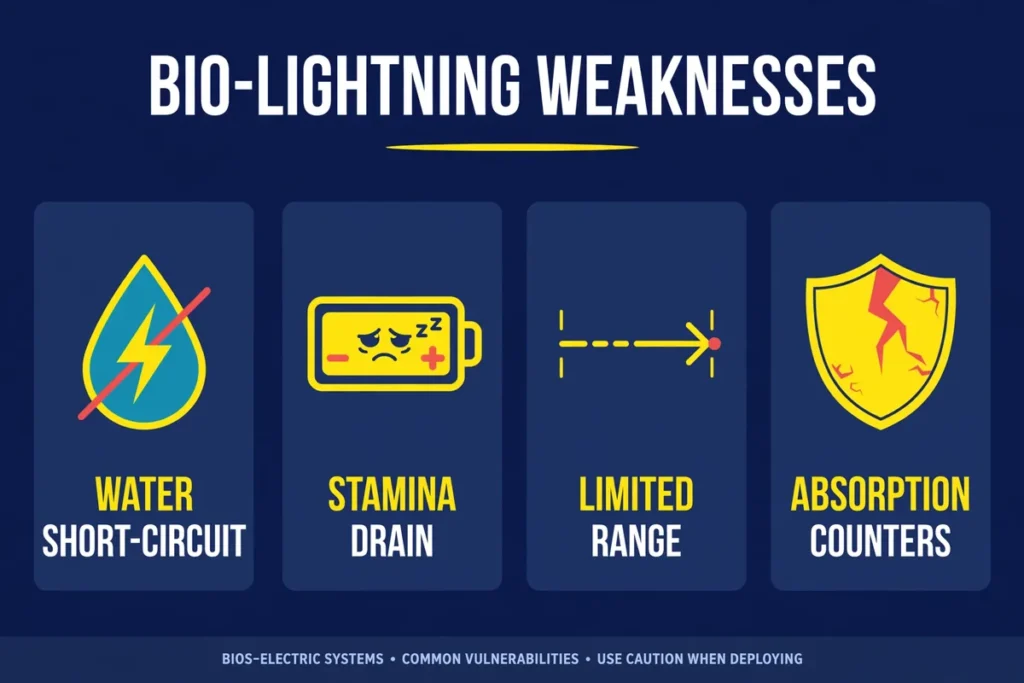
A power without costs is hard to write well. Bio-Lightning’s strengths and weaknesses both come from the same source, and its built-in limits come straight from the living-capacitor model.
Recharge Time and Fatigue
A long recharge time after a big release is the one limit with real-world backing: the Natural History Museum notes that eels don’t discharge high power continuously and take a long time to recharge. Everything beyond that is story design, not science. If the charge comes from the user’s own body, it is a reasonable creative choice to make every bolt cost energy, with fatigue, hunger or slower reactions as the price. A common worldbuilding question is whether a bio-electric human would need extra salt in their diet. No source we checked settles that, so treat it as a flavour choice, not a rule.
Self-Shock and Burns
The same energy that hurts a target can hurt the user. If a bolt is anywhere near as hot as real lightning (NOAA cites roughly 50,000 °F), it is reasonable to write burns as a risk at the point of release. A self-shock when storage fails is an obvious way to show a power that’s being pushed too far.
Water, Grounding and Lightning Rods
Many stories treat water as a double-edged setting: it carries a contact shock, as it does for the eel, but spreads a ranged one away from its target. That’s a common fiction rule rather than measured physics. Grounding plays a similar role: a grounded opponent, or a well-placed conductor, can pull a bolt off course. A Lightning Rod user is the natural counter, because their whole power is redirecting electricity.
Who Has Bio-Lightning? Canon vs Fan Interpretation
This is where most guides get loose. Plenty of characters throw electricity, but whether their power is body-generated lightning in canon is a separate question.
What Fan Wikis List
The Superpower Wiki’s Bio-Electricity Manipulation page lists users such as Black Lightning, Electro, Cole MacGrath and Misaka Mikoto. That list is fan interpretation. It’s edited by fans and we haven’t checked it against official publisher sources, so we don’t present any of these characters as confirmed Bio-Lightning users. A quick check shows why the label needs care. Black Lightning originally used a belt to project bolts and was later depicted as a metahuman who generates electricity himself. Electro (Max Dillon) gains the ability to generate electricity after a lightning-strike accident, but is also often shown absorbing power from outside sources. Cole MacGrath’s powers in inFamous refill by absorbing electricity from nearby sources, so he fails the body-sourced test. (Character summaries checked against Wikipedia’s articles on each character, which cite the official works; not checked against the comics or games directly.)
Anime has lightning-themed fighters too. Our Thunder Breathing guide covers the Demon Slayer technique, which is a swordsmanship style with lightning imagery rather than electricity made by the body.
How to Check a Character’s Canon
Ask three questions. Where does the electricity come from: the character’s body, or an outside source? Does the official work (the comic, anime, game or publisher material) say so, or is it only on a fan wiki? Does the character throw it through air, or only shock on contact? A character who passes all three is a strong Bio-Lightning example. One who fails the first is better described as an electricity manipulator.
Using Bio-Lightning in Stories, RPGs and Generators
For Writers
Build your power system around the four steps. Decide where the charge is made, how much the body can store, what the release looks and sounds like, and how long recovery takes. Give the cost a physical form, such as exhaustion, burns or a lost turn in a fight, and the power will feel earned instead of convenient.
Keep the science light but consistent. You don’t need real voltages. What readers notice is a bolt that cracks with thunder in one scene and fires silently in the next.
For RPG Players and Game Masters
In tabletop RPG play, Bio-Lightning works best as a charged ability with a cooldown that matches the recharge step. Most systems have no official Bio-Lightning power, so you will usually be adapting an existing electric attack or writing your own homebrew rule. Check your system’s official rules first.
Good table rules usually tie range and damage to how much charge the character spends, then add a risk of self-shock on a bad roll. That keeps the power powerful without making it free.
For Generator Users
If you landed on Bio-Lightning through our random superpower generator, try building the rest of the character around its limits. A user who needs contact plays very differently from one who can throw bolts but needs a minute to recover. You can browse related abilities in our Energy Powers section.
Conclusion
Bio-Lightning is the outward, lightning-scale end of body electricity. The living-capacitor cycle (make, store, release, recharge) explains how it would work and where it breaks down. The electric eel shows that a body can build a serious charge, and lightning physics shows why throwing that charge through air is the real superpower. Use the recharge window, the air gap and the risk to the user as your limits, and the power will feel grounded even when the bolt isn’t.


