
Plant Regeneration Superpower Explained: The Healer’s Green
Plant regeneration is the superpower of restoring life through plants, and it works in two directions: healing damaged or dead plants back to green, and healing your own body by absorbing plants or their energy. Power filings call the self-healing side chlorokinetic regeneration, also known as reverse photosynthesis. This guide covers both directions, the mechanics behind them, the real science that makes them plausible, the limits that keep them honest, and the most famous users in fiction. For the broader family of plant powers, see our Plant Manipulation guide.
In this guide: What Is Plant Regeneration? | The Two Directions: Healing Plants vs Healing Yourself | How Plant Regeneration Works | Real Science: Plants That Regenerate | Limits: What Plant Regeneration Cannot Fix | Famous Plant Regeneration Users in Fiction | Conclusion | FAQs
What Is Plant Regeneration?
Forget the idea that plants are fragile. Plant regeneration treats the green world as a reservoir of spare life: a withered sapling can be coaxed back to bloom, and a wounded warrior can drain a grove to close a gash. The filings define the self-healing side precisely: the power to regenerate wounds by absorbing plants or plant energy, either to empower the regeneration process or by directly transforming plants into the user’s own mass.
It is the healer’s power in the plant family. Where plant manipulation commands vegetation and plant growth acceleration hurries it, plant regeneration repairs it. And it is not pure fantasy: real plants resurrect from apparent death, regrow from fragments, and carry wound-healing chemistry in their sap.
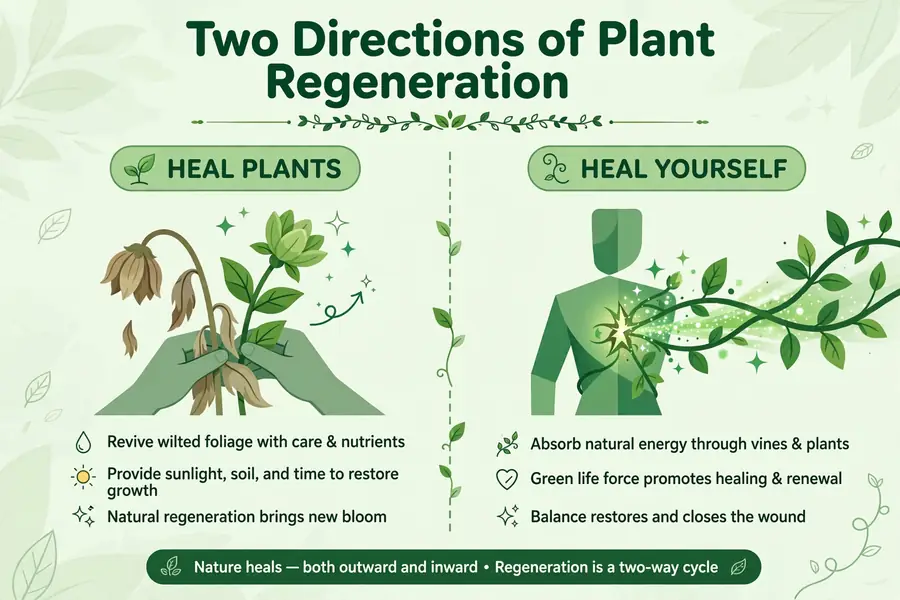
The Two Directions: Healing Plants vs Healing Yourself
| Heal plants (flora medic) | Heal yourself (self-regenerator) | |
|---|---|---|
| Target | Damaged, withered, or dead plants | The user’s own body |
| Method | Coax growth, close wounds, revive tissue | Absorb plants or plant energy, convert to mass |
| Best at | Restoring groves, reviving dead crops | Closing wounds, regrowing limbs, reforming |
| Also called | Plant restoration | Chlorokinetic regeneration, reverse photosynthesis |
| Famous example | Garden guardians, harvest goddesses | Undergrowth, Ryokugyu, Superman (TDKR) |
Direction One: The Flora Medic
The first direction points outward. A flora medic restores damaged, withered, or even dead plants: closing wounds in bark, coaxing a snapped stem to rejoin, or reviving withered plants that anyone else would compost. The filings list this under the plant manipulation family as one of its most humane techniques, and it scales from a single seedling to an entire scorched grove.
This is the gentlest expression of plant regeneration, and it is why the power shows up in stories about guardians and gardeners rather than warriors. Where plant manipulation commands and plant growth acceleration hurries, regeneration repairs.
Direction Two: The Self-Regenerator
The second direction points inward. A self-regenerator knits their own wounds by absorbing plants or plant energy: draining a grove to close a gash, or transforming plants into their own mass to replace what was lost. The filing calls this chlorokinetic regeneration and notes it is also known as reverse photosynthesis.
This is the power that turns a forest into a hospital and a battlefield into a pantry. The user does not just heal; they convert the green world into spare parts.
How Plant Regeneration Works
The mechanism is always conversion: green matter or green energy in, restored tissue out. What changes is the scale, from a closed cut to a reformed body, and the source, from a handful of leaves to an entire field.
Absorb and Transform
The mechanism is simple to state and dramatic to watch. The user absorbs plants or siphons plant energy, then channels it to empower their regeneration process: wounds close, bones set, tissue rebuilds. At higher mastery, the user skips the middleman and directly transforms plants into their own mass, regrowing a lost arm from a handful of vines or reforming after destruction from scattered fragments.
Sunlight supercharges the process. The filings describe photokinetic regeneration, healing while exposed to sunlight through photosynthesis, which is why so many regenerators fight better at noon than at midnight.
The Tiers of Regeneration
Not all regenerators are equal. The filings rank regenerative healing factor in tiers: enhanced regeneration closes cuts and fractures fast; supernatural regeneration regrows limbs and organs; absolute regeneration rebuilds the user from near-total destruction. Plant regeneration users climb the same ladder, with their tier set by how much plant matter or energy they can draw on.
The ceiling is the environment: a user in a jungle is nearly unkillable, while the same user in a desert is merely tough. Tier is a budget, and the green world funds it.
Real Science: Plants That Regenerate
The power is fantasy, but the biology it borrows is real. Everything below comes from published science reporting, and it is why the superpower feels earned rather than arbitrary.
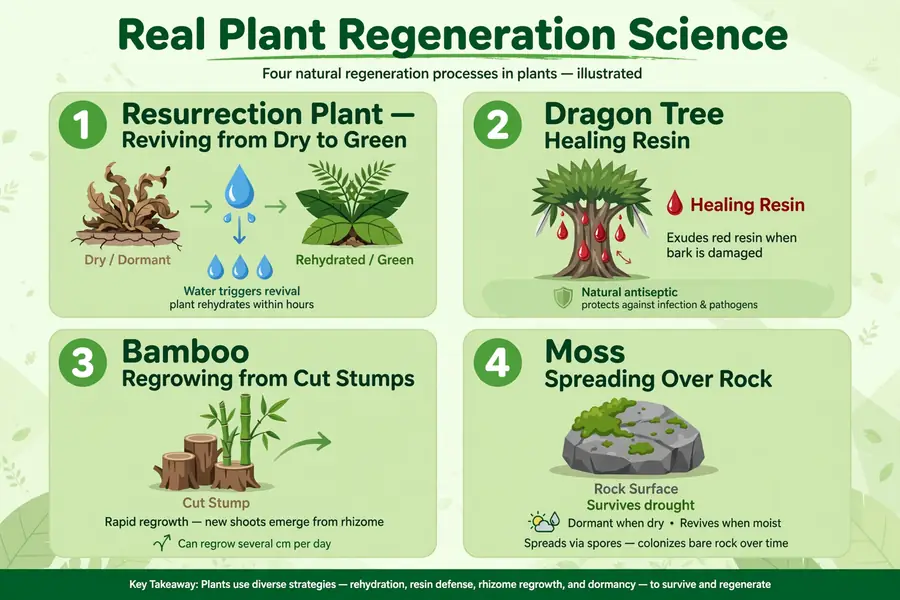
Resurrection Plants and Wound Signals
Real plants regenerate, and the science is striking. Resurrection plants in South Africa lose 95 percent of their water, look dead, and come back to life with the first rain. Research on Arabidopsis and maize found that wounding triggers glutamate receptor-like proteins that flood cells with calcium; when scientists suppressed the defense response, regeneration time doubled, measured by the ability to regrow roots or a callus, a stem-cell structure. Read the research on plant regeneration powers.
Plants also recover from fire by design: epicormic growth pushes new shoots from under bark, lignotubers sprout from the base, and some seeds only germinate after fire. The three R’s of fire country are resist, recover, recruit.
Nature’s Healing Pharmacy
Plants do not just heal themselves; their chemistry heals others. The dragon tree of the Canary Islands secretes dragon blood, a red resin used since ancient times for wounds; its sap carries phenolic compounds and antioxidants that stimulate tissue repair and fight infections. Bamboo regrows from intact roots after cutting, and its flavonoids promote wound healing in humans by enhancing collagen production. Moss survives extreme drought and regenerates after long dormancy.
A flora medic in fiction is just scaling up what these plants already do: wound closure, tissue repair, and chemical defense, run at supernatural speed.
Limits: What Plant Regeneration Cannot Fix
Every power needs its counters, and the green healer has honest ones. They fall into two groups: structural limits on what can be restored, and elemental counters that destroy the fuel.
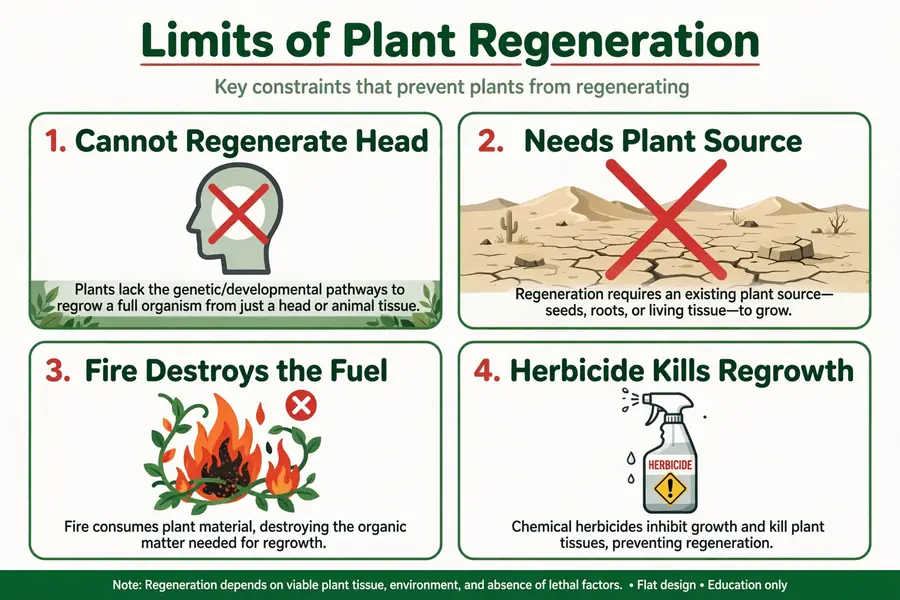
What It Cannot Fix
The filings are honest about the ceiling. A user may be unable to regenerate their head, which keeps the power from becoming true immortality. The user must generate plant life or draw plant life from other sources; with no plants and no stored energy, there is nothing to convert into new mass.
Distance, mass, precision, and duration scale with user skill, and beginners are capped at closing wounds rather than regrowing limbs. Tier is earned, not granted. If the matchup looks bad, a quick visit to a random weakness generator beats a fair fight.
Hard Counters
The counters are elemental and chemical. Fire burns the fuel before it can be absorbed, ice and cold freeze the medium, magma and extreme heat sterilize the field, and herbicide kills the plants outright. High radiation disrupts the growth pathways, and lightning strikes split the very trees a regenerator would drain.
The subtlest counter is dehydration: users who manipulate the water inside plants find dehydrated plants immune, and a few can only affect living plants. A smart enemy fights a regenerator in a desert, not a jungle.
Famous Plant Regeneration Users in Fiction
The filing names a compact roster, but three users define the lane so clearly that they lead every telling. The rest of the bench follows, each showing one scale of the power pushed hard.
The Reformers: Undergrowth, Ryokugyu, and Superman
Three users define the self-regeneration lane. Undergrowth (Danny Phantom), a living ghost plant monster, can regenerate a lost arm or reform after being blown to pieces by sinking into the Earth to regrow, as depicted in his own universe. Aramaki/Ryokugyu (One Piece) wields the Mori Mori no Mi and regenerates from a sapling, as depicted in his own universe. And Superman (The Dark Knight Returns), after being hit by a nuclear missile, absorbs energy from a field of plants to heal, as depicted in his own universe.
Each shows a different scale: Undergrowth reforms from fragments, Ryokugyu regrows from a sprout, Superman drains a whole field. The fuel is always green.
The Wider Roster
Beyond the icons, the bench is solid, each as depicted in their own universe: the Methanosians and Jungle Guardians (Ben 10), plant beings who regenerate through their own biology; Kara Danvers/Supergirl (Arrowverse); the Colossi of Age of Mythology, who heal by eating trees; Black Orchid (DC Comics), effectively immortal because each Black Orchid is a clone of the last, a new one waking with all memories when one dies; Poison Ivy and Swamp Thing (DC Comics), whose plant natures let them recover through the green; and Demeter (Percy Jackson), goddess of the harvest.
The roster proves the lane’s range: from tree-eating giants to clone-immortal spies to a Superman running on photosynthesis.
Conclusion
Plant regeneration is the healer’s power: restore the green world outward, or convert it inward into restored flesh. Absorb and transform is the whole mechanism, reverse photosynthesis is the poetry, and real plants, from resurrection flora to dragon trees, prove the concept is older than fiction. No other healing power comes with its own fuel supply growing out of the ground. Want to hand the green healer’s kit to your own character? Try our superpower generator and see what regrows.
FAQs
What is plant regeneration as a superpower?
Plant regeneration is the superpower of restoring life through plants. It works in two directions: healing damaged or dead plants back to green, and healing your own body by absorbing plants or their energy.
What is reverse photosynthesis?
Reverse photosynthesis is another name for chlorokinetic regeneration. Instead of plants converting sunlight into energy, the user converts plants or plant energy back into healed tissue.
Can plant regeneration bring dead plants back to life?
In fiction, yes: a flora medic can revive withered or even dead plants, from a single seedling to a scorched grove. In nature, resurrection plants come back from apparent death with water.
Does plant regeneration work better in sunlight?
Yes. The filings describe photokinetic regeneration, healing while exposed to sunlight through photosynthesis. Many regenerators fight better at noon than at midnight.
What are the limits of plant regeneration?
Users may be unable to regenerate their head, and they must have plants or plant energy to draw on. Fire, ice, herbicide, and radiation destroy the fuel. Tiers range from enhanced to absolute regeneration.
Who are famous plant regeneration users in fiction?
Undergrowth (Danny Phantom), Aramaki/Ryokugyu (One Piece), the Methanosians (Ben 10), Superman (The Dark Knight Returns), Supergirl (Arrowverse), and the Colossi (Age of Mythology), each as depicted in their own universe.


