
Plant Manipulation Superpower Explained: The Green Family
Plant manipulation is the superpower of controlling plant life, and it is also the plain-English umbrella term for the whole family of green powers. Every Greek-named variant you have heard of, from chlorokinesis to phytokinesis to botanokinesis, lives under this one roof. This guide maps the family: what each name means, the mechanics they all share, what they can do, where they fail, and who wields them best in fiction. For the deep dive on the most famous Greek-named variant itself, see our Chlorokinesis guide.
In this guide: What Is Plant Manipulation? | Plant Manipulation vs Chlorokinesis: What’s the Difference? | The Plant Power Family Tree | Core Mechanics Every Variant Shares | What Can Plant Manipulation Do? Applications | Real Science: How Plants Actually Work | Weaknesses and Limitations | Famous Plant Manipulation Users in Fiction | Conclusion | FAQs
What Is Plant Manipulation?
Forget the idea of one single trick. Plant manipulation covers every way a character can create, shape, and command plants: making seeds sprout in seconds, bending vines into weapons, hardening bark into armor, speaking through root networks, and brewing plant chemistry into poisons or medicines. The filings describe users who cause plants to grow, move, attack, or even rise from the soil, who mutate plants by rearranging DNA, and who revive withered or dead plants.
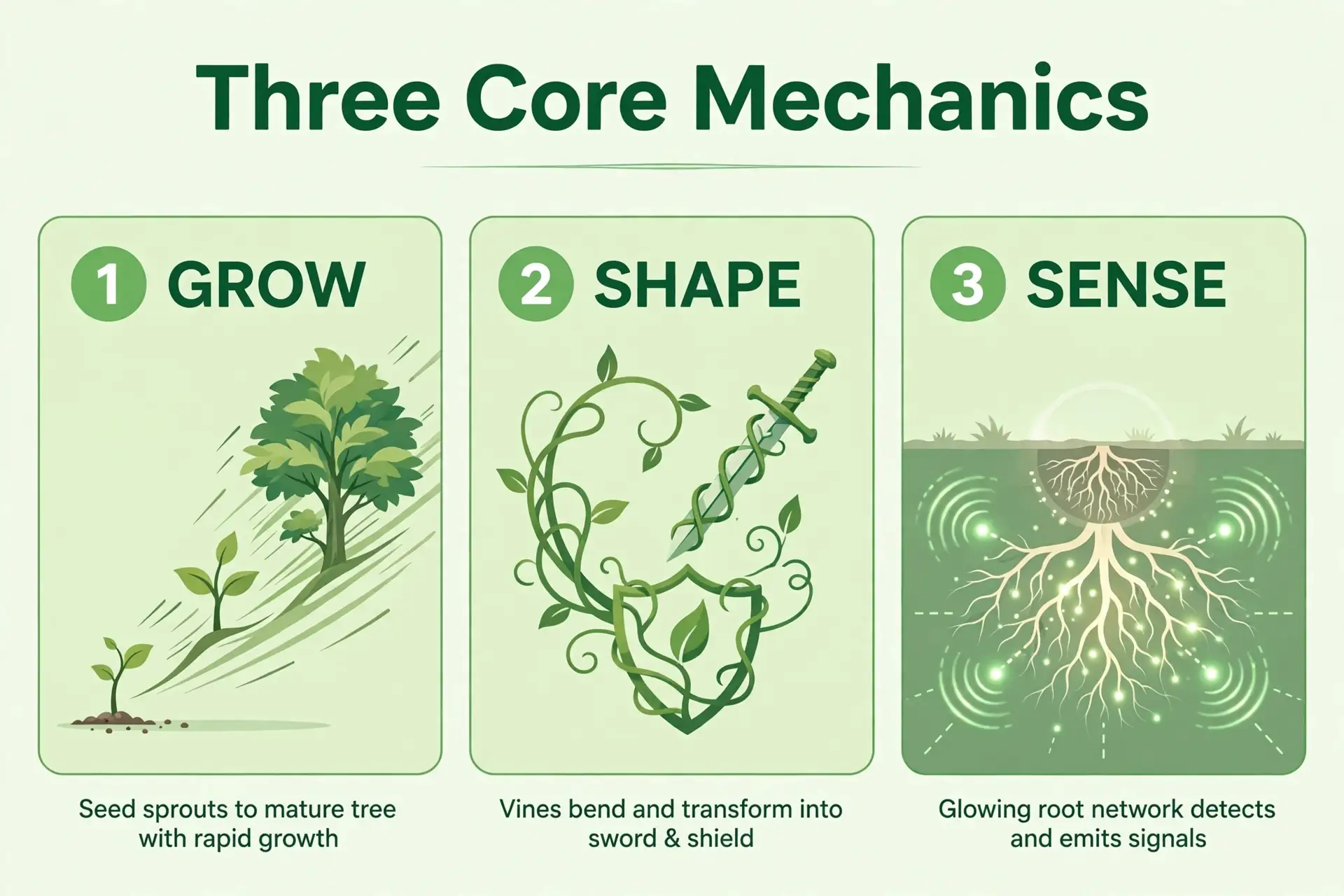
Three mechanics run through every version of the power. First, grow: accelerate germination and push plants to mature in moments. Second, shape and command: bend what grows into tools, weapons, walls, and snares, then direct each piece with intent. Third, sense and speak: perceive through vegetation and exchange signals with the green world. Master those three and you have the whole family in hand.
Plant Manipulation vs Chlorokinesis: What’s the Difference?
The Short Answer: Same Family, Different Label
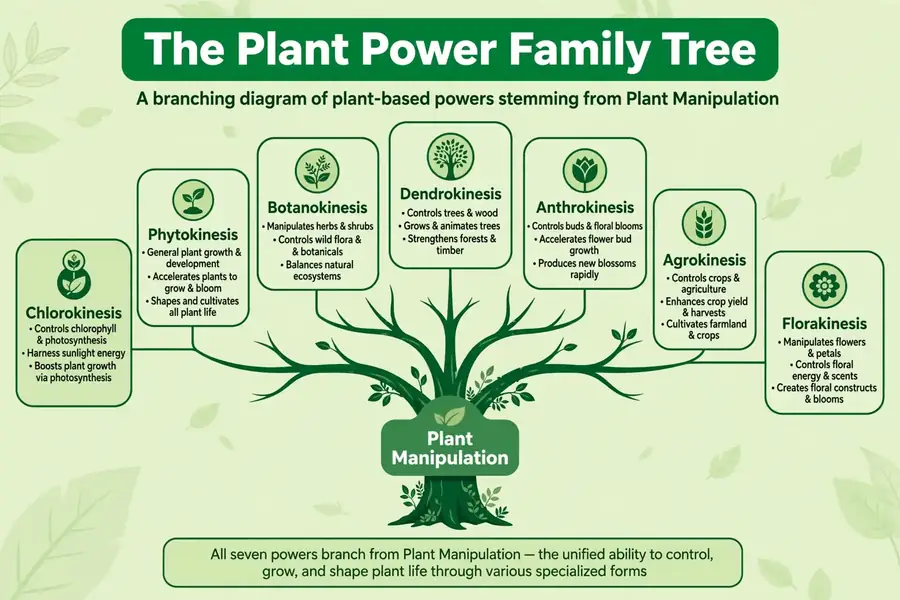
Plant manipulation is the plain-English umbrella term, and chlorokinesis is the most famous Greek name for the same family of powers. Our Chlorokinesis guide puts it directly: the only difference between chlorokinesis and phytokinesis is the Greek root, khloros (green) versus phyton (plant). Think of plant manipulation as the folder and chlorokinesis, phytokinesis, and botanokinesis as files inside it.
This matters because writers pick names for flavor. Comics reach for chlorokinesis, wikis prefer phytokinesis or botanokinesis, and games often just say plant control. For the deep dive on the Greek-named variant itself, including its mythology and pop-culture history, see our Chlorokinesis guide.
The Names Table, Decoded
| Name | Literal meaning | Where you see it |
|---|---|---|
| Plant Manipulation | English, plain | Universal, games, general fiction |
| Chlorokinesis | Greek: green + movement | Western comics, mainstream media |
| Phytokinesis | Greek: plant + movement | Superpower wikis, fan fiction |
| Botanokinesis | Greek: botany + movement | RPG communities, academic tone |
| Agrokinesis | Greek: field + movement | Agriculture-focused stories |
| Dendrokinesis | Greek: tree + movement | Tree specialists |
| Anthrokinesis | Greek: flower + movement | Flower specialists |
| Flora Manipulation | Latin: flora | Formal power descriptions |
| Verdokinesis | Latin: green + movement | Rare alternative |
| Phyllokinesis | Greek: leaf + movement | Leaf specialists |
The pattern tells you the scope: the narrower the root, the narrower the power. A dendrokinetic commands trees but may not manage moss; a full plant manipulation user handles the whole kingdom Plantae, from vines and roots to seeds, petals, and fungi-adjacent networks.
The Plant Power Family Tree
The Big Greek Names
The big three Greek names dominate fiction. Chlorokinesis rules Western comics and mainstream media, phytokinesis dominates superpower wikis and fan fiction for its botanical accuracy, and botanokinesis sounds academic and shows up in RPG communities. All three describe identical abilities: grow, shape, and command plant life.
Choosing between them is a style decision, not a power decision. A writer who wants scientific flavor picks phytokinesis; one who wants classic comic flavor picks chlorokinesis. Our family tree treats them as synonyms under the plant manipulation umbrella.
The Specialist Variants
| Variant | What it covers | Example lane |
|---|---|---|
| Vine Manipulation | Vines as whips, snares, grapples | Combat grappling |
| Thorn Manipulation | Thorns as spikes and projectiles | Ranged offense |
| Root Manipulation | Underground roots and networks | Sensing, surprise attacks |
| Tree Manipulation | Whole trees, groves, terrain | Fortresses, battlefields |
| Flower Manipulation | Blooms, petals, pollen | See our Floral Explosion guide |
| Seed Manipulation | Seeds as projectiles and plants | Artillery, rapid deployment |
| Wood Manipulation | Timber constructs and armor | Weapons, shields |
| Leaf Manipulation | Leaves as blades and swarms | Swarm tactics |
| Grass Manipulation | Grasses and ground cover | Terrain control |
| Carnivorous Plant Manipulation | Flytraps, pitcher plants | Traps with teeth |
| Esoteric variants | Divine, demonic, psychic, spiritual, magical | Same mechanics, mystic source |
Below the big names sits a crowd of specialists. Vine manipulation and thorn manipulation own the whip-and-spike combat lane, root manipulation owns the underground, seed manipulation owns projectiles and planting, wood manipulation owns constructs and armor, and flower manipulation owns the bloom (see our Floral Explosion guide for the explosive flower lane). Carnivorous plant manipulation covers flytraps and pitcher plants, while grass manipulation and leaf manipulation handle the small-scale swarm tactics.
Esoteric variants change the flavor entirely: divine, demonic, psychic, spiritual, and magical plant manipulation tie the power to gods, demons, minds, spirits, or spellcraft rather than biology. The mechanics stay green; only the source changes.
Core Mechanics Every Variant Shares
Grow: The First Mechanic
Every variant starts with growth. Users trigger rapid germination, force seeds to sprout in seconds, and push saplings into full trees mid-battle. Plant growth is the most-seen mechanic in fiction because it is visual and instant: a flat field becomes a forest, a seed becomes a cage.
Growth has rules even in fantasy. Most users need living seed or soil to work with, and the filings note that reviving withered or dead plants are advanced applications, not beginner tricks. Our Plant Growth Acceleration guide covers the speed lane in depth.
Shape and Command: The Second Mechanic
Shaping turns growth into intent. Users bend vines into whips and snares, harden bark into armor, weave roots into walls and bridges, and sharpen thorns into projectiles. Chlorokinetic constructs include weapons, barriers, and even plant servants, while matter surfing lets riders skim across leaves and petals.
Command is the targeting system: the user does not just grow a forest, they tell each branch where to strike and each root where to grip. Entangling vines that climb a target’s neck and choking vines are the classic hostile applications, and thorn projection gives the family its ranged game.
Sense and Speak: The Third Mechanic
The quietest mechanic is perception. Botanical communication, sometimes called green-speaking, lets users exchange signals with plants, while chlorokinetic scrying lets them perceive through vegetation: seeing, hearing, and feeling through leaves and roots across distance. Seismic sense through root networks turns the ground itself into an early-warning system.
Plant empathy and plant detection round out the sensory kit, and the mycelium networks of the root-fungus grid give advanced users a living telegraph. It is less flashy than a vine whip, but in stories it is often the difference between ambush and preparation.
What Can Plant Manipulation Do? Applications
The applications flow from the three mechanics. Growth supplies the material, shaping gives it purpose, and sensing aims it. Together they make the plant manipulator a battlefield controller, a fortress builder, and a scout without equal in green terrain.
Combat: Vines, Thorns, and Toxins
In a fight, the family plays control and attrition. Chlorokinetic combat opens with entangling vines to immobilize, follows with thorn projection or leaf projection for damage, and finishes with poisons or pheromones that sap strength over time. Plant weaponry covers grown blades, spike launchers, and living snares.
The signature finisher is the vine whip technique itself, covered in our dedicated Vine Whip guide. Regenerating weapons matter too: filings note users can quickly regenerate withering weapons at will, so breaking one vine just grows another.
Defense and Support: Walls, Armor, and Healing
Defense grows literally. Users raise walls of woven trunks, harden bark into plate armor, and drop root barricades between allies and danger. Plant defense scales from a personal thorn shield to fortress-grade forest creation around a whole position.
Support is the healer’s lane: plant chemicals close wounds, healing salves treat allies, and food generation from crops keeps a party fed. Plant restoration repairs damaged flora after the battle. For the dedicated healing angle, see our Plant Regeneration guide.
Utility: Travel, Camouflage, and Craft
Outside combat, the family is a toolbox. Matter surfing on leaves and petals gives fast, quiet travel; camouflage by leaf and petal cover hides the user in plain sight; seed and spore dispersal handles messaging and tracking. Gardening mastery and harvest manipulation turn the power into agriculture, and phytochemistry manipulation covers perfumes, medicines, and pheromones.
Craft completes the kit: shaping wood into tools and shelters, pressing cotton and paper from altered plant forms, and brewing sap and nectar into supplies. It is the rare superpower that is as useful in peacetime as in war.
Real Science: How Plants Actually Work
The power is fantasy, but the botany it borrows is real. Everything below is established science, and it is why the superpower feels plausible: plants really do communicate, share resources, and move fast when it counts.
Photosynthesis and the Wood Wide Web
Real plants run on photosynthesis, converting sunlight into chemical energy, and filings give advanced users photosynthesis modulation to harvest that energy directly. Underground, mycorrhizal networks link trees through fungal threads, shuttling nutrients and warning signals across a forest, which is the real-world mirror of the mycelium networks fiction loves. Read the established science on photosynthesis.
These are established biology, not invented lore. A writer grounding plant manipulation can borrow the wood wide web for communication mechanics and photosynthesis for energy mechanics without breaking plausibility.
Plants That Move Fast
Plants are not as still as they look. The Venus flytrap snaps shut in a fraction of a second, the Mimosa pudica folds its leaves when touched, and the squirting cucumber fires its seeds explosively. These are real rapid plant movements driven by turgor pressure, not muscles.
Fiction scales these mechanisms up: flytraps become man-traps, seed pods become artillery. Grounding the fantasy in these real mechanisms keeps the power feeling earned rather than arbitrary.
Weaknesses and Limitations
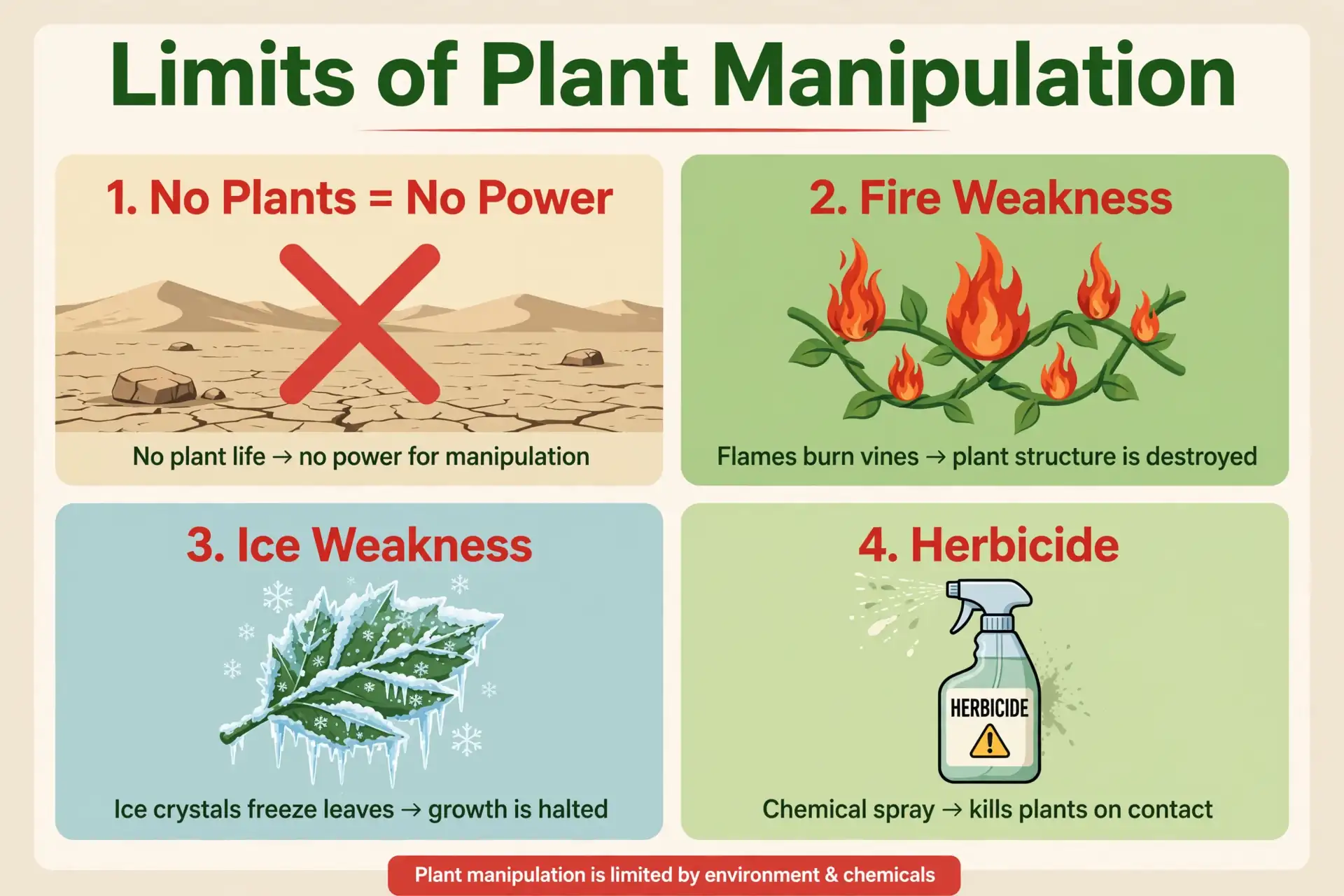
Every power needs its counters, and the green family has honest ones. They fall into three groups: no plants means no power, the elements oppose it, and skill sets the ceiling.
No Plants, No Power
The first limit is environmental. Most users are powerless without plants or at least growable soil; wastelands, barren rock, and infertile soil shut the power down. Some users cannot create plants at all and must work from existing vegetation, while others can only command plants they grew themselves.
Distance, mass, precision, and duration all scale with the user’s skill, and filings cap beginners at a few plant types or a short control window. If the matchup looks bad, a quick visit to a random weakness generator beats a fair fight.
Fire, Ice, and Other Hard Counters
The second limit is elemental opposition. Fire manipulation burns the arsenal faster than it grows, ice and cold freeze sap and shatter cells, and magma plus extreme heat sterilize the field. High radiation disrupts growth, lightning strikes split trunks, and plain herbicide kills the medium outright.
There is also the fine print: some supposed plant manipulators actually manipulate the water inside plants, so dehydrated plants are immune to them, and a few users can only affect living plants. Know which kind you are writing before the fight starts.
Famous Plant Manipulation Users in Fiction
The filing names a deep roster, but a few users define the family so clearly that they lead every telling. The rest of the bench follows, each showing one branch pushed to an extreme.
The Icons: Ivy, Swamp Thing, and Cornelia
Three users define the family in pop culture. Poison Ivy (DC Comics) is the toxic seductress of the green, wielding pheromones, poisons, and strangling vines, as depicted in her own universe. Swamp Thing (DC Comics), avatar of the Green, is the elemental end of the spectrum: a living ecosystem given human shape, as depicted in his own universe. Cornelia Hale (W.I.T.C.H.), Guardian of Earth, commands flora at scale, from growth bursts to thorn barricades, as depicted in her own universe.
Each maps to a different branch: Ivy to chemistry and control, Swamp Thing to the elemental embodiment, Cornelia to the guardian archetype. Together they cover the family’s dramatic range.
The Wider Roster
Beyond the icons, the bench is deep, each as depicted in their own universe: Flora (Winx Club), Fairy of Nature; Isabela Madrigal (Encanto), whose flowers bloom on emotion; Kurama (Yu Yu Hakusho) and his Rose Whip; Venusaur and Torterra (Pokémon) with Frenzy Plant; Swampfire and Wildvine (Ben 10); Undergrowth (Danny Phantom); Demeter and Meg McCaffrey (Percy Jackson); Groot (Marvel Comics); Green (One-Punch Man); Aramaki (One Piece) with the Mori Mori no Mi; Ibara Shiozaki (My Hero Academia).
The roster proves the concept’s range: street-level vine fighters, city-scale guardians, and god-tier elementals all grow from the same soil.
Conclusion
Plant manipulation is the green family: grow supplies the material, shape and command give it purpose, sense and speak aim it. It is the umbrella term that holds chlorokinesis, phytokinesis, botanokinesis, and every specialist variant, from vine whips to thorn barrages to living fortresses. No other elemental power is as useful in peacetime or as patient in war. Want to hand the green family to your own character? Try our superpower generator and see what grows.
FAQs
What is plant manipulation as a superpower?
Plant manipulation is the superpower of controlling plant life, and the plain-English umbrella term for the whole family of green powers, from chlorokinesis to phytokinesis to botanokinesis. Every variant runs three mechanics: grow, shape and command, sense and speak.
Is plant manipulation the same as chlorokinesis?
They belong to the same family. Chlorokinesis is the most famous Greek name for the power; plant manipulation is the plain-English umbrella term covering chlorokinesis, phytokinesis, botanokinesis, and every specialist variant.
What are the different types of plant manipulation?
The big Greek names are chlorokinesis, phytokinesis, and botanokinesis. Specialist variants include vine, thorn, root, tree, flower, seed, wood, leaf, grass, and carnivorous plant manipulation, plus divine, demonic, psychic, spiritual, and magical versions.
Can plant manipulators create plants from nothing?
It depends on the user. Some can generate plants from nothing, while others are limited to manipulating existing vegetation or only plants they grew themselves. Beginners are usually capped at a few plant types.
What can stop a plant manipulator?
No plants means no power, so wastelands and barren rock shut it down. Fire burns the arsenal, ice and cold freeze it, and herbicide kills the medium. Distance, mass, and duration all scale with user skill.
Who are famous plant manipulation users in fiction?
Poison Ivy and Swamp Thing (DC Comics), Cornelia Hale (W.I.T.C.H.), Flora (Winx Club), Isabela Madrigal (Encanto), Kurama (Yu Yu Hakusho), Venusaur and Torterra (Pokémon), and Groot (Marvel Comics), each as depicted in their own universe.


