
Plant Growth Acceleration Superpower Explained: The Green Rush
Plant Growth Acceleration Superpower Explained: The Green Rush
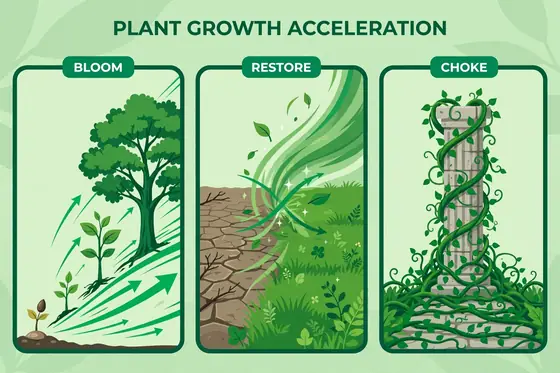
A seed becomes a forest before your coffee cools. Plant growth acceleration is the superpower of time-compressed plant growth: the user makes plants grow at impossible speed, from seed to giant in seconds, from blighted land to green field in days. Also filed as Accelerated Plant Growth, Plant Fertility Manipulation, or Plant Size Alteration, it is a sub-power of Plant Manipulation and Plant Enhancement, and it runs on three moves: BLOOM (grow it fast), RESTORE (heal it back), CHOKE (weaponize the rush). This guide follows THE GREEN RUSH framework. This is the eighth post of our Elemental Manipulation collection.
In this guide:
What Is Plant Growth Acceleration? | Plant Growth Acceleration vs Other Powers | What Can Plant Growth Acceleration Do? Applications | Real Science: The Green Engine | Weaknesses and Limitations | Famous Plant Growth Accelerators in Fiction | Conclusion | FAQs
What Is Plant Growth Acceleration?
Plant powers usually come in two flavors: commanding plants or arming them. The growth accelerator does neither. The signature feat is speed alone: a seed dropped on dirt becomes a towering tree before it can fall over, a barren field becomes a harvest before lunch.
Time-Compressed Growth, Defined
Plant growth acceleration is the superpower of time-compressed plant growth: the user influences and accelerates the growth of plants, causing flowers to bloom instantaneously, plants to mature with supernatural speed, and crops to produce in abundance. Catalogs file it as Accelerated Plant Growth, also called Plant Fertility Manipulation or Plant Size Alteration, a sub-power of Plant Manipulation and Plant Enhancement. It is the speed specialty of the green family: not summoning plants, not commanding forests, just making them grow faster than nature allows.
The signature feats define the lane. The user can grow plants from seeds to mature plants in moments, flower outside season, produce fruits and seeds outside season, and cause a cut plant to grow roots. But the filing draws one hard line: the user cannot create plants, so they need seeds and maybe fertile soil. Acceleration is a multiplier on life that already exists, never creation from nothing.
Bloom, Restore, Choke: The Three Moves
Every Plant Growth Acceleration runs three moves. First, BLOOM: the user grows plants from seeds to mature plants in moments, raising instant forests, living walls, and fields of ripe crops where there was bare dirt. Second, RESTORE: the user heals what is dying, regreening blighted land and waking dormant seeds, because accelerated growth is also accelerated recovery. Third, CHOKE: the user turns the rush into a weapon, and this is where the filing’s cost arrives, because growth that never stops is overgrowth, and overgrowth smothers.
The three moves cover everything the filing lists, from Accelerated Growth as the core application to Food Generation (the harvest that never waits for a season) and Planet Sustaining as the ultimate technique, without ever leaving the acceleration lane.
Plant Growth Acceleration vs Other Powers
Green-sounding powers blur together in fan discussions, so the lanes matter. Chlorokinesis (our Chlorokinesis guide) is the general art of plants: summon, command, mutate, communicate, any of it. Floral Explosion (our Floral Explosion guide) owns the armed bloom: flowers built to detonate. Earth Manipulation (our Earth Manipulation guide) owns soil and rock as the power itself; here soil is only the medium the growth needs, never the power. Plant Growth Acceleration is none of these. It owns speed specifically: the time-compressed growth feat, the instant mature plant. The table below keeps the lanes distinct.
The Family Comparison
| Power | What it controls | Signature move | How plant growth acceleration differs |
|---|---|---|---|
| Plant Growth Acceleration | The speed of plant growth: seed-to-giant in seconds | Growing a mature forest from seed in moments | This is the home row: time-compressed growth itself |
| Chlorokinesis | Plants generally: summoning, command, mutation, communication | Commanding any plant life at will | The general art; growth acceleration is the speed specialty |
| Floral Explosion | Flowers armed to detonate | Turning a bloom into a bomb | The detonation lane; growth acceleration never explodes anything |
| Earth Manipulation | Rock and soil as the power itself | Shaping, sensing through, and shaking the ground | The visible rock; here soil is only the medium, never the power |
| Growth Acceleration (general) | Any or all biological material, including the user | Accelerating any living growth | The general art; this post is the plant-only specialty |
| Age Acceleration | Aging, senescence, and decay | Withering a target in seconds | The opposite lane: age acceleration is decay, this power is healthy growth |
What Can Plant Growth Acceleration Do? Applications
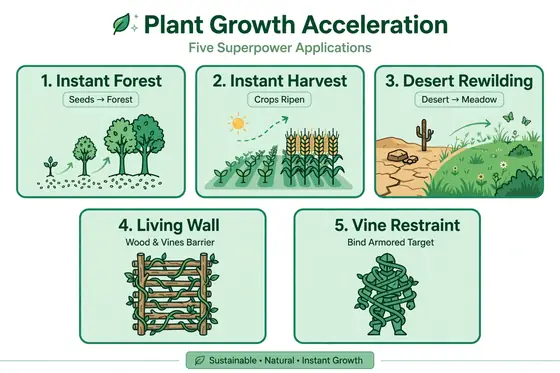
The applications flow from the three moves. Bloom builds in seconds, restore heals what is dying, and choke turns the rush into a weapon. Together they make the growth accelerator an instant farmer, a land healer, and a walking overgrowth event, depending on which move they lead with.
Bloom: Seed to Giant in Seconds
Bloom is the showpiece move. The user grows plants from seeds to mature plants in moments, which means a tossed handful of seeds becomes a wall, a forest, or a field in the time it takes to blink. In combat, Bloom raises barricades of living wood and ensnaring vines on demand; in agriculture, it collapses the growing season into an afternoon, delivering Food Generation without waiting on weather. The fiction’s most famous bloomer, Poison Ivy, can grow giant animated plants from seedlings in seconds, the benchmark every fast-growth feat gets measured against.
The move has one non-negotiable requirement straight from the filing: the user cannot create plants, so they need seeds and maybe fertile soil. A battlefield with no seed in it is just dirt to a bloomer; a desert with no soil is a dead zone. Writers who respect that requirement get better scenes, because the clever part of the power is never the speed, it is where the seed comes from.
Restore: Heal Blighted Land
Restore is the quiet move and the one that sets this power apart from every combat-focused plant power. Where Bloom builds in seconds, Restore rebuilds in seasons: the user accelerates regrowth across blighted land, reversing desertification, re-greening burned forest, and rescuing dying plants by pushing them through their recovery growth in fast forward. The filing’s associations, Fertility Inducement and Prosperity Embodiment, live here, and Planet Sustaining reads as the ultimate expression of Restore: not one garden but a world kept alive.
The cost of Restore is honest even at its kindest. Accelerated growth burns through soil nutrients at an accelerated rate, because there is no such thing as free biomass, and a user who regreens a field without feeding it can leave the land emptier than they found it. Restore at scale is farming at speed, and farming always sends a bill.
Choke: Overgrowth as Restraint and Weapon
Choke is the dark move. The user pushes growth past its limit until living plants become restraints, crushes, and terrain: roots that girdle, vines that bind, canopies that drown out the light. The general filing warns that the user can cause overgrowth of the affected material, and overgrowth is a weapon with a wide blast radius, because a forest grown in minutes does not distinguish a battlefield from a city. This is where the power most resembles the real-world kudzu, a cautionary tale of what runaway growth does when nobody can switch it off.
Choke also carries the built-in moral price of the power. The filing notes the user may be opposed by Pollution Manipulation and vulnerable against Pollution Manipulation, and a growth runaway poisons its own foundation: stripped soil, choked waterways, a monoculture where a living system used to be. The land always sends a bill, and Choke is what happens when the user refuses to pay it.
The Green Rush Toolkit
| Move | What it does | Who embodies it |
|---|---|---|
| Bloom | Seed to giant in seconds: instant forests, living walls, ripe crops | Poison Ivy (DC Comics), as depicted |
| Restore | Heal blighted land: reverse desertification, re-green burned ground | Filing technique (Planet Sustaining), as cataloged |
| Choke | Overgrowth as restraint and weapon: binding roots, crushing vines | Negasus Side (Hardcore Leveling Warrior), as depicted |
| Regrow | Cause a cut plant to grow roots and other similar feats | Filing capability (Plant Growth), as cataloged |
| Out-of-season harvest | Flowering, fruiting, and seeding outside season | Filing capability (Plant Growth), as cataloged |
Real Science: The Green Engine
The power is fantasy, but the engine is real, and it is stranger than most fiction. Everything below is established science, and it is the reason the superpower feels plausible: real plants already accelerate under the right conditions, and nature already holds the growth records fiction wishes it had.
Meristems and the Auxin Engine
Real plants already run a growth engine, and it is stranger than most fiction. Plants grow only at meristems, zones of cell division and cell elongation: most plants build from the shoot apical meristem, a single point at the tip, plus the root apical meristem below. That is why plants keep the unlimited growth throughout life no other familiar organism gets. A fictional accelerator is, in effect, a living meristem command, pushing those zones into overdrive.
The steering wheel is auxin, the growth hormone that provides chemical control of growth. Auxin is mostly made in the tips and stimulates cell elongation behind them; when light comes from one side, auxin concentrates on the shaded side, those cells elongate faster, and the shoot bends towards the light (positive phototropism). Roots answer the same hormone with the opposite move, growing downward (positive gravitropism), while hydrotropism steers them towards moisture. The plant in the superpower story is still obeying this machinery, just at impossible speed. Read the full mechanism on tropisms.
Bamboo: The Fastest Real Grower
If the superpower needed a mascot, it would be bamboo, the fastest-growing plant on Earth. Records give the scale: some varieties reach 91 cm in a single day, and Madake bamboo has been measured at 121 cm in 24 hours; Guinness World Records recognizes 35 inches in 24 hours. During peak season certain species add about 1.5 inches per hour, produce roughly 570 million new cells daily, and their shoots emerge with enough force to crack concrete. Fiction asks you to imagine seed-to-forest in seconds; bamboo proves nature already runs the same trick at a slower clock. Read the records on bamboo.
The trick is the intercalary meristems, the growth zones located at the nodes of the culm. Most plants grow only at the tip, but a new bamboo shoot emerges with its segments already pre-formed and tightly compressed, and when growth triggers, every single segment begins expanding at the same time, a telescoping elongation across dozens of zones at once. Add hollow stems that spend fewer resources per unit of height, and the tallest bamboo species, Dendrocalamus giganteus, can reach 30 metres tall in a single season. A growth accelerator in a story is bamboo’s mechanism with the brakes cut.
The Photosynthesis Fuel
No engine runs without fuel, and the growth engine runs on light. Photosynthesis converts light energy into chemical energy stored in glucose, using carbon dioxide and water to make glucose and oxygen in the chloroplasts, where the green pigment chlorophyll catches the light. Growth speed in the real world answers to limiting factors: light intensity, CO2 concentration, temperature, and water availability. A greenhouse can trap solar radiation and tune every factor, which is why real growers use them to push plants toward their biological speed limit. For more on the engine itself, see our photosynthesis page.
The growth accelerator in fiction is, in one reading, a user who removes the limits. Imagine the limiting factors lifted one by one: full light, full carbon, full water, and the plant converts it all to increased biomass production in seconds instead of months. Recent real research even found a molecule that speeds plants up: watering maize with itaconate made seedlings grow taller (UC San Diego, Science Advances, June 6, 2025). The superpower is that result with the dosage set to impossible.
Weaknesses and Limitations
Every power needs its counters, and the green rush has honest ones. They fall into two groups: the power might not have anything living to accelerate, and acceleration itself carries a cost that can turn on the user.
What Can Stop a Growth Accelerator?
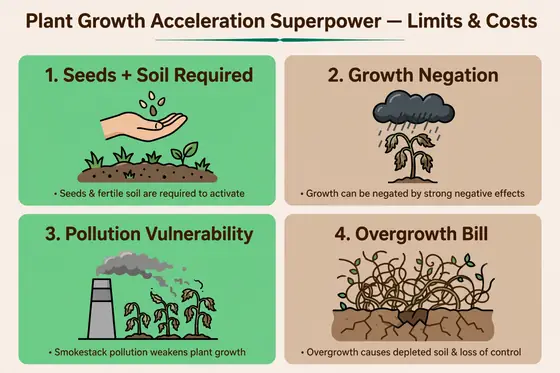
The first limit is raw material. The filing’s own limits say the user needs seeds and maybe fertile soil, may be limited to the user’s emotional state, may fail on plant-life that isn’t native to the area, and is weak against Growth Negation. Concrete, salt flats, deep space, and poisoned ground all answer the accelerator the same way: there is nothing living to accelerate. If the matchup looks bad, a quick visit to a random weakness generator beats a fair fight.
The second limit is the built-in cost. Accelerated growth burns the soil it stands in, and the real-world warning is kudzu, the vine that ate the South: originated from East Asia, introduced at the 1876 exposition, promoted for soil erosion control, then spreading at up to one foot per day until it was designated a noxious weed in 1997. Its mechanism is the warning the power carries: light deprivation as dense canopies block the sun, and nitrogen fixation that leaves soil with two to five times the nitrogen concentration, disrupting the conditions native plants depend on. Honesty matters here too: the US Forest Service estimates about 227,000 acres of forestland affected, far below the millions of acres often cited, so the lesson is real without the myth. A growth accelerator who never stops is kudzu with a face, and the land always sends the bill. Read the full story on kudzu.
Famous Plant Growth Accelerators in Fiction
The filing names no individual users, but fiction is full of them. Three users define the acceleration feat so clearly that they lead every telling. The rest of the bench follows, each showing one facet of the green rush pushed to an extreme.
Poison Ivy, Willow Park, and Isabela Madrigal
Poison Ivy of DC Comics is the gold standard: Pamela Isley carries supernatural control over plant life through the Green, an interplanetary force, and since her death and rebirth she can grow giant animated plants from seedlings in seconds. She has encouraged and directed the growth of plant life on a molecular level, once brought a whole skyscraper down with giant vines, and controlled an entire tree to crush her enemies, each as depicted in her own universe.
Willow Park of The Owl House is the gentler archetype: naturally very gifted at plant magic, she uses it to help plants and can make a tiny seed sprout humongous, summoning green thorny vines from the ground to grab and restrain. Isabela Madrigal of Encanto is the Bloom move in flower form, the gift that conjures flowers at will and vines on command, acceleration as effortless beauty. All three are presented as depicted in their own universe, with no cross-continuity claims.
The Wider Roster
Beyond the big three, the filing and the archetype pages list a wider bench, each as depicted in their own universe. Kadma of W.I.T.C.H., the former Guardian of Earth, holds an intense mystical connection to plants and can command flora causing plants to grow at incredible rates, sprout vines to ensnare enemies, and raise thick briars of thorns to block passages. Negasus Side of Hardcore Leveling Warrior casts Growth Acceleration: Plant as a special skill that resonates with the mana of a plant and increases the target’s growth speed, once dual cast with a root-summoning spell to completely bind the body of the Cyclops.
The filing’s Known Objects round out the bench: Pop Greens, Mosa Mosa no Mi, and Mori Mori no Mi (One Piece); the Cerestone (Batman Beyond); Magic Soil (Big Cook, Little Cook); the Green Prism Shard (Sonic Prime); and the unnamed jungle planet’s Planet Egg (Sonic X). Each is listed by the filing as an object tied to the power, no more and no less. The roster proves the concept’s range: heroes, villains, kids’ shows, and anime all drink from the same green rush. The canonical filing sits at Plant Growth.
Conclusion
Plant Growth Acceleration is the green rush: bloom grows it in seconds, restore heals it back, choke turns the rush into a weapon, and the land always sends a bill. It is the speed specialty of the elemental family, the quietest miracle and the loudest warning in one power. No summons, no detonations, just time-compressed life. Want to hand the green rush to your own character? Try our superpower generator and plant the first seed.
FAQs
What is Plant Growth Acceleration as a superpower?
Plant Growth Acceleration is the power to influence and accelerate the growth of plants: flowers bloom instantaneously, plants mature with supernatural speed, and crops produce in abundance. It is filed as Accelerated Plant Growth, a sub-power of Plant Manipulation and Plant Enhancement, and runs on three moves: bloom (grow it fast), restore (heal it back), and choke (weaponize the rush).
How is Plant Growth Acceleration different from Chlorokinesis?
Chlorokinesis is the general art of plants: summoning, commanding, mutating, and communicating with plant life. Plant Growth Acceleration is the speed specialty: time-compressed growth only, the seed-to-giant-in-seconds feat.
How is Plant Growth Acceleration different from Floral Explosion?
Floral Explosion arms flowers to detonate. Plant Growth Acceleration never explodes anything: it owns rapid growth itself, healing land, agriculture, and overgrowth as restraint or weapon. Growth, not explosion.
Can Plant Growth Acceleration work without seeds?
No. The filing draws a hard line: the user cannot create plants, so they need seeds and maybe fertile soil. A battlefield with no seed in it is just dirt to a growth accelerator.
What can stop a plant growth accelerator?
The power needs seeds and fertile soil, may be limited by the user’s emotional state, may fail on non-native plants, is weak against Growth Negation, and is vulnerable to Pollution Manipulation. There is also a built-in cost: accelerated growth burns through soil nutrients, and runaway growth is kudzu with a face.
Who are famous plant growth accelerators in fiction?
Poison Ivy (DC Comics), Willow Park (The Owl House), and Isabela Madrigal (Encanto) lead the roster, followed by Kadma (W.I.T.C.H.), Negasus Side (Hardcore Leveling Warrior), and the filing’s known objects, each as depicted in their own universe.


