Random Word Generator
A random word generator is an online tool that instantly produces words at random pulled from a curated database of English vocabulary spanning nouns, verbs, adjectives, and adverbs. At Super powers Generator, we built this tool for writers battling creative block, students preparing for spelling bees, teachers crafting vocabulary exercises, gamers hunting for fair Pictionary words and storytellers and RPG players who need fresh, unexpected words to spark their next character, superpower, or world-building idea. Simply set your filters — word type, length, syllable count, or starting letter and hit generate. No sign-up, no cost, completely free. Our free random word generator below gives you instant access to hundreds of unique English words on demand.
Random Word Generator
TextClick Generate to get your result
What Is a Random Word Generator?
A random word generator is an online tool that helps you generate random words instantly and I’ve personally found it to be one of those quiet little utilities that punches way above its weight. Whether you want to enhance your vocabulary, learn the English language, or just explore different types of words, this tool covers it all. It works across all parts of speech nouns, verbs, and adjectives giving you the standard option to pull a mixed group of words consisting of various speech categories, or you can choose a specific type depending on what your task needs.
What makes it truly useful is how easy it is to navigate the user interface is incredible in its simplicity. You simply input a number (the default is one, but you can add more according to your need — 1, 2, 3 or more) and press the generate button, and a list of words will appear.
The tool also gives you two dedicated input fields for first letter and last letter, letting you narrow down results with precision. To refine further, you can use the two radio buttons to choose how you want to size your words either by Number of Syllables or by Word Length. Paired with that is a dropdown menu set to equals by default, with additional options for less than and greater than, giving you full control over word sizing. There’s also an extra input field where you can set your preferred value using the up and down arrows. Once you’re done exploring, hit the reset button to clear all filters and start fresh for new results. From there, you scan the results, keep the ones you like by clicking on them, and they go straight into a dedicated word list area. This lets you build a new list tailored to your needs a place to create and store words you actually want to use. The features here are built around common real-world ways the tool gets used, and having that option to group results by type is something I personally rely on a lot.
How to Use the Random Word Generator (Step-by-step)
Step 1 — Choose How Many Words to Generate
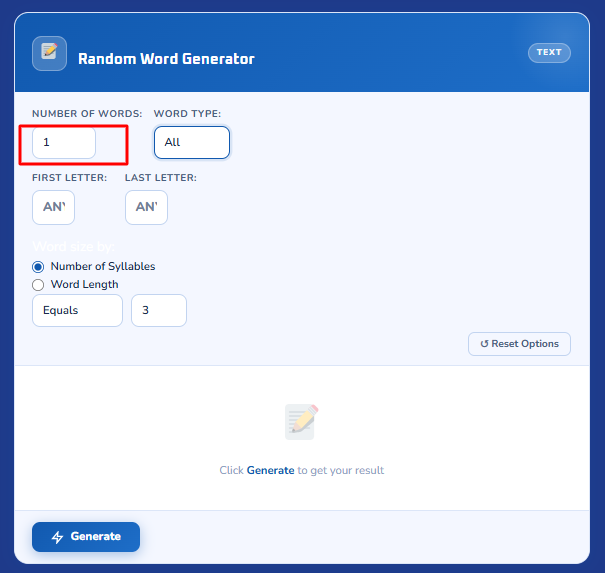
Start by entering a number in the Number of Words field. The default is 1, but you can increase it to 2, 3, or as many as you need using the up and down arrows.
Step 2 — Select Word Type
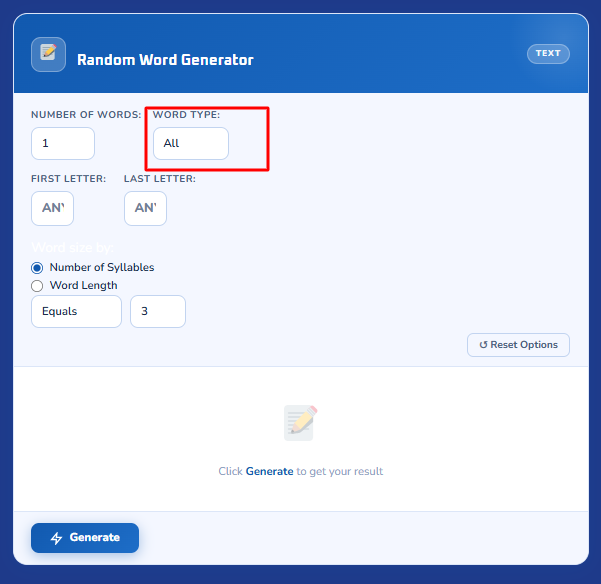
Use the Word Type dropdown to filter results. You can choose from All, Nouns, Verbs, Adjectives, or Adverbs depending on what suits your need.
Step 3 — Filter by First Letter or Last Letter (Optional)
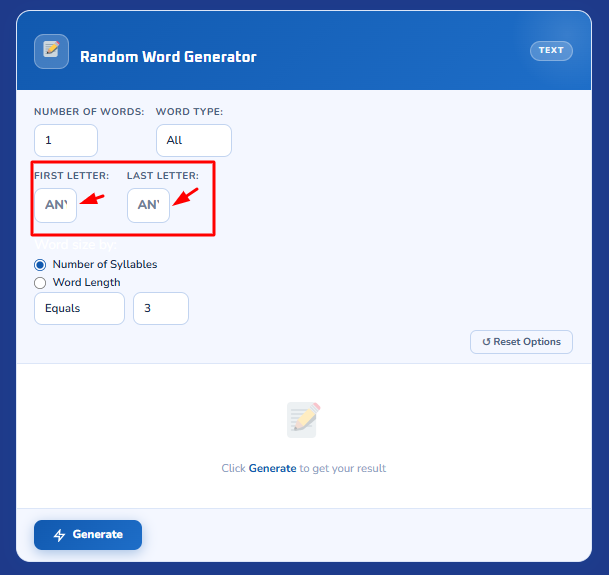
Use the First Letter and Last Letter input fields to narrow your results. This is optional but helpful when you want words starting or ending with a specific letter.
Step 4 — Set Word Length or Syllable Count
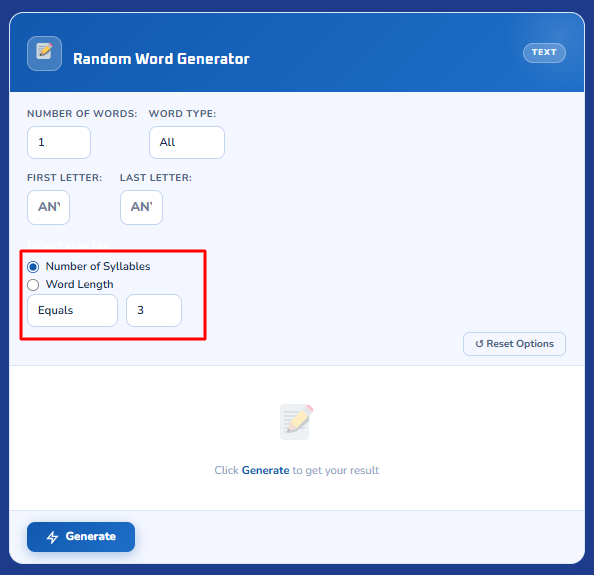
Select either Number of Syllables or Word Length using the radio buttons. Then use the Equals, Less Than, or Greater Than dropdown along with the number field to define your preferred word size.
Step 5 — Click Generate, Then Copy Your List
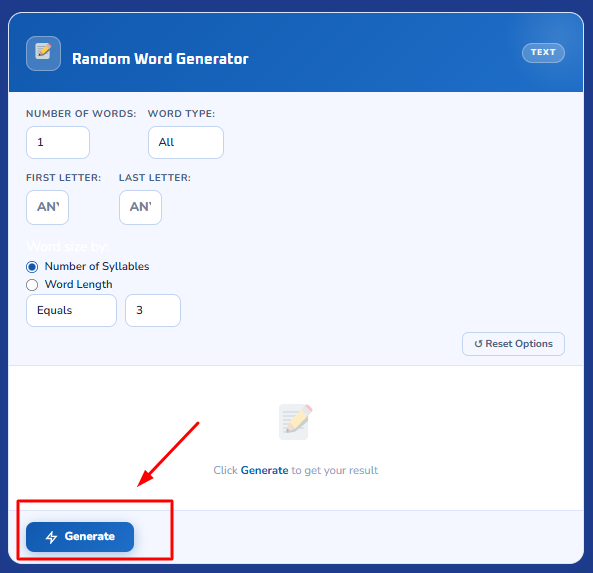
Hit the Generate button at the bottom. Your results will appear instantly. Scan through the words, keep the ones you like by clicking on them, and copy your final word list with a single click.
Key Features of This Random Word Generator
Filter by Word Type (Noun, Verb, Adjective, Adverb) :
Choose exactly what kind of word you need. The word type filter lets you switch between nouns, verbs, adjectives, and adverbs so every generated word is relevant to your task.
Filter by First Letter and Last Letter :
Narrow down your results with precision. Enter any letter in the first letter or last letter field to get words that match a specific pattern or starting and ending character.
Control by Syllable Count or Character Length :
Use the radio buttons to choose between syllable count or character length as your sizing method. This gives you full control over how simple or complex the generated words are.
Equals / Less Than / Greater Than Length Controls :
Pair your sizing method with the equals, less than, or greater than dropdown to define the exact range of word size you want, making your results as broad or as specific as you need.
One-Click Copy Output :
Once your word list is ready, you don’t have to manually select anything. Simply hit the copy button and your entire list is saved to your clipboard instantly, ready to paste wherever you need it.
10 Creative Uses for a Random Word Generator
1. Creative Writing Prompts and Story Starters
Writer’s block is one of the most frustrating experiences for any creative — and one of the most effective cures is a single unexpected word. When you generate 5 random words and challenge yourself to use all of them in one paragraph, your brain is forced to make unconventional connections it would never reach through intentional thinking. That forced creativity is exactly how breakthrough writing ideas are born. For an advanced challenge, use the words in the exact order they were generated — the constraint pushes your storytelling instincts even further. Use the verbs filter for action-driven story starters, or the adjectives filter for vivid, sensory prose. At SuperpowersGenerator, our random word generator lets you control both word type and syllable count simultaneously, giving writers the precise level of vocabulary difficulty they need for any writing exercise.
2. Pictionary and board games
The biggest problem with Pictionary word cards is repetition the same words keep appearing once you have played enough rounds. A random word generator solves this permanently. Because the words are genuinely random, the playing field stays completely level for both teams nobody can anticipate or recognize a word in advance. Our generator lets you filter by word length and syllable count, which means you can directly control difficulty: short single-syllable nouns for beginners, longer multi-syllable words for competitive players who want a real challenge. This same approach works equally well for Charades, Catchphrase, Hangman, and any other word-guessing game that needs a steady supply of fresh, unpredictable words. No physical cards to print, no sign-up required just instant random words whenever the game needs them.
3. MadLibs for kids
MadLibs looks like entertainment but it is secretly one of the most effective vocabulary and grammar exercises a child can do. Every time a child drops a randomly generated noun, verb, or adjective into a blank space, they are practicing parts of speech in a real, applied context without feeling like they are studying. Our tool is especially well-suited for this because you can filter by specific word type nouns only, verbs only, adjectives only so you always get exactly the right kind of word for each blank. Parents and teachers can turn a family game night or a classroom activity into a genuine learning moment without anyone noticing. When kids encounter an unfamiliar word in the results, they naturally ask what it means — and that curiosity is exactly the spark that accelerates vocabulary growth faster than any flashcard system.
4. Vocabulary building and spelling bees
The most common mistake in spelling bee preparation is practicing from the same predictable word list every session. Once your brain learns to expect certain words, the real value of a spelling test disappears. A random word generator fixes this by making every practice session genuinely unpredictable. An effective study method used by competitive spellers is to have two students use the generator together — one reads the word aloud while the other spells it, then they switch. The syllable filter lets you gradually increase difficulty as preparation progresses. For teachers, building a 10-word vocabulary quiz takes seconds — filter by the specific part of speech that matches your current grammar lesson and your word list is ready instantly. Super powers Generator uses a curated English vocabulary database that avoids obscure or outdated words, meaning students are learning real, practical language that serves them beyond the classroom.
5. Naming a band, product, or event
Creative block hits hardest when you are staring at a blank page trying to invent the perfect name for something. A random word generator completely changes the approach instead of forcing yourself to think of names, you generate words and let your brain react to what appears. Generate an adjective and a noun, combine them, and suddenly you have dozens of potential band names, product titles, or event names that you never would have reached through deliberate brainstorming. This technique works because unexpected combinations produce names that are genuinely memorable. Names built from common, predictable words blend into the background names that emerge from random combinations are surprising, distinct, and far more likely to stick in someone’s memory. Use the generator as a brainstorming partner that removes the blank-page paralysis, not as a machine that hands you a finished answer.
6. Generating username or gamertag ideas
The most common frustration in online gaming is finding that every username you want is already taken. A random word generator offers a clean solution to this. Generate two random words one adjective and one noun combine them, and you have a unique, memorable gamertag that is almost certainly available across Xbox, PlayStation, Steam, and Discord. This approach consistently produces better results than dedicated username generators because the combinations are genuinely unexpected. Names like “VelvetThunder” or “QuantumPenguin” are both available and memorable in a way that “GamerPro123” never will be. Use our syllable filter to generate short, punchy words that fit comfortably within platform character limits. Twitch streamers building a brand, Discord community members, and competitive esports players all use this technique to land on handles that are distinctive without trying too hard.
7. Password inspiration (not the whole password)
Random words make excellent passphrase components and cybersecurity experts have recommended this approach for years. The logic is straightforward: four random words combined into a passphrase like “hollow bridge velvet stone” is significantly harder to crack than a single complex password built from character substitutions, while being far easier to remember. This method is known as the dice ware or passphrase approach, and it is endorsed by security researchers as one of the most practical ways to create strong, human-rememberable passwords. Generate three to four words using our tool as your starting point, then personalize them by adding numbers, modifying spelling, or combining words in your own way. The generated words are your raw material, not your finished password always modify and personalize before using any word combination for real account security.
8. Teachers creating vocabulary quizzes
Standard vocabulary quizzes become predictable quickly students learn to anticipate which words will appear and prepare specifically for those, rather than genuinely building their vocabulary. A random word generator removes that predictability entirely. A teacher can generate 10 to 15 words in seconds, apply the word type filter to match the specific part of speech relevant to the current lesson, and have a ready-to-use quiz word list without any preparation time. Beyond straightforward quizzes, random words open up more dynamic classroom activities. In a Word Definition Race, generate five words and have students compete to write definitions from memory without using a dictionary. In a Synonym Challenge, generate one word and see which student can list the most synonyms in sixty seconds. In a Sentence Construction exercise, use generated verbs or adjectives as anchors for grammatically correct sentence writing. Super powers Generator’s word type filter makes all of these activities practical because teachers can isolate exactly the part of speech that matches what they are currently teaching.
9. Brain warm-up for writers
Professional writers use random word exercises as a daily warm-up the same way athletes stretch before competing. The goal is not to produce polished writing but to switch your brain into creative mode before tackling a real project. Generate five random words, set a ten-minute timer, and write continuously without stopping using all five words somewhere in a single coherent paragraph. No editing, no self-correction, no backspacing. This exercise works because the randomness forces your brain to build connections it would never construct deliberately, and those unexpected connections carry over into your actual writing session as creative momentum. The noun filter gives you concrete, grounded words that anchor narrative. The verb filter produces action-driven sentences that build story energy. The adjective filter develops descriptive, sensory language that brings scenes to life. At Super powers Generator, the word length control adds another dimension short words for quick, punchy warm-ups and longer words for more layered, complex writing challenges.
10. Superpower / character creation for RPGs and storytelling
This is the use case that lives most naturally on Super powers Generator. When you are designing an RPG campaign, writing a novel, building a comic book character, or developing a world for any kind of creative fiction, a single unexpected random word can unlock an entire character concept that deliberate brainstorming never would have reached. Words like “tether,” “fracture,” “hollow,” or “cascade” — generated completely at random can suggest a power concept, a character flaw, a location name, or a world-building rule that becomes the foundation of something genuinely original. Generate adjectives for character personality traits, nouns for locations and objects within your world, and verbs for character abilities and powers. Then take those results and combine them with our dedicated creative tools — the Superhero Name Generator, the Random Weakness Generator, and the Superhero Costume Idea Generator — for a complete character creation workflow that no competitor in this space can replicate.
Random Word Generator for Writers: Tips & Challenges
From Blank Page to Breakthrough
I’ve spent years watching writers struggle with writer’s block, and the simplest fix is often the most overlooked a random word generator. This versatile tool creates unpredictable lists of words, phrases, and parts of speech that train your mind to make unexpected connections. You can customise the input to filter by nouns, verbs, or adjectives, adjust word length, and shape output around your current project needs.
Tips for Writers
My go-to morning routine is using one as a warm-up exercise to get the creative flow going. For world-building, generate unique names for characters, products, bands, or fictional locations in sci-fi or fantasy settings. Leverage AI options like Canva‘s AI Topic Generator, which uses advanced models for structured thematic inspiration beyond single words. Even pseudo words from fake word generators help define and incorporate new concepts into your writing world.
Creative Challenges
The in-order challenge asks you to brainstorm 5 to 20 generated words and work them into a story or paragraph in the exact order they appeared. Random word disruptions push further set a timer for 1 to 5 minutes and pull a new word into your next sentence each time. Use a randomly generated sentence as sentence starters and enders, or attempt the micro-fiction constraint to fit random words into a single coherent sentence. For groups, interactive improv lets you pair up where one writer tells a story while the other interjects at 10 to 15 second intervals, with words integrated immediately a true extreme challenge.
Potential Challenges
The primary difficulty is maintaining a logical narrative flow while forced to include unrelated terms. Coherence issues and frustration build fast when you force-fit difficulty words or technical jargon, which can hinder rather than help. The answer is a flexible mindset — treat every awkward word as a detour, not a dead end. Use generators to spark inspiration, not pressure, and let them begin pushing your story somewhere unexpected.
Random Word Generator for Games
When playing games like Pictionary or MadLibs, a random word generator is a very useful tool. The Random Word Generator can generate a number of random words from a word list, which helps players play a game in a fair and honest way. Because the words are randomly generated through random generation and randomization, no one can choose a specific word, which keeps gameplay balanced and improves game fairness. During many word games, players use these game words or gameplay words to fill blank spaces, creating funny results and making the gameplay more fun.
From my experience, this word generator and word tool also benefit kids and children by generating considered words that help improve vocabulary and support vocabulary improvement. The Random word generator can also prepare users for spelling bees and other competitions by providing a list of randomized generated words. At the same time, the generator can give inspiration for a unique gaming name, handle, username ideas, or random names using a creative word list, making it a great part of gaming and other word game activities.
Random Word Generator for Students & Teachers
If you are wondering how a random word tool can help in education, the answer is simple: it helps teachers use generators to create better lesson planning, assessment, and more engaging lessons in different classroom environments. In a typical class, teachers may start warmups where students enter and define a word, build a sentence, or analyze it through a lens from literature or social studies. These random words can generate discussion, explore a character or historical event, and bring a fresh perspective to a lesson. Many educators also keep activities fresh, fair, and engaging through games like pictionary, charades, and madlibs. At the same time, they can prepare vocabulary, spelling, bees, matching, and other exercises by creating lists and prompts that are generated quickly, helping streamline content creation and support gamified learning for students.
For students and learners, a random word generator works as one of the most useful tools for improving learning beyond rote memorization. In creative writing, students may receive 3 to 5 random words as prompts that must be integrated into a story or paragraph. This activity helps writers overcome block while encouraging them to think, practice deeper thinking, and explore connections between unrelated ideas. When encountering new terms from a wider lexicon, learners search for definitions, study context, and understand proper usage, which supports vocabulary expansion. Activities such as spontaneous speaking, spoken language drills, and oral communication tasks—especially in esl settings—help build confidence, improve fluency, and strengthen problem-solving, divergent, and lateral skills. When students look at a problem and respond on their feet, the process enhances active processing and helps them develop stronger academic and communication abilities..