
Aquatic Adaptation Superpower
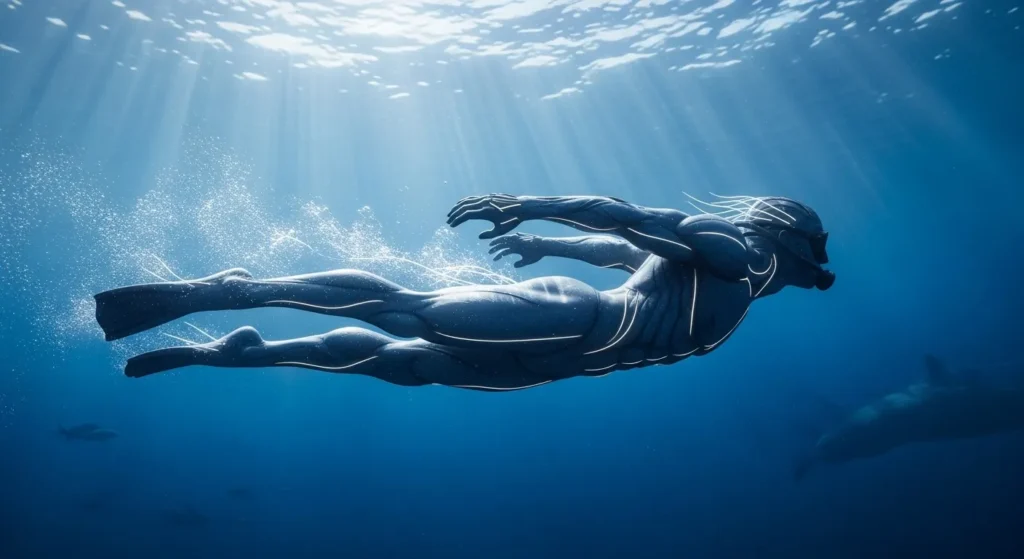
Understanding This Underwater Superpower
Aquatic Adaptation is a special superpower that enables a person to function efficiently beneath the waves just as well as on land often even better. This ability grants physical and mental traits perfectly suited for underwater environments. Through my years studying marine capabilities, I’ve seen how this power breaks down into several fascinating components that explain how it truly works.
Characters who gain this Aquatic Adaptability develop remarkable features: breathing naturally in water without gills becoming visible, water pressure resistance that protects them at crushing depths, enhanced swim speed with hydrodynamic movement allowing effortless traversing through currents, and specialized senses tuned to navigate murky depths. These abilities transform someone into an Aquatic Adapter capable of submerging to ocean floors and traverse territories that would crush ordinary humans.
Power Mechanics and Combat Uses
The Sub-Aquatic Adaptation aspect particularly interests me it’s not just survival but dominance in aquatic realms. In combat applications, this Underwater Adaptation provides tactical advantages across different levels of mastery. Beginners might handle shallow undersea exploration, while advanced users demonstrate complete Water Adaptation that lets them guide others through the deepest trenches.
However, limitations exist. Heat-based attacks, electrical currents, and rapid dehydration serve as effective counters. The most successful users combine this with synergistic combos pairing Aquatic Adaptation with water manipulation or marine telepathy creates devastating related powers. I encourage you to explore the full list on the wiki or use the superpowers generator to spark ideas for unique character combinations.
Explore More : Bone Manipulation
Aquatic Adaptation Superpower Generator
Build your ultimate Aquatic Adaptation Superpower with our free generator.
Customize your power level and style, then generate a one-of-a-kind hybrid ability.
Each result comes with a unique superpower name, combat stats, signature moves, core ability, and weakness, making it ideal for RPG characters, world-building, and creative storytelling.
Aquatic Adaptation
Breathe underwater and survive ocean depths
Aquatic Adaptation in Action [Video Demonstration]
Also Known As
In biological context, nature uses specifically detailed terms:
Hydrophytic Adaptations – How plants called hydrophytes have adapted to aquatic environments
Natatorial Adaptation – Refers to specialized features for swimming, like a streamlined body
Morphological and Physiological Adjustments – General terms for structural changes including gill respiration and air bladders
In fiction and superpower context, Alternative Terms include:
Aquatic Adaptability or Adapter – Overall ability to function in water
Sub-Aquatic Adaptation, Undersea, and Underwater Adaptation – Powers for deep-water operate
Amphibious Adaptation – Specifically the Breathing ability to operate on both land and in water
Core Capabilities & Powers
Users who possess this ability can survive and adapt to underwater environments in ways that otherwise seem impossible.
Breathing Beyond Limits
Many breathe water in lieu of or along with a gaseous breathing medium, possibly through gills that extract dissolved oxygen, enabling indefinite submersion without impairment. Others modify their respiration to extend breath-holding for hours, which includes efficient oxygen storage in blood and muscle, CO₂ buffering, and controlled metabolic rates that limit oxygen demand.
Pressure Mastery and Deep Diving
The ability to endure high pressure and extreme temperatures comes from depth adaptation that allows safe descent to hadal depths. Structural reinforcement of bones and connective tissue, collapsible air spaces, and pressure-stable biochemistry prevent barotrauma even at crushing pressures. Advanced individuals can operate in these conditions with complete ease.
Heightened Aquatic Perception
Their senses perceive normally regardless of distortion, ignoring various impurities that would reduce visibility in silty waters. In dim, turbid-water conditions, low-light vision and lateral-line analogue systems help detect movement and pressure gradients, while elite practitioners develop echolocation for mapping structures and tracking targets through sonar pings.
Superior Swimming Mechanics
To swim well, they rely on streamlined morphology with a flexible spine, powerful core, and webbed digits, which translates to superior speed and acceleration. Microtextured skin or a mucosal boundary layer reduces turbulence and drag, enabling rapid course changes, tight turns, and vertical bursts.
Environmental Resilience
Salinity tolerance lets the body maintain fluid balance across fresh and salt water, while thermoregulation and cold resistance mitigate hypothermia during long dives. Protective eyelids or nictitating membranes shield against particulates and high-speed flow.
Stealth and Concealment
For stealth, chromatophore-like pigmentation and refractive skin patterns break up outlines, letting users hug thermoclines, ride currents, and minimize wake signatures to remain unseen by patrols or drones. Noise discipline and bubble-free propulsion enhance silent approaches.
Navigation and Spatial Awareness
Intuitive current reading, tide timing, and geomagnetic sensitivity allow fast route planning even in featureless blue expanses, while expert navigators use seafloor contours, thermohaline layers, and acoustic landmarks for reliable return paths.
Underwater Communication Systems
Including underwater communication, click-codes, hand signals, and low-frequency hums travel farther than normal speech, and advanced users transmit focused sonar bursts for encrypted short-range communication and target marking.
Applications & Uses
The potential of an aquatic adaptation superpower becomes clear when you consider what normal humans struggle with in marine environments. I’ve always been fascinated by how this incredible ability would transform our relationship with the ocean.
Revolutionary Breathing Systems
Breathing underwater would revolutionize exploration by eliminating the need for scuba gear entirely. Through respiration similar to gills, you could breathe both water and air with complete freedom, offering advantages that extend far beyond recreational diving.
Superior Sensory Capabilities
Enhanced senses like superior sight let you see clearly in murky conditions. The ability to develop sonar or echolocation opens up vast ocean depths for navigation, while electromagnetic field sensing adds another layer of awareness in deep-sea zones.
Superhuman Movement and Speed
Superhuman swimming speed combined with effortless gliding and agile maneuvering makes movement super-fast and precise. This maneuverability gives you an edge in any underwater scenario, from scientific research to environmental conservation.
Physical Dominance Underwater
The physical augmentation provides increased strength for handling heavy objects, essential for combat or rescue missions. Pressure resistance and immunity allow you to withstand crushing forces at extreme depths.
Extreme Environment Survival
Thermal tolerance helps you survive both the cold of deep oceans and the heat near geothermal vents. This opening to extreme temperatures and pressures represents true environmental independence.
Natural Defense Mechanisms
Defensive traits like natural camouflage, tough skin, or bioluminescence can confuse predators and enhance survival. These biological adaptations provide protection across both aquatic and terrestrial settings without limitations, giving you the freedom to operate wherever needed.
Power Levels & Mastery
Level 1 – Starting Out in the Water
Beginners who first gain this ability discover something truly reliable the gift of underwater breathing. Through extended apnea or basic gill function, you’ll find yourself moving beneath the surface with surprising confidence. Your improved swim speed becomes immediately noticeable, while enhanced vision in low light conditions opens up a world most people never see. I remember the first time I could operate safely at moderate depths exploring harbors, coastal shelves, and large rivers felt like unlocking hidden territories. However, limited exposure to cold water remains a real concern at this stage. Your tactics naturally focus on stealth entries, short ambush bursts, and quiet reconnaissance missions rather than prolonged operations. The weaknesses become clear quickly: fatigue sets in during prolonged sessions, cold exposure drains energy faster than expected, and you’ll notice reduced effectiveness when facing turbulent storms or rough conditions.
Level 2 – Advancing Beyond the Shallows
Intermediates achieve something remarkable robust pressure resistance that opens up deeper dives than ever before. You’ll improve your hydrodynamic agility dramatically, making pursuit and evasion feel almost instinctive. What truly fascinated me at this stage was when lateral-line style sensing and basic sonar navigation began to emerge, enabling precise tracking even through murky turbidity where visibility drops to nothing. Your amphibious physiology stabilizes beautifully across both salt and fresh water environments—salinity shifts no longer cause those painful cramps or dehydration that plagued earlier attempts. Combat uses become far more sophisticated: 3D grappling maneuvers, current-riding flanks, and coordinated signals with allies transform group operations entirely. The real game-changer? Operating windows extend to hours underwater with only minimal recovery time needed between sessions.
Level 3 – Mastering the Abyss
Masters don’t just survive they thrive in abyssal environments where most would perish, wielding near-immunity to crushing water pressure and bone-chilling cold. You can navigate solely by echolocation, read micro-currents for precise object detection, and maintain high-speed pursuit through treacherous caves and sunken wrecks without hesitation. Your camouflage becomes truly adaptive, while wake control approaches complete invisibility to enemy sonar systems. The strategic feats you can include at this level are breathtaking: sabotage of armored hulls, covert base insertions via geothermal vents, and deep-sea artifact retrieval from locations others can’t even reach. On land, you retain superior fluid balance and resilience, though you’ll remain strongest when near aquatic zones where your abilities peak.
Limitations & Weaknesses
Aquatic adaptation superpowers sound incredible until you realize the limitations and weaknesses that come with them. From my research into superhuman abilities, I’ve noticed that users with these powers face significant challenges that completely change how effectively they function.
Limitations :
1- Struggles Beyond the Shoreline
The biggest issue is environmental dependency—these individuals struggle with poor performance on dry land, often feeling sluggish and weak when outside their aquatic element. Their vulnerability to dehydration becomes critical, as leaving water for too long means they cannot survive without rapidly returning to their natural habitat.
2- When Water Becomes the Enemy
This dependence on water quality adds another layer of complexity; polluted, extremely hot, or freezing water can hinder their abilities, while crushing pressure at extreme depths proves they’re not always fully adapted to every aquatic realm.
3- The Breathing Paradox
The Superpower Wiki documents how water breathing often creates conflicting adaptations, making breathing air difficult or even impossible similar to how whales retain air-breathing needs, requiring periodic surfacing. This trade-off represents an incomplete adaptation where partial traits evolve, creating potential conflicts between aquatic and terrestrial existence.
Weaknesses :
1- Facing Hostile Forces
Power dynamics shift dramatically when facing counter-powers; powerful hydrokinetic opponents can manipulate the very element these users rely on, use it against them, or negate their specialized abilities through adaptation immunity. The inability to resist such attacks, combined with slow reaction times during transformation and delayed response to threats, leaves them overwhelmed and vulnerable.
2- The Physical Toll
Physical and physiological drawbacks include metabolic strain from maintaining complex adaptations like gills and enhanced senses, which becomes tiring over time. Sensory overload in extreme underwater conditions can overwhelm their senses if the adaptation isn’t perfect, while the salinity and pressure variations demand instant adjustments that may prove impossible. Understanding these challenges shows that even evolving to breathe water comes with a scope of difficulties that make the user far less powerful than they initially appear, especially when out of their comfort zone.
Power Synergies & Combinations
Strategic Power Combinations
When you combine Aquatic Adaptation with other power combinations, the potential for superior underwater dominance multiplies dramatically.
Hydrokinesis for Tactical Superiority
Having direct control over currents and pressure lets you generate devastating riptides and whirlpools while maintaining incredible mobility through laminar flow highways for rapid strikes against enemies, using positioning to drive them into chokepoints.
Ice Manipulation as Defensive Mastery
Ice Manipulation becomes your strategic ace when you lure opponents into tight spaces, then seal passages with ice, create buoyant shields, or form a frozen sheet overhead while retaining full maneuverability underneath to use the environment against threats.
Marine Telepathy and Animal Summoning
Coordinate with dolphins, orcas, and cephalopods through Marine Telepathy and Animal Summoning for scouting, decoy tactics, and netting maneuvers that transform these animals into living tools for summoning backup during critical moments.
Bio-Electricity for Non-Lethal Control
Layer conductive nets with precise low-voltage pulses for non-lethal incapacitation—your Adaptive bodies naturally resist friendly shock profiles, so the bio-enhanced electricity won’t harm you during operations.
Enhanced Vision and Night Mastery
Pair Enhanced Vision with Night Mastery to gain low-light acuity, thermal and electromagnetic perception that defeat camouflage and locate machinery even during silt-outs, giving you vision superiority in any condition.
Pressure Shields for Safe Operations
Pressure Shields generate boundary layers that nullify incoming shockwaves, allowing safe operation near explosives or high-thrust propulsors without compromising your enhanced abilities.
For more related abilities, browse our superpower wiki or roll a new idea with the superpowersgenerator to explore mastery combinations.
Known Users
Aquatic Adaptation has appeared across numerous fictional universes, showcased by iconic characters who dominate underwater environments. Here are the most notable users of this power:
Comics :
Aquaman (DC Comics) – The King of Atlantis possesses complete aquatic adaptation, allowing him to breathe underwater, communicate with marine life, and withstand crushing ocean depths. His physiology is perfectly suited for oceanic survival.
Namor the Sub-Mariner (Marvel Comics) – As a human-Atlantean hybrid, Namor demonstrates superior swimming speed, underwater breathing, and enhanced strength in aquatic environments. He becomes significantly weaker when dehydrated.
Mera (DC Comics) – Queen of Atlantis with full aquatic capabilities including pressure resistance and the ability to thrive in any underwater condition, from shallow reefs to deep ocean trenches.
Aqualad/Kaldur’ahm (DC Comics) – Atlantean warrior with gills, webbed hands, and enhanced underwater combat abilities. He can survive indefinitely beneath the waves.
Anime & Manga :
Fishman Species (One Piece) – Entire race of aquatic beings including Jinbe and Arlong who possess natural underwater adaptation, breathing through gills, and ten times the strength of humans when submerged.
Kisame Hoshigaki (Naruto) – Known as the “Monster of the Hidden Mist,” he can breathe underwater and merge with water to become nearly undetectable in aquatic environments.
Merfolk Characters (My Hero Academia) – Various heroes and civilians with fish-like quirks allowing them to operate in water without oxygen limitations.
Movies & Television :
Gill-man/The Creature (Creature from the Black Lagoon) – Amphibious humanoid with full aquatic adaptation including breathing apparatus, webbed extremities, and specialized vision for murky waters.
Abe Sapien (Hellboy) – Amphibious humanoid who requires regular water submersion, possesses gills, and can survive extreme underwater pressures.
The Deep (The Boys) – Superhero with gills, enhanced swimming capabilities, and the ability to communicate with sea creatures. He requires moisture to prevent gill damage.
Merpeople (Harry Potter) – Magical beings fully adapted to underwater life in lakes and oceans, capable of speaking Mermish and creating underwater civilizations.
Video Games :
Zora Race (The Legend of Zelda) – Aquatic humanoids who breathe underwater naturally, swim at high speeds, and can navigate both fresh and saltwater environments.
Tidehunter (Dota 2) – Sea creature with complete aquatic mastery, enhanced strength in water, and the ability to summon oceanic forces.
League of Legends Aquatic Champions – Including Nami (mermaid), Fizz (amphibious yordle), and Nautilus (deep-sea titan), each with unique underwater adaptations.
Ecco the Dolphin – Intelligent dolphin with echolocation, high-speed swimming, and the ability to communicate with all marine species.
Mythology & Religion :
Poseidon/Neptune (Greek/Roman Mythology) – God of the seas with absolute dominion over all aquatic realms, immune to drowning and capable of surviving any oceanic condition.
Triton (Greek Mythology) – Merman son of Poseidon, possessing a fish tail, the ability to breathe underwater, and control over sea waves.
Selkies (Celtic/Norse Mythology) – Shapeshifters who can transform between human and seal forms, adapted perfectly for marine life.
Ningyo (Japanese Folklore) – Fish-like humanoids with complete aquatic adaptation, said to grant immortality or bring curses.
Literature :
Ariel (The Little Mermaid) – Mermaid princess with tail, gills, and complete underwater breathing capability. She can communicate with all sea creatures.
Percy Jackson (Percy Jackson Series) – Demigod son of Poseidon who can breathe underwater, create air bubbles for others, remain dry if desired, and withstand oceanic pressure at any depth.
Gollum/Sméagol (The Lord of the Rings) – Developed aquatic adaptation over centuries, capable of holding breath for extended periods and catching fish with bare hands underwater.
Other Notable Users :
Splash Woman (Mega Man 9) – Robot master designed for underwater combat with complete aquatic functionality and specialized weaponry.
King Shark (DC Comics) – Humanoid shark with gills, enhanced underwater senses, and the ability to breathe and fight effectively in ocean environments.
Lagoon Boy (DC Comics) – Atlantean with the ability to inflate his body underwater and adapt to various aquatic pressures and temperatures.
This diverse range of users demonstrates how aquatic adaptation manifests differently across universes, from biological evolution to magical transformation, yet all share the fundamental ability to thrive where others would drown.
Conclusion
Aquatic Adaptation stands as one of fiction’s most tactical superpowers, granting complete underwater dominance while requiring strategic thinking to overcome land-based vulnerabilities. From Aquaman’s oceanic command to Poseidon’s mythological supremacy, this ability showcases the perfect balance between power and limitation.
The core strength lies in environmental mastery pressure resistance, enhanced swimming, specialized senses, and survival in Earth’s most hostile depths. However, users face real trade-offs: dehydration on land, electricity vulnerability, and water dependency create compelling strategic challenges.
Whether inherited genetically, granted magically, or developed through mutation, aquatic adaptation represents humanity’s endless fascination with conquering the ocean’s mysteries. As both a combat advantage and survival tool, this power proves that true strength comes from mastering your environment and converting it into your greatest asset.
For fans of underwater heroes and marine mythology, aquatic adaptation delivers limitless storytelling potential across every medium from comics to video games to ancient legends.





One Comment