
Chlorokinesis (Plant Manipulation) – Powers, Abilities & Full Guide
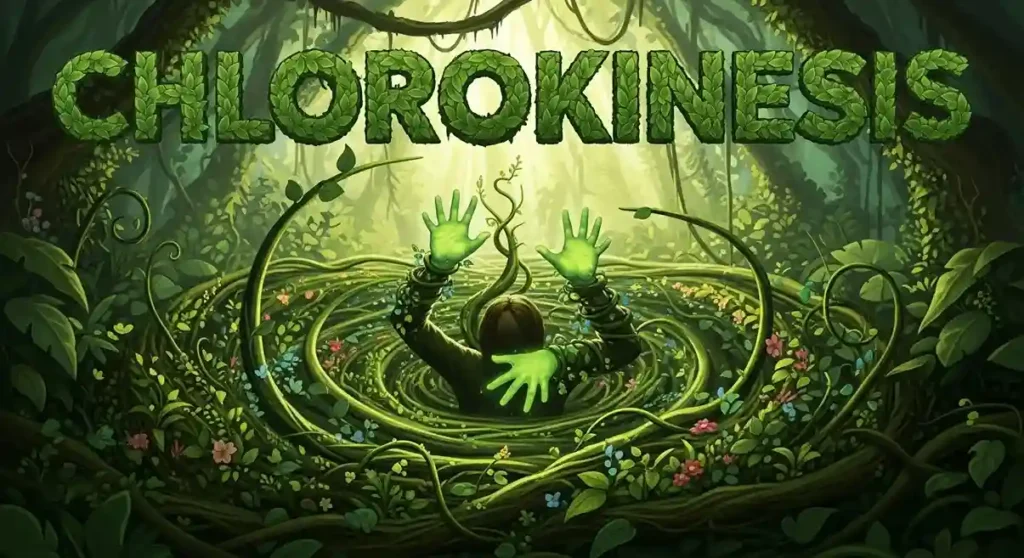
Chlorokinesis is the ability to sense, command, and transform plant life. A power that feels less like fiction and more like remembering an old language. I first felt it while camping: my hand brushed a vine and the growth seemed to accelerate, curling into a tiny green spiral as if answering a whisper. In RPGs and pop culture we see characters call it botanokinesis, verdokinesis, agrokinesis, or phytokinesis; whatever names we use, the sub-power is the same: controlling and manipulating wood, roots, flowers, moss, even communicating through mycelium networks—a quiet green speaking. You can harden bark into armor, shape seeds into weapons, or let grass grow into a bridge; the guide to how it works is simple—wields focus, nature answers. Television, movies, random superpower generator lists love to show trees erupting in combat, yet the real limits are patience and respect. It is a kinetic dance with vegetation, a sibling to Organikinesis, Psychokinesis, Essekinesis, letting you generate new forms, change fruits, shape soil, rock, speak to every green thing. I still keep a tiny moss patch on my desk; when I’m stuck writing, I touch it and remember the power is always there, waiting for the next quiet command.
Chlorokinesis Power Profile Generator
Discover your plant manipulation identity
Common Misspellings of Chlorokinesis :
If you arrived here searching for any of these terms, you're in the right place — they all refer to the same plant manipulation power:
- Chlorokenesis — missing the second 'i'
- Clorokinesis — missing the 'h'
- Chorokinesis — missing the 'l'
- Chlorokenisis — alternate ending
- Chloroctenis — common phonetic misspelling
- Cloroquinesis — Spanish phonetic variation
- Plantkinesis / Florakinesis / Florokinesis — fan-created alternate names
All of these point to one power: Chlorokinesis , the ability to control and manipulate plant life.
Chlorokinesis Definition & Meaning :
Chlorokinesis is the powerful ability of plant manipulation, where a person can control and manipulate plants to grow faster, change shape, produce more fruit, or even make them wilt and die. It is linked with Nature, the Earth element, and sometimes the Wind element as a unique by-product, often shown in both Western media and Eastern media. This connection with plant cells, chloroplasts, and photosynthesis makes it more than fantasy, as its applications can be seen in agriculture, landscaping, and even imagined in warfare. Depending on levels of practice and proper training, it can be used for good or evil, showing both peaceful and destructive sides, from beings made of plants who are deeply attached to environment and filled with love for living beings, to those who use it for violence or revenge with their Elemental Powers in creative ways as a true master of plant life.
What is Plant Manipulation Called?
Plant manipulation goes by many names across comics, wikis, anime, and fantasy fiction. Here is every official term used for this power:
| Name | Meaning | Where It's Used |
|---|---|---|
| Chlorokinesis | Greek: green + movement | Most common in Western comics & media |
| Phytokinesis | Greek: plant + movement | Superpower wikis, fan fiction |
| Botanokinesis | Greek: botany + movement | Academic tone, RPG communities |
| Agrokinesis | Greek: field + movement | Agriculture-focused portrayals |
| Verdokinesis | Latin: green + movement | Less common alternative |
| Flora Manipulation | Latin: flora | Formal power descriptions |
| Dendrokinesis | Greek: tree + movement | Tree-specific variant |
| Anthrokinesis | Greek: flower + movement | Flower-specific variant |
| Plant Manipulation | English | Most universally understood term |
| Nature Manipulation | English | Broader version including weather/earth |
The most widely recognized name is Chlorokinesis, though Phytokinesis and Botanokinesis are equally valid. All refer to the same core ability: the power to sense, control, and manipulate plant life.
Is Chlorokinesis Real or Possible?
Chlorokinesis, the supernatural ability to manipulate and control plant life, remains purely a creation of the imagination in modern science. This fictional superpower allows characters to make plants grow, create vines, create roots, and even use plants as weapons through some mystical connection with nature.
From my years studying botanical sciences and folklore, I've encountered countless claims about people who can supposedly influence plant growth through will alone. However, there's no scientific explanations that support this phenomenon as a real phenomenon. No documented cases exist in peer-reviewed literature, despite what sources like Riordan Wiki or shows like Once Upon a Time might suggest about such powers and abilities.
Yet the concept isn't entirely without historical context. Pre-Hispanic medicine was closely associated with religion and magic, where ancient Asian, African, and European civilizations developed extensive knowledge about plant properties. These cultures collected their wisdom in codices and pictographic documents that kept a record of herbal practices. Native descendants continue to apply this ancestral knowledge, preserved in monasteries and local centers where medical knowledge from specialized gardens provides raw material for treatment of common illnesses.
This historical use of plants in healing has been mentioned in several movies and tv shows. Percy Jackson and the Olympians features children of Demeter and Persephone, while The Trials of Apollo introduces Meg Mccaffrey with plant-controlling abilities. The DCU presents The Green as an elemental force connected to all plant life, serving as the source for plant-based powers in characters with this connection, including Poison Ivy, Jason Woodrue (the Floronic Man), Black Orchid, and Swamp Thing.
In W.I.T.C.H., Cornelia serves as the Guardian of the Earth, with abilities based on earth elements. Magi Labyrinth Of Magic shows Hakuryuu who gains and acquires power from the Djinn Zagan, granting the specific power to make life grow. Even Pokemon features Grass-type characters as a distinct type of sentient plants and animals capable of rapid plants growing by themselves.
These fictional representations typically show movements that attack using sharp leaves, vines, and explosive seeds by channeling the energy of nature. Characters often generate substances like secreted poisons, perfumes, or pollen to generate different effects, mainly producing long-term ailments in an opponent. There are myriad methods shown to recover health by absorbing an opponent's vitality through roots that extract nutrients, or by photosynthesizing sunlight directly.
Those who have this ability exist only in fantasy and science fiction. Whether you believe in such possibilities or not, there's no denying that plant manipulation remains impossible in reality, though it's certainly more common in entertainment media. The guide to understanding chlorokinesis must acknowledge it as not real but rather a fascinating element of storytelling that draws from humanity's ancient relationship with the plant kingdom.
Believed by some to exist based on historical plant knowledge, the concept reflects our deep connection to nature, even if the supernatural ability itself remains purely fictional. The clear distinction between historical herbal wisdom and imaginary chlorokinesis helps us appreciate both the documentation of real botanical knowledge and the creative powers of human imagination in fantasy narratives.
History & Origins of Chlorokinesis
The history and origins of Chlorokinesis show it as a fictional ability to control plants, not a real power. The term is derived from Greek words meaning green and movement, and this concept appears in various forms of popular media, particularly in comic books, anime, and fantasy stories. Examples include She-Ra, Naruto, and the Riordan series, where the idea of plant-based powers is creatively explored.
Mythology and Folklore References :
The story of chlorokinesis has its roots in mythological tales and Greek myths where figures like Gaea, the primordial goddess of the Earth, held infinite power over plants and vegetation. She could create, transform, and shape beings into flora, such as the nymph Daphne turning into a laurel tree to escape Apollo a striking example of plant control and transformation. The children of Demeter, her Roman counterpart Ceres, and even descendants of Dionysus or Bacchus were associated with growth, harvest, and the ability to manipulate trees and sacred places. These stories show the life-giving, protective, symbolic, and medicinal qualities of nature. I’ve always felt that myths of accelerated growth and infinite control reflect humanity’s desire to bond with and harness natural forces.
Folklore and Ancient Beliefs :
In folklore and traditions, Sacred Groves of Mongolian and Eastern Siberia cultures reveal how silence, respect, and worship of gods and Protective Spirits shaped sacred practices. Acts like knocking on wood for good luck, found in Germanic languages, echo ancient reverence for trees. Through plant symbolism, fungi, and flowers like peony and poppy, people attached meanings of healing, compassion, and the afterlife—beliefs woven across many mythologies. As I’ve seen in my own studies of cultural traditions, different cultures viewed vegetation not just as food or medicine, but as a living bridge to the divine.
Chlorokinesis in Pop Culture & Media
Chlorokinesis has appeared across pop culture and media in many vivid forms, from comics like Swamp Thing and Poison Ivy to movies such as Percy Jackson and TV series in the fantasy genre. These depictions spotlight the ability to command vegetation, grow and shape vines, woods, roots, seeds or even flowers into weapons or armor, and to communicate through plant networks or green speaking. What I find fascinating is how creators lean into the dual nature: both the beauty of blooming nature and the danger of hard bark armor or choking roots, showing realistic limits alongside tremendous power.
Chemical Alchemy (Toxins, Scents & Pheromones)
Chlorokinetics re-engineer plant metabolism so the foliage bleeds anesthetics, hallucinogens, or caustic irritants—picture blinding pollen squalls and searing capsaicin detonations. Equally, they can coax the same tissues to distill healing salves, neutralizing antitoxins, pacifying terpenes that quiet unruly crowds, or aromatic veils that erase every trace of scent.
Symbiosis & Companion Flora
Hijacking the native root–fungus grid, riders stretch perception belowground. Footfalls translate into soil tremors they can overhear, moisture veins become tactile maps, and a quick “ping” flings data through distant trunks. The system elevates intel to equal status with brute impact.
Core Abilities of Chlorokinesis
Growth Acceleration & Morphogenesis
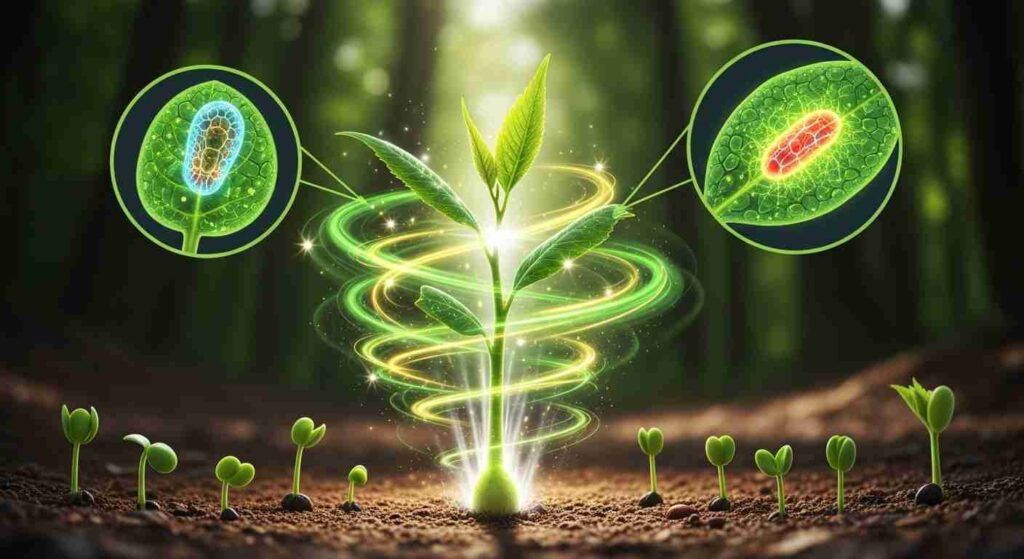
As a user, you can trigger rapid germination and sprouting, making seed pods come alive with force. With your will, flowering can follow your command, and flowers bloom as powerful signals or clever distractions. You are capable of guiding shapes with precision, turning young saplings that harden into protective barricades, or bending pods into grappling hooks. As an advanced wielder, you may even remodel lignin and cellulose, giving you the ability to adjust hardness, refine flexibility, and control weight with mastery.
Plant Motion Control & Telepathy
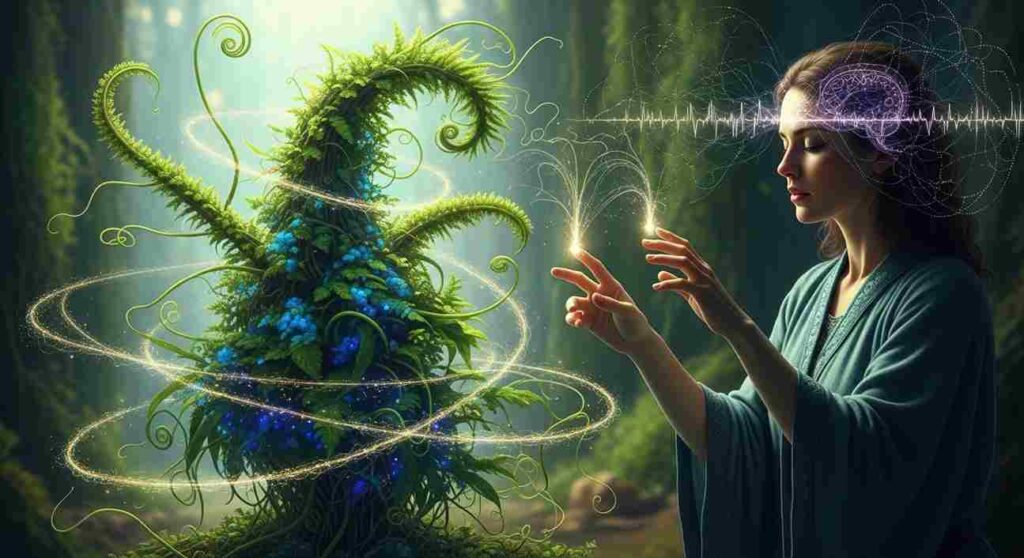
In my own journey of exploring botanical energy, I’ve felt how empathy allows a wielder to truly connect with nature. With focus, one compels vines to coil, guiding branches to lower, or urging roots to tunnel deep into the earth. It may look like puppetry, but in reality, it feels more like a gentle negotiation with living structures. A truly skilled mind can even steer the forest, shifting the canopy to open or close, and coordinate multiple species almost simultaneously. From experience, this flow isn’t about control—it’s about harmony, where every movement carries the quiet strength of the plants themselves.
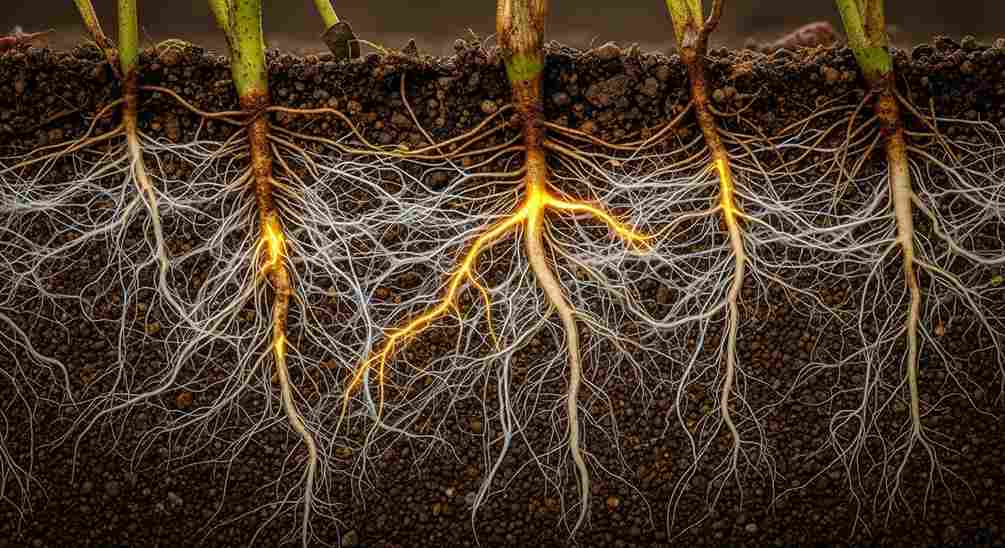
Root & Mycelium Network Communication
Through hidden root–fungus superhighways, skilled users can extend their natural senses deep underground. I’ve experienced how one can eavesdrop on footsteps, trace soil vibrations, and even feel when water runs below. By sending a subtle ping, it becomes possible to connect with distant plants and relay messages across this living network. This unique power turns nature into a web of information and subtle force, giving control beyond the surface world.
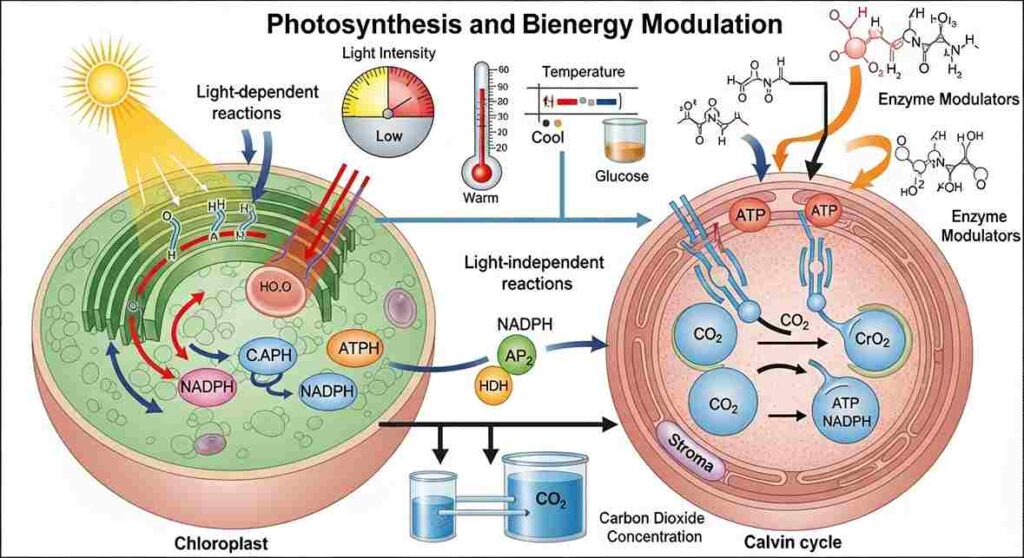
Photosynthesis & Bioenergy Modulation
In certain settings, skilled users can gently nudge photosynthesis to harvest ambient light, turning it into energy for empowering constructs or even healing minor plant damage. I’ve seen how experts convert bioenergy within plant tissues into sudden kinetic jolts, sometimes described as a chlorophyllectric lash, showing how living systems can store and release hidden strength.
Arbormancy – Tree & Terrain Shaping
When exploring the higher tiers of chlorokinesis, I’ve found that shaping the land through plants feels almost natural. An entire grove can be curled and guided to create natural defenses, where ramparts rise from woven trunks and bridges form from connected branches. I once practiced forming mazes of hedges, and the winding paths became corridors that could easily trap an enemy. By grounding deep roots, even strong fortifications can weaken, while high canopies interlock to provide shaded zones perfect for an ambush. I’ve also seen nests appear in these spaces, giving a sense of living architecture that feels both protective and strategic.

Chlorokinesis in Combat & Applications
Arbormancy – Tree & Terrain Shaping
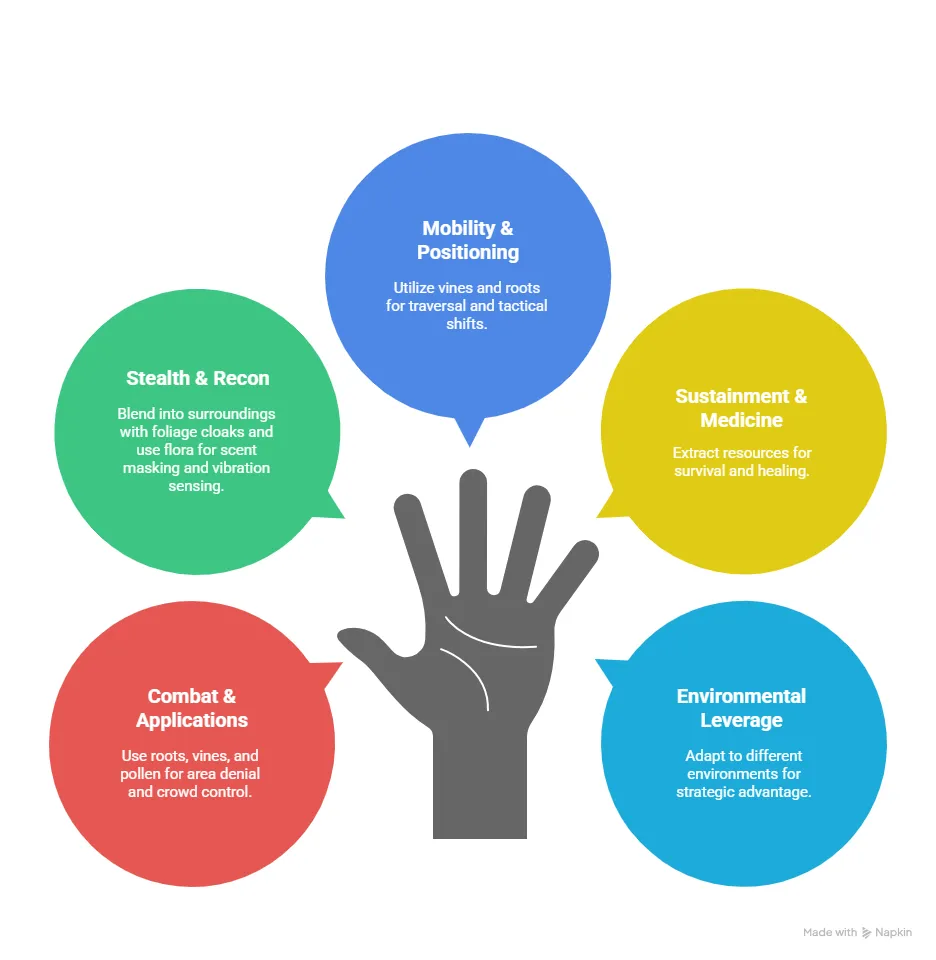
In my experience, chlorokinesis becomes a real advantage when used for Area Denial and Crowd Control. I’ve seen roots erupt from the ground to form root snares around an enemy’s feet, while bramble walls reshape natural choke points. With pollen mists, a user can disorient opponents, forcing them to wear masks or retreat through tight corridors. Even creeping vines from ceilings and floors turn into hidden hazards.
Stealth, Camouflage, and Recon
For Stealth, Camouflage, and Recon, I once relied on color-shifting foliage cloaks that blended me into the understory until I was nearly invisible, like a ghost. Scent-masking flora often confuses trackers, while ivy listens to vibrations, silently relaying approximate positions in dense forests.
Mobility and Positioning
Mobility is where grappling vines shine. A skilled user can swing across rooftops or use living bridges and springy boughs for silent traversal. I’ve used tree roots to lift platforms, gaining elevation, cover, and safe retreat paths. Even a sudden pull of foes or collapsing terrain behind the user creates clever tactical shifts.
Sustainment and Field Medicine
During long missions, Sustainment and Field Medicine keep teams supplied. I’ve dug edible tubers, drawn purified water from succulent tissues, and used medicinal bark or sap to reduce bleeding. Such practices boost morale with calming aromas, detoxify mild poisons, and prove valuable in attrition battles.
Environmental Leverage
Finally, true Environmental Leverage is about knowing the land. In wetlands, reeds and mangroves make perfect ambushes, while in deserts, hardy shrubs and cactus water reserves act as survival lifelines. In coastal zones, I’ve seen kelp forests snare submersibles and swimmers, where chlorokinesis shines by shaping whatever biomass exists, even turning potted plants in a corridor into traps. Only experts can adapt to every setting with such precision.
Levels of Chlorokinesis Power
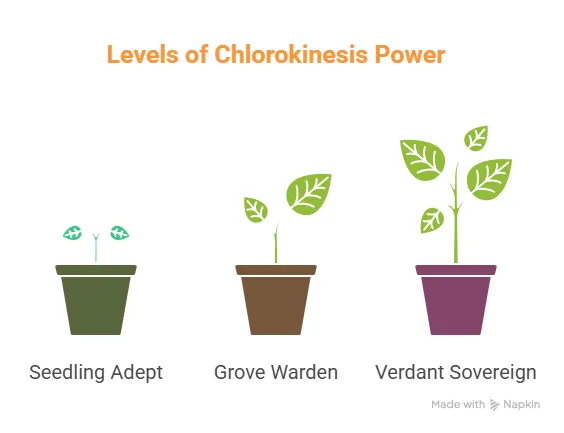
Level 1 — Seedling Adept
Range of Control
At this stage, the power works only in a small radius, like inside a room or an open courtyard, and the feats are basic yet useful.
Early Plant Feats
I remember when I first practiced, the speed of germination amazed me — watching a vine curl around objects, setting light grabs, and seeing flowers bloom with gentle scent tweaks. With focus, I could even form thin bark plating across my forearms for a little defense.
Beginner Tactics
The tactics here are simple : set an ambush on single targets, slow pursuers by pulling up ankle-high roots, or lay down trip-vine traps for surprise control.
Natural Limiters
But there are real limiters; the ability needs existing plants or seeds, and sudden growth bursts often drain stamina quickly, leaving one weak in barren interiors where greenery cannot be called upon.
Level 2 — Grove Warden
Expanding the Scope
At this stage, a Grove Warden learns to work with entire Neighborhood spaces, shaping not just a park or city corner, but whole streets. From my own training, I noticed how landscaping could quickly shift when using morphogenesis to create bramble walls or even mycelium networks that help with sensing movement across the ground. In one trial, I built sturdy living bridges and shields using Multi-plant coordination, and it felt like commanding a small cadre of companion plants.
Impressive Feats
The feats at this level are remarkable: rapid growth spurts that allow plants to Shape terrain mid-fight, partition battlefields, and even snare→thorn chains that can combine into traps. Some of my proudest moments came from testing targeted toxin release with nonlethal irritants—strong enough to deter but not to harm. The ability to maintain plant structures while launching a volley of vines gave me control I had never imagined before.
Tactics and Execution
During live practice, the best approach was to use layered defenses and attacks—mixing companion plants with natural barriers. This style allowed me to Shape terrain mid-fight, trap opponents with brambles, and keep shifting positions. Using plant chains, walls, and volleying thorn projectiles gave me both offense and defense at the same time.
Limiters in Action
Yet, there are limits. A harsh drought or heat can reduce reliability, while anti-plant agents may partially neutralize effects. Even my strongest constructs weaken when my concentration split across too many living forms. Still, with patience, I’ve learned how to block an enemy’s advance using living barricades that feel like breathing walls, proving the tactical scope of this power block is vast.
Level 3 — Verdant Sovereign
Mastering the Ecosystem
When I first began training at this scale, I realized how deeply connected an ecosystem could be, stretching from forests and mangroves to the quiet kelp beds hidden under the sea.
Orchestrating Plant Power
As a Grove Warden, my role felt like pure orchestration—shaping wood with surprising density and elasticity, while keeping absolute control over the precise biochemical cocktails that pulse through every leaf. Through long-range messaging carried by root webs, I could spark a temporary awakening in vegetation, guiding them into semi-autonomous defense when danger pressed in.
Combat and Strategy
In battle, I learned how to encircle armies with living fortifications, sending tunnel roots under walls or triggering flood zones beneath a fast-growing canopy. It became less about brute strength and more about how to fight a war of logistics—denying resources to foes while sustaining allies with quiet strategy.
Risks and Limitations
But power always comes with weight. The massive bioenergetic cost could not be ignored, and I often wrestled with the ethical risks of altering fragile habitats. Every move exposed vulnerability to wildfire, sudden frost, or the reach of sterilizing agents. Worse still, prolonged use could cause ecological imbalance if I didn’t act with care.
Strengths & Limitations of Chlorokinesis
Chlorokinesis powers provide exceptional strengths in plant manipulation. This unique abilities guide shows how creating and controlling plant life enables effective offense through ensnaring enemies and deploying toxins. Defense capabilities include rapidly accelerating growth to form barriers and living constructs. Manipulating biology produces unique effects, allowing control over plant matter in large-scale operations.
Key limitations commonly affect practitioners. Fire creates severe vulnerability, destroying plant-based defenses instantly. Reliance on the presence of existing vegetation limits effectiveness. Physical strain poses potential problems during extended manipulation, restricting the scope of plant control.
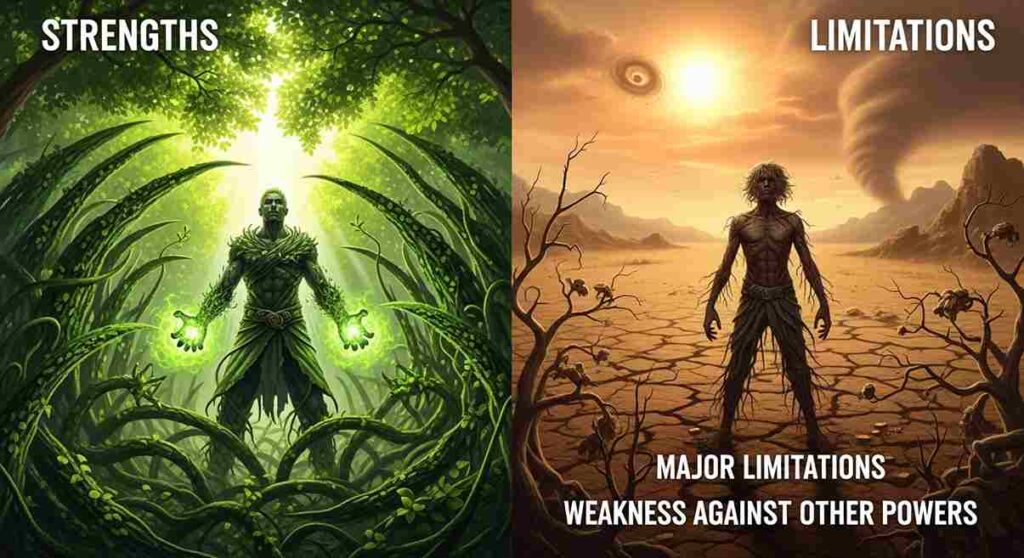
Strengths of Controling Plants :
Defensive Mastery and Offensive Tactics
Chlorokinesis excels in defense by creating sturdy plant-based barriers and clever traps for protection, while users can simultaneously weaponize plants through creating flexible whips from branches and projecting sharp thorns to harm enemies.
Advanced Construction and Environmental Control
Powerful users can create impressive plant constructs and golems by shaping vegetation into complex, functional forms that serve multiple purposes. The ability to rapidly grow plants from seeds allows practitioners to produce fresh fruits and food regardless of season.
Mystical Abilities and Life Enhancement
Advanced chlorokinesis can allow teleportation through large bodies of vegetation, while many users can revive cut or withered plants, demonstrating their deep connection to the restorative aspects of nature.
Communication and Body Transformation
Some can even communicate telepathically with plant life for gaining valuable information and understanding about vegetation. In certain portrayals, a user can augment their body with plant materials to enhance physical strength and other abilities, potentially achieving a unique form of plant-based immortality.
Toxic Generation and Seasonal Mastery
The power also involves generating toxic substances like sleeping gases and poisons that make bloom timing irrelevant when survival is at stake.
Major Limitations of Plant Control
Fire-Based Weaknesses and Environmental Dependencies
Chlorokinetic users face a significant weakness when confronting fire-based powers, as their vulnerability to fire creates serious tactical disadvantages. The ability to manipulate plants becomes severely limited in barren or sterile environments where existing vegetation is absent, making the power's effectiveness dependent on the presence of plant life.
Physical Exhaustion and Environmental Challenges
Manipulating large and complex plant structures proves physically exhausting for any user, while environmental factors like extreme cold can impede the power since not all plants have evolved resistance to heat variations.
Control Difficulties and Collateral Risks
Even when effective, the user's control can be difficult to master, leading to potential collateral damage and accidental harm to allies due to the biology of how these abilities function.
Weaknesses Against Other Powers
Fire-Based Vulnerabilities
Pyrokinesis poses perhaps the greatest threat to plant manipulators. Fire ignites dry biomass with devastating efficiency, turning defensive barriers into fuel for destruction. A skilled pyrokinetic creates strategic firebreaks that sever entire root networks, isolating plant controllers from their power source. The smoke produces additional complications, as it disrupts both vision and breathing, making it nearly impossible to maintain concentration required for complex plant manipulation.
Ice and Cold Attacks
Cryokinesis attacks target the fundamental biology of plants. When ice power freezes the sap and intracellular water within plant tissues, it's making even the strongest foliage become fragile and easy to shatter. I've witnessed entire wooden fortifications crumble after exposure to sustained freezing attacks, leaving chlorokinetic defenders completely exposed.
Wind-Based Disruption
Aerokinesis practitioners use hot, dry winds that systematically desiccates plant tissues, weakening them beyond repair. Wind manipulation also scatters spores and seeds off-target, disrupting reproduction-based tactics. Perhaps most frustratingly, strong winds collapses pollen-based tactics before they can take effect, neutralizing one of chlorokinesis's most subtle weapons.
Electrical and Energy Attacks
Electrokinesis brings unique dangers through lightning surges that spark massive wildfires, creating chain reactions beyond any plant controller's ability to stop. Electrical attacks also carbonize plant constructs instantly, reducing elaborate defenses to ash in seconds.
Chemical and Sonic Warfare
Toxikinesis attacks corrodes the cellulose and lignin that give plants their structural integrity, dissolving protective barriers and natural armor. Meanwhile, Sonokinesis uses resonant vibrations to rupture cell walls from within, causing leaves and branches to literally shred themselves apart.
Light Manipulation and Technology
Shadow and Darkness Manipulation starves plants of essential light, cutting off photosynthesis and hinders all growth-based powers. Modern threats include Technopathy and Technomancy, where opponents deploys drones equipped with saws and mechanized harvesters specifically designed to neutralize living fortifications.
Death and Telekinetic Powers
Necromancy and Decay powers accelerates natural rot, turning defensive barriers into useless mulch while undermines fungal mycelium communication relays. Severing Telekinesis proves particularly effective as it cleanly slices through vines and roots, bypassing traditional entanglement defenses entirely.
Comparisons & Related Powers to Chlorokinesis
Chlorokinesis vs Biokinesis
These two powers are often confused because both deal with living matter — but their scope is completely different.
Chlorokinesis is specific. It works only within the plant kingdom controlling vines, roots, trees, flowers, fungi, and all botanical life. Deep power, but narrow domain.
Biokinesis is universal. It governs the biology of any living organism humans, animals, plants, microbes. A biokinetic can alter DNA, reshape bone structure, trigger disease, or heal cells directly. Where chlorokinesis commands the forest, biokinesis commands life itself.
The simplest way to understand it: Chlorokinesis is a subcategory of Biokinesis — every plant a chlorokinetic controls, a biokinetic can influence too, plus everything else.
| Feature | Chlorokinesis | Biokinesis |
|---|---|---|
| Scope | Plants only | All living organisms |
| Targets | Botanical life | Humans, animals, plants, microbes |
| Offense | Vines, thorns, plant toxins | Organ failure, mutation, paralysis |
| Defense | Bark armor, root walls | Biological immunity, self-healing |
| Healing | Herbal/plant-based only | Direct cellular repair |
| Weakness | Fire, barren environments | Mental exhaustion, ethical limits |
| Power Ceiling | Ecosystem-level control | Species-level alteration |
Chlorokinesis vs Phytokinesis — Is There Any Difference?
No, they are the same power. Both refer to the ability to control and manipulate plant life — the only difference is the Greek root used to name them.
- Chloro comes from Greek khloros meaning "green"
- Phyto comes from Greek phyton meaning "plant"
Phytokinesis meaning: From Greek 'phyton' (plant) and 'kinesis' (movement) — the power to move and control plant life.
Different names, identical ability.
The term Chlorokinesis is more commonly used in Western comics and pop culture, while Phytokinesis appears more in superpower wikis and fan communities. Some writers prefer phytokinesis because it feels more botanically accurate — plant movement rather than just green movement — since chlorokinesis technically could imply only green-colored plants.
Other names used for the exact same power include Botanokinesis, Agrokinesis, Verdokinesis, and Flora Manipulation — all describing one thing: the ability to sense, control, and manipulate plant life.
| Term | Origin | Usage |
|---|---|---|
| Chlorokinesis | Greek: green + movement | Most common in comics & media |
| Phytokinesis | Greek: plant + movement | Common in wikis & fan fiction |
| Botanokinesis | Greek: botany + movement | Academic-sounding alternative |
| Agrokinesis | Greek: field/land + movement | Less common, agriculture-focused |
| Flora Manipulation | Latin: flora | Used in formal power descriptions |
Botanokinesis vs Chlorokinesis
They are the same power. Botanokinesis and Chlorokinesis both describe the ability to control, manipulate, and communicate with plant life — the only difference is which Greek root was used to name them.
- Chloro comes from Greek khloros meaning "green"
- Botano comes from Greek botanē meaning "plant" or "herb" — the same root used in the word botany
Same ability, different label. A chlorokinetic and a botanokinetic can do identical things — grow vines, shape roots, synthesize toxins, communicate through mycelium networks.
The term Chlorokinesis is more popular in comics and mainstream media, while Botanokinesis tends to appear in academic-sounding fan wikis and RPG communities because it sounds more scientifically grounded. Neither is more "correct" than the other.
| Term | Root Meaning | Common Usage |
|---|---|---|
| Chlorokinesis | Greek: green + movement | Comics, pop culture, mainstream media |
| Botanokinesis | Greek: plant/herb + movement | Wikis, RPGs, fan communities |
Advanced Power Fusion Techniques
Terrakinesis + Chlorokinesis :
Soilaeration and mineralenrichmentenablesrapidrooting systems that produceinstantforests or defensive bunkers. This combination creates underground networks where roots can burstthrough hardened surfaces while maintaining structural integrity.
Hydrokinesis + Chlorokinesis :
Water routing boosts turgor pressure and accelerates growth patterns, allowing practitioners to create underwaterkelptraps and floatingreedbridges that extend operational capabilities across aquatic environments.
Aerokinesis + Chlorokinesis :
Directs pollen storms and spreads medicinal aerosols while wind-lifted seed grenades extend tactical range. This fusion cools entire canopies and creates atmospheric advantages in combat scenarios.
Light Manipulation + Chlorokinesis :
Provides artificial sun energy for photosynthesis in caves or during night operations. Laser-guided precise constructs allow for targeted growth and flash-curing processes that harden wood structures instantly.
Animal Empathy + Entomokinesis + Chlorokinesis :
Coordinates pollinators and guardian insects with vine sentries to establish complex eco-traps. This creates living surveillance networks that respond to threats automatically.
Seismokinesis + Chlorokinesis :
Generated quakes fracture pavements and concrete foundations, allowing root systems to penetrate urban environments while creating impenetrable barricades from underground growth networks.
Chlorokinesis Training and techniques:
Mastering techniques requires intensive training through multiple phases. Success depends on three core areas: Mindfulness (Meditation), Subconscious conditioning, and Focused attention.
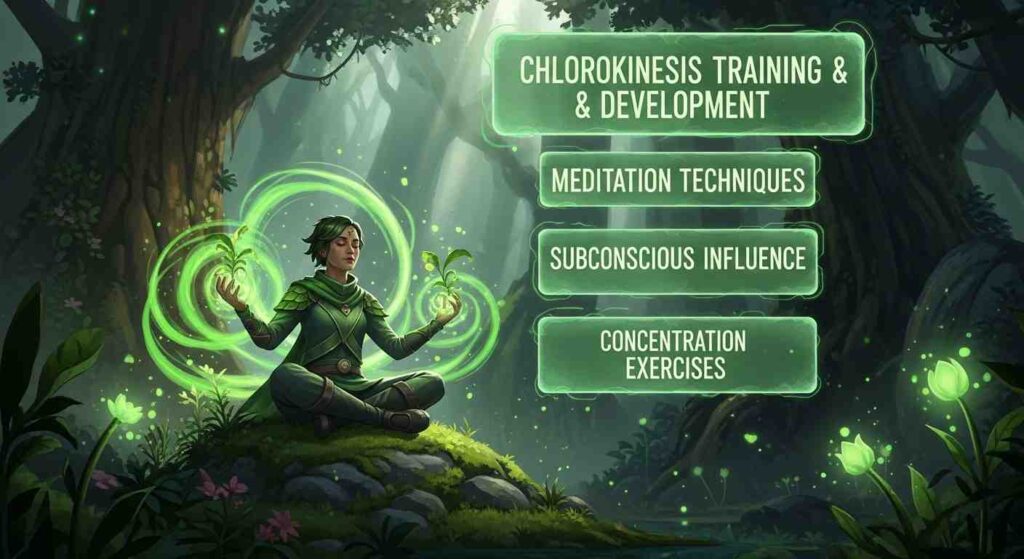
Essential Meditation Practices :
Mental domination is necessary to make your psychic ability work effectively. Through recurring practice and focused learning, you develop the power to connect with plant life. Your mind must be dominated by intention when this ability is performed.
You need to find a comfortable place to train without distractions. Make sure you won't become discomforted during sessions. Sit in any position, close your eyes, and rest your body. Take it easy - imagine yourself calmly sitting in perfect stillness, connecting with botanical energy around you.
Subconscious Programming Methods :
Building subconscious belief is the most effective way to move plant elements naturally. You should feel each element within your hand as you practice - this creates the foundation to build lasting connection. Start light, then gain weight gradually as your abilities strengthen. The element will become harder to lift as resistance increases, which actually improves your performance in this area. Once you're able to reach the pinnacle of control at your current level, take the next step forward. This progression ensures you've truly achieved mastery before advancing to more complex plant manipulation techniques.
Focused Attention Techniques
Focused attention is where intention becomes action. Choose one plant — a single leaf, a seed, a vine — and give it your complete mental focus. Don't try to command it. Observe it so deeply that it begins to feel like an extension of your own awareness.
Once comfortable, practice directing attention like a beam — concentrated on one root or stem at a time. Advanced practitioners gradually build split-focus training, holding awareness on two plants simultaneously, then three, until multi-plant coordination becomes natural.
Three core exercises:
The Single Vine Lock — Hold unbroken focus on one vine for five minutes. Any distraction resets the count. Builds the concentration stamina needed for sustained plant control.
The Growth Watch — Observe a germinating seed during meditation without trying to influence it. Over time, this passive presence begins to feel like a two-way connection.
The Network Scan — Close your eyes and sense the plants around you without looking. Map them by feeling alone. This trains the expanded awareness needed for mycelium communication and long-range plant telepathy.
How Strong is Chlorokinesis?
Chlorokinesis is an incredibly strong power that ranks among the most versatile abilities in any fictional universe. A user can mentally control and manipulate all forms of vegetation and plants with extraordinary strength. The ability allows practitioners to create barriers by rapidly growing defensive walls, ensnaring enemies with thick vines, and withering hostile plant life on command. For offense, users can produce toxic spores that devastate opponents, while defense capabilities include accelerating growth of protective vegetation. The specific applications vary tremendously – from telepathically communicating with life forms to transforming entire landscapes for support. What makes this ability exceptionally powerful is how users can simultaneously coordinate multiple aspects of vegetation control, maintaining perfect mental focus while executing complex strategies against their targets.
Personality Traits of Chlorokinetics

Nature Connection Strength
Nature-oriented users with strong affinity for the natural world may have deeper understanding of plants and ecosystems. The ability varies based on personality - showing natural curiosity about botanical life and empathy with plant consciousness.
Dual Nature Applications
Chlorokinesis can be used for nurturing or destructive purposes. Protective individuals foster growth and support others, creating barriers and shielding through plants. Aggressive users might weaponize and control vegetation, implying a more destructive side.
Speed Variations
Patient practitioners enjoy cultivating and observing growth over time. Impatient users who want immediate results could instantly grow and manipulate plants. It depends on whether someone values gradual development or quick appeal.
Advanced Abilities
Empathetic users have potential for green-speaking - telepathically communicating with plant life. This unique sense creates understanding between human and botanical consciousness, manifest as a person suggesting deeper connections about the natural ecosystem.
Known Users of Chlorokinesis
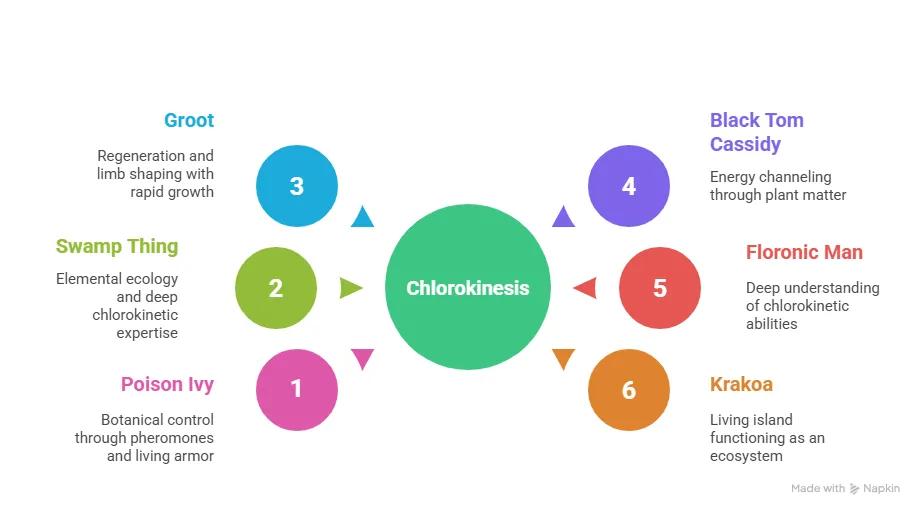
1- DC Universe Champions
Poison Ivy (Pamela Isley) — DC's most iconic plant manipulator, using pheromones, toxins, and living armor made from botanical matter. She can control any plant life within her range and is considered one of the most dangerous chlorokinetics in fiction.
Swamp Thing — The ultimate guardian of "The Green," a elemental force connecting all plant life on Earth. Swamp Thing doesn't just control plants — he is a plant, making him arguably the most powerful plant manipulator in DC canon.
Floronic Man (Jason Woodrue) — A botanist transformed into a plant-human hybrid. His deep scientific understanding of plant biology combined with chlorokinetic ability makes him uniquely dangerous among DC villains.
2- Marvel Universe
Groot — The sentient tree-being capable of rapid regeneration, reshaping his own limbs, and controlling his woody body with precision. His famous resilience comes from his ability to regrow from a single twig.
Black Tom Cassidy — Channels destructive energy blasts through plant matter, particularly wood. His power requires plant contact but delivers devastating offensive force.
Plantman (Samuel Smithers) — A Marvel villain who uses a special ray gun to control plant life, later gaining the ability to transform himself into plant matter entirely.
Man-Thing — A biochemist transformed into a swamp creature with deep connection to plant and environmental forces, capable of merging with and controlling vegetation around him.
3- Anime & Manga Characters
Hashirama Senju (Naruto) — Perhaps the most powerful plant manipulator in anime. The First Hokage's Wood Release (Mokuton) allowed him to create entire forests from nothing, build massive wooden structures, and even suppress the chakra of Tailed Beasts. His ability is considered legendary even by Naruto standards.
Yamato (Naruto) — The only other known user of Wood Release in Naruto, using it primarily for restraint, construction, and suppression of Nine-Tails chakra.
Hashirama Senju clones (Naruto) — Created by Orochimaru and Kabuto to replicate Hashirama's Wood Release with varying degrees of success.
Plant Manipulation in JJK
Jujutsu Kaisen does not feature a character with pure chlorokinesis, but several sorcerers use techniques that closely resemble plant manipulation in both appearance and function.
Noritoshi Kamo uses Blood Manipulation (Ketsueki Shojo), creating blood constructs that behave like vines and roots — wrapping, piercing, and restraining enemies in a style visually similar to classic plant control.
Mei Mei's Bind Toads — Though bird-based, the binding and entanglement mechanics mirror root snare techniques common in chlorokinesis.
The Culling Game Arc introduces several players whose domain expansions and cursed techniques incorporate environmental and organic matter control, drawing thematic parallels to plant manipulation.
The closest pure plant manipulation in JJK universe appears in the form of wooden structure constructs and organic barrier techniques used by various sorcerers during the Shibuya Incident arc.
Erick Alphonse (Black Clover) — Uses magic that grows and controls plants for both offense and defense, a textbook example of anime chlorokinesis.
Somosa De Medizales (Black Clover) — Spirit of the forest whose entire existence is tied to plant life and forest manipulation.
4- Video Game Characters
Poison (Street Fighter) — Plant-based fighting moves incorporating vine whips and botanical attacks.
Cagney Carnation (Cuphead) — A giant flower boss who weaponizes seeds, roots, and floral projectiles.
Treant Protector (Dota 2) — An ancient tree spirit with abilities centered on controlling forest terrain and plant growth.
Maokai (League of Legends) — A twisted treant who hurls saplings and entangles enemies with magical roots.
is chlorokinesis possible in real life ?
Chlorokinesis is not possible in real life - this supernatural ability to mentally manipulate plants and vegetation exists only in the realm of fantasy and science fiction, not reality. While plants do respond to their environment through natural biological processes, this happens as an unconscious process rather than through conscious control by humans. The power to summon vegetation, control growth, or communicate with plant life remains fictional and depicted only in movies, books, and games. This ability falls firmly within the fantasy genre, where supernatural powers defy the laws of science that govern our real world.
Final Thoughts
Chlorokinesis remains a captivating fictional power that bridges our ancient connection to nature with modern imagination. While true plant manipulation exists only in fantasy, the mindfulness and meditation techniques associated with botanical connection offer real benefits for anyone seeking a deeper relationship with the natural world.
Whether you're exploring chlorokinesis for creative writing, gaming, or pure curiosity, remember that the most powerful aspect isn't controlling plants—it's recognizing our existing connection to the green world that sustains us. In that awareness lies a different kind of magic, one available to anyone willing to slow down and truly appreciate the incredible botanical life surrounding us.
The next time you touch a leaf or walk through a garden, you might not command the vegetation but you might discover something equally transformative about your place in nature's grand design.


