Random Verb Generator
Random Verb Generator
TextClick Generate to get your result
How to Use This Random Verb Generator ?
This tool is built for speed. You land, you generate, you copy — but a handful of filters let you get far more specific than a single random verb. Here is exactly how each control works.
Step-by-Step: Generate Your First Random Verb in Seconds
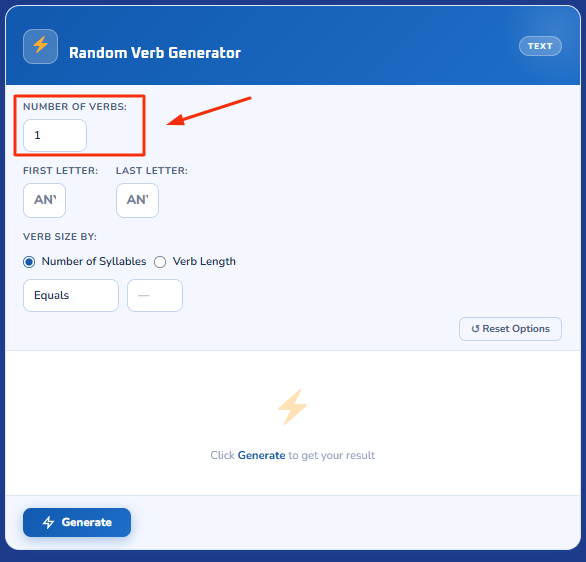
Step 1 — Set your quantity.
The number field defaults to 1. Use the up and down arrows to increase it — generate 2, 5, 10, or as many verbs as your project needs in a single click. Writers brainstorming a scene benefit from generating 10 at once and picking the one that clicks.
Step 2 — Apply your letter filters (optional).
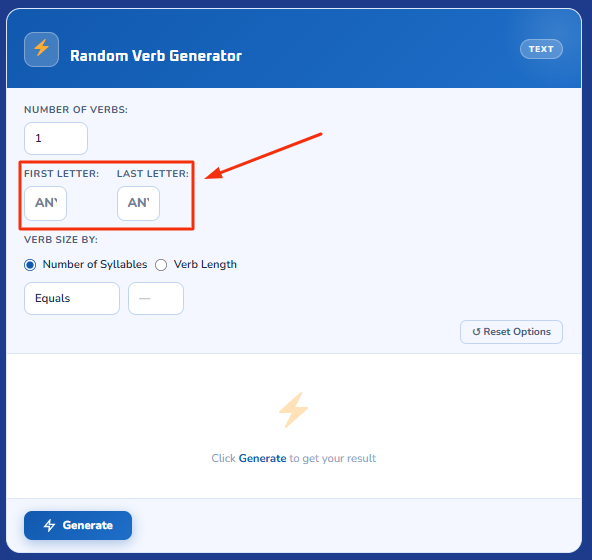
Two input fields sit side by side: First Letter and Last Letter. Type any letter into either field to narrow results. Want only verbs that start with “S”? Type S in the first field. Need a verb ending in “-ize”? Type Z in the last field. Leave both blank to keep the full pool open.
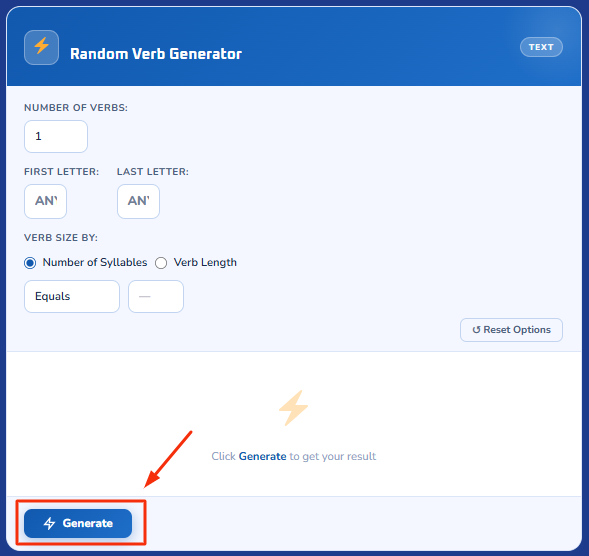
Step 3 — Click Generate.
Hit the Generate button. Your results appear instantly — no page reload, no wait.
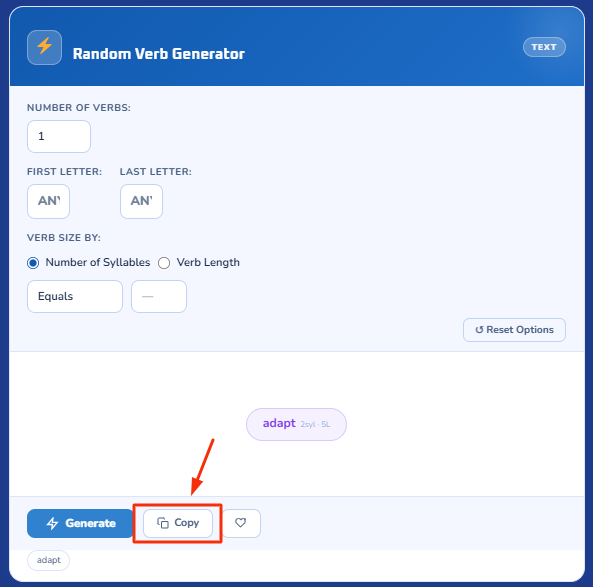
Step 4 — Copy and use.
Click the Copy button to grab your results as plain text, ready to paste anywhere — a Word document, a lesson plan, a game card, a script.
Filter Options Explained — What Each Control Actually Does
Most tools offer filters and never explain them. Here is what every control on this generator does, and when you should use it.
Number of Verbs
This controls how many verbs the tool pulls per generation. The default is 1. For games like Pictionary or Charades, generate 10–15 at once and write them onto cards. For creative writing exercises, generate 3 and challenge yourself to use all three in one paragraph.
First Letter filter
Restricts results to verbs beginning with a specific letter. This filter is useful for word games with alphabet constraints, alliteration exercises in copywriting, or classroom activities where each student is assigned a different letter.
Last Letter filter
Restricts results to verbs ending with a specific letter. Combine it with the First Letter filter — for example, first letter “S” and last letter “G” — and the tool returns only verbs matching both conditions simultaneously, such as “stinging” or “swirling.”
Word Size By — Number of Syllables vs Word Length
This is a radio button that switches what the size filter measures. Select “Number of Syllables” if you are working on poetry, song lyrics, or spoken content where rhythm matters — a verb with two syllables has a completely different feel in a line than a five-syllable verb. Select “Word Length” if you need verbs that fit a specific character count, such as for a crossword puzzle, a design layout with a tight text box, or a game board with fixed tile spaces.
Equals / Less Than / Greater Than (dropdown)
This dropdown pairs with the number input below it to define the size rule. Set it to “Equals 2” and the tool returns only verbs with exactly 2 syllables (or exactly 2 characters, depending on which radio button is active). Set it to “Less Than 5” to exclude long, complex verbs and stay within shorter, more accessible options — useful for ESL learners or younger students. Set it to “Greater Than 3” when you specifically need longer, more descriptive action words for formal writing or literary prose.
Size Number input
Enter any whole number here using the up and down arrows. This value works together with the dropdown above — “Greater Than” + “4” means every result has more than 4 syllables or more than 4 characters, depending on your radio selection.
Reset button
Clears every filter at once and returns all settings to their defaults — quantity back to 1, both letter fields empty, size filter off. Use this whenever you want to start a fresh, fully open generation without any constraints.
What Is a Verb? A Complete Definition
A verb is a word that describes what a subject in a sentence is doing, helping verbs indicate physical, mental actions, occurrences, and states of being through examples like Jeffrey builds a house, Anita thinking about horses, where true love exists. Every sentence must have at least one verb, and at a basic level it can consist solely of a single verb in imperative form like run, where implied you functions as the main part of the predicate, expressing an action like jump, an occurrence that may happen or become, or a state that may exist, stand, or is.
A verb is essential for completing meaning, often changing by inflection to show tense, mood, and voice, and in speech is used to describe anything carried out by a person, animal, thing, or abstract concept, whether deliberate, natural process, or passive state. A grammatically complete sentence must contain one, though we encounter sentences without it in less formal contexts; in fact, one may be entirely sit or appear outside, but is normally preceded by a subject like a dog that sits, or Johnny who ran to catch a bus, see a movie in a theater, get older, like to read, think, explore history more, while Herman would prefer us not to give advice, as theory implies we approach humanitarian aid differently. The Oxford, Learners, and Dictionary view defines a group of words that express action like eat, an event, while Cambridge calls it a phrase of condition or experience, and Collins offers an elaborate definition where verbs like sing, feel, or die help say what someone or something does, what happens, giving clear information.
The 6 Types of Verbs in English
English verbs fall into six categories. Each one behaves differently inside a sentence, and knowing the difference determines whether you use a generated verb correctly or awkwardly.
1. Action Verbs (Dynamic Verbs) Action verbs describe something a subject physically or mentally does. Run, build, decide, imagine. They describe a process with a beginning and an end, which is why they work naturally in continuous tenses — “she is running” is grammatically correct because running is an ongoing process. Action verbs form the largest group in this generator’s word pool.
2. Stative Verbs (State of Being Verbs) Stative verbs describe a condition that exists rather than something happening. Know, belong, contain, believe, own, prefer, seem. The critical rule: stative verbs do not appear in continuous tenses. “She knows the answer” is correct. “She is knowing the answer” is not — a state has no process, so the continuous aspect does not apply.
3. Transitive Verbs A transitive verb requires a direct object to complete its meaning. “She kicked” demands an answer — kicked what? “She kicked the ball” is complete. The action transfers from the subject through the verb and lands on something else. Remove the object and the sentence collapses.
4. Intransitive Verbs An intransitive verb is complete without a direct object. “He arrived.” “She slept.” “The river flows.” The action stays with the subject and transfers to nothing. Many verbs in English function as both — “she runs” is intransitive, “she runs a company” is transitive. The sentence structure determines the category, not the verb itself.
5. Linking Verbs Linking verbs connect a subject to a word that describes or identifies it. They create an equation rather than an action. Be, seem, appear, and sensory verbs — look, feel, sound, smell, taste — all function as linking verbs when they connect a subject to an adjective. “The soup tastes bitter.” Replace the linking verb with “is” and the meaning holds — that is the test. Linking verbs are followed by adjectives, never adverbs.
6. Auxiliary Verbs (Helping Verbs) Auxiliary verbs attach to a main verb to form tenses, questions, and negations. Without them, compound tenses do not exist.
Primary auxiliaries — be, have, do — build tense structures. Every continuous tense uses be. Every perfect tense uses have.
Modal auxiliaries — can, could, will, would, may, might, must, should, shall — change the meaning of the main verb by expressing ability, possibility, obligation, or prediction.
| Modal | What it signals |
|---|---|
| can / could | ability, past possibility |
| will / would | future certainty, conditional |
| may / might | possibility |
| must | strong obligation |
| should | advice or expectation |
Modal verbs never change form, carry no third-person “s,” and are always followed by the base form of the main verb. No competitor page in this space covers auxiliary and modal verbs — yet they are the structural framework behind every tense in the table above.
Phrasal Verbs — The Category Every Competitor Ignores
A phrasal verb combines a base verb with a particle — a preposition, adverb, or both — to create a meaning entirely separate from the original verb. “Give” means to transfer something. “Give up” means to quit. The particle does not modify the verb — it transforms it into a new semantic unit.
Common examples:
| Phrasal Verb | Meaning |
|---|---|
| give up | stop trying |
| look into | investigate |
| take off | remove, or depart |
| run into | encounter unexpectedly |
| put off | postpone |
| put up with | tolerate |
| look after | take care of |
| take over | assume control |
Strong Verbs vs Weak Verbs in Writing
Key Differences in Writing
From my own experience working with text tools, I’ve noticed that the difference between strong verbs and weak verbs often determines whether writing feels alive or flat. Strong verbs are precise, descriptive action words that carry vivid imagery on their own — words like scoffed, dashed, or sprinted hit differently than something generic like walked or said. What makes them powerful is that they eliminate the need for adverbs or extra words to deliver meaning. Instead of verb-adverb combinations that add verbosity, a single sharp verb brings clarity, making writing more engaging, concise, and energetic. Think of it this way — bellowed is instantly more memorable than shouted loudly, and that one swap makes the overall tone tighter and clearer. Strong verbs carry vigor and confidence, keeping the reader genuinely engaged rather than passive.
Examples of Weak vs. Strong
The shift becomes obvious in real sentences. “She walked slowly into the room” creates no picture — the action that occurred feels dull and basic. But “She crept into the room” — suddenly there’s tension. Same action, completely different feel. Likewise, “He said angrily” is passive and forgettable, while “He bellowed” lands with weight. ### When to Use Which, the answer is straightforward — reach for strong verbs whenever you want a vivid picture, want to express emotion, or need to control the pace of your writing. Reserve weak verbs only when the action shouldn’t steal focus from more significant elements in the sentence.
What Can You Use a Random Verb Generator For?
A random verb generator is far more than a novelty. The moment you introduce an unexpected action word into any language task — writing, teaching, gaming, or designing — your brain is forced to make connections it would never reach through deliberate thinking alone. That is the mechanism behind every use case below: randomness removes the default, and the default is usually what makes writing, lessons, and content feel predictable.
Spark Creative Writing and Beat Writer’s Block
Writer’s block is rarely about having nothing to say. It is almost always about being trapped inside the same familiar word patterns. When you pull a random verb — one you would never consciously choose — your sentence has to go somewhere new to accommodate it. That structural pressure is what breaks the block.
The practical exercise is simple: generate five random verbs and write one paragraph that uses all five. The constraint forces unexpected connections between ideas, images, and characters that deliberate plotting rarely produces. This is why strong, dynamic verbs transform a sentence that fades into one that lands — “she seized the moment” carries entirely different weight than “she took the moment,” and randomness is often what surfaces the better choice.
Random verb generation also directly combats passive voice habits. Writers who rely on weak verb phrases — “was running,” “had been thinking” — find that a generated active verb forces a structural rewrite of the entire sentence, and the result is almost always stronger.
Teach Grammar and Vocabulary More Effectively
For language teachers, a randomly generated verb does something a pre-written worksheet cannot: it removes the predictability that lets students coast. When the verb is unexpected, learners have to actually think about conjugation, tense, and sentence structure rather than pattern-matching from memory.
Effective classroom activities built around random verb generation include:
Tense conversion drills. Generate one verb and ask students to write it in all 12 tenses — simple, continuous, perfect, and perfect continuous across past, present, and future. The randomness ensures every student is working with a different verb, eliminating copying.
Sentence building chains. Each student generates one verb and writes an opening sentence. The next student must continue the story using the previous verb and add their own newly generated one. This activity builds both grammar accuracy and narrative thinking simultaneously.
Conjugation speed rounds. Generate a verb, call out a subject pronoun and a tense, and ask students to conjugate it in under 10 seconds. Random verbs — especially irregular ones like “drive” or “sink” — expose conjugation gaps that regular verb drills miss entirely.
Help ESL Learners Build Real Vocabulary
ESL learners face a specific problem that random verb tools address particularly well: they tend to rely on the same 50–100 verbs because those are the ones they learned first. A random verb generator systematically breaks that habit.
The most effective ESL application is the daily verb challenge: generate three verbs each morning, look up each one, write one sentence per verb from personal experience, then speak those sentences aloud. Over 30 days, that is 90 new verbs encountered in a contextualized, active way — far more effective than passive vocabulary lists.
Random verb generation is also valuable for false friend recognition. When a generated verb looks similar to a word in the learner’s native language but means something different, it creates a memorable, correctable moment that sticks better than any textbook explanation.
Elevate Games — Pictionary, Mad Libs, and Charades
Action words are the engine of word-based games, and generating them randomly removes the host preparation burden entirely.
For Pictionary, generate 10–15 action verbs before the session and write each on a separate card. Use the syllable filter to control difficulty — one-syllable verbs like “leap” or “grab” are beginner-appropriate, while three-syllable verbs like “exaggerate” or “negotiate” are much harder to draw and better suited for experienced players.
For Mad Libs, the verb slots are what make or break the comedy. Generating verbs randomly rather than choosing them deliberately produces funnier, more absurd combinations because deliberate choices unconsciously trend toward the predictable.
For Charades, use the Word Length filter set to “Less Than 6 characters” to keep verbs short and physically demonstrable. Longer verbs with abstract meanings are significantly harder to act out and frustrate players rather than challenge them.
Give Content Creators and Copywriters Stronger CTAs
Every call-to-action is built around a verb. “Click,” “buy,” “subscribe,” “download” — the same verbs appear across millions of pages, which is precisely why they stop working. Readers become blind to default CTA verbs the same way they become blind to banner ads.
Using a random verb generator as a CTA brainstorming tool works as follows: generate 20 verbs, filter out anything abstract or intransitive, and scan the list for action words that could plausibly anchor a button or headline. “Claim,” “unlock,” “discover,” “master,” “explore” — these are all verbs that could be sitting in the generator’s output, waiting to replace “click here” on your highest-traffic page.
The same principle applies to headline writing. Headline verbs carry the emotional tone of an entire article. A random verb session for headline ideation produces options you would never brainstorm linearly, and the unusual ones are often the most memorable.
Inspire Poets and Lyricists
Poetry and songwriting share a specific problem: the words a writer consciously reaches for are almost always the words readers have already seen. The verb that arrives unexpectedly — the one the poet would never have chosen on purpose — is often the one that carries the most genuine emotion and the sharpest imagery.
Using the syllable filter is particularly useful here. A two-syllable verb lands differently in an iambic line than a three-syllable one. Generating verbs filtered to a specific syllable count lets a poet or lyricist explore action words that fit an existing rhythmic structure without forcing a compromise.
The imagery direction of an entire stanza often pivots on a single verb. Generating a verb that belongs to an unexpected semantic field — a physical action verb dropped into an emotional context, or a sensory verb placed in an abstract passage — creates the kind of tonal friction that readers remember.
Build Vocabulary Through Daily Practice
Vocabulary acquisition research consistently shows that encountering a word in an active, generative context — using it in a sentence you construct yourself — produces retention rates significantly higher than passive reading or flashcard review.
A structured daily routine using random verb generation: generate five verbs each morning, write one original sentence per verb from personal experience, and revisit yesterday’s verbs before generating today’s. This spaced repetition loop, built around randomly assigned words, prevents the selection bias that self-directed vocabulary learning almost always produces — where learners unconsciously avoid words that feel difficult and repeatedly practice words they already know.
Verb Tenses and How They Change Meaning
A verb without a tense is an incomplete thought. The word “run” tells you an action exists. “Ran,” “was running,” “had been running,” and “will have been running” each tell you something entirely different about when that action happened, whether it was finished, and how it related to another event in time. Tense is not a grammatical formality — it is the mechanism that gives a verb its full meaning, and understanding it changes how you use every verb this generator produces.
English has 12 tenses in total, organized across three time frames — past, present, and future — and four aspects: simple, continuous, perfect, and perfect continuous. Most learners know three or four of these. Knowing all 12 is what separates functional English from precise English.
The 12 English Verb Tenses — Complete Reference Table
The table below uses the verb “write” as the base example across all 12 tenses. Every randomly generated verb from this tool follows the same structural pattern.
| Tense | Formula | Example |
|---|---|---|
| Simple Present | base form / base + s | She writes every morning |
| Present Continuous | am/is/are + verb-ing | She is writing right now |
| Present Perfect | has/have + past participle | She has written three chapters |
| Present Perfect Continuous | has/have been + verb-ing | She has been writing for two hours |
| Simple Past | past form (regular: + ed) | She wrote yesterday |
| Past Continuous | was/were + verb-ing | She was writing when the phone rang |
| Past Perfect | had + past participle | She had written the ending before the plot made sense |
| Past Perfect Continuous | had been + verb-ing | She had been writing for a year before publishing |
| Simple Future | will + base form | She will write the final chapter tomorrow |
| Future Continuous | will be + verb-ing | She will be writing all weekend |
| Future Perfect | will have + past participle | She will have written 80,000 words by December |
| Future Perfect Continuous | will have been + verb-ing | She will have been writing for three years by then |
Every one of these tenses changes the meaning of the verb — not slightly, but fundamentally. “She wrote” is a completed event. “She was writing” places you inside the action as it was happening. “She had written” tells you the action was already complete before something else occurred. The verb is the same; the tense is doing all the semantic work.
When you generate a random verb with this tool and intend to use it in writing, teaching, or a grammar exercise, always decide on the tense first. The tense frames the context. The verb fills it.
Simple, Continuous, Perfect, Perfect Continuous — What Each Aspect Actually Signals
Understanding the four aspects helps you choose tense with intention rather than habit.
Simple aspect describes an action as a complete, whole unit. It does not comment on the duration or whether it was in progress. “She wrote.” Done. “She writes.” Habitual fact. Simple tense is the default state of action.
Continuous aspect (also called progressive) places the reader inside the action while it is unfolding. It signals duration and incompleteness — the action is a process, not a finished point. “She was writing” means you are standing in the middle of the action, not looking at it from outside. This aspect is what makes narrative scenes feel immediate.
Perfect aspect creates a bridge between two time points. It tells you that an action is relevant to, or completed before, another moment in time. “She has written the draft” — the draft exists now, completed, with present relevance. “She had written the draft” — it was complete before some past event you are about to mention. Perfect tense is the tense of consequence.
Perfect continuous aspect combines duration with relevance. It emphasizes how long an ongoing action had been happening up to a specific point. “She had been writing for six hours before she noticed the power was out.” The duration is the point — not just that she was writing, but how long.
Writers who understand these four aspects do not guess their tense. They choose it based on what relationship between time and action they want to create in the reader’s mind.
Regular vs Irregular Verbs — Why It Matters When You Generate One
Every verb in English falls into one of two categories when forming its past tense and past participle, and this distinction directly affects how you use a randomly generated verb.
Regular verbs follow a predictable pattern. Add “-ed” to the base form to create the simple past and the past participle.
| Base Form | Simple Past | Past Participle |
|---|---|---|
| walk | walked | walked |
| jump | jumped | jumped |
| decide | decided | decided |
| explain | explained | explained |
| complete | completed | completed |
The pattern is consistent. Once you know a verb is regular, you can conjugate it in any tense without memorization.
Irregular verbs do not follow the “-ed” rule. Their past forms are unpredictable and must be learned individually. They are also among the most commonly used verbs in English — which is why learners encounter them constantly before they have memorized the exceptions.
| Base Form | Simple Past | Past Participle |
|---|---|---|
| run | ran | run |
| write | wrote | written |
| sink | sank | sunk |
| know | knew | known |
| choose | chose | chosen |
| break | broke | broken |
| drive | drove | driven |
| give | gave | given |
| take | took | taken |
| speak | spoke | spoken |
When this random verb generator produces an irregular verb, this distinction becomes immediately practical. If you are an ESL learner and you generate “drive,” you cannot apply the “-ed” rule and write “drived.” If you are a teacher and a student generates “sink,” the conjugation exercise just became significantly more instructive than if they had generated “walk.”
The generator’s verb pool includes both regular and irregular verbs. For teaching purposes specifically, using the syllable or length filter and working through the irregular results is a more effective drill than a prepared worksheet, because the irregularity arrives unexpectedly — exactly the way it does in real language use.
How to Conjugate Any Randomly Generated Verb Across All Tenses
When you generate a verb, here is the complete process for conjugating it across all 12 tenses. The example below uses the generated verb “chase.”
First, identify whether it is regular or irregular. “Chase” follows the regular “-ed” pattern: chased / chased. If the generator returns “begin,” you are working with an irregular verb: began / begun. This single identification step determines whether you apply the standard rule or look up the past forms.
Second, identify the base form and its past participle. For “chase”: base form = chase, past participle = chased.
Third, apply the 12-tense formula from the table above.
| Tense | Chase conjugated |
|---|---|
| Simple Present | I chase / She chases |
| Present Continuous | I am chasing |
| Present Perfect | I have chased |
| Present Perfect Continuous | I have been chasing |
| Simple Past | I chased |
| Past Continuous | I was chasing |
| Past Perfect | I had chased |
| Past Perfect Continuous | I had been chasing |
| Simple Future | I will chase |
| Future Continuous | I will be chasing |
| Future Perfect | I will have chased |
| Future Perfect Continuous | I will have been chasing |
This exercise works for any verb the generator produces. For teachers, this is a ready-made conjugation activity: generate one verb per student, have each student complete the full 12-tense table, then compare. Because every student has a different verb, the class covers far more linguistic ground in a single session than any shared worksheet allows.
For writers, running a generated verb through all 12 tenses reveals how the same action shifts in emotional weight and temporal texture depending on where you place it. “She had been chasing that answer for years” has an entirely different gravity from “she chased that answer.” Both use the same verb. The tense is doing all the work.
Why Tense Choice Is a Stylistic Decision, Not Just a Grammatical One
This is the point most grammar instruction skips. Tense is not only about when something happened. It is about what relationship you want to create between the reader and the action.
Simple past creates distance. It positions the reader outside the event, looking back at it as a completed fact. This is why news reporting and formal non-fiction default to simple past — it signals objectivity and completion.
Past continuous creates intimacy. It places the reader inside the event as it unfolds, removing the distance that simple past creates. Literary fiction and memoir use past continuous precisely for this effect — “she was walking through the market when she first heard the name” pulls the reader into the scene differently than “she walked through the market.”
Present perfect creates relevance. “Scientists have discovered” signals that the past finding connects to something meaningful right now. It is the tense of announcements, updates, and consequences.
Present simple creates universality. “Water boils at 100 degrees Celsius” is not happening right now — it is always true. This is why definitions, general truths, and instructions default to simple present. It is the tense of facts that do not expire.
When you generate a verb with this tool and place it in a sentence, you are not just choosing an action. You are choosing a tense, and that choice determines how the reader experiences the moment you are describing. The verb opens the door. The tense decides what kind of room the reader walks into.
Why Random Verbs Boost Creativity ?
How Random Verbs Interrupt Your Thinking
Random verbs work as a pattern interrupt for the brain. Our brains naturally rely on familiar patterns and routine thinking, which leads to habitual, safe, and obvious solutions. Introducing a random verb forces you to move away from that and triggers lateral thinking — disrupts the cycle and overcomes mental blocks, forging new neural connections between unrelated concepts. This technique, known as random word stimulation, breaks conventional thinking and encourages divergent thinking toward innovative ideas and improved problem-solving.
Forced Connections and Creative Constraints
Take a random verb like levitate and connect it to a topic like marketing — your mind builds a logical bridge, creating creative insights from what seems unexpected. This random walk away from the core problem leads to unconventional ideas through forced connections. It also combats feeling stuck by acting as an external spark, providing a new perspective without requiring too many immediate, logical steps. Having a boundary through a narrow context — instead of too many choices — paradoxically enhances focus and helps you think sharper with a single random word.
The Most Common English Verbs and Why “To Be” Leads
What the Top 10 Reveal About Everyday English
When I first started using a random verb generator to study English verbs, I noticed the same verbs kept showing up — and that was no accident. These are the most used verbs, the high-frequency verbs that hold daily communication together. The top 10 common verbs — to be, to have, to do, to say, to get, to make, to go, to know, to take, and to see — form the core of the language. Each one carries enormous weight. Think about how often you use am, is, are, was, or were in a single day, or how naturally have, has, and had slip into perfect tenses. Then there’s do, does, and did quietly working behind actions, questions, and negatives. We say, says, said things, we get, gets, got, gotten things, we make, makes, made things. We go, goes, went places, know, knows, knew facts, take, takes, took chances, and see, sees, saw the world around us. These verb forms cover everything — movement, possession, existence, understanding, recognizing patterns, communicating ideas, articulating feelings, obtaining goals, becoming better, arriving somewhere new, creating and producing things, grabbing, carrying, transportation, visual perception, and mental understanding. Research confirms these are the most frequently used words across every kind of conversation, appearing and leading naturally in speech and writing alike.
Why “To Be” Stands Above the Rest
Here’s what a random verb generator quietly teaches you over time — no matter how many verbs cycle through, to be always feels different. It is the most common verb in English grammar, and once you understand its functioning, its foundation becomes obvious. Unlike others, it serves multiple capacities: as a linking verb or copula, it connects a subject to a state of being, quality, or identity — like saying someone is a doctor or feels happy. As an auxiliary verb, it is required for forming continuous tenses (“she is studying“) and passive voice (“the work was completed“). It even handles location (“she is in the kitchen“) and pure existence — think of “I am.” What makes it stand apart further is its irregularity: no other verb has the highest number of forms — be, am, is, are, was, were, been, being — connecting centuries of frequent use and defining how English itself works at every level.