Random Noun Generator
Random Noun Generator
TextClick Generate to get your result
What Exactly Is a Random Noun Generator?
A random noun generator is a web-based app or digital tool that helps you generate a random noun from a dictionary of hundreds of thousands — by rough calculation, the English language holds between one million and 2 million words, with approximately 75% being nouns, putting the estimate at around 1,500,000. These generators let you filter results by word length, starting letters, ending letters, and type, whether you want a name, a place, a thing, or people-related nouns — exactly what your creative writing, brainstorming, or games needs.
A noun is the main word that occurs as the subject of a clause, the object of a verb, or a core part of speech within a sentence. The tool is easy to use — simply enter your starting letters and ending letters in the input fields, then choose how you want to measure word length: by number of syllables or character length, and filter using the dropdown set to equals by default, or switch to less than or greater than to narrow your results. Use the arrow button to set your preferred word count, hit generate, scan what appears, and build a new list by clicking the ones worth keeping. Hit reset anytime to clear all filters and start fresh — making it one of the most particularly useful digital tools for generating placeholder text, creating a solid word list, and more.
How to Use This Random Noun Generator ?
Step 1: Enter Starting and Ending Letters
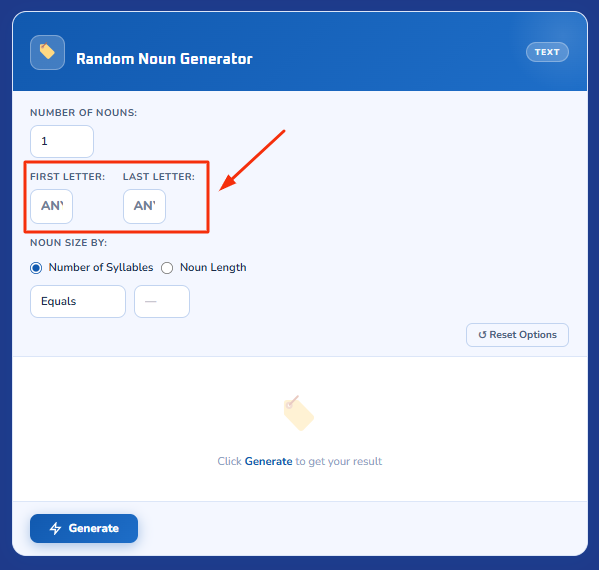
Type your desired starting letters and ending letters in the input fields to filter nouns that match your preferred pattern.
Step 2: Choose Word Size Method
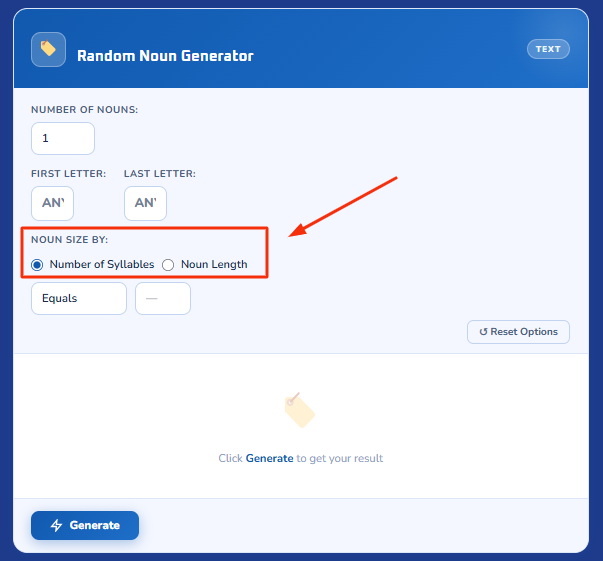
Select how you want to measure word size using the radio buttons — either by Number of Syllables or Word Length.
Step 3: Set Your Filter Condition
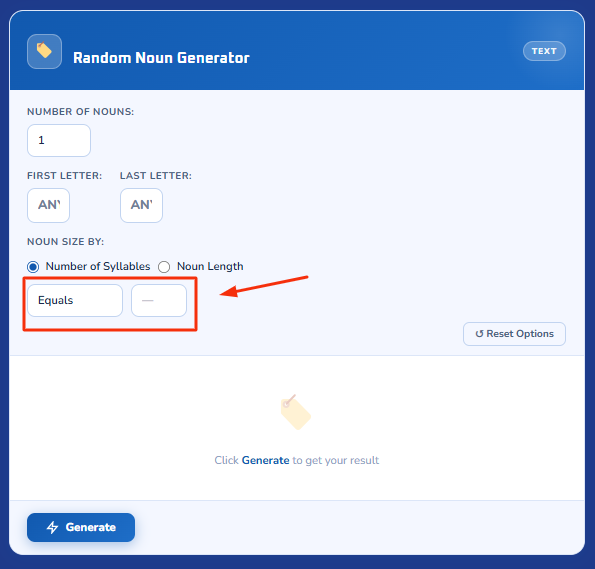
Use the dropdown to define your condition — choose equals (default), less than, or greater than to control the size of the nouns returned.
Step 4: Input Your Preferred Number
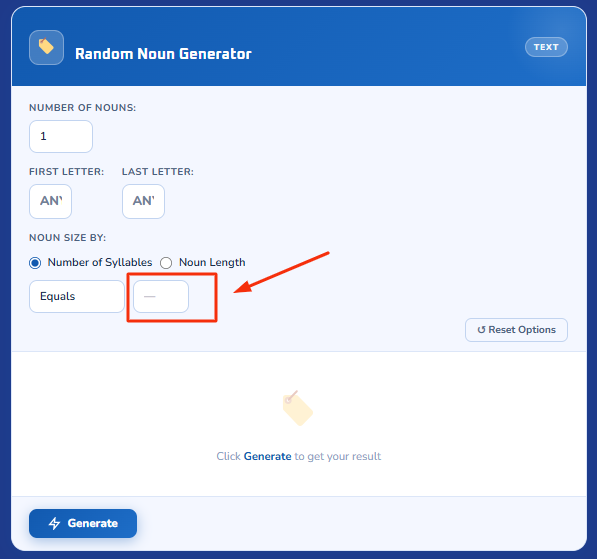
Use the up and down arrows in the number field to set the exact value that matches your chosen filter condition
Step 5: Generate Your Random Nouns
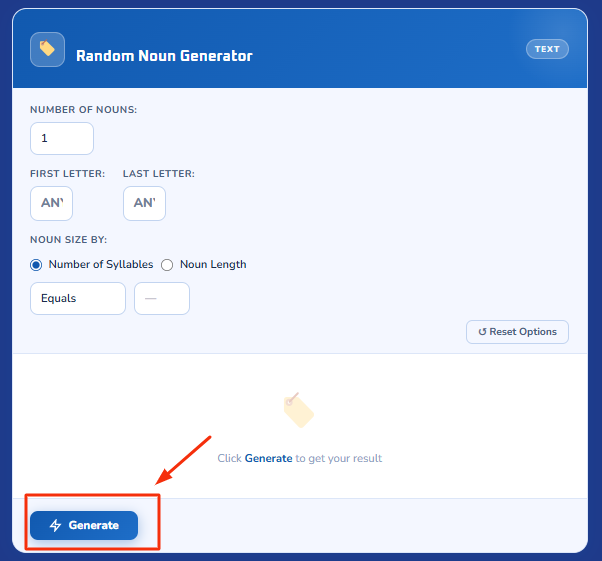
Hit the Generate button and a fresh random noun list will instantly appear on your screen.
Step 6: Reset and Start Over
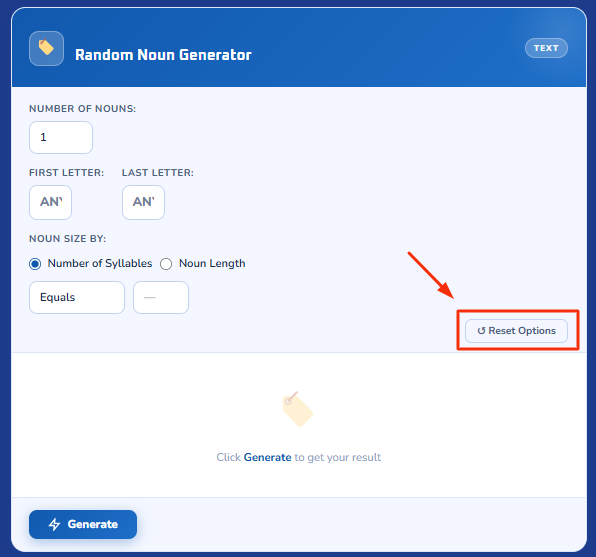
Not satisfied with the results? Click the Reset button to clear all filters and generate a completely new list from scratch.
What Is a Noun?
Among all parts of speech, a noun is a word that acts as a name or label for a person, place, thing, idea, action, or quality. Whether it is common or proper, concrete or abstract, nouns are the building blocks of sentences — without them, no clause truly makes sense. Take dog, London, chair, or love — each is a specific word that can be identified instantly.
How Nouns Function in Sentences
Nouns occur as subjects, objects, or complements, working alongside a verb to give sentences their main meaning. They name people, things, ideas, actions, and qualities, making them the most one-of-a-kind parts that functions across every sentence structure. Common nouns refer to general objects, while proper nouns point to specific names. Abstract nouns capture ideas and qualities, whereas concrete nouns represent physical things — together, these words complements every other element of speech.
Classification of Nouns
Proper Nouns
- Unique, specific entity names that are always capitalized
- Examples: Germany, January, Nebraska, White House
Common Nouns
- General category labels referring to any thing or concept
- Examples: country, month, university
Countable Nouns
- Any noun you can make plural and put on a list
- Examples: bike, dog, car, item, object, word
Collective Nouns
- A single word representing an entire group, assembly, or cluster
- Examples: gaggle, bevy, team, faculty, batch, bunch, series, unit, collection, set
Concrete Nouns
- Real, physical, tangible things you can touch, smell, taste, or see with sight
- Examples: animal, flower, computer, car, object, world
Abstract Nouns
- Theoretical, intangible concepts existing only as a thought or sense
- Examples: freedom, love, brightness, theory, idea, emotion, feeling, quality, state, condition, belief, value
Pronouns
- A substitute or replacement used to refer to any noun or entity
- Examples: he, she, it, they, we, you, I, them, their
Top Uses for a Random Noun Generator
A random noun generator serves different people in different ways. Here are the most practical and common use cases.
Writers and Storytellers
Writers use a random noun generator to break creative blocks. When a story stalls, a single unexpected noun — like labyrinth or remnant — can unlock a new scene, character name, or plot direction. It works as an instant writing prompt without the need for a full sentence.
Students and Teachers
Students use random nouns to build vocabulary, practice sentence construction, and prepare for spelling exercises. Teachers use them to create quick classroom activities — from grammar drills to creative writing warm-ups. Generating a list of random nouns takes seconds and removes the prep work entirely.
Marketers and Brand Builders
Marketers use random noun generators during the early stages of naming — whether for a product, a campaign, or a domain. A random noun can spark a brand name concept that feels fresh and unforced. Combining two random nouns is also a popular method for generating startup name ideas.
Game Players
Random nouns are a core component of games like Pictionary, MadLibs, and word association challenges. Instead of reusing the same word lists, a generator keeps every round unpredictable and fair.
Content Creators
Bloggers and content teams use random nouns to brainstorm topic angles, social media hooks, and headline ideas — especially when ideating at scale.
Fun Activities & Challenges With Random Nouns
Random nouns create structured creative constraints. Constraints improve output quality in writing, learning, and group activities.
The 3-Noun Story Challenge
The 3-noun story challenge requires a writer to generate three random nouns and build one coherent story around all three. The activity develops narrative flexibility by forcing unexpected word combinations into a single context. Solo writers, classroom groups, and writing circles use it to reduce blank-page paralysis.
Random Noun Writing Prompts
A random noun paired with a random verb produces a two-word writing prompt. The prompt defines a subject and an action without prescribing a plot. Writers who generate one prompt daily build a consistent creative writing habit over time.
Classroom Vocabulary Games
A teacher generates 10 random nouns and assigns one task per word — definition, spelling, or sentence construction. Unpredicted word lists prevent memorization and measure active vocabulary rather than prepared recall. The method applies directly to spelling bee preparation and vocabulary assessment.
Pictionary and Charades
A random noun generator replaces static printed word cards in drawing and acting games. Generated words eliminate repetition across rounds and remove the possibility of list memorization by any player.
Brand Name Brainstorm
Two random nouns combine to produce an abstract brand name candidate. Marketing teams evaluate each combination for phonetics, meaning, and market relevance. The method is used in naming workshops to generate high-volume brand name options quickly.
Random Noun Generator vs Random Word Generator
A random noun generator and a random word generator are two distinct tools with different outputs, use cases, and target users. While both generate words automatically, they differ in the type of words they produce and the tasks they support.
Output Type
A random noun generator produces only nouns: people, places, things, and ideas. A random word generator produces words from all parts of speech: nouns, verbs, adjectives, and adverbs combined. The output type determines which tasks each tool serves.
Primary Use Cases
A random noun generator serves tasks that require naming: story characters, brand concepts, vocabulary exercises, and game prompts. A random word generator serves tasks that require full linguistic variety: sentence construction, creative writing warm-ups, and mixed grammar practice.
Target Users
Students learning noun identification use a noun-specific generator to practice a single grammatical category in isolation. Writers building a full sentence structure use a word generator to access multiple parts of speech simultaneously.
Precision vs Variety
A random noun generator delivers precision: every result belongs to one grammatical category. A random word generator delivers variety: results span multiple categories without filtering. Precision reduces irrelevant output, while variety increases combinatorial possibilities for creative or linguistic tasks.
When to Use Each Tool
Use a random noun generator when the task requires a subject, an object, or a name. Use a random word generator when the task requires a complete phrase, a mixed word list, or cross-category inspiration.