Random Adjective Generator
The random adjective generator on this page pulls from over 1,000 curated English adjectives covering descriptive, possessive, demonstrative, quantitative, interrogative, proper, and compound types — so every result you generate is grammatically categorized and ready to use. It is designed for creative writers breaking through descriptive ruts, ESL learners expanding vocabulary, teachers building word exercises, and anyone playing word games who needs a random describing word instantly. Type a number, click generate, and your adjectives appear, no account, no cost, no friction.
Random Adjective Generator
TextClick Generate to get your result
Explore our other tools: Random Noun Generator | Random Verb Generator | Random Word Generator
How to Use Random Adjective Generator
Using this tool takes less than ten seconds. Every setting is optional — if you only need a quick adjective, hit generate immediately and the result appears. If you need something specific, the filters below let you narrow results by letter, length, or syllable count before generating.
Step 1 — Set How Many Adjectives to Generate
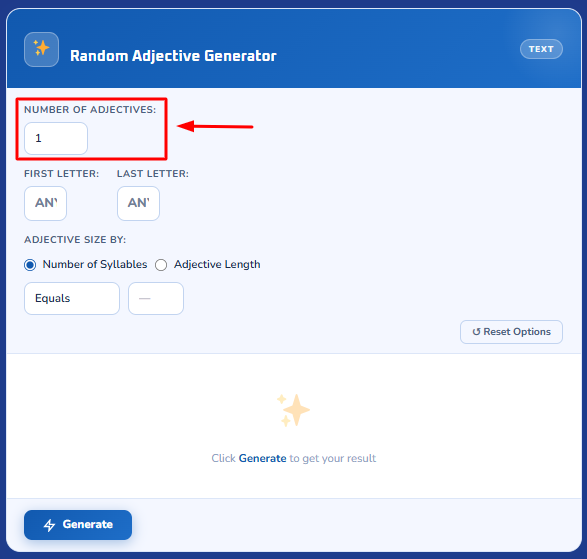
The number field at the top controls your output volume. It defaults to one adjective, which is ideal when you need a single precise describing word. Use the up and down arrows to increase the count — set it to five when you want options to compare, ten when building a vocabulary list, or twenty when creating a classroom exercise or word game. There is no cap that limits meaningful use, so scale the output to match your actual need rather than generating one adjective at a time repeatedly.
Step 2 — Apply Filters to Control Your Results
Four filter controls let you define exactly what kind of adjective the generator produces.
The first letter field restricts results to adjectives that begin with a specific letter. This is useful when writing alliterative phrases, completing a word exercise that requires a particular starting letter, or generating adjectives that fit alphabetically into a list.
The last letter field works the same way at the opposite end of the word. Combine first and last letter filters together to generate adjectives that start and end with letters of your choosing — a narrow constraint that is especially useful for structured poetry, wordplay, and creative naming exercises.
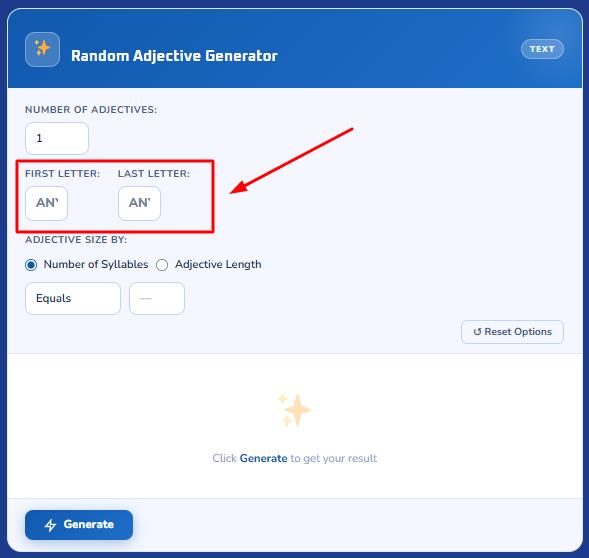
The word size controls give you precision over how long or phonetically complex your adjective is. Select number of syllables when rhythm matters, for example, a two-syllable adjective fits a poetic line differently than a four-syllable one. Select word length when character count is the constraint, such as fitting an adjective into a fixed-width label, a social media character limit, or a crossword-style puzzle. Once you choose which measurement to use, set the condition using the dropdown, equals generates adjectives of exactly that size, less than generates shorter results, and greater than generates longer ones. Enter your target number in the input field using the arrows.
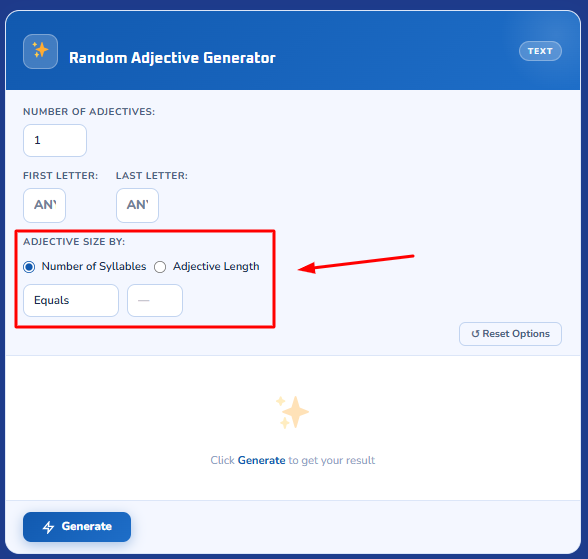
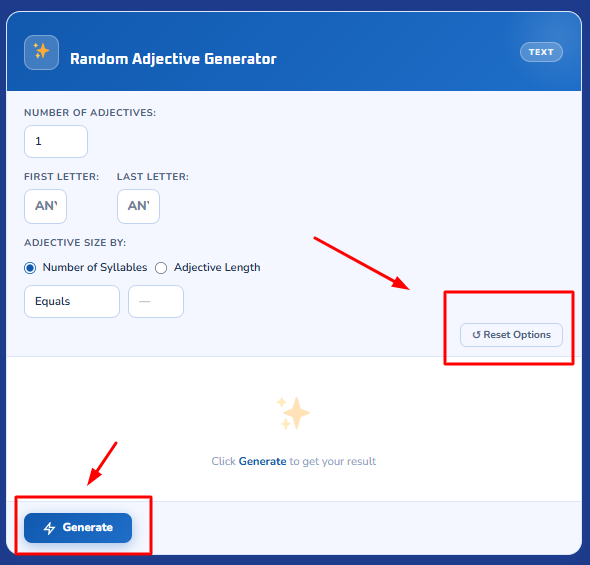
Use the reset button at any time to clear all active filters and return every setting to its default state. This is the fastest way to start a new search without manually clearing each field.
Step 3 — Generate, Copy, and Regenerate
Click the generate button and your adjectives appear instantly. Copy any result directly into your document, caption, exercise, or game. If the output does not match what you had in mind, click generate again — the tool pulls from a pool of over 1,000 English adjectives across descriptive, quantitative, demonstrative, possessive, and compound types, so repeated generations produce genuinely different results without cycling through the same words. You do not need to reload the page or adjust any setting between attempts.
Step 4 — Put the Adjective to Work Immediately
Generating a random adjective is most effective when you test it in context the moment it appears. Take the result and drop it into a sentence around the noun you are describing. For example, if the generator returns translucent, the immediate test is: “The translucent curtain filtered the afternoon light into soft patterns across the floor.” If the word fits the tone and image you are building, use it. If it does not, regenerate — the next result will come from a completely different semantic category, which often sparks a better direction than simply editing the original word. This generate-test-regenerate loop is the fastest way to move past descriptive blocks in writing without losing momentum.
What is an Adjective ?
An adjective is a part of speech that modifies or describes a noun or pronoun. It is the word that brings someone or something to life in a sentence. From my experience working with language tools, I have seen how often people underestimate the role adjectives play. They do not just decorate speech; they carry information about quality, quantity, number, and identity. They answer the core questions we ask about the world, what kind, which one, and how many, and without them, language feels flat and incomplete. A random adjective generator is built on this very idea: that every noun and pronoun deserves a word that provides detail and specifying characteristics about it.
What makes adjectives so powerful is where and how they appear in a sentence. In the attributive position, an adjective comes directly before the noun it describes. Think of three old houses, a tall and skinny boy, or an enormous yellow sun. In the predicative position, it comes after a linking verb, like saying Jane is smarter than her brother, or that one idea feels silly but fun. Adjectives can work independently or in comparison, and they set limits on nouns and pronouns by specifying exact qualities. Whether the word is beautiful, doglike, fast, random, or as unexpected as this, an adjective generator, especially a random adjective generator, gives you many such examples in seconds, making it a surprisingly fun tool for anyone who loves words.
Nouns, Adjectives, and Adverbs: What Actually Sets Them Apart?
When I first started working with language tools, the core distinction between nouns, adjectives, and adverbs confused me more than I expected. A noun represents a person, place, or thing and answers what or who like teacher, desk, bravery, or London. An adjective comes before a noun or pronoun and describes its quality or quantity, telling you which one or what kind like calling a house beautiful. An adverb modifies verbs, other adjectives, or fellow adverbs, describing actions in terms of how, when, or where and it often ends in ly, like when she sings beautifully.
These distinct functions are not interchangeable. Loud describes the dog as an adjective, but loudly describes how the dog barked as an adverb and that one shift changes the entire function. A good random adjective generator respects this boundary. Here is a quick comparison table:
| Part of Speech | Function | Answers Question | Example |
|---|---|---|---|
| Noun | Names a thing | What / Who? | The dog barked |
| Adjective | Describes a noun | Which one / What kind? | The loud dog barked |
| Adverb | Modifies a verb / adj | How / When / Where? | The dog barked loudly |
Where Adjectives Sit in a Sentence ?
In English, adjectives appear in two main positions within a sentence, and each position has its own structure, role, and way of modifying a noun or pronoun.
Attributive Position :
The attributive position places the adjective directly before the noun or pronoun it needs to modify, forming part of a noun phrase without any linking verb in between. The adjective acts as a modifier that modifies the noun directly, making it a natural feature of the noun phrase itself.
Examples:
- Three happy kids
- A beautiful smile
- A fast red car
Predicative Position
The predicative position places the adjective after a linking verb such as be, seem, become, feel, or taste. Here, the adjective follows the verb and acts as a subject complement, meaning it describes the subject of the clause rather than sitting inside the noun phrase. The adjective is always separated from the noun it modifies by a verb, forming part of the predicate instead.
Examples:
- The souptastesgreat
- The lionishungry
- The kidsfeltexcited
Key Differences
Key differences between attributive and predicative positions come down to where the adjective is placed in the sentence and what role it plays — whether it modifies directly or acts as a complement to the subject through a linking verb.
Why Adjectives Matter in Written and Spoken Communication
A random adjective generator gives you a variety of precise words instantly, which is useful when writing vivid, emotionally engaging content in English. Adjectives appear in 2 main positions: attributive sits before a noun and predicative comes after, usually separated by a linking verb. Both are crucial for written and spoken communication because they transform basic, functional statements by modifying nouns and pronouns with necessary details about quality, quantity, size, and appearance, giving precision, clarity, and helping reduce ambiguity for the audience.
How Adjectives Shape Mental Images and Emotion
- Precision and Clarity: Specifying the right adjective helps reduce ambiguity and gives the audience a clear mental picture of what is being discussed, like saying blue book instead of just book.
- Creating Imagery: The show, not tell approach used by great writers and speakers relies on strong imagery. A sprawling, ancient, haunted house builds a far more powerful mental picture than just a house.
- Evoking Emotion and Setting Tone: Words like magical, radiant, or appalling trigger specific emotional responses, conveying feelings, evoking emotion, and shaping the overall mood and tone for better persuasion and engagement.
- Enhancing Description with Sensory Details: Sensory details appeal to all five senses: sight, sound, taste, smell, and touch, making narratives feel immersive and tangible.
- Differentiating Subjects: Adjectives help people distinguish between similar items and add character and depth to descriptions, for example a grumpy cat versus a happy cat.
- Effective Communication in Professional Contexts: In professional, IELTS, and testing contexts, conveying feelings with depth through strong descriptions reflects true language proficiency and effective communication that is both persuasive and full of character and imagery.
Types of Adjectives
1- Descriptive Adjectives
The most common type you’ll run into are descriptive adjectives, the backbone of English writing. They describe the characteristics, traits, and qualities of a noun or pronoun, sitting in 2 key positions in a sentence. When placed before a noun, they work in the attributive position, like a friendly person or a purple wall. When they come after a linking verb, they shift into the predicative position, think she looks attractive. The main thing I’ve noticed while working with adjective tools is that descriptive words are what people reach for most and they are usually separated from the noun only when sentence structure demands it.
Examples
- The purple flowers in the garden looked stunning.
- She was friendly to everyone she met.
- The garden flowers looked attractive after the rain.
2- Demonstrative Adjectives
Demonstrative adjectives are commonly used to express relative positions in space and time. Words like this, that, these, and those do exactly that and they point to something specific without needing extra explanation. I find these particularly powerful in writing because they create an instant connection between the reader and what’s being described, whether it’s something close or far away in space or time.
Examples
- This book on the table is mine.
- That building across the street is very old.
- These days are getting shorter every week.
- Those memories from last summer were beautiful.
3- Possessive Adjectives
Possessive adjectives express possession and ownership, and they are some of the most naturally used words in daily conversation. My, your, its, her, his, our, their, and whose all fall into this category. Think about how often we say things like “my favorite food is pizza” or recall how our team celebrated its victory at the Olympics, even the memory of spending a day with your parents carries a possessive adjective without you even noticing.
Examples
- My favorite food is pizza.
- She spent the day with her parents.
- Their team celebrated its victory at the Olympics.
4- Interrogative Adjectives
Interrogative adjectives are used to ask questions, specifically what, which, and whose. They modify a noun directly within the question itself. These small words carry a lot of weight in how we form questions and turn an ordinary sentence into something that demands an answer.
Examples
- What color do you want to paint the wall?
- Which button turns off the lights in this room?
- Whose turn is it to wash the cat tonight?
5- Proper Adjectives
Proper adjectives are formed from proper nouns and are related to a specific person or place. African rhythms, Napoleonic strategy, Shakespearian drama, these words carry the identity of their origin right inside them. I remember when I studied Victorian England in school and reading a Russian newspaper or tasting Haitian food that is genuinely tasty brings that history alive in a way no textbook quite manages.
Examples
- He was reading a Russian newspaper this morning.
- I think Haitian food is incredibly tasty.
- We studied the history of Victorian England in school today.
6- Compound Adjectives
Compound adjectives are formed from multiple words, usually connected by hyphens. They give you precision that single words simply can’t match. I once dealt with a double-dealing salesman on a family trip to Disneyland with my happy-go-lucky daughter, and the better-off members of the city living by the river didn’t seem to have enough patience for the rest of us. A never-ending workload, a cross-eyed look, a run-of-the-mill idea, these paint a far clearer picture than any single word could.
Examples
- The better-off members of the city live by the river.
- She had enough of the double-dealing salesman.
- My happy-go-lucky daughter loved our trip to Disneyland.
The Royal Order of Adjectives – Why Word Order Matters ?
A random adjective generator helps you find the right adjectives in English fast. But knowing where these adjectives sit in a sentence matters just as much as picking them. Adjectives take 2 main positions: attributive position places them before a noun, and predicative position places them after a linking verb. Native speakers follow this intuitively, keeping sentences in a natural flow. Breaking this word order creates confusion for the reader and listener, forcing them to rethink what they read and killing clarity and understanding.
How Adjectives Stay in Proper Order
Adjectives follow the royal order of adjectives, a proper order that keeps nouns correctly describes and sentences clean when using more than one adjective.
Determiner First Articles, possessives, and demonstratives like the, your, our, and these always open the stack and modify the noun before anything else.
Quantity and Opinion Quantity words like one, seven, many, and few come next. Then opinion splits into general opinion such as popular, valuable, and heroic, followed by specific opinion like perfect, delicious, and misunderstood. A personal opinion that is widely held, for example calling a tablet the best choice for digital illustrators, still belongs in the opinion slot.
Size, Age, Shape and Color Size covers huge, tiny, medium-sized, and small. Age includes new, old, decades-old, and second-newest. Shape brings in square, round, triangular, and geometric. Color covers blue, gray, yellow, and red.
Origin, Material and Qualifier Origin and material adjectives like American, African, wooden, and velvet come next. The qualifier closes the chain with tight descriptors like hound dog, denim skirt, pickup truck, and vampire bat.moment you are describing. The verb opens the door. The tense decides what kind of room the reader walks into.
Why Order Changes Everything ?
An incorrect order does not just sound unnatural, it shifts meaning entirely. A red ornamental vase puts classification and ornamental type front and center. Flip it and the emphasis moves to color. Green big dragons sounds like a specific new category of dragon, while big green dragons correctly describes size and color the way native speakers expect. This is what preventing ambiguity looks like, and it is exactly why emphasis changes when adjectives are separated from their proper order. Realizing this makes a random adjective generator a real writing tool, not just a word picker.
Degrees of Adjectives : Positive, Comparative & Superlative
Learning the Degrees of Adjectives
A random adjective generator is a great way to explore how adjectives work across different positions in a sentence. In English, adjectives appear in attributive position before a noun or in a predicative position after a linking verb. Understanding adjective forms and adjective evolution is fundamental to building vocabulary and improving English writing and English speaking skills. A simple word like fast grows into faster and fastest, and each form serves a different purpose in comparison and context. These grammar rules and comparison rules are the main building blocks every student needs, whether working on a degrees of adjectives worksheet or exploring the linguistic roots of word forms. Mastering the degrees helps you provide context, rank ideas clearly, and drive real writing improvement and speaking improvement.
Degrees of Adjectives in Everyday Life
The three distinct levels of adjective degrees are your go-to tool for comparing objects, people, and experiences in everyday life. Degrees of adjectives exercises build a strong foundation and help students internalize specific rules so they can navigate English assignments accurately. A good guide to these levels makes use more natural over time.
1- The Positive Degree
The positive degree is the simplest form and the base form of the regular adjective itself, used with a single noun and with no comparison. It simply describes a person, place, or thing, such as a brave soldier, a tall building, or a beautiful flower. A useful grammar tip for this usage is the as…as structure, which shows equality, for example, he is as smart as his brother.
2- The Comparative Degree
The comparative degree is used to compare two nouns and show a higher degree or lower degree of quality. The formation rule is simple: add -er to short adjectives or use more before long adjectives, followed by the connector word than. For examples, Rahul is braver than his friend, or this building is taller than that one. This is how comparing two items works in practice.
3- The Superlative Degree
The superlative degree represents the highest level of quality and follows the article rule that the must always come before superlative forms. Add -est or -iest to one-syllable adjectives and two-syllable adjectives ending in y, ow, or le, and use the word most when prefacing three-syllable adjectives. For example, the bravest person in the room or the tallest skyscraper in the city.
10 Ways to Use a Random Adjective Generator
A random adjective generator is not just a novelty tool. Each use case below solves a specific problem that writers, educators, designers, and developers run into regularly — and the tool handles it faster than any alternative.
1- Overcome Descriptive Blocks in Creative Writing
Every writer eventually reaches for the same ten adjectives dark, small, bright, cold, soft and the writing flattens. The problem is not a lack of vocabulary, it is a lack of prompting. Generating five random adjectives mid-session forces your brain to evaluate words it would never have retrieved on its own, and that evaluation process is what breaks the block. Drop the generated adjective next to your noun, test whether it works, and if it does not, the friction of rejecting it usually surfaces the word you actually needed.
2- Play MadLibs and Word Games
MadLibs and adjective-based party games stall when players reach for predictable words like “big” or “funny.” A random adjective generator removes the pause entirely players generate a word on the spot, and because the result is genuinely unexpected, the game stays funnier and more unpredictable for longer. Set the count to match how many blanks need filling, generate, and play without anyone defaulting to safe choices.
3- Build ESL and EFL Vocabulary Exercises
Teaching adjectives from a fixed worksheet gives students the same word set every class. Generating a fresh batch each lesson exposes students to adjectives across different categories descriptive, quantitative, possessive, compound without repeating the same examples. Use the syllable filter to control difficulty: one-syllable adjectives for beginner sessions, three-syllable adjectives for advanced classes. Students can also practice adjective order by receiving five random adjectives and arranging them correctly before a noun.
4- Name Products, Characters, and Brands
Strong product names and fictional character names often carry an adjective that does most of the descriptive work Invisible Shield, Mighty Mite, Hollow Knight. When naming stalls during a brainstorm, generating twenty adjectives in one click gives you a pool of candidates to pair with your noun. Filter by first letter if your brand name needs to start with a specific character, or filter by length if the name needs to fit a short format. The unexpected result is frequently more memorable than anything produced by deliberate effort.
5- Generate Poetry and Songwriting Prompts
Forced constraints produce better creative output than open prompts this is a well-documented effect in creative writing. Generating a random adjective and committing to using it in the next line of a poem or lyric forces a direction that would not have emerged naturally. Use the syllable filter to match the adjective’s rhythm to your existing meter: a three-syllable adjective like luminescent fits an iambic line differently than a one-syllable word like stark, and choosing deliberately between them is what separates controlled craft from accidental writing.
6- Write Stronger Social Media Captions
Captions written under time pressure default to the same descriptive words amazing, beautiful, incredible which audiences scroll past without reading. A single generated adjective that is slightly unexpected (austere, honeyed, oblique) makes a caption pause-worthy because it creates a small moment of cognitive friction that holds attention for one extra second. Generate three adjectives, pick the one that fits the image or topic, and build the caption around it rather than bolting it on at the end.
7- Expand Your Personal Vocabulary
Reading is the most commonly recommended vocabulary-building method, but it is passive you encounter words in context and may or may not retain them. Generating a random adjective and immediately writing one original sentence using it is active retention. The act of constructing context around a new word embeds it faster than reading it does. Run a daily practice of generating five adjectives you do not immediately recognize, writing a sentence for each, and your working vocabulary expands in a measurable, deliberate way rather than incidentally.
8- Describe Concepts in Design Briefs
Design briefs fail when the creative direction is vague modern, clean, and professional tell a designer nothing distinctive. Before writing a brief, generate fifteen to twenty adjectives and identify the three or four that genuinely match the feeling you want the design to produce. Words like clinical, weathered, kinetic, or subdued communicate a visual direction far more precisely than conventional brief language. Use the tone-adjacent results as a shared vocabulary between client and designer, reducing revision rounds caused by misaligned expectations.
9- Create Variable and Class Names in Code
Descriptive variable names are better code, but naming is one of the most time-consuming micro-decisions in a development session. When you need a named constant, a test variable, or a placeholder class that communicates its purpose without conflicting with reserved words, generating a random adjective gives you an immediate candidate. Filter by length to match your naming convention short adjectives for terse variable names, longer ones for descriptive class identifiers. This is faster than browsing a thesaurus and keeps you in the code editor rather than a browser tab.
10- Run a Constrained Writing Challenge
Generate five random adjectives, set a ten-minute timer, and write one paragraph that uses all five in their correct grammatical position. The constraint is the point being forced to use gaunt, phosphorescent, reluctant, hollow, and serrated in a single coherent paragraph builds descriptive range faster than any open-ended writing prompt. This works as a solo daily practice, a classroom warm-up, or a timed group competition where everyone uses the same five generated adjectives and compares results. Use the regenerate function at the end to get five new adjectives for the next round without resetting manually.
Common Adjectives Mistakes
Most adjective errors are not random they follow predictable patterns that appear repeatedly in both native and non-native English writing. Each mistake below weakens the clarity and credibility of your writing in a specific, fixable way.
1- Stacking Too Many Adjectives Before a Noun
Placing three or more adjectives before a single noun creates a phrase that is technically grammatical but practically unreadable. “A beautiful, large, ancient, rectangular, brown, Italian, wooden dining table” exhausts the reader before they reach the noun being described. The mistake is treating every attribute as equally important when most adjectives in a stack are doing redundant work.
The fix:
Limit pre-noun adjectives to two. Move any additional description into a separate clause after the noun “a large Italian dining table, ancient and rectangular, with a dark wooden finish” where each detail gets its own breathing room and the sentence stays readable.
2- Confusing Adjectives with Adverbs
This is one of the most common grammar errors in everyday writing and speech. The classic example is “I feel badly” which is grammatically wrong because feel here is a linking verb, and linking verbs take adjectives, not adverbs. The correct form is “I feel bad.” The same error appears in “the soup smells wonderfully” instead of “the soup smells wonderful” and “she looked beautifully” instead of “she looked beautiful.”
The fix:
After a linking verb be, feel, seem, appear, look, smell, taste, sound, become always use an adjective, not an adverb. The adjective describes the subject, not the verb. If the verb describes an action rather than a state, the adverb is correct: “she looked carefully at the map” uses carefully correctly because looked is an action verb here, not a linking verb.
3- Getting Adjective Order Wrong
English has a fixed order for adjective sequences that native speakers follow instinctively but rarely consciously: Opinion → Size → Age → Shape → Color → Origin → Material → Purpose. Violating this order produces phrases that sound immediately wrong even if the reader cannot identify why. “A wooden lovely old small box” lands as unnatural. “A lovely small old wooden box” follows the correct order and sounds natural without the reader noticing the structure at all.
The fix:
Before placing multiple adjectives before a noun, run them through the order above. Opinion adjectives (lovely, horrible, perfect) always come first. Material adjectives (wooden, metallic, silken) always come second to last. Purpose adjectives (sleeping bag, dining table) always come last. Use the random adjective generator to practice generate three adjectives, pick a noun, and arrange them in the correct order before using them together.
4- Using Double Comparatives
Double comparatives place more in front of an adjective that already carries its own comparative form. “More faster,” “more better,” “more taller,” and “more smarter” are all double comparatives each word is already a comparative form (faster, better, taller, smarter) and adding more in front creates a redundant intensifier that signals poor grammar immediately.
The fix:
One-syllable adjectives and most two-syllable adjectives form their comparative by adding -er use that form alone, without more. Multi-syllable adjectives that do not take -er use more on its own more intelligent, not intelligenter. The rule is simple: never combine more with an -er ending. Choose one or the other based on the adjective’s syllable count.
5- Misusing Absolute Adjectives
Absolute adjectives describe a state that cannot logically exist in degrees unique, perfect, infinite, impossible, dead, empty, complete. These words already represent an extreme, which means they cannot be modified by intensifiers like very, more, most, quite, or rather. Phrases like “very unique,” “most perfect,” “more impossible,” and “quite empty” are logically contradictory something is either unique or it is not, either perfect or it is not.
The fix:
Use absolute adjectives without intensifiers. If you want to add emphasis, reframe the sentence rather than modifying the adjective. Instead of “this is very unique,” write “there is nothing else like this” or “this stands entirely on its own.” Instead of “the room was quite empty,” write “the room had nothing in it.” The meaning intensifies because the sentence earns its emphasis rather than borrowing it from an adverb.
6- Using Vague Adjectives That Add No Information
Adjectives like nice, good, bad, big, small, interesting, and amazing appear so frequently that they carry almost no descriptive weight anymore. Calling a meal “really nice,” a film “very interesting,” or a problem “quite bad” tells the reader nothing specific about the meal, film, or problem that they could not have assumed already. These adjectives are placeholders they signal that description is coming without actually delivering it.
The fix:
Replace vague adjectives with specific ones that carry genuine descriptive information. “Nice” becomes “warm,” “generous,” “unhurried,” or “quietly satisfying” depending on what you actually mean. “Interesting” becomes “unsettling,” “counterintuitive,” “sharply observed,” or “structurally unusual.” When you cannot immediately identify a specific adjective, use the random adjective generator to surface candidates the constraint of evaluating an unexpected word forces you to articulate exactly what you are trying to describe, which is where the right adjective comes from.