Random Fake Word Generator
A random fake word generator helps you instantly create unique, pronounceable words that don’t exist yet but sound real. Whether you’re a writer building fictional worlds, a teacher designing phonics exercises, or a brand creator searching for a distinctive name, this tool gives you endless creative possibilities. You don’t need to search anywhere else, the generator is right here on this page, ready to use immediately. It produces a mix of fake words, made-up words, and invented words that feel natural and usable across different contexts. Instead of struggling to think of something new, you can generate fresh word ideas in seconds and use them however you need.
Fake / Nonsense Words
TextClick Generate to get your result
What Is a Fake Word?
A fake word is any made up term that does not exist in any recognized language — it carries no definition, no meaning, yet can be pronounced like a real word. What makes pseudo words so strange is that they appear legitimate, which leads people to second-guess themselves. A group can collectively use a term they don’t know just to display intelligence when their knowledge fails them, and this is one of the more common human behaviors around language.
A fake word generator or nonsense word tool exists for legitimate reasons. The world of linguistics and creative writing constantly needs to generate random pseudo words, and a free tool helps you find them instantly. Whether you are one of a number of educators, developers, or writers, the list of ways this tool stays useful keeps growing. It initially seems like an odd question to replace real language with something fabricated, but the reasons speak for themselves.
Fake Word, Pseudo Word, or Nonsense Word — Are They Really That Different?
1- Pseudo Words and Spelling Rules
People use these terms interchangeably, but they are not the same. A typical pseudoword like “blorp” or “sark” is a made-up, non-dictionary word that still follows standard spelling rules and language spelling rules — it looks and sounds like it could be real. A pseudo word is essentially an imitation of real English words, built from legal phonological patterns, which means a child can actually blend its sounds together and follow the rules of phonics to read it.
2- Fake Words and Decoding Skills
That is the whole point — these invented words force students to rely on decoding skills rather than relying on visual memory or sight-word recognition. A nonsense word, on the other hand, is a broader term — any string of letters that is a non-real word, and it does not always have to follow spelling rules. Something like “qxzj” is pure nonsense but would not qualify as a pseudoword since it carries zero phonological structure. Then there are fake words — a synonym for both, used loosely across educational contexts.
3- Nonsense Words in Early Literacy Assessments
Where it gets interesting is in how these words are used in early literacy. I have seen children in literacy assessments completely freeze on pseudowords like “nep” — not because they lack ability, but because their brain wants to check against memorizing words they already know. That is exactly what these tests are designed to ensure does not happen. Tools like a random fake word generator primarily serve to test decoding, not word recognition. Whether you call them alien words, wug words, or just non-dictionary invented words, their definition stays the same — a word that lacks meaning, exists outside real language, and is built to make a child sound out every single letter without relying on any visual shortcut or prior sight-word knowledge. The synonyms may vary, the primary goal does not.
Famous fake words in history
Many fake words, made-up words, and invented words have become surprisingly famous over time. Some were created for fun, while others came from literature, science, or branding but later became part of everyday language.
For example, “robot” was once a completely invented word introduced by Czech writer Karel Čapek in his 1920 play. Another well-known fake word is “googol,” a mathematical term describing the number 1 followed by 100 zeros, which later inspired the name of Google. Even the word “nerd,” now widely used, was originally a playful creation popularized by Dr. Seuss. Some and common fake words :
- robot
- googol
- nerd
- quark
- kodak
- yahoo
- meme
- avatar
- cyberspace
- robotnik
- blurb
- pandemonium
- chortle
- serendipity
- gas
- utopia
- dweeb
- gonk
- muggle
- hobbit
How to Use the Random Fake Word Generator (Step-by-Step)
Using this tool takes about three seconds. There are no settings to configure, no account to create, and no limit on how many times you can generate. Here is exactly how it works.
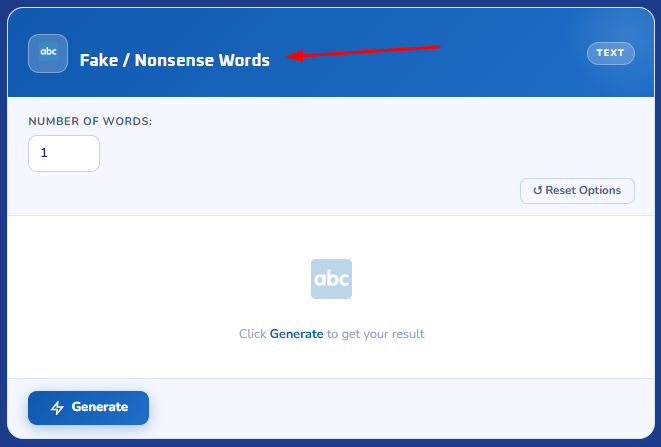
Step 1 : Find the Form
Go to the section labeled “Fake / Nonsense Words.”
Step 2 : Click the Generate button
Hit the “Generate” button to create a new fake word.
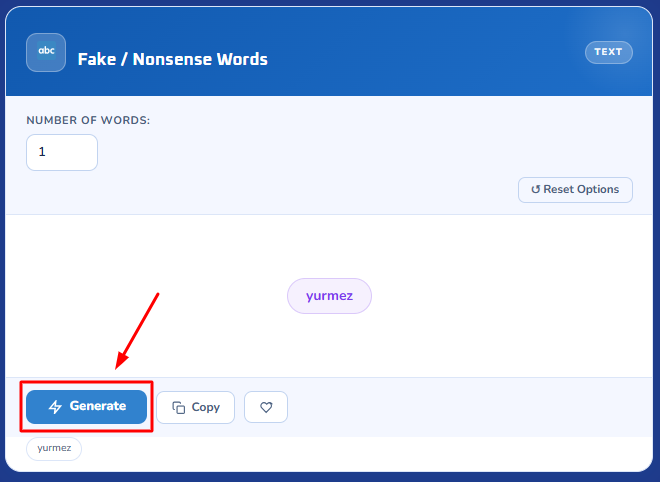
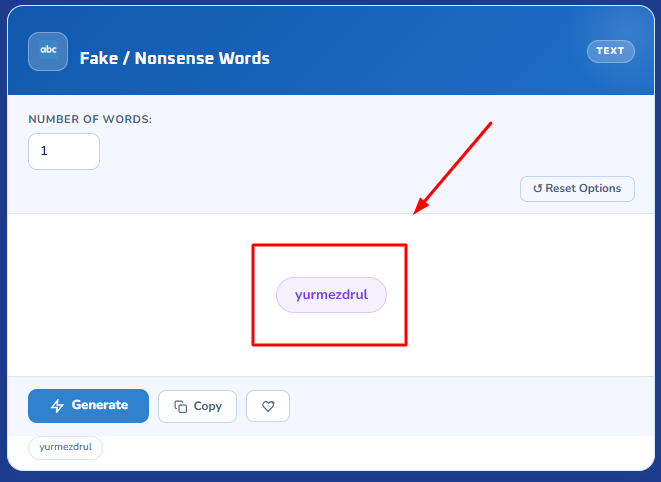
Step 3 : View the result
Instantly, you’ll get one generated word along with its meaning.
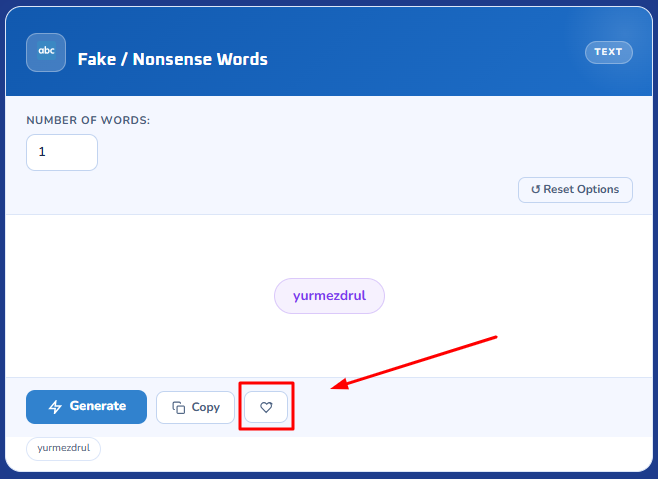
Step 4 : Save or copy the word
If you like it, click the heart button to copy or save it for later use.
7 Real Uses for a Fake Word Generator (With Examples)
A fake word generator is a surprisingly versatile tool that goes far beyond novelty. Whether you’re deep in brainstorming sessions, protecting privacy, or building entire worlds from scratch, this tool quietly does heavy lifting across creative projects, language education, software data inputs, and more. I’ve personally used it mid-project when everything felt stuck, and it never fails to unlock something useful.
1. Brand Naming With Invented Names
Some of the most iconic companies built their identity on invented names. Kodak was engineered around the letter K for its sharp sound. Xerox was deliberately constructed to feel technical. Häagen-Dazs was fake Danish invented by a Bronx businessman. Even Google started as a deliberate misspelling used as a trademark. The brilliance of a made-up word is zero trademark conflict, no baggage, no prior associations — just clean commercial logic. A fake word generator gives you a batch of pronounceable, punchy syllables that are easy to say and easy to spell. Generate 20–30 options, build a shortlist, read each one aloud, and test the tone — do harsh consonants suit warrior cultures, or do flowing vowels fit ancient civilizations better? A word like Trenvali works naturally for invoicing software; it sounds professional without carrying the weight of real word expectations. It’s never the final answer alone, but it’s always the best starting point for unique branding around products, services, and companies seeking brand originality.
2. Creative Writing and Worldbuilding With Exotic Names
When you’re building a fictional world and need a language — like Velthari for something ancient, Blorquix for something alien, or Sipanu for something soft, invented words are how Tolkien built his Elvish languages, and you can do the same. A fake word generator becomes a naming bank: generate 5–10 exotic names in batches for characters, fantasy towns, alien species, spells, currencies, and organizations across books, tabletop games, and D&D campaigns. Use short, hard words for weapons and monsters, and longer, flowing words for places and ancient names to give your game worlds natural texture that generic descriptive names simply can’t provide.
3. Defeating Writer’s Block With One Fake Word
A single randomly generated fake word can smash writer’s block entirely. Take one generated word, write its definition, build a paragraph around it — that invented word becomes a writing prompt that removes all blank page pressure by replacing it with a constraint that redirects your thinking. A daily warm-up of five minutes writing anything around one fake word is genuinely how good writing gets started; it keeps you moving even when a blank document feels impossible. The meaningless becomes meaningful the moment you invent a purpose for it — and there’s no wrong answer when the word itself is made up.
4. Placeholder Content Smarter Than Lorem Ipsum
Designers and developers know the pain of lorem ipsum — that tired filler text that fills website mockups and printed materials without ever feeling real. Replacing dummy text with meaningful text like Trenvali Pro, Dusphet Suite, or Crimosk Analytics makes app mockups, SaaS dashboards, e-commerce product listings, navigation menus, product names, feature names, and menu items feel like a real product during a client presentation. Stakeholders respond to plausible placeholder text rather than Latin gibberish, and the flow of the design, content, and product interface reads far more naturally — making the jump from mockup to real copy at launch feel far less dramatic.
5. Dummy Accounts and Secure Dummy Usernames for Privacy
For dummy accounts and website sign-ups, fake names and secure dummy usernames like Blorquix47 protect your real identity from tracking while being far stronger than Password1. Pseudowords built on natural phonetic patterns are easier for your brain to remember than random strings like xK92#mPq, making them excellent password components, passphrases, or even a codeword with private meaning shared within a group — essentially a lightweight code language no outsider can crack with a simple dictionary lookup. A fake word generator produces options that feel distinct, carry no prior associations, and pair cleanly with a number or symbol to meet most security requirements.
6. Language Learning and Phonics Through Fake Words
In language learning and education, literacy educators use fake words through tools like Nonsense Word Fluency (NWF) as an early literacy tool — because students must decode pure sounds without relying on memorization, they genuinely practice phonics rules, spelling practice, decoding drills, and reading warm-ups using invented words like dusphet or crimosk in classroom exercises. Working through unfamiliar combinations of letters forces learners to apply pronunciation rules rather than guess from context, which builds far stronger phonics foundations. A word list of 10–15 fake words read aloud in sequence is one of the most efficient tools a literacy educator can use to assess and sharpen early decode ability.
7. Software Testing and Data Simulation With Random Strings
For software testing and data simulation, populating databases and user interface components with diverse, strange, long data inputs and random strings, rather than the same 2–3 repeated entries, stress-tests your system realistically across 8–10 or even 30 field variations at once. A fake word generator produces inputs that are neither real word entries nor purely chaotic random strings, hitting that middle ground where your system handles soft, short values like Sipanu just as cleanly as harder 20-character long data inputs. Whether you’re simulating 5–10 user interface components or building out 47 test records for a full database run, generated pseudo words give your QA process the diverse coverage it actually needs
How Fake Words Are Generated?
Most fake word generators work like a black box. This one does not. Here is exactly how pronounceable fake words are built, and why the output consistently feels usable rather than random.
Phoneme Clusters and Syllable Rules
Every pronounceable word follows rules about which sounds can sit next to each other. In linguistics, these are called phonotactics. Our generator is built around them.
Syllables follow patterns that linguists describe using C (consonant) and V (vowel) notation. The four most common in English:
CVC, consonant, vowel, consonant. The most common English syllable structure. Example: cat, hop, and fake words like dusphet.
CCVC, two consonants, then vowel, then consonant. Creates harder sounding words. Example: plan, grip, and fake words like blorquix. Note: English allows bl, cr, tr at the start of a word, but not nb or vt. The generator knows the difference.
CVCC, consonant, vowel, two closing consonants. Creates grounded, closed sounding words. Example: melt, hand.
CVCV, alternating consonant vowel pairs. Creates soft, open sounding words. Example: solo, mama, ideal for brand names and character names.
The generator selects phoneme clusters that fit these structures. That is why every output is pronounceable. It follows the same rules your brain uses to decide whether a string of letters is readable.
Why Some Generated Words “Feel” More Real Than Others
Generate ten fake words and you will notice immediately that some feel like they could be in a dictionary, while others feel obviously invented. This is not random. It is explained by two things, morpheme mimicry and familiarity bias.
A morpheme is the smallest unit of meaning in a language, prefixes like pre and un, suffixes like tion, ment, and al. When a fake word accidentally contains a recognizable morpheme fragment, your brain assigns partial meaning to it and the word feels real.
Two examples from our generator:
blorquix, no familiar morpheme fragments. The qu cluster is unusual. The ix ending is rare. Your brain finds no foothold. Result: feels alien and clearly invented.
tremval, trem echoes tremble and tremor. val echoes rival and festival. Neither is a real morpheme, but your brain pattern matches both. Result: feels like a real word you simply cannot place.
Word length reinforces this effect. Most common English words are two to three syllables long. A generated word like velpanu sits in that range and feels plausible for that reason alone, even before your brain processes the individual sounds.
Randomness vs. Controlled Phoneme Selection
There is a clear difference between a fake word generator and a random letter generator.
A random letter generator produces strings like xqvbtmr. Technically random, but completely unusable. No one can pronounce it, remember it, or mistake it for a real word.
A fake word generator works from curated phoneme pools organized by syllable role. Opening consonants, vowels, closing consonants, and consonant clusters are each drawn from separate pools. The tool assembles them into recognized syllable structures such as CVC, CCVC, and CVCV, constrained by English phonotactic rules.
The result is controlled randomness. Every word is unique and generated on demand, but every word is also filtered through the same rules that make real English words pronounceable.
This is the same principle constructed language designers, known as conlangers, use when building fictional languages from scratch. The difference is that this tool does it in under a second, for free.
The practical upshot: when you generate a word here, you are not getting a dice roll. You are getting a word assembled to feel like it belongs in English, unfamiliar enough to be original and familiar enough to be usable.