Random Weird Word Generator
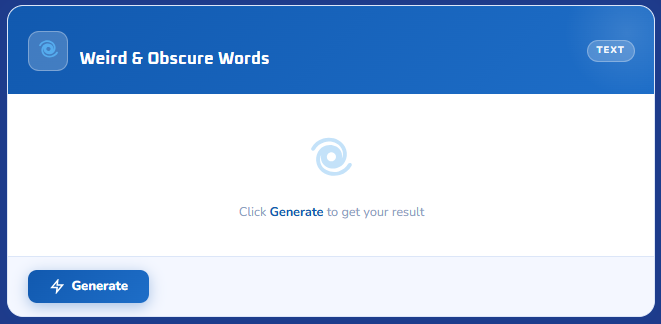
Weird & Obscure Words
TextClick Generate to get your result
what is a Random Weird Word Generator ?
A weird words generator is a fantastic online tool that helps you describe something in a more strange, unusual, or even mystical way using the English language. It treats every word as more than just a definition, adding meaning, context, and usage to improve your vocabulary and overall language skills. I have often used this kind of digital tool when I run out of words or feel caught by a lack of creativity, and it always brings a surprise. It can turn a simple idea into something eccentric, peculiar, or even archaic in sense, sometimes touching on ideas like fate and destiny.
What makes it powerful is how it can present a shower of mysterious, obscure, and uncommon terms by introducing a new type of word discovery. This generator acts as an unlimited source for mindbogglingly unique, excellent, and substantial definitions, helping you construct your thoughts more systematically and pragmatically while keeping your brain active. If you are looking to learn a new word today that you may have never heard in a normal conversation, this language tool offers hundreds of odd, funny, and entertaining choices. Each result has included means and a clear number of ways it can be used, making it perfect for idea generation, vocabulary learning, and expanding your knowledge in a fun and practical way
What makes a word “weird” — 3 qualifying criteria
Not every unusual word feels weird the same way. After spending time exploring languages and diving deep into how a random weird word generator actually works, I noticed that weird words mostly fall into a few clear buckets.
1. Strange Spellings That Violate Sound Rules
Take Borborygmus — a borrowed word that describes stomach rumbling — it hits you abruptly with its heavy consonant clusters and strange spelling-to-sound disconnect. Then there’s Colonel, pronounced nothing like it looks, or Queue, where four silent letters simply follow one working one. These spellings violate what an average speaker expects, and that lack of clear rules is exactly what makes them extremely hard to forget.
2. Archaic or Specialized Usage That Feels Unfamiliar
Even niche or archaic words like Treppenwitz — a concept meaning the wit you think of on the staircase after leaveing a conversation — carry a specialized usage that feels unfamiliar yet somehow perfect. These words were once used in common place settings but have since drifted so far from typical speaker vocabulary that even finding them in a random weird word generator seems like a small discovery.
3. Quirky Word Formation That Breaks Grammatical Norms
The third layer of weirdness lives in structural formation. Some Words break normal grammatical logic through irregular plurals, odd compounds, or quirky inventions that rarely follow standard word patterns. Absquatulate — meaning to leave abruptly — is one of those typical American Examples of blending sounds into something theatrical, resulting in expressions built from a kernel of borrowed roots across languages that simply don’t belong anywhere — and that’s precisely what makes them worth collecting.
How to Use the Weird Word Generator (Step-by-Step)
Ready to expand your vocabulary with the strangest words in the dictionary? Here is how to use the tool:
Step 1 : Find the Form
Locate the section titled “Weird & Obscure Words.”
Step 2 : Generate
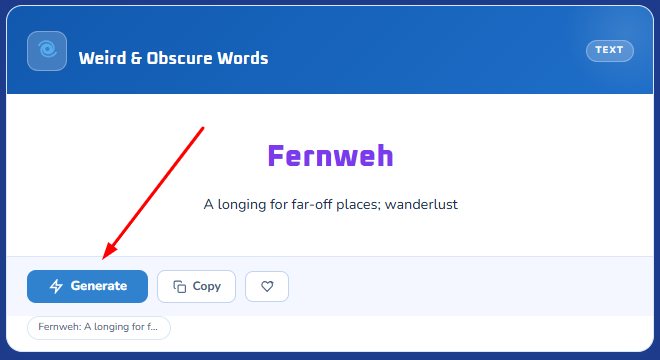
Click the “Generate” button.
Step 3 : View Your Result:
The tool will instantly display one weird word along with its definition.
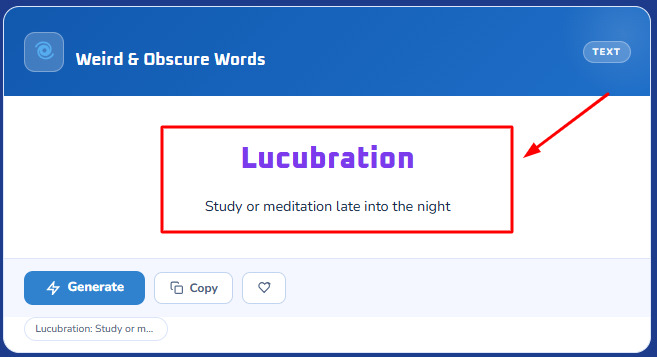
Step 4 : Save It
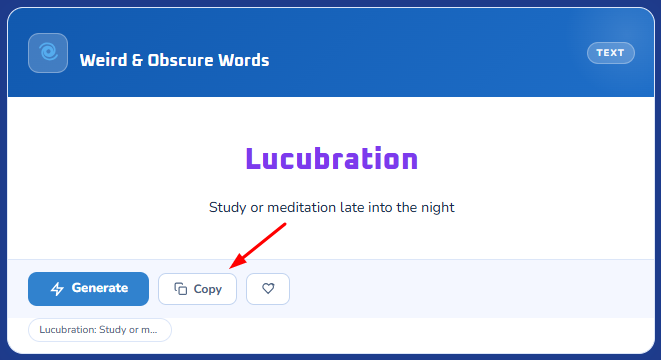
If you love the word, click the heart button to save or copy it to your collection.
10 Genuinely Weird English Words
English has over one million words. The average person uses fewer than 30,000. The rest? Mostly forgotten — strange, obscure, and wonderfully weird. Below are 10 real English words so unusual that most native speakers have never heard them, each with a definition, word type, and an example sentence showing it in context.
Use the Random Weird Word Generator above to discover hundreds more like these instantly.
1. Bumfuzzle (verb)
Definition: To confuse or fluster someone so completely they have no idea what to do next.
Example: The last interview question bumfuzzled him — he sat in silence for a full minute.
Why it’s weird: It’s in the dictionary. Nobody uses it. Yet it describes a feeling everyone has experienced.
2. Lollygag (verb)
Definition: To waste time aimlessly; to dawdle without any sense of urgency or purpose.
Example: We lollygagged through the market for two hours without buying a single thing.
Why it’s weird: One of the few English words where the sound perfectly matches the meaning — slow, soft, going nowhere fast.
3. Snollygoster (noun)
Definition: A shrewd, unscrupulous person — particularly a politician driven purely by self-interest rather than principle.
Example: The editorial called him a snollygoster who changed positions whenever it suited his career.
Why it’s weird: President Truman actually used this word in a 1952 speech. It vanished from public use shortly after.
4. Flibbertigibbet (noun)
Definition: A frivolous, overly talkative person who can’t stay focused on a single topic.
Example: Her aunt was a lovable flibbertigibbet who jumped from gossip to recipes to astrology in one breath.
Why it’s weird: It appears in Shakespeare’s King Lear as the name of a devil — and somehow also became a word for chatty people.
5. Widdershins (adverb)
Definition: Moving in a direction contrary to the sun — counterclockwise. Historically associated with bad luck or witchcraft.
Example: According to old folklore, walking widdershins around a church three times would summon the devil.
Why it’s weird: Still used in Scottish English today. Zero crossover into standard modern usage despite being a precise, useful directional word.
6. Kerfuffle (noun)
Definition: A commotion or fuss caused by a disagreement or disorganized situation — usually minor but noisy.
Example: There was a brief kerfuffle at the checkout when two customers reached for the last discounted item.
Why it’s weird: Borrowed from Scottish Gaelic, it sounds absurd but appears in formal journalism and even parliamentary debate transcripts.
7. Ultracrepidarian (adjective / noun)
Definition: Describing a person who gives opinions on subjects they know absolutely nothing about.
Example: Every comment section is full of ultracrepidarian voices confidently explaining fields they’ve never studied.
Why it’s weird: It comes from a Latin story about a cobbler who criticized a painter’s work beyond the shoe — ne sutor ultra crepidam. The concept is ancient. The word is almost never used.
8. Sonder (noun)
Definition: The sudden realization that every stranger you pass has a life as vivid, complex, and full as your own.
Example: Standing in a crowded train station, she felt a wave of sonder wash over her — all these lives, all at once.
Why it’s weird: Coined by writer John Koenig in The Dictionary of Obscure Sorrows and now widely used online — yet still absent from most major dictionaries.
Repeat this before every writing session for thirty days. First draft quality improves because you are no longer starting cold, and your sense of your own voice sharpens because you have spent thirty sessions deliberately contrasting your style against someone else’s.
9. Petrichor (noun)
Definition: The distinctive, pleasant earthy smell produced when rain falls on dry ground.
Example: She stepped outside after the storm and breathed in the petrichor rising from the warm pavement.
Why it’s weird: Coined in 1964 by Australian scientists. It names something everyone has experienced but almost no one knew had a word.
10. Zephyr (noun)
Definition: A soft, gentle breeze — especially one coming from the west. Also used poetically to describe anything light and airy.
Example: A warm zephyr drifted through the open window, rustling the pages of his book.
Why it’s weird: Ancient Greek in origin (Zephyros was the god of the west wind), it survived thousands of years of language change to land quietly in modern English — still barely used outside poetry.
Who Uses a Random Weird Word Generator? (Use Cases)
1. Writers & Novelists — Breaking Out of Descriptive Ruts
Every writer hits the same wall. The same adjectives, the same sentence rhythms, the same vocabulary cycling on repeat. A random weird word generator forces your brain out of its default patterns.
One obscure word dropped into a scene can completely reframe the tone — a character who “bumfuzzles” their opponent reads differently than one who “confuses” them. The weird word carries personality. The common word carries nothing.
Best for: fiction writers, screenwriters, poets, bloggers hitting creative block.
How to use it: Generate 5–10 weird words before a writing session. Pick one. Force it into your draft somewhere. Even if it doesn’t survive editing, it will have shifted how you were thinking..
2. ESL Learners — Going Beyond Textbook English
Language textbooks teach survival English — the 2,000 most common words. Nobody teaches you “petrichor,” “zephyr,” or “kerfuffle.” But advanced English fluency isn’t about knowing more common words. It’s about understanding the full range of how native speakers actually express themselves.
Weird, obscure, and unusual words give ESL learners something textbooks never do: a sense of the language’s personality. English is strange, layered, and borrowed from dozens of other languages. Exploring that strangeness is how learners move from functional to fluent.
Best for: intermediate to advanced ESL learners, language enthusiasts, students preparing for IELTS or TOEFL advanced vocabulary sections.
How to use it: Generate one weird word per day. Write it down, look up its origin, and use it in a sentence by evening.
3. Teachers — Vocabulary Games & Classroom Activities
A random weird word generator is one of the most underused classroom tools available. Pull up a weird word on the projector with the definition hidden — ask students to guess the meaning based on the sound alone. The guesses are almost always funnier than the real definition, and the laughter makes the word impossible to forget.
This works at every level. Primary school teachers use it for spelling bee warm-ups. High school English teachers use it to spark etymology discussions. University lecturers use it to open lectures on linguistics or creative writing.
Best for: English teachers, ESL instructors, homeschool educators, debate coaches.
How to use it: Generate a weird word at the start of each class. Challenge students to use it naturally in conversation before the session ends.
3. Teachers — Vocabulary Games & Classroom Activities
A random weird word generator is one of the most underused classroom tools available. Pull up a weird word on the projector with the definition hidden — ask students to guess the meaning based on the sound alone. The guesses are almost always funnier than the real definition, and the laughter makes the word impossible to forget.
This works at every level. Primary school teachers use it for spelling bee warm-ups. High school English teachers use it to spark etymology discussions. University lecturers use it to open lectures on linguistics or creative writing.
Best for: English teachers, ESL instructors, homeschool educators, debate coaches.
How to use it: Generate a weird word at the start of each class. Challenge students to use it naturally in conversation before the session ends.
4. Game Players — Pictionary, Charades & Party Games
Standard Pictionary and charades word lists go stale fast. Everyone has drawn “elephant” and acted out “running” a hundred times. Weird words fix this immediately.
Try drawing “lollygag.” Try acting out “widdershins.” The combination of unusual meaning and unfamiliar vocabulary creates genuine challenge — and genuine laughter. It levels the playing field too, since nobody has an advantage when nobody knows the word.
Best for: party hosts, game nights, team-building events, family gatherings.
How to use it: Generate 20–30 weird words before your game session and write them onto cards. Use them as your custom word deck.
5. Social Media Creators — Word of the Day Content
“Obscure word of the day” is one of the most consistently performing content formats on Instagram, TikTok, and X (Twitter). The formula is simple: unusual word, clean definition, surprising example. Audiences share it because it makes them feel like they learned something worth passing on.
A random weird word generator is the sourcing engine behind this entire content format. Instead of manually digging through dictionaries, creators can generate a shortlist in seconds, pick the most surprising result, and build content around it.
Best for: vocabulary-focused accounts, educational creators, language teachers with social audiences, general interest content creators.
How to use it: Generate 10 words at a time. Pick the one with the best story behind it — unusual origin, surprising modern relevance, or a meaning that contrasts with how it sounds.
6. Developers & Designers — Unique Placeholder Names & Project Naming
Naming things is one of the hardest parts of any creative or technical project. Weird words make surprisingly strong placeholder names, codenames, and project titles — they’re memorable, they’re pronounceable, and they’re unique enough that a quick search won’t return a thousand conflicts.
Designers use them for mockup usernames and dummy content. Developers use them for internal project codenames. Brand strategists use them as starting points for naming exercises — not to use the weird word itself, but to let it point toward something adjacent.
Best for: UX designers, software developers, brand strategists, startup founders in early naming stages.
How to use it: Generate 15–20 weird words in one session. Look for anything that has the right sound or feel for what you’re building, even loosely. Use it as a creative prompt, not a final answer.
What Makes English Words Weird ?
The Layered, Borrowed Beast Behind the Language
A random weird word generator reveals just how strange and inconsistent English truly is. The language did not grow in a straight line. it evolved by absorbing a vast vocabulary from Norse, French, Latin, and Germanic roots, retaining archaic spellings that no longer match how we speak. When early printing presses were introduced, initial errors made by Flemish operators accidentally fixed spellings in ink, locking in inconsistencies for centuries. The Great Vowel Shift of the 15th century then drastically shifted how sound worked in spoken English, but the written words never caught up, creating a painful disconnect between spelling and pronunciation.
Why Borrowed Words Make It More Complex
What makes this even more complex is the layered way English borrowed words from other languages without changing their original form. Sushi, yoga, and hundreds of others came in as-is, creating irregular patterns and silent letters that feel almost bizarre to learners, whether studying for IELTS through the British Council or following guides from Kaplan International. Words like conscience and conscious look similar but behave differently, and pairs like Germanic “cow” versus French “beef,” or “begin” versus “commence,” show how context shapes meaning across the same vocabulary. Knowing these 55 facts about English helps avoid mistakes and makes those confusing words a little less intimidating.
What makes a good paragraph?
Weird Words
Weird words are real and authentic, sitting right in the dictionary. What makes them odd is their peculiar sound or amusing, surprising meanings. Many are archaic or onomatopoeic. Take kerfuffle, meaning a commotion or fuss, lollygag meaning to waste time, or absquatulate meaning to leave abruptly. These have funny-sounding characteristics and examples that feel almost fake but are completely genuine.
Unusual Words
Unusual words are uncommon terms, seldom heard in everyday conversation. They carry a refined, poetic, even academic quality with very precise meaning used infrequently. Petrichor describes the smell of rain on dry ground. Ephemeral means lasting a very short time. Susurrus captures a soft whispering or rustling sound. These sit at a low frequency of use, mostly in formal writing.
Fake Words
Fake words or pseudowords do not exist in standard dictionaries. Some are invented for stories or word games, made up for creative purposes. Others appeared by errors, mistakenly slipping into print as ghost words. Galumph was coined by Lewis Carroll, pronounceable but originally meaningless. Dord was accidentally created through a typo, making it a classic ghost word. These carry a nonsense, invented vibe with N/A standing in dictionaries.
| Category | Real? | Frequency | Vibe/Context |
|---|---|---|---|
| Weird | Yes | Low-moderate | Funny, Surprising |
| Unusual | Yes | Low | Refined, Formal |
| Fake | No | N/A | Nonsense, Invented |
Benefits of Using Our Random Weird Word Generator
Unlimited Generation — No Account, No Daily Cap
Open the page. Click Generate. Keep going. No sign-up screen. No email required. No daily limit cutting you off mid-session.
Tools like Vondy lock features behind a login. Others cap how many words you can generate for free. This tool has no friction between you and the words — which means you actually use it instead of abandoning it at a registration wall.
Every Word Comes With a Definition
Generating a weird word you cannot understand is pointless. Every result on this generator includes a plain-English definition so you know exactly what the word means and how to use it — no second tab, no dictionary search required.
Most competitors give you the word and nothing else. This turns a random picker into an actual vocabulary tool.
Real Dictionary Words — Not AI-Fabricated Nonsense
Every word in this generator comes from real lexical sources — archaic English, borrowed vocabulary, rare but legitimate modern words that fell out of everyday use.
Tools like Vondy use AI models to invent words that sound plausible but exist nowhere. You cannot use a made-up word in writing, a game, or a classroom without undermining your credibility. Every word here is real. Every word here is usable.
One-Click Copy — Ready to Use Instantly
Found a word that works? One click copies it to your clipboard. No highlighting, no retyping, no extra steps. Paste it directly into your story, lesson plan, social post, or game card and keep moving.