Random Letter Generator
A random letter generator is a free online tool that picks one or more letters from the alphabet using equal probability selection. Use it to generate consonants, vowels, or mixed letters for games, learning, and creative word building.
Random Letter Generator
TextClick Generate to get your result
What Is a Fake Word?
A random letter generator is a free, online tool designed to generate letters from the English alphabet. I’ve personally used it for creative projects, quick game setups, and even educational purposes, and what surprised me most was how truly reliable the results were every time. The process is surprisingly easy: just select the number of different letters you need, pick upper or lower cases, and hit the button your letters appear instantly.
What makes this simple yet powerful application stand out is how customizable the options are. You can control case sensitivity, manage duplicates, toggle vowel inclusion, and even request a single letter or multiple selections depending on what your work demands. Whether you need Cursive Letters displayed for handwriting practice or standard characters for everyday work, this one tool handles it all, making it a genuinely reliable choice for multiple purposes every time you use it.
How Does Equal Probability Work Across All 26 Letters?
Equal probability in a random letter generator means every letter in the English alphabet — from A to Z — has exactly the same chance of being selected each time you click Generate. No letter is favored, no letter is suppressed. The selection is mathematically fair across all 26 options.
The exact probability for any single letter on any single draw is 1 in 26, or approximately 3.85%.
That means whether you are generating the letter A or the letter Z, the tool treats both with identical weight. High-frequency letters like E, T, and A do not appear more often. Rare letters like Q, X, and Z are not pushed aside. Every draw is a clean, unbiased pick from the full alphabet.
How Does Equal Probability Work Across All 26 Letters?
Equal probability matters because it makes the output genuinely unpredictable and fair. If the generator secretly weighted common letters more heavily — the way they actually appear in English text — the results would be biased. E would show up in roughly 13 out of every 100 picks. Z would barely appear at all.
That kind of frequency-weighted output would be useful for simulating written English, but it would be useless for word games, fair draws, and educational exercises where every letter needs an equal chance to appear.
A truly fair random letter generator ignores natural language frequency entirely. It treats the alphabet as a flat pool of 26 equal options, not as a weighted distribution shaped by how English is actually written.
What Is the Difference Between Generating a Single Letter and a Sequence?
A single letter generation picks one random letter from the alphabet per draw. A sequence generation picks multiple letters in a series — each selected independently — to produce a string of two or more random letters. Both use the same equal-probability selection method, but sequences serve different use cases and create different kinds of output.
What Does Generating a Single Random Letter Mean?
Generating a single letter means the tool runs one draw from the alphabet pool and returns exactly one result — for example, M.
That single letter is a complete, self-contained output. You use it as-is. A teacher picks a single letter and asks students to name an animal starting with that letter. A word game player uses a single letter to determine whose turn it is. A developer testing a form field needs one random character to verify input handling.
Single letter generation is fast, decisive, and unambiguous. There is only one output to interpret, and the use case is almost always about that one letter carrying a specific role — a starting point, a category trigger, or a fair selector.
What Does Generating a Random Letter Sequence Mean?
Generating a sequence means the tool runs multiple independent draws back-to-back and returns all results together — for example, M, R, T, A, E if you requested five letters.
Each letter in a sequence is selected with no memory of what came before it. The second draw does not know the first result. The fifth draw does not know any of the previous four. Every position in the sequence is an isolated, equal-probability pick from the full letter pool.
Sequences are fundamentally different from single letters in what they enable. A sequence is raw material — a collection of letter options that you then do something with. You unscramble them into a word. You use them as constraints for a writing exercise. You arrange them to construct a fictional name. You feed them into a fake word generator to produce something pronounceable.
How do You Use This Random Letter Generator ?
Using this tool is simple and takes just a few seconds. Follow these steps:
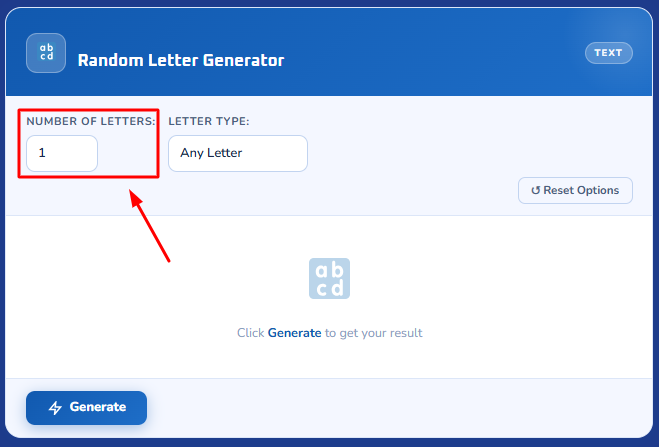
Step 1: Set the Number of Letters
In the “Number of Letters” field, choose how many letters you want to generate. The default is set to 1, but you can increase or decrease it using the up and down arrows based on your need.
Step 2: Select the Letter Type
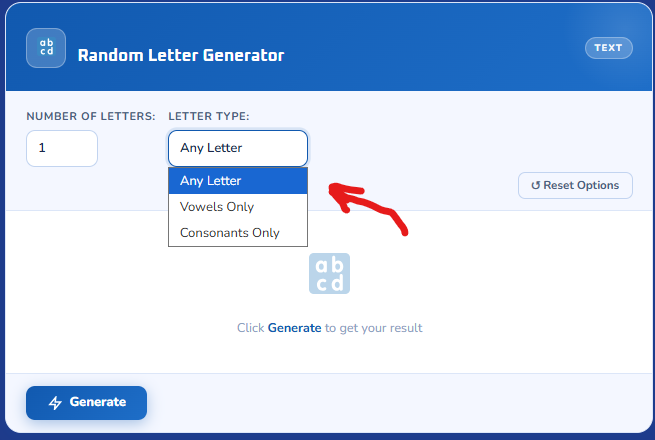
Use the “Letter Type” dropdown to filter your results. You have three options:
- Vowels Only – generates vowel letters only
- Any Letter – generates a random mix of all alphabets
- Consonants Only – generates consonant letters only
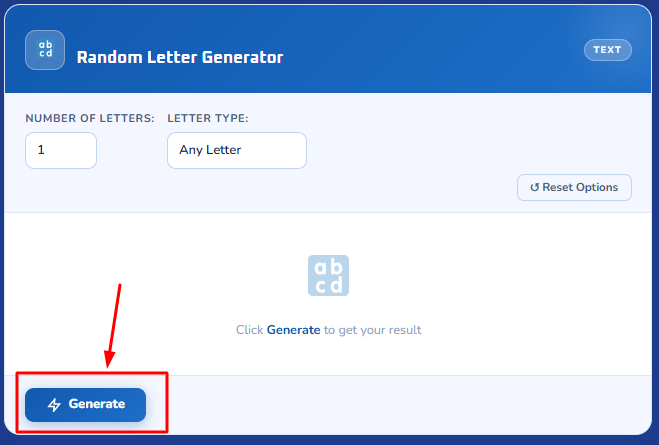
Step 3: Click the Generate Button
Hit the Generate button on the bottom left of the tool. Your random letter(s) will appear instantly on the screen.
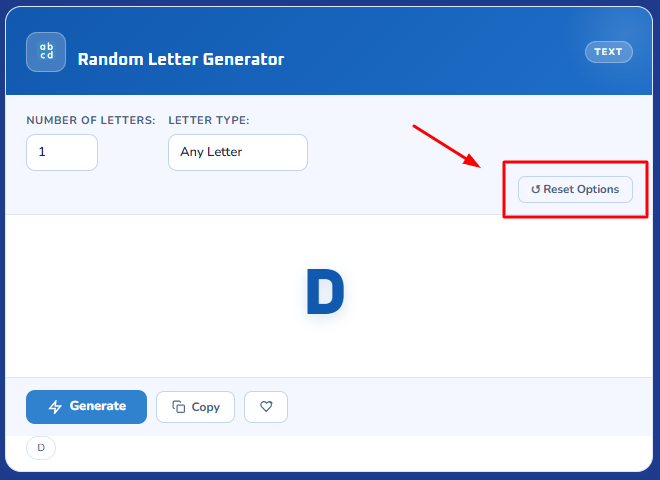
Step 4: Reset If Needed
Want to start over? Click the Reset button that appears after generating. It clears the result so you can run a fresh generation.
What are the Letters of the English Alphabet ?
What Are the Letters of the English Alphabet?
The English alphabet is a set of 26 letters arranged in a fixed order from A to Z. It is the writing system used for the English language and serves as the foundation for every word, sentence, and text written in English. Each letter represents one or more sounds and exists in two forms — uppercase (A) and lowercase (a).
How Many Letters Are in the Alphabet?
The English alphabet has 26 letters, ranging from A to Z.
Those 26 letters are:
A B C D E F G H I J K L M N O P Q R S T U V W X Y Z
Every word in the English language is built from combinations of these 26 letters. A random letter generator draws its output exclusively from this set, giving each of the 26 letters an equal 1-in-26 chance of being selected on every draw.
Which Letters Are Vowels and Which Are Consonants?
The 26 letters are divided into two groups — vowels and consonants.
Vowels (5): A, E, I, O, U
Consonants (21): B, C, D, F, G, H, J, K, L, M, N, P, Q, R, S, T, V, W, X, Y, Z
Vowels are letters that produce an open, unobstructed sound when spoken. Consonants are letters that produce a sound shaped or stopped by the lips, teeth, or tongue. Every pronounceable English word contains at least one vowel, which is why the vowel-only and consonants-only filter options in a random letter generator are useful — a sequence of only consonants cannot form a natural word without vowels being added.
Note: Y is classified as a consonant in the standard 26-letter breakdown, but it functions as a vowel sound in words like gym, cry, and rhythm.
What Is Letter Frequency in English Text?
Letter frequency refers to how often each letter appears in written English. Not all 26 letters appear equally in natural language — some letters are used far more than others.
The most common letters in English text, in order, are:
E — T — A — O — I — N — S — H — R — D — L — C — U — M — W — F — G — Y — P — B — V — K — J — X — Q — Z
E is by far the most frequent letter, appearing in roughly 13% of all English text. Z and Q are the rarest, each appearing in less than 0.1% of written English.
This frequency distribution is why Scrabble assigns different point values to different tiles — E is worth 1 point because it is easy to use, while Q and Z are worth 10 points because they almost never appear. It is also why a random letter generator deliberately ignores frequency weighting. If the tool matched real English distribution, you would almost never see Q, X, or Z — defeating the purpose of fair, equal-probability selection.
What Was the 27th Letter of the Alphabet?
The English alphabet once had 27 letters. The 27th letter was the ampersand (&), known at the time as “Et” — Latin for “and.”
The ampersand was a standard part of the English alphabet until 1835, when it was officially removed. It was placed at the end of the alphabet, after Z. When reciting the alphabet aloud, students of that era would say “…X, Y, Z, and per se and” — meaning “& by itself means and.” Over time, “and per se and” was slurred together into the word ampersand, which is the name we still use today for the & symbol.
The ampersand survives on modern keyboards as a punctuation mark and programming symbol, but it is no longer considered a letter of the alphabet.
What Are Letter Numbers?
Letter numbers are the numerical positions of each letter in the alphabet. A is assigned the number 1, B is 2, and so on through to Z, which is 26.
The full letter-number mapping is:
| Letter | Number | Letter | Number | Letter | Number |
|---|---|---|---|---|---|
| A | 1 | J | 10 | S | 19 |
| B | 2 | K | 11 | T | 20 |
| C | 3 | L | 12 | U | 21 |
| D | 4 | M | 13 | V | 22 |
| E | 5 | N | 14 | W | 23 |
| F | 6 | O | 15 | X | 24 |
| G | 7 | P | 16 | Y | 25 |
| H | 8 | Q | 17 | Z | 26 |
| I | 9 | R | 18 |
What Is the Difference Between Vowels and Consonants in Random Letter Generation?
In a random letter generator, letters are not always treated the same. Vowels (A, E, I, O, U) and consonants are often filtered separately because real language follows patterns, not pure randomness. Most readable and natural-sounding words depend on a balanced mix of both. That’s why advanced generators let you choose only vowels, only consonants, or a mix with controlled ratios.
This separation becomes especially important when you move from random letters to pronounceable outputs. For example, when you combine consonants and vowels in patterns like CVC (consonant–vowel–consonant), you start forming realistic, usable words. This is the same principle used in a fake word generator, where structured letter combinations create natural-sounding invented words.
Why Would You Generate Only Vowels?
Generating only vowels might seem unusual, but it serves specific purposes:
- Phonics practice: Helps beginners focus on vowel sounds independently
- Speech training: Useful for improving pronunciation and vocal clarity
- Creative patterns: Writers sometimes use vowel-only strings for stylistic effects
- Linguistic experiments: Helps understand sound flow without consonant interruption
In short, vowel-only generation isolates the core sound energy of language.
Why Would You Generate Only Consonants?
Consonant-only generation is equally useful, especially for structure-focused tasks:
- Word puzzle creation (like crosswords or guessing games)
- Pattern building: Helps users manually insert vowels later
- Brand name ideation: Many modern names start as consonant-heavy structures
- Game mechanics: Useful in word games where players must complete missing vowels
Consonants provide the framework or skeleton of most words.
How Does Vowel-Consonant Ratio Affect Pronounceability?
A completely random mix of letters often produces outputs like “XQTRZ”, which are hard to read or use. But when you control the vowel-to-consonant ratio, the results become instantly more natural.
- Balanced ratio (e.g., 40% vowels, 60% consonants) → “Melo”, “Tarin” (easy to pronounce)
- Too many consonants → “Strk”, “Blnt” (harsh, difficult)
- Too many vowels → “Aeoiu”, “Euao” (fluid but unrealistic)
The key takeaway:
👉 Pronounceability increases when vowel and consonant patterns mimic real language rules.
What can you use a Random Letter Generator For?
A random letter generator is used for word games, language education, creative writing, brand name brainstorming, fake word creation, password generation, and software testing. Each use case benefits from the tool’s core property — unbiased, equal-probability letter selection that removes human choice from the equation entirely.
How Do You Use Random Letters for Word Games?
GRandom letters are used in word games to create fair, unpredictable starting conditions that no player can anticipate or prepare for in advance.
Scrabble and tile-based games use random letter draws to determine which tiles each player receives. Generating random letters beforehand lets you simulate a draw, practice with an unfamiliar set of letters, or create custom challenge rounds where all players work from the same randomly selected pool.
Boggle-style games require a grid of random letters from which players form as many words as possible. Generating a random 16-letter sequence — 4 rows of 4 — gives you an instant custom Boggle board without needing the physical game.
Alphabet road trip games use a randomly selected starting letter to determine which category items players must name. Instead of always starting at A, a random letter generator makes every round different and prevents experienced players from stockpiling answers for the early letters.
Hangman benefits from random letter selection during the guessing phase — generating the next letter to guess removes repetitive patterns and forces players to think more carefully rather than defaulting to E, T, A every time.
Word association drills use a random letter as the constraint — every answer must begin with that letter. The randomness of the letter is what makes the exercise genuinely challenging.
How Do Teachers Use a Random Letter Generator for Education?
Teachers use random letter generators to create dynamic, repeatable learning activities that hold student attention better than fixed exercises.
Phonics and alphabet recognition for early learners becomes interactive when a random letter appears on screen and the student must identify it, say its sound, and name a word that begins with it. Cycling through random letters means no two sessions feel identical.
ESL and second language teaching benefits directly from the uppercase and lowercase filter options. A teacher can generate lowercase letters only and ask students to write the uppercase equivalent, or vice versa. This tests letter recognition in both forms without the predictability of going through the alphabet in order.
Spelling bee practice works by generating a random letter and asking students to spell the most difficult word they know that begins with it. The randomness prevents students from memorizing a prepared list in alphabetical order.
Vocabulary expansion exercises use a random letter as a constraint — students must write down every word they know that begins with that letter within 60 seconds. Repeating this across multiple random letters maps which areas of vocabulary are strong and which need work.
Letter-ordering memory games use a full shuffled sequence of all 26 letters — generated with the unique letters setting enabled — and challenge students to rearrange them back into correct alphabetical order.
How Do Writers Use Random Letters for Creative Projects?
Writers use random letters as creative constraints and raw material — tools for breaking through blank-page paralysis and generating naming ideas that pure imagination often fails to produce.
Character name construction starts with a random 3–5 letter sequence used as the phonetic skeleton of a name. A writer generating K, A, R, V has a starting shape — Karv, Varko, Kavar — that feels more authentic to a fictional world than a name pulled consciously from familiar cultural references.
Brand name and product name brainstorming works the same way. A random sequence of 4–6 letters produces letter combinations a human brain would not naturally generate, which is exactly where distinctive, trademarkable names come from. Many successful brand names — Kodak, Xerox, Häagen-Dazs — were built around unusual letter combinations that stuck in memory precisely because they did not follow predictable patterns.
Writing prompt constraints use a random letter to determine a rule that governs the next piece of writing. Every sentence must begin with the generated letter. Every character name must contain it. The verb in every sentence must start with it. Constraints like these force creative decisions that produce more original work than unconstrained writing.
Fictional language and worldbuilding use random letter sequences to develop the phonetic identity of an invented language. Generating consonant-heavy sequences produces languages that feel harsh and guttural. Vowel-heavy sequences feel flowing and melodic. A writer building a fantasy world can use the random letter generator to establish the sound rules of each culture’s language before a single word is formally defined.
Invented word creation is where random letters connect directly to the Fake Word Generator on this site. A random letter sequence like B, L, O, R, F is raw material. Feed it into the Fake Word Generator and it becomes a pronounceable invented word — usable as a character name, a place name, a product name, or a concept in a fictional universe.
How Do Developers and QA Testers Use Random Letter Generators?
Developers and QA testers use random letter generators to produce unpredictable input data that reveals how systems behave under realistic, non-patterned conditions.
Form field and input validation testing requires random letter strings to verify that a text input accepts the characters it should accept, rejects the ones it should not, and handles edge cases like single-character entries or maximum-length strings without breaking.
Database population with dummy data uses random letter sequences to fill name fields, code fields, and identifier columns with realistic-looking but meaningless content. This lets developers test queries, sorting, and filtering against data that resembles real user input without exposing any actual personal information.
Random sampling and anonymization in surveys and research datasets uses random letter codes to replace participant names or identifiable information while maintaining a unique identifier for each record. R, K, and P are assigned to three respondents — the data remains analyzable without being traceable.
Password and token seed generation uses random letter sequences as the base of a credential. Combined with numbers and symbols, a random 8–12 letter sequence produces a strong password that no dictionary attack can predict.
How to generate random letters in Excel is a related technical need. The formula =CHAR(RANDBETWEEN(65,90)) generates a random uppercase letter. For lowercase, use =CHAR(RANDBETWEEN(97,122)). These formulas use ASCII character codes — 65 maps to A, 90 maps to Z, 97 maps to a, 122 maps to z — to produce a random letter in any spreadsheet cell. Dragging the formula down a column fills an entire dataset with random letters instantly.
How Do You Use Random Letters for Password Creation?
password. Human-chosen passwords follow patterns — dictionary words, names, dates — that make them vulnerable to systematic attacks. A random letter generator removes those patterns entirely.
To create a strong password using this tool, generate 8–12 random letters using the any letter setting with both uppercase and lowercase enabled. Then manually insert one or two numbers and a symbol into the sequence. The result is a password that contains no recognizable word, no predictable structure, and no pattern a brute-force algorithm can exploit efficiently.
The key advantage over dedicated password generators is memorability. A random 6-letter sequence like MRVTKA is harder to crack than password123 and easier to remember than x#9kL@2mQp because it can be spoken aloud, visualized as a sound, or associated with an invented word — which is, again, where the Fake Word Generator becomes useful.How Do Random Letters Create Fake Words? (Your Unique Angle)
How Do Random Letters Create Fake Words?
Random letters create fake words when they are arranged according to phonotactic rules — the sound-pattern laws that govern which letter combinations are pronounceable in a given language. A random sequence like B, L, O, R, F can become the fake word Blorf because it follows patterns English speakers recognize as word-shaped. A sequence like X, Q, K, B, Z cannot, because no arrangement of those letters produces something a human mouth can say naturally.
The bridge between random letters and fake words is not chance — it is structure applied to randomness.
What Are Phonotactic Rules and Why Do They Matter?
permitted in a language. Every language has its own phonotactic rules — patterns that native speakers internalize without ever being taught them explicitly.
In English, the phonotactic rules that matter most for fake word creation are:
Consonant clusters at the start of a word are limited to specific combinations. BL, CR, ST, TR, and FL are valid opening clusters — blorf, craven, strap all feel natural. XQ, BK, and GZ are not valid opening clusters — no native English word begins with these combinations, and invented words that do feel immediately foreign and unpronounceable.
Vowels act as syllable anchors. Every syllable in an English word contains at least one vowel sound. A fake word with no vowels — STRPK — has no syllable structure and cannot be pronounced. A fake word with vowels distributed across it — STROPAL — has three syllable anchors and can be sounded out naturally.
Ending sounds follow patterns. English words commonly end in consonants like T, N, S, R, L, and D, or in vowel-consonant combinations like -ATE, -ORE, -ING, -EST. Fake words that end in these patterns feel finished. Fake words that end in unusual clusters — BLORFX — feel incomplete.
When a random letter generator produces a sequence that happens to align with these rules, the result can become a convincing fake word with minimal rearrangement.
Which Letter Combinations Sound Natural vs Unnatural?
Not all random letter combinations have equal potential as fake word material. The difference between a promising sequence and an unusable one comes down to the ratio of vowels to consonants and the specific letters involved.
High-potential combinations contain a mix of common consonants and at least one vowel, with consonant clusters that appear in real English words:
- B, L, O, R, F → Blorf — sounds like a creature name or a sci-fi planet
- V, E, L, T, A → Velta — sounds like a brand name or a character
- S, T, R, A, V, E → Strave — sounds like a real but obscure verb
- K, O, R, V, A → Korva — sounds like a fictional place name
Low-potential combinations contain rare consonants clustered together with no vowel anchors:
- Q, X, Z, V, K → no natural arrangement produces a pronounceable word
- B, D, G, P, T → all consonants, no syllable structure possible without adding vowels
- X, W, Q, J → individually rare letters that do not combine into natural English clusters
This is precisely why the vowels-only and consonants-only filter settings in the random letter generator matter for fake word creation. Generating a balanced sequence — using the any letter setting — gives you the best raw material because it statistically produces a vowel roughly every 5 letters, matching the natural vowel density of English words.
How Do You Go From Random Letters to a Pronounceable Fake Word?
The process moves through three stages — generation, filtering, and arrangement.
Stage 1 — Generate a raw letter sequence. Use the random letter generator on this page to produce 4–7 letters using the any letter setting. A sequence of 4–7 letters is the most productive length for fake word creation. Shorter sequences produce words that feel like abbreviations. Longer sequences produce words that are difficult to remember or pronounce in a single breath.
Stage 2 — Assess the sequence for vowel presence. Check whether the sequence contains at least one vowel. If it does not, generate again or mentally add a vowel between the existing consonants. A sequence with one or two vowels spread across four to six consonants has the best fake word potential.
Stage 3 — Arrange the letters into a pronounceable order. You do not have to use the letters in the order they were generated. Rearrange them until you find an order that your mouth can move through naturally. Try saying the arrangement aloud. If you stumble or stop, restructure. If it flows — even if it sounds strange — it is a valid fake word.
Alternatively — use the Fake Word Generator directly. The Fake Word Generator on this site handles stages 2 and 3 automatically. It takes random letter input and applies phonotactic filtering to produce invented words that are already pronounceable, already structured like real words, and already ready to use — without manual rearrangement.
How Do You Go From Random Letters to a Pronounceable Fake Word?
NThe process moves through three stages — generation, filtering, and arrangement.
Stage 1 — Generate a raw letter sequence. Use the random letter generator on this page to produce 4–7 letters using the any letter setting. A sequence of 4–7 letters is the most productive length for fake word creation. Shorter sequences produce words that feel like abbreviations. Longer sequences produce words that are difficult to remember or pronounce in a single breath.
Stage 2 — Assess the sequence for vowel presence. Check whether the sequence contains at least one vowel. If it does not, generate again or mentally add a vowel between the existing consonants. A sequence with one or two vowels spread across four to six consonants has the best fake word potential.
Stage 3 — Arrange the letters into a pronounceable order. You do not have to use the letters in the order they were generated. Rearrange them until you find an order that your mouth can move through naturally. Try saying the arrangement aloud. If you stumble or stop, restructure. If it flows — even if it sounds strange — it is a valid fake word.
Alternatively — use the Fake Word Generator directly. The Fake Word Generator on this site handles stages 2 and 3 automatically. It takes random letter input and applies phonotactic filtering to produce invented words that are already pronounceable, already structured like real words, and already ready to use — without manual rearrangement.
What Makes a Fake Word Sound Real?
A fake word sounds real when it satisfies three conditions simultaneously.
It is pronounceable in a single attempt. A native English speaker who has never seen the word can sound it out correctly on the first try. Veltora passes this test. Xqbrvk does not.
It has a recognizable syllable rhythm. English words follow stress patterns — typically with one stressed syllable and one or more unstressed ones. BLO-rf has one syllable. vel-TO-ra has three with a clear stress on the second. Fake words that fit these patterns feel borrowed from a language you have not encountered before, which is exactly the feeling that makes them useful for fiction, branding, and creative naming.
It does not accidentally match a real word. A fake word that sounds identical to an existing English word — or worse, an offensive word in any language — loses its invented quality immediately. This is one of the practical advantages of using a generator over purely manual invention: a tool can cross-reference its output against known word lists and flag accidental matches before you commit to a name.
What Are the Real-World Use Cases for Fake Words Built From Random Letters?
Brand naming is the highest-stakes application. Companies spend significant resources creating names that are distinctive, trademarkable, globally pronounceable, and not already in use. Random letter sequences are the starting material for this process. Kodak was built around an invented word. Google is a deliberate misspelling of googol. Häagen-Dazs was a made-up sequence of letters designed to sound vaguely Scandinavian. Each of these names began as a phonetic experiment with arbitrary letters before it became a global brand.
Fantasy and science fiction worldbuilding requires names for characters, places, creatures, and concepts that feel like they belong to a world with its own linguistic logic. A fantasy continent where every place name begins with a heavy consonant cluster — Stravok, Breldune, Thravar — feels like it has its own cultural and linguistic identity. Random letter generation, filtered through phonotactic awareness, is how writers build that consistency without constructing an entire fictional language from scratch.
Game design and tabletop RPGs need an endless supply of NPC names, location names, item names, and faction names that feel culturally distinct from each other. A dungeon master generating random letters for each culture in their world produces naming conventions that players recognize as culturally different — even without being told why.
Neologism creation — the invention of new words for new concepts, starts with phonetic experimentation. When a new technology, phenomenon, or idea needs a name that does not yet exist, random letter sequences provide the raw material that linguists, marketers, and writers then shape into something meaningful. The word blog began as a truncation of weblog. Podcast was a portmanteau built from arbitrary phonetic components. New words come from deliberate play with sound and letter combination, exactly what random letter generation enables.
Linguistic research and phonics education use fake words called nonce words or pseudowords to test reading ability, pronunciation, and phonological awareness without the confounding variable of word familiarity. A student who can correctly read BLORF aloud has demonstrated phonics competence independent of vocabulary knowledge. Random letter generators are a practical source of fresh pseudowords for educators who need new test material regularly.