Random Paragraph Generator
Random Paragraph Generator
TextClick Generate to get your result
What is a random paragraph?
A Random Paragraph Generator is a tool designed to provide users with ready-made paragraphs for different purposes. The process is simple. You choose a number, click a button, and the chosen number of random paragraphs instantly appear on a webpage. This is the right place for anyone looking to find a random paragraph, a random sentence, or even a random word. It also provides a perfect solution when content needs something long enough to build ideas. You can arrive at the page, see the next paragraph button, and explore several paragraphs in different ways it can be used. Each random paragraph is created to follow a logical step, making the output useful and easy to read.
How many words are in a paragraph?
When using a random paragraph generator, each random paragraph usually contains around 45 to 55 words. This makes it long enough to serve practical needs while remaining concise. The tool is versatile, allowing writers, students, and marketers to save time and get a perfect solution for structured content. Within these paragraphs, each sentence can have adjectives in different positions. In attributive position, they come before a noun, while in predicative form they appear after, usually separated by a linking verb, following 2 main patterns to ensure every random sentence is clear and meaningful.
How Does the Random Paragraph Generator Work?
The random paragraph generator involves the user inputting specific criteria or keywords to guide the generator’s output. The generator uses these inputs to search its database, take into account factors such as sentence structure, grammar, and context to ensure that the generated paragraphs are coherent and meaningful.
It can select sentences and phrases from pre-existing templates or combine fragments to create unique content. Advanced natural language processing techniques generate highly sophisticated paragraphs that align with the desired theme or topic. The result can be used as-is or modified to suit the user’s needs, including proper placement of English adjectives, noun positions, attributive, and predicative positions, linking verbs, usually separated before or after other sentence elements. Even with 2 main sentences, the generator preserves structure and clarity.
How to use the random paragraph generator (Step-by-Step) ?
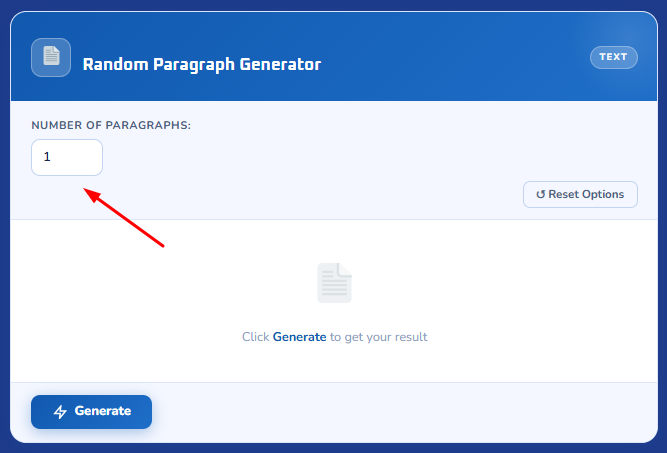
Step 1 Select Number of Paragraphs
By default, the tool is set to 1 paragraph. You can increase or decrease the number using the up and down arrows. It allows you to choose from 1, 2, 3, 4, to 5 paragraphs based on your needs.
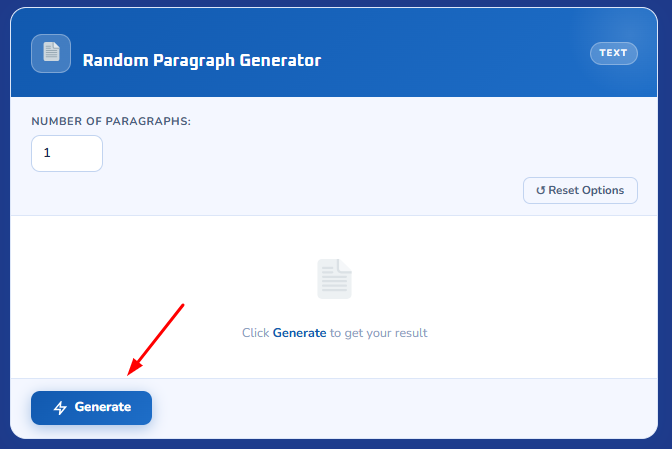
Step 2 Generate Paragraph
Click the Generate button to instantly create a random paragraph. The tool will display the generated content based on your selected number.
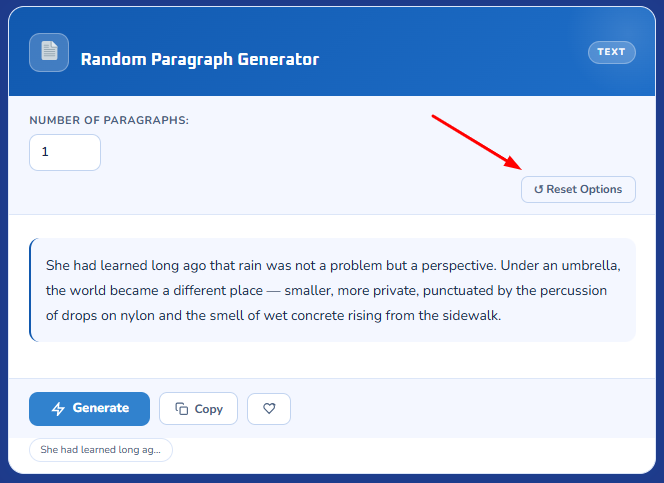
Step 3 Reset Options
If you want to start fresh, click the Reset Options button on the right side. This will erase the generated paragraph and allow you to create a new one.
What can you use a random paragraph generator for?
A random paragraph generator serves more people than most expect. Writers, developers, teachers, marketers, and students all use it for different reasons. Each use case below represents a real problem this tool solves — a practical workflow that saves time and removes friction.
Creative Writing and Story Starters
A random paragraph breaks the blank page problem immediately. Instead of creating from nothing, you react to something that already exists.
Use the generated paragraph as your opening scene and build forward. Place it in the middle and work in both directions. Use it as your closing scene and write everything that leads up to it. Because you did not choose the topic, your brain cannot fall back on familiar patterns, which is exactly where original storytelling happens.
Generate one paragraph, read it once, set a timer for fifteen minutes, and write. The only rule is that the paragraph must appear somewhere in what you produce.
Overcoming Writer’s Block
Writer’s block is not a creativity problem. It is a starting problem. The moment any words exist on the page, the psychological barrier drops.
Generate a paragraph on any topic. Read it, then immediately start writing your own content. The act of reading primes your language centers, and by the time you open your actual document, your brain is already in writing mode.
A second technique is rewriting practice. Take the generated paragraph and rewrite it entirely in your own voice, preserving the meaning but changing every sentence. After two or three rewrites, moving to original work feels natural rather than forced.
Typing Practice and Speed Tests
Typing practice needs real, readable text to be effective. Random letters build mechanical muscle memory but do not train the natural rhythm of language. Real prose, with varied sentence lengths, punctuation patterns, and mixed word lengths, trains your fingers the way actual writing demands.
Because each paragraph covers a different topic, you never memorize a passage from overuse. Your fingers encounter new word combinations every session, which prevents the shortcut patterns that inflate your WPM on familiar text.
Generate five paragraphs and type them sequentially without stopping. Track your accuracy on the final paragraph versus the first. The gap shows exactly how much your technique degrades under sustained effort.
Website and App UI Placeholder Text
Lorem ipsum is the traditional solution for placeholder text, and it is also a poor one. Readers skip fake Latin entirely, which means usability testers are not evaluating how real users will scan the page. A genuine English paragraph gets read, and that produces useful feedback.
Random paragraphs also expose layout problems that lorem ipsum hides. A word like “internationalization” will break a narrow column in a way that “lorem” never will. Quotation marks, apostrophes, and em dashes test edge cases in font rendering that placeholder Latin never reaches.
Generate two or three paragraphs of different lengths to test how your layout handles short, medium, and long content in the same component.
Classroom and ESL Exercises
Teachers and ESL instructors need fresh reading material frequently, at an appropriate level, without spending time writing original passages. A random paragraph generator solves all three at once.
For reading comprehension, a generated paragraph serves as a passage students have never seen before, which eliminates the problem of students recalling answers from previous exposure. For ESL learners, it provides authentic English prose at a pace the teacher controls, with vocabulary coverage that broadens naturally across sessions.
Other classroom uses include grammar analysis, summarization practice, rewriting a neutral paragraph in a different tone, and paragraph completion exercises where students write the ending after reading only the opening sentences.
SEO and Content Testing
SEO professionals use random paragraphs in ways that are not obvious but genuinely practical.
For readability baseline testing, running a generated paragraph through a Flesch-Kincaid tool before checking your own content establishes a neutral reference point. If the gap between the two scores is large, you have concrete evidence your writing needs adjustment.
For schema markup validation, Google’s Rich Results Test requires real natural language to confirm that FAQ, HowTo, or Article schema is rendering correctly. Lorem ipsum fails this test. A random English paragraph passes cleanly.
For site migrations, random paragraphs serve as safe dummy content that holds layout without accidentally indexing anything meaningful before real content is ready.
Software and Layout Testing for Developers
Developers need text that behaves like real text without being real text. Random paragraphs fill that role better than any alternative.
For unit and integration testing, a generated paragraph covers the full surface area of natural language: varying sentence lengths, mixed punctuation, contractions, and numbers written as words. Hard-coded strings like “Hello world” never expose the edge cases that appear in production.
For database performance testing, a random paragraph stored in a text field behaves the way production data actually behaves, exposing encoding issues, collation bugs, and search index behavior that fixed-length placeholder strings never reveal.
For NLP pipeline development, a generated paragraph is a quick, dependency-free source of real prose input without any copyright concerns.
Daily Writing Warm-Up Routine
Professional writers warm up before writing the same way athletes warm up before training. A random paragraph generator is the simplest warm-up tool available because it requires no setup, no planning, and no prior context.
Generate one paragraph and choose one of three responses. Expand it by writing 200 more words developing the central idea. Contradict it by writing a paragraph that argues against the main claim. Rewrite it in your own voice, keeping the ideas but changing every sentence.
Repeat this before every writing session for thirty days. First draft quality improves because you are no longer starting cold, and your sense of your own voice sharpens because you have spent thirty sessions deliberately contrasting your style against someone else’s.
Random paragraph vs lorem ipsum vs AI text generator
The choice often starts with AI Text Generators because it depends on the goal to generate content that feels functional and context-aware, especially when creating finished, usable, copy for a real design or layout. For test use cases, Random Paragraphs help produce quick, rapid, and random paragraphs that act as placeholder filler, while Lorem Ipsum remains the best option for purely visual, non-distracting layouts. This works much like English grammar, where adjectives have 2 main positions in a sentence, the attributive position comes before a noun, and the predicative comes after, usually separated by a linking verb, showing how each option is suited for either non-semantic structure or meaningful output.
| Tool | Purpose | Key Features | Ideal Use Case |
|---|---|---|---|
| Lorem Ipsum | Design and Layout testing | Lorem, Ipsum, dummy, Latin, text, fill, space, layout, typography, color, content, UI, Graphic, Design, Mockups, design, finished, copy, written, Testing, fonts, columns, headlines, distraction, meaningful, Prototyping, test, responsiveness, spacing, apps, web | When viewers should focus on visual elements without being distracted by meaningful text; testing fonts, columns, spacing, and overall layout |
| Random Paragraph | Rapid Prototyping and Document Testing | Random, rand(), Microsoft, Word, English, language, sentences, coherent, narrative, quick, brown, fox, jumps, lazy, dog, Rapid, Prototyping, Testing, quickly, fill, document, formatting, inputs, layouts, responsive, Writing, Exercises, practice, rewriting, summarizing | When developers need to quickly fill a document, check formatting, test layouts, or practice Writing Exercises for prototyping |
| AI Text Generator | Content Creation, Brainstorming, Marketing | AI, generators, ChatGPT, Jasper, create, relevant, coherent, on-brand, prompts, moving, placeholders, Final, Content, Creation, blogs, emails, social, media, posts, marketing, materials, Brainstorming, Ideation, writer’s, block, generate, ideas, outlines, Contextual, Mockups, filler, resembles, final, product, test, user, experience, UX, website, clients, paragraph, landing, page, email, blank, inspiration, 2-second, check | When you need ready-to-use content, overcome writer’s block, generate Contextual Mockups, enhance user experience (UX), or produce on-brand blogs, emails, social media posts, and marketing materials |
What makes a good paragraph?
A random paragraph generator creates good, well-organized paragraphs that begin with a topic sentence which briefly explains the paragraph and what it is about. The next few sentences focus on development and support, elaborating each detail in proper order to develops a single controlling idea that is expressed and called the core line. It serves several important functions as it substantiates an essay thesis statement, unifies the content, directs flow, and advises the reader about the subject being discussed, while readers generally look at the first lines to determine the perspective, making it often best to put it at the very beginning.
In some cases, however, it is more effective to place another line before, for example, linking the current idea to a previous one or providing background information. Although most outputs should have structure, there are situations where it might not need a strict start and is able to omit it, like when it narrates a series of events or continues developing an introduced idea where all details clearly refer to a main point, perhaps indirectly. The vast majority still supports your flow with a sentence that summarizes, presents one final piece, and helps wrap up naturally without forcing a hard end or conclusion.
Types of paragraphs
Narrative Paragraph
Using a random paragraph generator helps you explore narrative paragraphs with ease. A narrative paragraph tells a story, showing a sequence of action from beginning to middle and end. You might notice an opening like Barack Obama’s Audacity of Hope, where an interesting man entered the arena of politics, which raises curiosity about what will happen next. Each paragraph is designed to convey events clearly, introduce the subject, and use transitions to guide the reader through the flow of time and action.
Descriptive Paragraph
A descriptive paragraph describes something or a person, shows the reader a thing, and uses carefully chosen words so the description appeals to the five senses: touch, smell, sight, sound, and taste.
Expository Paragraph
Expository paragraphs explain, provide instruction, or describe a process step by step using a clear method, which requires research and the writer’s knowledge and expertise.
Persuasive Paragraph
Persuasive paragraphs try to convince an audience to accept a particular point of view, understand a position, or support it with facts, examples, and evidence, while capturing attention and directing the reader along a course of action.
Paragraph length by context
Digital Content and Blogs
Digital Content and Blogs operate under specific structural requirements that differ significantly from other writing forms. The context of online platforms demands that writers prioritize readability and accommodate scanning habits of digital audiences. Content on screens typically ranges from 2–4 sentences containing 20–100 words, allowing users to quickly navigate and consume information. This approach ensures that readability remains high while maintaining sufficient depth for meaningful engagement. The balance between brevity and substance helps improve user experience across various digital platforms.
Academic Writing
Academic Writing requires a substantially different structural approach compared to Digital Content. This format demands 4–8 sentences per paragraph, typically ranging from 100–200+ words, enabling writers to develop complex ideas thoroughly. The length of academic paragraphs serves a specific purpose: facilitating in-depth analysis, presenting solid evidence, and supporting rigorous argument development. longer paragraphs in this context allow for detailed analysis of complex, descriptive narratives that require careful examination and scholarly unpacking.
Journalism and News
Journalism and News writing operates under entirely different constraints shaped by information dissemination goals. Writers in this field typically employ 1–3 sentences designed to deliver information quickly and efficiently. The emphasis falls on speed and clarity, where shorter paragraphs create rhythmic balance in news content. This structure prioritizes immediate comprehension and rapid consumption by audiences seeking current information.
Fiction and Narrative
Fiction and Narrative writing presents the most flexible approach to paragraph construction, being Highly variable in nature. Writers employ everything from a single 1 sentence to 150+ words depending on narrative demands. longer ones serve purposes like scene-setting, establishing atmosphere and immersion, while brief segments accelerate action and create dynamic control pacing. The length and structure adjust fluidly based on story needs and stylistic choices.
Business Writing
Business Writing maintains a focused approach with 2–5 sentences per unit, emphasizing practical communication. Writers maintain strict clarity and employ concise language throughout, ensuring actionable information reaches readers immediately. The context of business communication demands that every word serves a purpose, with emphasis on direct, results-oriented content. This balance between readability and information density ensures messages resonate with professional audiences.
What makes a good paragraph?
Most online tools make you create an account before you can use them. This one does not. Open the page, click generate, and your paragraph appears instantly. No email address, no password, no subscription tier to navigate around.
Free With No Sign-Up Required
The tool is completely free, and that is not a limited free tier with a daily cap. Every feature available on this page is available to every visitor without any registration. No account creation, no email confirmation, no payment details saved for a future upsell. Open the page and start generating.
Unlimited Generations
There is no daily limit, no cooldown period, and no counter tracking how many paragraphs you have generated. Generate one paragraph or generate one hundred. Come back tomorrow and generate the same amount again. The tool does not throttle your usage or prompt you to upgrade after a fixed number of requests.
Human-Written Paragraphs
Every paragraph in this generator was written by a person, not produced by an algorithm filling a template. That distinction matters because human-written paragraphs have natural variation in sentence rhythm, word choice, and structure that makes them genuinely useful for typing practice, UI testing, classroom exercises, and writing warm-ups. Algorithmically generated text tends to repeat structural patterns across outputs, which reduces its usefulness the more you rely on it.
Multiple Topic Categories
The paragraph database covers a wide range of subjects so that consecutive generations feel genuinely different from each other. Whether you need something for a creative writing prompt, a UI mockup, a classroom exercise, or a typing drill, the variety means you are unlikely to encounter the same paragraph twice in normal use.